I now have comprehensive, well-sourced content with excellent diagrams. Here is the full answer.
Opponent Process Theory of Color Vision
Background: Two Theories Working Together
Color vision is explained by two complementary theories that operate at different levels of the visual pathway:
| Theory | Proposed by | Where it operates | What it explains |
|---|
| Trichromatic (Young-Helmholtz) | Thomas Young (1802), Hermann von Helmholtz | Photoreceptors (cones) | Color detection - 3 cone types (L, M, S) absorb different wavelengths |
| Opponent Process | Ewald Hering (~1878) | Retinal ganglion cells, LGN, cortex | Color discrimination and perception - why certain colors can't coexist |
These are not competing theories - they describe successive stages of color processing. - Neuroscience: Exploring the Brain, 5th ed., p. 981
The Trichromatic Foundation (Stage 1)
Three types of cones detect light based on peak wavelength sensitivity:
- L cones (long wavelength) - "red" cones (~560 nm)
- M cones (medium wavelength) - "green" cones (~530 nm)
- S cones (short wavelength) - "blue" cones (~430 nm)
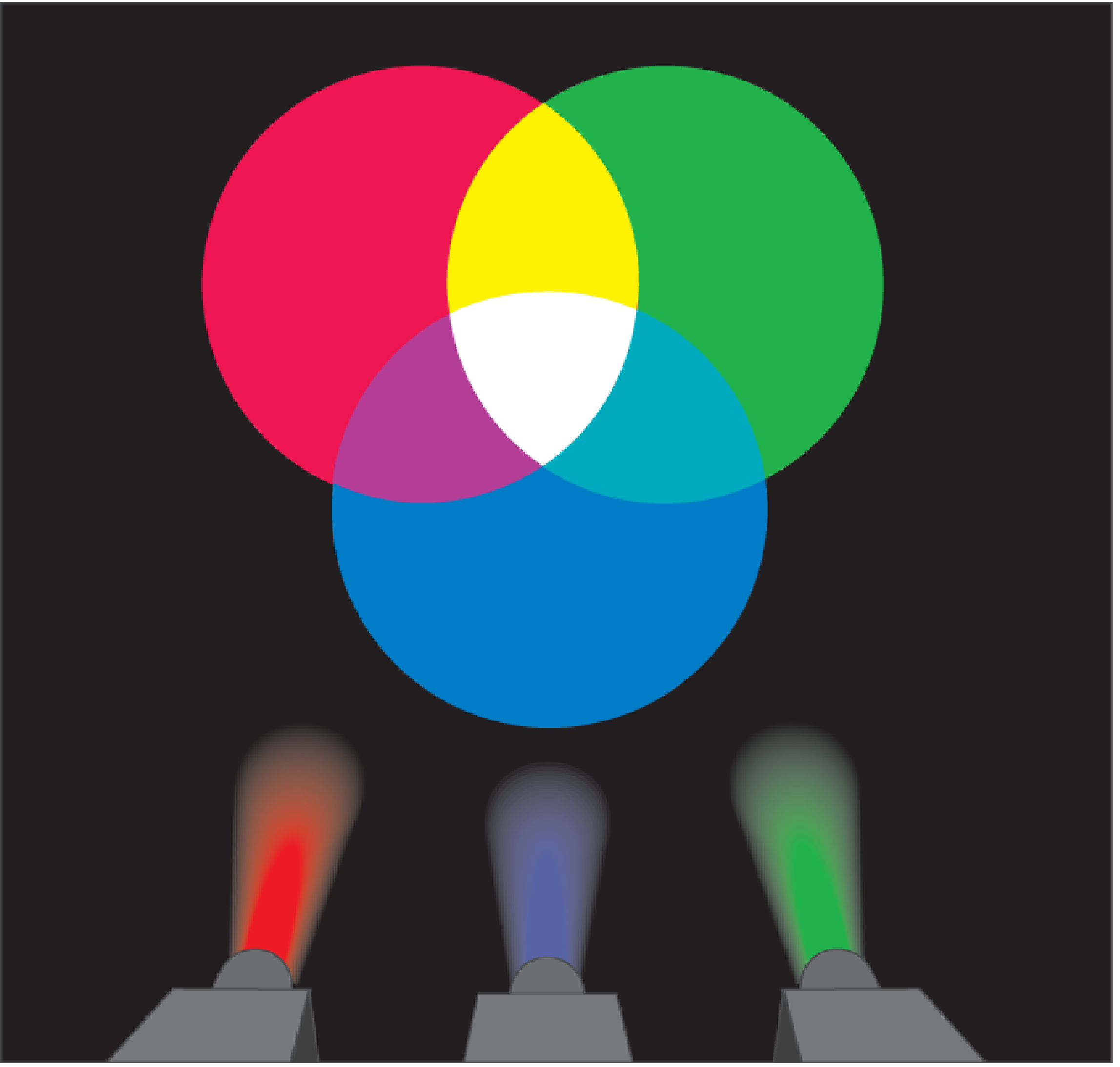
Color perception arises from the ratio of activation across these three cone types. White light = equal activation of all three.
Trichromatic mixing: red + green + blue light produces white when all three cone types are equally activated. - Neuroscience: Exploring the Brain, p. 874
Opponent Process Theory (Stage 2)
Proposed by Ewald Hering to explain a key perceptual observation: you can never perceive red-green or blue-yellow simultaneously. You can see reddish-yellow (orange) or bluish-green (teal), but never "reddish-green" - these are opponent (mutually exclusive) color pairs.
Hering postulated three opponent mechanisms:
| Process | Excited by | Inhibited by |
|---|
| (R - G) | Red | Green |
| (Y - B) | Yellow | Blue |
| (W - Bk) | White (light) | Black (dark) |
This is not just a psychological phenomenon - it reflects actual neural wiring in the retina and beyond. - Kandel's Principles of Neural Science, 6th ed., p. 586
Neural Substrate: Color-Opponent Ganglion Cells
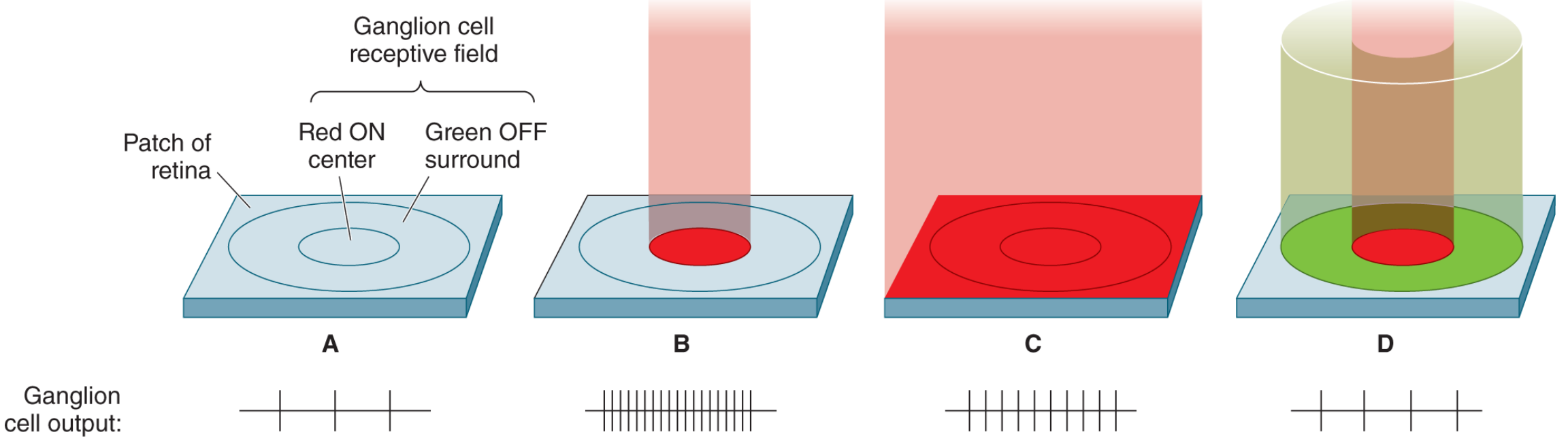
The opponent mechanism is implemented starting at the retinal ganglion cell level via center-surround receptive fields.
How it works:
P-type (parvocellular) ganglion cells - the primary carriers of color opponent signals - have center-surround receptive fields where center and surround respond to opposite colors:
(A) Red ON center / Green OFF surround receptive field. (B) Red light on center → strong excitation. (C) Red light floods center + surround → reduced response (surround partially activated). (D) Green light on surround → strongest inhibition, nearly silences the cell. - Neuroscience: Exploring the Brain, p. 903
The four P-cell types for Red-Green opponency:
| Cell type | Center | Surround | Shorthand |
|---|
| L-ON | Red (L cone) excites | Green (M cone) inhibits | R+ G- |
| L-OFF | Red (L cone) inhibits | Green (M cone) excites | R- G+ |
| M-ON | Green (M cone) excites | Red (L cone) inhibits | G+ R- |
| M-OFF | Green (M cone) inhibits | Red (L cone) excites | G- R+ |
Blue-Yellow opponency:
Blue-yellow opponency is mediated by small bistratified (nonM-nonP) ganglion cells:
- Blue ON / Yellow OFF: S cones excite center via dedicated blue bipolar cells; L+M cones (which together signal yellow) inhibit via a separate bipolar cell
- Blue OFF / Yellow ON: opposite arrangement
- These project to the koniocellular layers of the LGN
White-Black (luminance) contrast:
M-type (magnocellular) ganglion cells have antagonistic centers and surrounds but no color opponency - they respond to luminance contrast regardless of wavelength. They project to the magnocellular layers of the LGN.
Circuit Mechanism
Red light on center
    → L cone activated
        → Depolarizing (ON) bipolar cell
            → Ganglion cell: EXCITED (fires action potentials)

Green light on surround
    → M cones activated
        → Horizontal cells → inhibitory pathway
            → Ganglion cell: INHIBITED (firing suppressed)
One color excites via a direct depolarizing bipolar cell route; the opponent color inhibits via an indirect hyperpolarizing bipolar cell route, mediated by horizontal cells. - Guyton & Hall Medical Physiology, p. 643
"Each color contrast type of ganglion cell is excited by one color but inhibited by the 'opponent' color. Therefore, color analysis begins in the retina and is not entirely a function of the brain." - Guyton & Hall
Central Pathway: LGN to Visual Cortex
| Signal | Ganglion cell | LGN layer | Cortical projection |
|---|
| Red-Green opponent | P-type | Parvocellular (layers 3-6) | V4, deep layer 4 of V1 |
| Blue-Yellow opponent | Small bistratified | Koniocellular | Distinct layers of V1 |
| Luminance (W-Bk) | M-type | Magnocellular (layers 1-2) | Dorsal stream (motion/depth) |
In the primary visual cortex (V1), these opponent signals are recombined in various ways. Only about 10% of cortical neurons are primarily driven by color contrast (vs luminance contrast), suggesting that despite its perceptual importance, color vision is computationally a small part of cortical processing. - Kandel's Principles of Neural Science, p. 586
Why We Can't See "Reddish-Green"
Because R-G opponent cells respond in opposite directions to red vs green - firing faster for one, slower for the other - there is no neural state that simultaneously encodes both. The opponent channel can only signal one or the other at a time, which is why red and green (and blue and yellow) are perceptually mutually exclusive. Colors like orange and teal are possible because they activate the opponent channels to intermediate (partially overlapping) degrees.
Afterimage Explanation (Classic Test of Opponent Theory)
Stare at a red square for 30 seconds, then look at a white wall - you see a green afterimage. This is because:
- The R+ G- opponent cells are fatigued by prolonged red stimulation
- When you look at white (which carries all wavelengths), the red response is temporarily diminished
- The green side of the channel dominates transiently → green afterimage
This phenomenon was one of Hering's original observations that led him to propose opponent processing.
Summary
PHOTORECEPTORS (cones)          GANGLION CELLS / LGN         CORTEX
──────────────────────          ────────────────────          ──────
L cones (red ~560nm)   ──┐
                          ├──→ R+G- or R-G+ (P cells)  ──→ Parvocellular ──→ V4
M cones (green ~530nm) ──┘                                  LGN layers 3-6    color
                                                                               perception
S cones (blue ~430nm) ─────→ B+Y- (small bistratified) ──→ Koniocellular
L+M cones (→yellow) ───┘                                    LGN

L+M+S (all) ───────────────→ M cells (no color opponency) ──→ Magnocellular ──→ Motion/depth
Stage 1 (Trichromacy): cones detect wavelength ratios
Stage 2 (Opponent Process): ganglion cells compute color differences
Stage 3 (Cortical): opponent signals recombined for full color perception
Sources:
- Kandel - Principles of Neural Science (6th ed.), p. 586
- Neuroscience: Exploring the Brain (5th ed.), pp. 874, 903-904, 981
- Guyton & Hall Medical Physiology, p. 643