
T inversion in lead v1 and v2
Reading File
Finding Sources
Finding Sources
Reading File
Reading File
Finding Sources
Finding Sources
Finding Sources
Finding Sources
Reading File
Reading File
Now I have sufficient information to provide a comprehensive answer. Let me also fetch the Wellens' sign ECG image.
Loading Image
Loading Image
Here is a structured clinical overview of T-wave inversion in leads V1 and V2.
T-Wave Inversion in V1 and V2
Normal vs. Abnormal
T-wave inversion in V1 alone is a normal variant and has no clinical significance. T-wave inversion extending to V2 may still be normal in women, but in adult men it is considered abnormal and warrants clinical correlation.
Causes / Differential Diagnosis
1. Wellens' Syndrome (Critical — Do Not Miss)
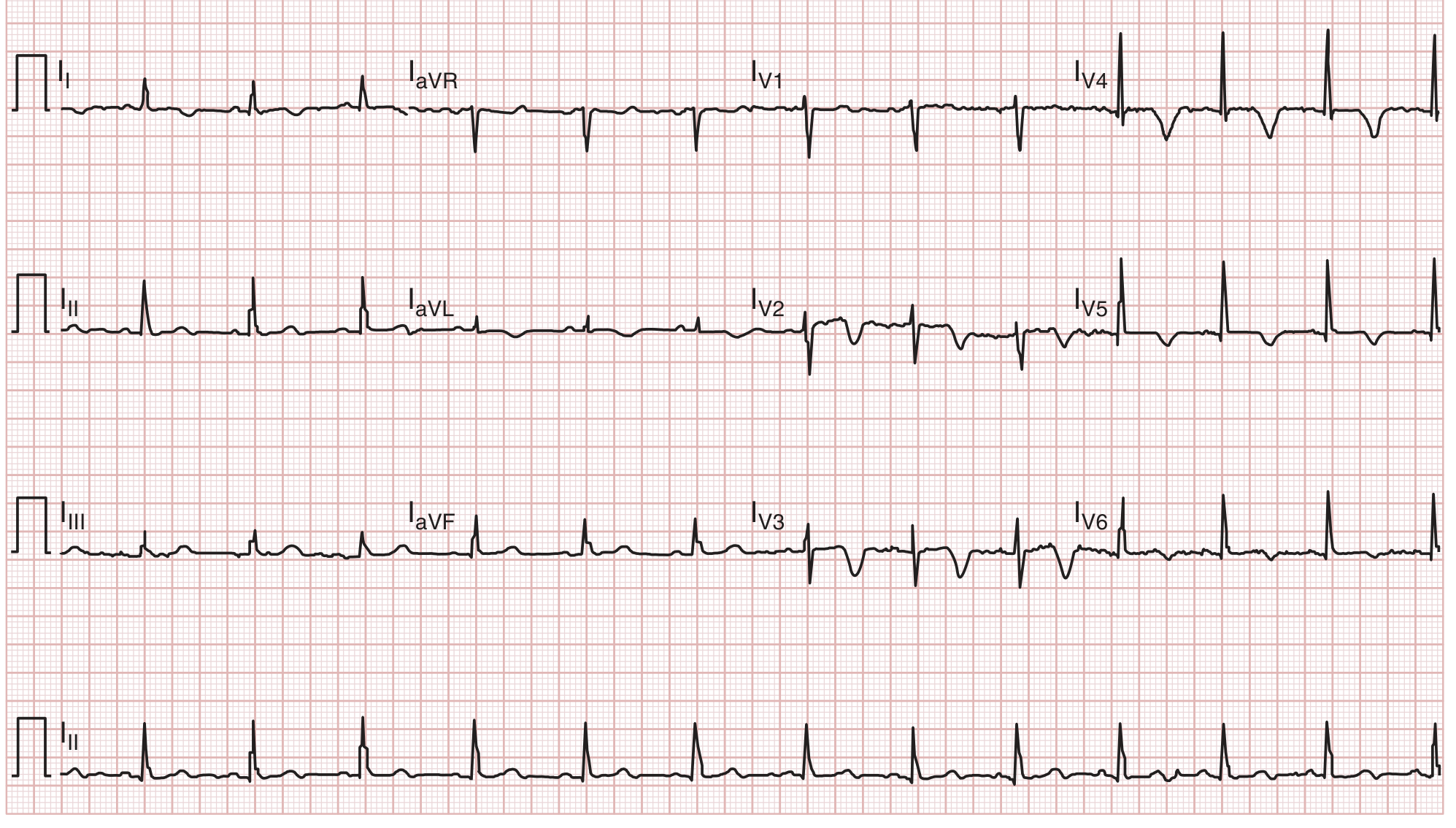
A pre-infarction pattern caused by critical proximal LAD stenosis. The T-wave changes appear when the patient is pain-free (post-ischemic reperfusion pattern).
Two patterns:
| Pattern | Morphology | Prevalence |
|---|---|---|
| Type A (Biphasic) | Biphasic T waves in V2–V3 | ~25% |
| Type B (Deep inversion) | Deep symmetric T-wave inversion in V2–V3, often extending to V1 | ~75% |
Diagnostic criteria (Tintinalli's):
- History of episodic chest pain consistent with unstable angina
- During pain, the ECG may be normal
- When pain-free: abnormal T waves most prominent in V2–V3, often in V1 and V3
- Deep symmetric T-wave inversion (~75%) or biphasic T waves (~25%)
- No pathologic Q waves or loss of R waves
These patients are at high risk of massive anterior MI and require urgent coronary angiography.
ECG showing Wellens' pattern (deep symmetric T-wave inversion V1–V3):
2. Pulmonary Embolism (PE)
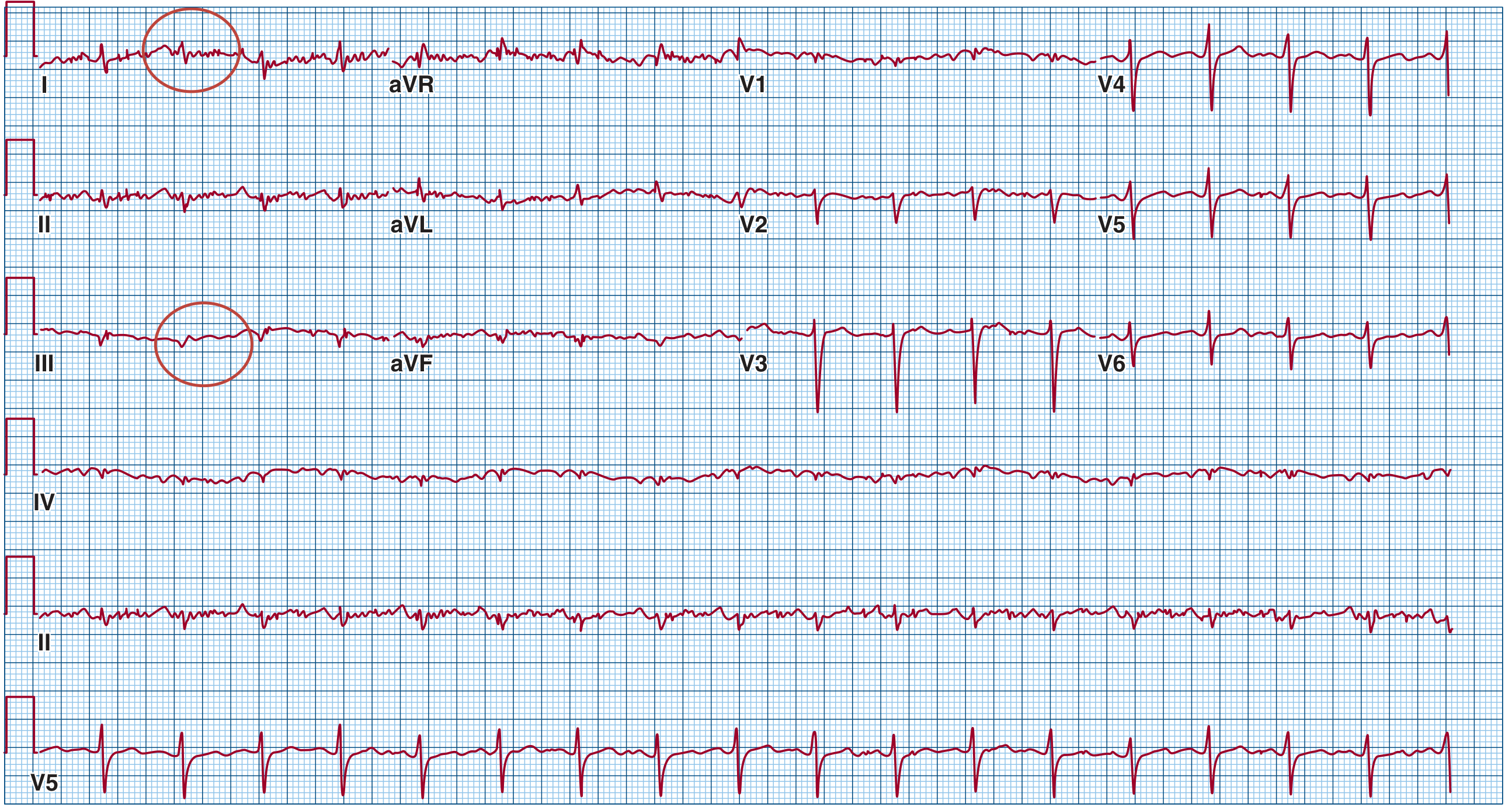
T-wave inversion in V1–V3 (especially V2–V3) is the most frequent ECG sign of high-risk (massive) PE and reflects acute RV strain from right heart dilatation.
- May accompany the S1Q3T3 pattern, right axis deviation, sinus tachycardia, or RBBB
- Both the Qr pattern in V1 and T-wave inversion in V2 are independent predictors of RV dysfunction and adverse outcome
- ~20% of PE patients have no ECG changes; ECG alone cannot rule in or rule out PE
ECG from a 60-year-old with massive PE and cardiogenic shock (note T-wave inversion in right precordial leads + S1Q3T3):
3. ARVC (Arrhythmogenic Right Ventricular Cardiomyopathy)
T-wave inversion in V1–V3 (or more) is a major diagnostic criterion for ARVC, accompanied by:
- Prolonged terminal QRS (>55 ms from S-wave nadir to end of QRS) in V1–V3
- Epsilon waves (small deflections after the QRS in right precordial leads)
- VT with LBBB morphology
4. Brugada Syndrome
Type I Brugada pattern: coved ST elevation (≥2 mm) with T-wave inversion in V1–V2. This is the diagnostic pattern; it may be present spontaneously or only after sodium channel blocker challenge (e.g., procainamide, flecainide, ajmaline).
5. Right Bundle Branch Block (RBBB)
Secondary T-wave inversions in V1–V2 are an expected finding in RBBB and are not independently pathological — they follow the direction opposite to the dominant terminal R' wave (discordant repolarization).
6. Right Ventricular Hypertrophy / Cor Pulmonale
Chronic RV pressure overload (e.g., from pulmonary hypertension) can produce T-wave inversions in V1–V3 as a "strain" pattern.
7. Posterior MI (Isolated)
T-wave inversion in V1–V2 may represent a reciprocal change of posterior STEMI. Applying posterior leads (V7–V9) to confirm ST elevation over the left posterior chest helps confirm this diagnosis.
8. Normal Variant / Juvenile T-wave Pattern
Isolated inversion in V1–V2 (sometimes V3) can persist as a normal variant, especially in young women, and is termed the juvenile T-wave pattern when there are no other findings.
Quick Summary Table
| Cause | Key Features |
|---|---|
| Wellens' syndrome | Pain-free, deep symmetric or biphasic T-wave inversions V2–V3; critical LAD stenosis |
| Pulmonary embolism | RV strain, S1Q3T3, tachycardia; most frequent ECG sign of high-risk PE |
| ARVC | Epsilon waves, prolonged terminal QRS V1–V3, T-wave inversion V1–V5 |
| Brugada syndrome | Coved ST elevation + T-wave inversion V1–V2 |
| RBBB | Secondary discordant T-wave inversion; expected finding |
| RV hypertrophy | Chronic RV strain; tall R in V1 |
| Posterior MI | Reciprocal change; tall R/T in V1–V2; confirm with V7–V9 |
| Normal variant | Isolated V1–V2; young women; no other findings |
Clinical bottom line: T-wave inversion confined to V1 is usually benign. Extension to V2 in an adult male — especially in the context of chest pain — demands urgent evaluation for Wellens' syndrome, ACS, or PE, as these carry high short-term mortality risk.
Sources: Tintinalli's Emergency Medicine, Fuster & Hurst's The Heart 15th Ed., Braunwald's Heart Disease
Female pt
Checking Date & Time
Good clarification. In a female patient, T-wave inversion in V1 and V2 shifts the differential in important ways:
T-Wave Inversion V1–V2 in a Female Patient
Key Difference from Males
T-wave inversion in V1 and V2 is more often a normal variant in women — particularly premenopausal women, where it can extend to V3 and still be considered physiological (persistent juvenile T-wave pattern). This is the most important gender-specific caveat.
However, "normal variant" is a diagnosis of exclusion — all pathological causes must still be considered based on clinical context.
Revised Differential Priority in Females
✅ Normal / Benign (Higher probability in females)
| Finding | Notes |
|---|---|
| Juvenile T-wave pattern | T-wave inversion in V1–V3 is common in young/premenopausal women; a normal variant |
| Athlete's heart | T-wave inversion in V1–V2 in female athletes is classified as a normal training adaptation and does not warrant further investigation (Fuster & Hurst, 15th Ed.) |
Per international athlete ECG criteria, T-wave inversion ≥1 mm in depth in two or more contiguous leads excluding aVR, III, and V1 is abnormal. Because V1 is excluded from this criterion, isolated inversion in V1–V2 in a female athlete requires specific clinical judgment.
⚠️ Still Must Exclude (Pathological — same as males)
| Cause | Distinguishing Features |
|---|---|
| Wellens' syndrome | History of chest pain; pain-free ECG with deep symmetric or biphasic T waves V2–V3; critical LAD stenosis — equally dangerous in women |
| Pulmonary embolism | Dyspnea, hypoxia, tachycardia; particularly relevant in women on OCPs or postpartum |
| ARVC | Less common in women; epsilon waves, terminal QRS prolongation V1–V3 |
| Brugada syndrome | Coved ST elevation V1–V2; less penetrant in women but still occurs — female sex is associated with fewer spontaneous events |
| RBBB | Discordant secondary T-wave changes; benign if isolated |
| RV hypertrophy / pulmonary HTN | Women are disproportionately affected by pulmonary arterial hypertension — screen if dyspnea present |
| Posterior MI | Reciprocal changes; less likely to present classically in women |
Pulmonary Hypertension — Female-Specific Consideration
Pulmonary arterial hypertension (PAH) has a female:male ratio of ~3:1. T-wave inversion in the right precordial leads from chronic RV pressure overload should prompt echocardiography if any exertional dyspnea is present in a female patient.
Practical Approach in a Female Patient
T inversion V1–V2 in a female
        │
        ├─ Asymptomatic + young/premenopausal + no other ECG changes?
        │       → Likely normal variant / juvenile pattern — reassure
        │
        ├─ History of chest pain (even if pain-free now)?
        │       → Rule out Wellens' syndrome — urgent troponin + cardiology referral
        │
        ├─ Dyspnea, hypoxia, tachycardia?
        │       → Rule out PE (especially if on OCP/pregnant/postpartum)
        │       → Rule out pulmonary hypertension (echo)
        │
        ├─ Palpitations, syncope, family history of SCD?
        │       → Consider ARVC, Brugada, channelopathy — refer to electrophysiology
        │
        └─ Coved ST elevation in V1–V2?
                → Brugada pattern — refer regardless of symptoms
Bottom line: In a female patient, isolated V1–V2 T-wave inversion is more likely to be a normal variant than in a male, but Wellens' syndrome, PE, and pulmonary hypertension remain clinically significant causes that must be excluded based on symptoms, age, and risk factors.
This is a shared conversation. Sign in to Orris to start your own chat.