
Sodium potassium ATPase
I'll look this up in the medical library for a thorough answer.
Reading File
Now let me search the medical library and PubMed in parallel for comprehensive coverage.
Finding Sources
Finding Sources
Searching PubMed
"sodium potassium ATPase" AND physiology
Good - found relevant sections. Let me now read the core physiology section from Guyton & Hall and the kidney section, plus search for more detailed content.
Finding Sources
Reading File
Let me search for the primary physiology content on the Na-K ATPase pump from Guyton & Hall and other core physiology sources.
Finding Sources
Finding Sources
Excellent - found rich sources. Let me now read the key sections from Guyton & Hall (physiology), Medical Physiology (Boron), and Kandel (neuroscience) in parallel.
Reading File
Reading File
Reading File
Excellent content. Let me now fetch the pump diagram image and read more from Medical Physiology (Boron) about the pump's cycle and inhibitors (cardiac glycosides).
Loading Image
Reading File
Finding Sources
I now have a very comprehensive picture. Let me also get the cardiac glycoside and cell volume maintenance content, plus the Costanzo section on digoxin.
Reading File
Reading File
Reading File
I now have a thorough, multi-textbook foundation to write a comprehensive answer. Let me also fetch the cardiac glycosides mechanism diagram and get the cardiac glycoside binding info.
Reading File
I now have comprehensive information from multiple authoritative textbooks. Let me compile the full answer.
Sodium-Potassium ATPase (Na⁺/K⁺-ATPase)
Overview
The Na⁺/K⁺-ATPase (also called the sodium-potassium pump or Na-K pump) is a transmembrane enzyme found in virtually every cell of the body. It uses the energy from ATP hydrolysis to actively transport 3 Na⁺ ions out of the cell and 2 K⁺ ions in against their electrochemical gradients with each cycle. Because it moves unequal numbers of ions, it generates a net outward current and is therefore electrogenic.
- Guyton and Hall Textbook of Medical Physiology
- Medical Physiology (Boron & Boulpaep)
Structure
The pump belongs to the P-type ATPase superfamily (named for the phosphorylated intermediate they form during the catalytic cycle). It consists of two subunits:
- α subunit (~110 kDa): The catalytic subunit. Contains 10 transmembrane helices. Carries the ion-binding sites, the ATP-binding pocket (intracellular face), and the phosphorylation site (an aspartate residue). Multiple isoforms (α1–α4) exist with different tissue distributions.
- β subunit: A glycoprotein required for proper folding, membrane targeting, and function of the α subunit. Multiple isoforms (β1–β3).
A third regulatory protein called phospholemban (PLM) modulates Na⁺/K⁺-ATPase activity in the heart, analogous to how phospholamban regulates the SERCA pump.
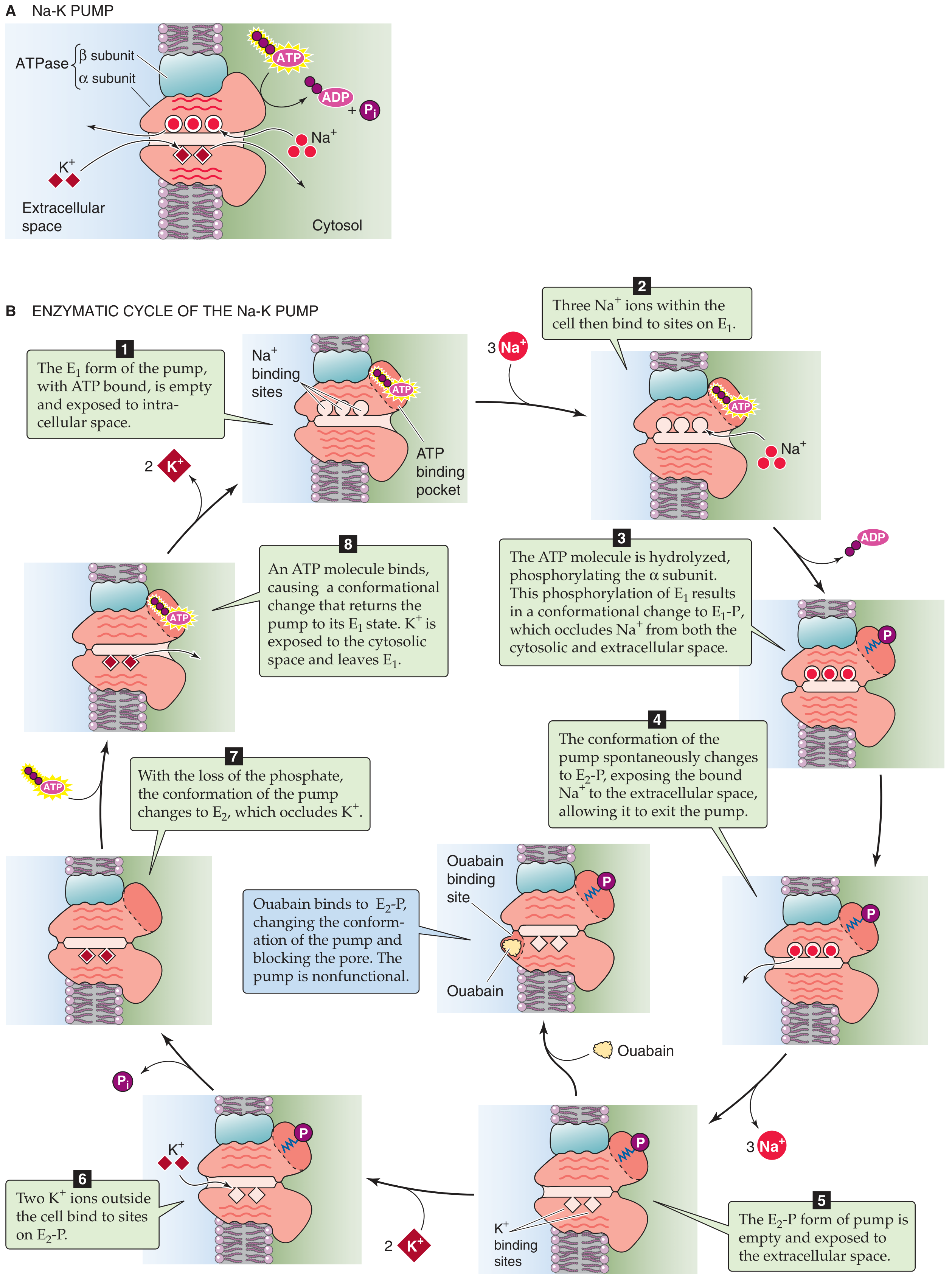
Figure: (A) Structural schematic of α and β subunits. (B) The eight-stage enzymatic cycle showing conformational transitions, ion occlusion, and the ouabain-binding site. - Medical Physiology (Boron & Boulpaep), Fig. 5-8
Mechanism: The 8-Stage Catalytic Cycle (E1-E2 Model)
The pump alternates between two major conformational states: E1 (ion-binding sites face the cytoplasm) and E2 (sites face the extracellular space).
| Stage | State | Event |
|---|---|---|
| 1 | E1·ATP | Pump is empty, ATP bound, Na⁺ binding sites face intracellular space (ICF) with high Na⁺ affinity |
| 2 | E1·ATP·3Na⁺ | Three intracellular Na⁺ ions bind |
| 3 | E1-P·(3Na⁺) (occluded) | ATP phosphorylates the α subunit at an aspartate residue, ADP leaves. Na⁺ ions are now occluded (inaccessible to both sides) |
| 4 | E2-P·3Na⁺ (deoccluded) | Major conformational shift E1→E2: Na⁺ sites now face extracellular fluid (ECF); Na⁺ affinity decreases |
| 5 | E2-P (empty) | Three Na⁺ ions dissociate into extracellular space; K⁺ affinity becomes high |
| 6 | E2-P·2K⁺ | Two extracellular K⁺ ions bind |
| 7 | E2·(2K⁺) (occluded) | Phosphate is hydrolyzed and released; K⁺ ions become occluded |
| 8 | E1·ATP·2K⁺ (deoccluded) | New ATP binds; major conformational change E2→E1; K⁺ sites face ICF; K⁺ affinity decreases |
| → back to 1 | E1·ATP | Two K⁺ released into cytoplasm; cycle restarts |
"Because each cycle of hydrolysis of one ATP molecule is coupled to the extrusion of three Na⁺ ions from the cell and the uptake of two K⁺ ions, the stoichiometry of the pump is three Na⁺ to two K⁺, and each cycle of the pump is associated with the net extrusion of one positive charge from the cell. Thus, the Na-K pump is electrogenic."
- Medical Physiology (Boron & Boulpaep)
Ion Concentrations Maintained
The pump creates and sustains the following gradients across the cell membrane (typical values in nerve):
| Ion | Extracellular | Intracellular |
|---|---|---|
| Na⁺ | 142 mEq/L | 14 mEq/L |
| K⁺ | 4 mEq/L | 140 mEq/L |
- Guyton and Hall Textbook of Medical Physiology
Physiological Functions
1. Resting Membrane Potential
The pump contributes directly (electrogenically, by ~-3 to -4 mV) and indirectly (by setting up the K⁺ gradient that drives K⁺ leak channels, which is the dominant determinant of the ~-70 mV resting potential). - Kandel, Principles of Neural Science, 6th Ed.
2. Cell Volume Regulation
Animal cells have deformable membranes and cannot sustain hydrostatic gradients. Without the Na-K pump, impermeant intracellular anions (proteins, organic phosphates) would create a Donnan effect, drawing in Na⁺ and Cl⁻, leading to progressive water entry and cell swelling ("osmotic work" model). The pump effectively makes NaCl a functionally impermeant extracellular solute by continuously extruding Na⁺:
"The action of the Na-K pump is required to prevent the cell swelling that would otherwise occur."
- Medical Physiology (Boron & Boulpaep)
3. Secondary Active Transport
The Na⁺ gradient established by the pump is the driving force for many cotransporters and antiporters, including:
- Na⁺/glucose cotransporter (SGLT) in intestine and kidney
- Na⁺/H⁺ exchanger (NHE)
- Na⁺-K⁺-2Cl⁻ cotransporter (NKCC) in the loop of Henle
- Na⁺/Ca²⁺ exchanger (NCX) in cardiac myocytes
In this sense, virtually all secondary active transport in animal cells depends indirectly on Na⁺/K⁺-ATPase. In cells with high transport rates such as renal proximal tubules, one-third or more of total cellular energy metabolism is devoted to fueling the Na-K pump. - Medical Physiology (Boron & Boulpaep)
4. Action Potential Restoration
After each action potential, K⁺ is slightly depleted extracellularly and Na⁺ slightly raised intracellularly. The pump restores these gradients (though the actual contribution per single action potential is very small relative to the standing gradient).
5. Renal Ammonium Transport
In the kidney, NH₄⁺ can substitute for K⁺ at the K⁺-binding site of the pump. In the inner medullary collecting duct (IMCD), Na⁺-K⁺-ATPase-mediated basolateral NH₄⁺ uptake is critical for ammonia secretion and acid-base regulation. - Brenner and Rector's The Kidney
6. Hormonal Regulation
- Aldosterone: stimulates K⁺ secretion in principal cells of the late distal tubule and collecting duct via upregulation of basolateral Na⁺-K⁺-ATPase. - Guyton and Hall
- Thyroid hormone: increases Na-K pump activity in muscle, liver, and kidney, contributing to increased oxygen consumption and thermogenesis. - Medical Physiology (Boron & Boulpaep)
- Catecholamines/PKA: Phospholemban (PLM) is phosphorylated by PKA (activated during the fight-or-flight response), which modulates Na⁺/K⁺-ATPase activity in cardiac myocytes. - Braunwald's Heart Disease
- Insulin: stimulates pump activity, driving K⁺ into cells (clinically relevant in hyperkalemia treatment).
Inhibition: Cardiac Glycosides
Cardiac glycosides (digoxin, ouabain, digitoxin) are the classic inhibitors of Na⁺/K⁺-ATPase. They bind to the extracellular face of the α subunit at the E2-P state, specifically at the same site as extracellular K⁺ - explaining why hyperkalemia competitively antagonizes glycoside binding, and why hypokalemia potentiates toxicity.
Mechanism of positive inotropy:
- Cardiac glycoside inhibits Na⁺/K⁺-ATPase on the myocardial cell membrane
- Intracellular [Na⁺] rises (less Na⁺ pumped out)
- The reduced Na⁺ gradient decreases the driving force for the Na⁺/Ca²⁺ exchanger (NCX), which normally exports Ca²⁺ using the inward Na⁺ gradient as energy
- Less Ca²⁺ is expelled → intracellular [Ca²⁺] increases
- Increased [Ca²⁺] → increased myosin-actin cross-bridge formation → positive inotropy
- Costanzo Physiology, 7th Ed.
- Brenner and Rector's The Kidney
Isoforms and Tissue Distribution
| α Isoform | Distribution |
|---|---|
| α1 | Ubiquitous (kidney, all cells) |
| α2 | Heart, skeletal muscle, brain |
| α3 | Brain, heart |
| α4 | Spermatogenic cells |
The kidney predominantly expresses α1β1 and restricts the pump to the basolateral membrane of epithelial cells, which is the basis for vectorial Na⁺ transport from tubular lumen to blood.
Related P-type ATPases (Family Context)
The Na⁺/K⁺-ATPase is the founding member of the P2C subfamily of P-type ATPases. Other members include:
- H⁺/K⁺-ATPase (gastric parietal cells, kidney) - secretes gastric acid; shares α/β subunit structure with Na-K pump
- SERCA pumps (sarcoplasmic/ER Ca²⁺-ATPase) - sequesters Ca²⁺ into SR/ER
- PMCA (plasma membrane Ca²⁺-ATPase) - extrudes Ca²⁺
- ATP7B (Cu²⁺ pump) - mutated in Wilson disease
Clinical Relevance Summary
| Condition | Pump Relevance |
|---|---|
| Digoxin toxicity | Excess Na-K ATPase inhibition → arrhythmias; worsened by hypokalemia |
| Congestive heart failure | Digoxin used therapeutically for positive inotropy via Na-K ATPase inhibition |
| Hyperkalemia treatment | Insulin + glucose drives K⁺ into cells via Na-K ATPase stimulation |
| Fluoride poisoning | Fluoride ions inhibit Na⁺/K⁺-ATPase → can cause hyperkalemia as a preterminal event |
| Hypokalemia | Facilitates NH₄⁺ uptake via Na-K ATPase in IMCD → increases urinary acid excretion |
| Cell swelling | Any condition that depletes ATP or inhibits the pump → Donnan-driven cell swelling |
Sources:
- Guyton and Hall Textbook of Medical Physiology
- Medical Physiology, Boron & Boulpaep
- Kandel, Principles of Neural Science, 6th Ed.
- Costanzo Physiology, 7th Ed.
- Braunwald's Heart Disease
- Brenner and Rector's The Kidney
- Rosen's Emergency Medicine
This is a shared conversation. Sign in to Orris to start your own chat.