

I want definition of this above mentioned amputations and I want the where exactly it done in detail
Reading File
Searching for detailed information on all 8 amputation levels shown in the image.
search_medical_text
levels of amputation lower limb Ray transmetatarsal Lisfranc Chopart Syme below-knee above-knee
Management of Chronic Limb-Threatening Ischemia
Page 77
search_medical_image
levels of amputation lower limb foot ankle knee diagram

Hugging Face pmc clinical VQA raw
Page 0
GradeResponse
GradeResponse
Here is a comprehensive breakdown of all 8 levels of amputation in the lower limb shown in Fig. 21.6:
Levels of Amputation in the Lower Limb
1. Ray Amputation
Definition: Removal of an entire toe along with its corresponding metatarsal bone (partial or complete).
Where it is done:
- The incision passes through the metatarsal shaft or at the metatarso-phalangeal (MTP) joint level.
- One or more "rays" (toe + metatarsal unit) are excised while leaving the remaining foot intact.
- Most commonly performed for diabetic foot infections, osteomyelitis, or gangrene limited to a single toe and its metatarsal.
2. Transmetatarsal Amputation (TMA) — Gillies
Definition: Amputation through the shafts of all five metatarsal bones, removing the forefoot while preserving the hindfoot and ankle.
Where it is done:
- The bone cut is made through the mid-shafts of the metatarsals (across all 5).
- The plantar flap is longer than the dorsal flap to allow cushioned weight-bearing over the stump.
- Preserves a functional, plantargrade foot stump.
3. Tarsometatarsal Amputation — Lisfranc's
Definition: Disarticulation through the tarsometatarsal joints (the joint between the metatarsals and the tarsal bones — specifically the cuneiforms and cuboid).
Where it is done:
- The amputation passes through the Lisfranc joint complex, which is the articulation between the bases of all 5 metatarsals and the three cuneiforms + cuboid.
- All metatarsals are removed; the tarsal bones (cuneiforms, cuboid, navicular, calcaneus, talus) are retained.
- The stump is at the level of the midfoot/tarsus.
4. Midtarsal Amputation — Chopart's
Definition: Disarticulation through the midtarsal joint (Chopart's joint), which is the combined talonavicular and calcaneocuboid joint.
Where it is done:
- The cut passes through the transverse tarsal joint — between the talus + calcaneus (posteriorly) and the navicular + cuboid (anteriorly).
- Only the calcaneus and talus are retained; everything anterior (navicular, cuboid, cuneiforms, metatarsals, toes) is removed.
- Risk of equinus deformity due to Achilles tendon pull on the retained calcaneus/talus without the anterior muscle counterbalance — often requires tendon lengthening.
5. Syme's Amputation
Definition: Ankle disarticulation with retention of the heel pad for end-bearing.
Where it is done:
- Disarticulation occurs at the ankle joint (tibiotalar joint).
- The distal tibia and fibula are trimmed of their malleoli.
- The heel pad (calcaneal fat pad with its skin) is preserved and sutured over the bone ends — this is critical as it allows the patient to bear weight directly on the stump, even without a prosthesis.
- Named after James Syme (19th-century Scottish surgeon).
- Results in a long below-knee stump with excellent weight-bearing capability.
6. Below-Knee (Transtibial) Amputation — Burgess
Definition: Amputation through the shaft of the tibia and fibula, below the knee joint, preserving the knee.
Where it is done:
- The standard level is approximately 10–15 cm below the tibial tuberosity (roughly the junction of the proximal and middle thirds of the tibia).
- The Burgess technique uses a long posterior myocutaneous flap from the gastrocnemius/soleus muscles to pad the bone end — providing better soft tissue coverage and improved prosthetic fitting.
- The fibula is cut slightly shorter (~1–2 cm) than the tibia.
- Preserving the knee joint dramatically improves prosthetic function and mobility.
7. Transcondylar (Through-Knee) Amputation — Gritti-Stokes
Definition: Amputation at or through the femoral condyles, at the level of the knee.
Where it is done:
- The Gritti-Stokes variant: the femur is transected through or just above the femoral condyles (supracondylar level), and the patella is preserved and fused to the femoral stump (patelloplasty) to provide end-bearing.
- The knee joint is disarticulated or the femur is cut just proximal to the condyles.
- Results in a long femoral stump — good for end-bearing but may be difficult to fit a prosthetic knee unit due to the length.
- Done when below-knee amputation is not feasible but above-knee is not yet required.
8. Above-Knee (Transfemoral) Amputation
Definition: Amputation through the shaft of the femur, above the knee joint.
Where it is done:
- Typically through the middle third of the femur, ideally leaving the stump at least 10 cm above the knee joint line.
- The longer the femoral stump, the better the lever arm for prosthetic control — but enough room must be left for a prosthetic knee unit.
- Standard technique involves myodesis (suturing muscles to bone) or myoplasty to balance the stump and prevent flexion-abduction deformity from unopposed iliopsoas and hip abductors.
Summary Table
| # | Amputation | Eponym | Level of Bone/Joint Cut |
|---|---|---|---|
| 1 | Ray | — | Through metatarsal shaft (single ray) |
| 2 | Transmetatarsal | Gillies | Mid-shafts of all 5 metatarsals |
| 3 | Tarsometatarsal | Lisfranc's | Tarsometatarsal joints (bases of metatarsals) |
| 4 | Midtarsal | Chopart's | Talonavicular + calcaneocuboid joints |
| 5 | Ankle disarticulation | Syme's | Tibiotalar (ankle) joint; malleoli trimmed |
| 6 | Below-knee | Burgess | Tibia/fibula shafts, ~10–15 cm below tibial tuberosity |
| 7 | Transcondylar | Gritti-Stokes | Through/just above femoral condyles |
| 8 | Above-knee | — | Mid-shaft of femur, above knee joint |
Key principle: As you move proximally up the limb, function and energy expenditure for walking worsen. Preserving every possible level — especially the knee joint — is the primary surgical goal. (Management of Chronic Limb-Threatening Ischemia, p. 77)
With proper diagram from internet that support the text as given
search_medical_image
Ray amputation toe metatarsal foot diagram

Hugging Face pmc clinical VQA raw
Page 0
search_medical_image
Lisfranc Chopart Syme amputation levels foot anatomy diagram

Hugging Face pmc clinical VQA raw
Page 0
GradeResponse
GradeResponse
search_medical_image
transmetatarsal amputation forefoot surgical technique
search_medical_image
Syme amputation ankle disarticulation heel pad stump
Here is the full detailed breakdown with supporting clinical images:
Levels of Amputation in the Lower Limb — Fig. 21.6
1. Ray Amputation
Definition: Removal of a single toe along with its corresponding metatarsal bone (whole ray unit).
Where it is done:
- The incision is made around the affected toe and carried proximally along the metatarsal shaft.
- The metatarsal is divided at its base or mid-shaft, and the entire ray (metatarsal + all phalanges) is excised.
- The remaining metatarsals are left intact.
- Most common for diabetic foot osteomyelitis, gangrene, or tumors limited to a single ray.
Supporting X-ray — Post Ray Amputation (2nd Ray):
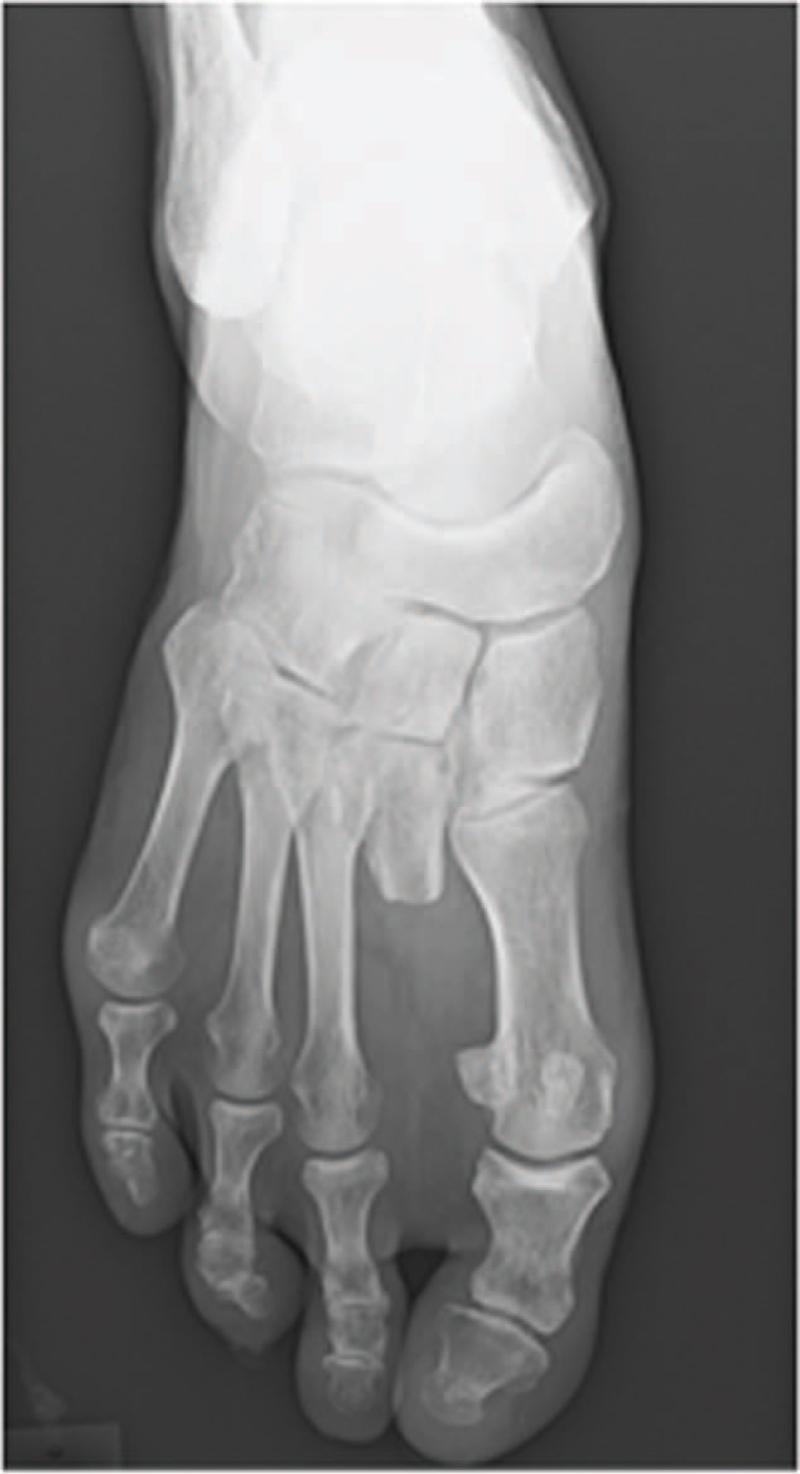
AP radiograph showing complete resection of the 2nd metatarsal and its phalanges (2nd ray). All other rays remain intact.
2. Transmetatarsal Amputation (TMA) — Gillies
Definition: Amputation through the shafts of all five metatarsals, removing the entire forefoot while preserving the hindfoot and ankle.
Where it is done:
- Bone cuts are made through the mid-shafts of all 5 metatarsals simultaneously.
- A long plantar skin flap is fashioned (longer than the dorsal flap) to cover the stump — this provides a durable, well-padded weight-bearing surface.
- The fibula-like taper at each metatarsal stump end is bevelled to avoid pressure points.
- The ankle joint and all tarsal bones are fully preserved.
3. Tarsometatarsal Amputation — Lisfranc's
Definition: Disarticulation through the tarsometatarsal (Lisfranc) joints — the articulation between the bases of all 5 metatarsals and the cuneiforms/cuboid.
Where it is done:
- All 5 metatarsals are disarticulated from the tarsus at the Lisfranc joint line.
- The 3 cuneiforms, cuboid, navicular, talus, and calcaneus are all retained.
- The stump ends at the midfoot level.
- The 2nd metatarsal base locks into a mortise between the cuneiforms — the surgeon must carefully release this during disarticulation.
4. Midtarsal Amputation — Chopart's
Definition: Disarticulation through the transverse tarsal joint (Chopart's joint = talonavicular + calcaneocuboid joints combined).
Where it is done:
- The surgical cut passes through the joint between:
- Talus → Navicular (medially)
- Calcaneus → Cuboid (laterally)
- Everything anterior to this line (navicular, cuboid, cuneiforms, metatarsals, toes) is removed.
- Only the talus and calcaneus are retained.
- Risk: unopposed Achilles tendon causes equinus deformity — so Achilles tendon lengthening or tenotomy is often performed simultaneously.
Clinical photograph series showing progression from Lisfranc → Chopart amputation:
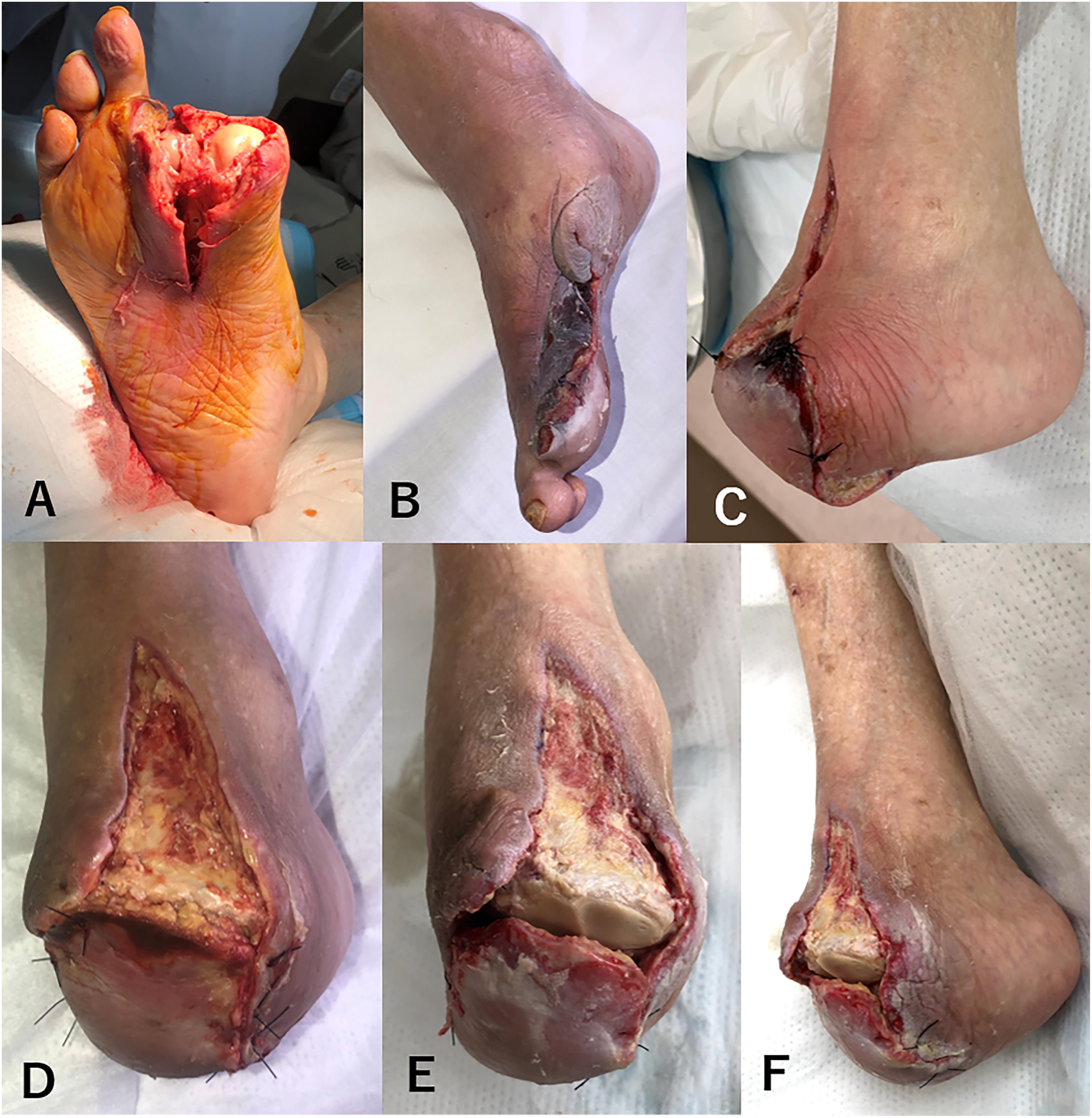
Panel A–B: Initial toe/metatarsal amputations. Panel C: Lisfranc amputation stump with sutures. Panels D–F: Chopart amputation — midfoot removed, talus exposed at the ankle level. This series illustrates how infection in diabetic foot disease drives progressively proximal amputation levels.
5. Syme's Amputation
Definition: Ankle disarticulation with preservation of the heel pad for direct end-bearing.
Where it is done:
- Disarticulation at the tibiotalar (ankle) joint.
- The malleoli (medial and lateral projections of tibia and fibula) are trimmed flush with the joint surface to create a smooth, broad bone end.
- The calcaneal fat pad (heel pad) — with its overlying skin — is carefully dissected free from the calcaneus and rotated anteriorly to cover the bone ends.
- This heel pad is uniquely durable and allows the patient to bear weight directly on the stump tip, sometimes without a prosthesis.
- Results in the longest possible below-knee stump length.
6. Below-Knee (Transtibial) Amputation — Burgess Technique
Definition: Amputation through the shafts of the tibia and fibula, preserving the knee joint.
Where it is done:
- Standard bone division: 8–15 cm below the tibial tuberosity (roughly the junction of the proximal and middle thirds of the leg).
- The Burgess long posterior flap technique:
- A long posterior myocutaneous flap of gastrocnemius/soleus muscle + overlying skin is preserved.
- This flap is folded anteriorly over the bone ends, providing well-vascularised, padded stump coverage.
- The fibula is cut 1–2 cm shorter than the tibia.
- The anterior tibial crest is bevelled to prevent a sharp pressure point under the prosthetic socket.
- Preserving the knee is critical — below-knee amputees walk with ~25% extra energy expenditure vs. ~65% extra for above-knee amputees.
7. Transcondylar / Through-Knee Amputation — Gritti-Stokes
Definition: Amputation at the level of the femoral condyles, at or just above the knee joint.
Where it is done:
- In the Gritti-Stokes variant:
- The femur is divided just above (supracondylar level) or through the condyles.
- The patella is preserved, its cartilage is removed, and it is sutured to the cut surface of the femoral stump (patellodesis) — providing a broad, end-bearing stump surface.
- In simple through-knee disarticulation, the femoral condyles are retained without patellodesis.
- Advantage: long lever arm; good proprioception; no muscle cutting across bone (disarticulation preserves soft tissue).
- Disadvantage: the wide condylar stump is bulky and makes fitting a prosthetic knee unit difficult.
8. Above-Knee (Transfemoral) Amputation
Definition: Amputation through the shaft of the femur, above the knee joint.
Where it is done:
- Bone division through the middle third of the femur, ideally leaving a stump ≥10 cm proximal to the knee joint line to allow fitting of a prosthetic knee unit.
- Myodesis (suturing muscle directly to bone through drill holes) or myoplasty (muscle to muscle) is performed to:
- Provide soft tissue padding over the bone end.
- Balance the stump — preventing flexion-abduction deformity caused by unopposed iliopsoas (hip flexor) and hip abductors pulling the femur.
- The longer the femoral stump, the better the prosthetic control — but at least 5–7 cm of femur below the lesser trochanter must remain.
Summary Table
| # | Name | Eponym | Exact Level of Cut |
|---|---|---|---|
| 1 | Ray | — | Through shaft/base of one metatarsal |
| 2 | Transmetatarsal | Gillies | Mid-shafts of all 5 metatarsals |
| 3 | Tarsometatarsal | Lisfranc | Tarsometatarsal joint line (metatarsal bases) |
| 4 | Midtarsal | Chopart | Talonavicular + calcaneocuboid joints |
| 5 | Ankle disarticulation | Syme | Tibiotalar joint; malleoli trimmed; heel pad preserved |
| 6 | Below-knee | Burgess | Tibia/fibula shafts, 8–15 cm below tibial tuberosity |
| 7 | Transcondylar | Gritti-Stokes | Through/above femoral condyles; patella retained |
| 8 | Above-knee | — | Mid-shaft femur, ≥10 cm above knee joint |
Key Principle: Every level of amputation saved preserves function. The knee joint is the single most important landmark — its preservation dramatically reduces energy cost of walking and improves prosthetic outcomes.
This is a shared conversation. Sign in to Orris to start your own chat.