
Herd Immunity
Reading File
Finding Sources
Searching PubMed
"herd immunity" AND vaccination
Searching the Web
herd immunity definition threshold vaccination
Reading File
Reading File
Searching Images
herd immunity diagram vaccinated unvaccinated population diagram
Herd Immunity
Definition
Herd immunity (also called community or population immunity) is the indirect protection of non-immune individuals in a population that occurs when a sufficiently large proportion of the population is immune to an infectious agent - either through vaccination or prior infection - such that the chain of person-to-person transmission is broken. When enough people are immune, an infected person is unlikely to encounter a susceptible contact, so the pathogen cannot sustain spread even though some susceptible individuals remain unprotected (Park's Textbook of Preventive and Social Medicine, p. 115).
Mechanism
Transmission of an infectious disease depends on the effective reproduction number (R) - the average number of secondary cases produced by each infected person in a given population. If enough people are immune, R falls below 1, and the disease can no longer sustain an epidemic and eventually dies out in that population (Roitt's Essential Immunology).
Herd Immunity Threshold (HIT)
The herd immunity threshold is the proportion of immune individuals in a population above which a disease can no longer persist. It is not necessary, nor generally possible, to immunize 100% of a population to stop transmission - only enough to push the susceptible fraction below the threshold. The classic formula (assuming a fully effective vaccine) is:
HIT = 1 - (1/R0)
where R0 (R-naught) is the basic reproduction number - the average number of people one infected person would infect in a fully susceptible population. Highly contagious diseases require a higher threshold:
- Measles (R0 ~ 12-18): threshold ~ 95%
- Polio (R0 ~ 5-7): threshold ~ 80-85%
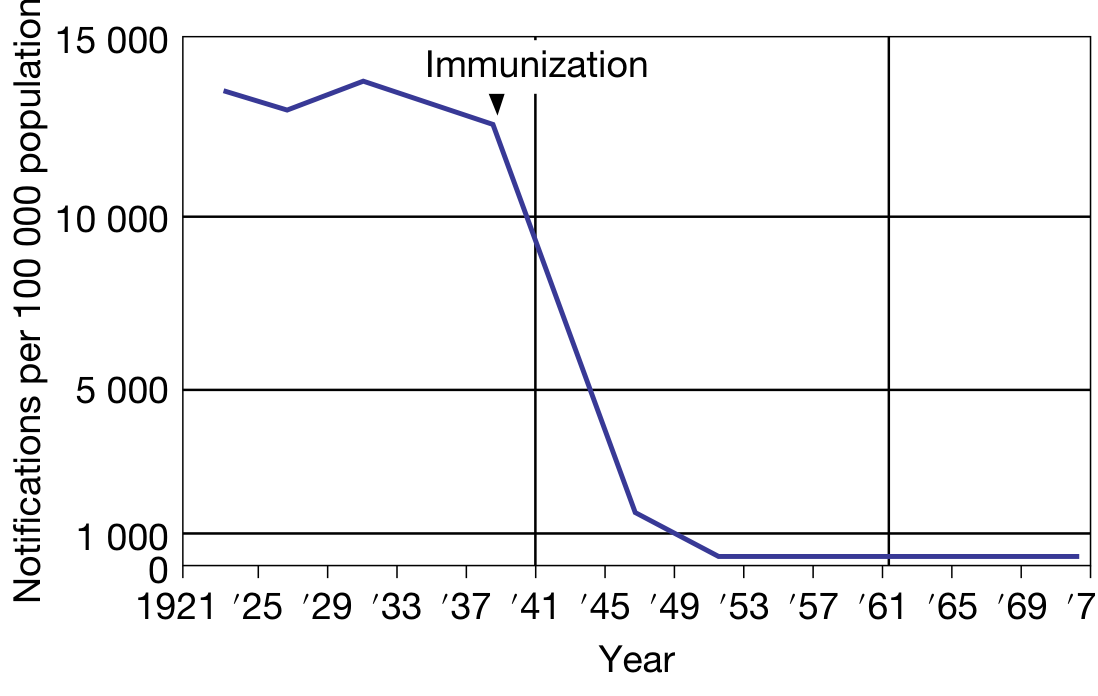
- Diphtheria: eliminated from communities once roughly 75% of children were immunized
The threshold's exact value depends on the virulence of the organism, vaccine efficacy, and the population's contact patterns (Park's Textbook of Preventive and Social Medicine, p. 115).
Elements contributing to herd immunity
- Clinical and subclinical infection occurring naturally in the population
- Immunization coverage of the population
- Herd structure - the composition and mixing patterns of the population, which is never static (affected by births, deaths, migration). An ongoing, sustained immunization programme is needed to maintain herd immunity at a protective level (Park's Textbook of Preventive and Social Medicine, p. 115).
Important nuances and exceptions
- Tetanus is an exception: herd immunity does not protect the individual against tetanus because the organism (Clostridium tetani) does not spread person-to-person - it lives in soil and animal feces as spores, so each person must be individually immunized (Roitt's Essential Immunology, ch. 12; Park's, p. 115).
- Smallpox eradication was achieved not primarily through herd immunity but through active surveillance and containment of cases, alongside vaccination.
- Herd immunity can decline over time if immunization programmes lapse (e.g., waning smallpox immunity after vaccination was stopped) or if vaccine-hesitant clusters form - focal measles outbreaks have occurred in under-vaccinated religious/community groups despite high overall national coverage.
- Herd immunity levels can be estimated through serological surveys (serological epidemiology).
The figure below (from Roitt's Essential Immunology) shows the dramatic fall in diphtheria notifications in England and Wales following the introduction of mass immunization, illustrating herd immunity in action:
Clinical/public health relevance
Herd immunity thresholds guide national vaccination coverage targets (e.g., WHO/health authorities set ~95% coverage goals for measles). It especially protects those who cannot be vaccinated themselves - infants too young for a vaccine, immunocompromised patients, or people with vaccine contraindications - by reducing their likelihood of exposure.
A note on current evidence: my PubMed search for recent systematic reviews/meta-analyses on "herd immunity and vaccination" mostly returned veterinary studies and a hepatitis A-specific analysis (PMID: 37738564, threshold modeling among people who inject drugs), which don't materially update the classical textbook concepts above. If you want, I can look deeper into disease-specific herd immunity thresholds (e.g., COVID-19, pertussis) or the ethics debate around vaccination mandates.
This is a shared conversation. Sign in to Orris to start your own chat.