
Teach me venous infarct of brain
Reading File
Now I'll search the library in parallel for comprehensive coverage of cerebral venous infarction:
Finding Sources
Finding Sources
Searching PubMed
"cerebral venous thrombosis"[MeSH Terms] AND ("diagnosis" OR "treatment")
Excellent finds. Let me read the primary neurology source and the radiology source in parallel, along with a paragraph-level search for venous infarct pathology:
Reading File
Reading File
Finding Sources
Good data. Let me pull the radiology content, the Goldman-Cecil management section, and search for images in parallel:
Reading File
Reading File
Finding Sources
Searching Images
cerebral venous sinus thrombosis MRI CT imaging empty delta sign
Excellent. Let me now read the Adams & Victor content on dural sinus thrombosis and the Neuroanatomy clinical case, plus fetch the best imaging:
Reading File
Reading File
Loading Image
Loading Image
I now have comprehensive material from multiple authoritative textbooks plus excellent imaging. Let me compile a thorough, well-structured teaching response.
Venous Infarct of the Brain (Cerebral Venous Thrombosis / CVT)
1. Overview & Epidemiology
Cerebral venous thrombosis (CVT) is an uncommon but potentially devastating form of stroke accounting for 0.5–1% of all strokes. It is distinct from arterial stroke in its mechanism, imaging, clinical behaviour, and — importantly — its treatment. The increasing recognition of CVT is due to enhanced clinical awareness and widespread use of MRI.
- Most common in adult women, especially in association with pregnancy, the puerperium, and oral contraceptive use
- Also occurs in neonates and young infants (about half of paediatric cases)
- Rare but recognized complication of SARS-CoV-2 infection
- Incidence ~0.08% among hospitalized patients
Bradley and Daroff's Neurology in Clinical Practice — CVT constitutes 0.5–1% of all strokes; most modern cases involve adult women with puerperium or pregnancy-related risk factors.
2. Anatomy of Cerebral Venous Drainage
Understanding which veins drain which areas predicts the clinical syndrome:
| Structure | Drains |
|---|---|
| Superior sagittal sinus (SSS) | Bilateral parasagittal cortex (legs/feet region) |
| Transverse/lateral sinus | Temporal lobe convexity |
| Straight sinus | Deep structures (thalami, basal ganglia) via internal cerebral veins |
| Vein of Labbé | Superior temporal lobe |
| Vein of Trolard | Parietal cortex |
| Cavernous sinus | Orbit and frontal base |
The superior sagittal sinus is the most frequently thrombosed structure.
3. Pathophysiology
Why venous infarct differs from arterial infarct
In arterial occlusion, blood flow to the territory simply stops → cytotoxic oedema → infarction.
In venous occlusion, the sequence is:
- Sinus/vein thrombosis → outflow obstruction
- → Venous hypertension upstream in draining veins
- → Impaired perfusion pressure (arteries still deliver blood but it cannot drain)
- → Vasogenic oedema (interstitial fluid leaks from congested capillaries)
- → Blood-brain barrier breakdown → haemorrhagic transformation (very common — much more so than arterial infarct)
- → Eventually cytotoxic oedema and infarction if untreated
Key consequences of this mechanism:
- Venous infarcts are frequently haemorrhagic (fragmented, petechial haemorrhage into congested tissue)
- They do not respect arterial territory boundaries
- They are often multifocal and bilateral
- Both grey matter and subcortical white matter are affected (cortex + immediate subcortex)
- Cerebral oedema is paradoxically less prominent than in large arterial infarcts
Grainger & Allison's Diagnostic Radiology — "Reduction in parenchymal venous drainage leads to venous hypertension and subsequent infarction, which is frequently haemorrhagic."
4. Causes & Risk Factors
Aseptic CVT (the majority):
| Category | Examples |
|---|---|
| Hypercoagulable states | Protein C/S deficiency, antithrombin III deficiency, Factor V Leiden, antiphospholipid syndrome, polycythaemia, paroxysmal nocturnal haemoglobinuria |
| Hormonal | OCP, pregnancy, puerperium |
| Inflammatory/vasculitic | Behçet disease, SLE, IBD, sarcoidosis |
| Infection | Meningitis, encephalitis |
| Malignancy | Direct invasion or hypercoagulability |
| Dehydration | Especially in neonates and infants |
| Local trauma | Head injury, neurosurgery, lumbar puncture |
| COVID-19 | Vaccine-induced immune thrombocytopenia (VITT) |
| Idiopathic | ~15–20% of cases |
Septic CVT (less common today due to antibiotics):
- Cavernous sinus thrombosis: complication of facial/orbital infection → proptosis, chemosis, painful ophthalmoplegia
- Lateral sinus thrombosis: complication of otitis media/mastoiditis → headache, fever, otalgia, vertigo, papilledema, abducens palsy
Patients should be screened for thrombophilia after CVT.
5. Clinical Presentation
CVT is a great masquerader. Onset may be acute, subacute, or chronic.
Symptoms by mechanism:
Raised intracranial pressure (from impaired CSF absorption — the arachnoid granulations drain into the SSS):
- Headache (most common symptom — present in >90%) — typically diffuse, progressive, worsening over days
- Vomiting
- Papilledema
- Transient visual obscurations
- Sixth nerve palsy (false localising)
Focal brain injury (venous infarction/haemorrhage):
- Hemiparesis or paraparesis (bilateral leg weakness in SSS thrombosis — affects parasagittal motor cortex)
- Hemisensory loss
- Aphasia
- Hemianopia
- Alternating focal deficits (unusual for arterial stroke)
Cortical irritation (from congestion and haemorrhage):
- Focal or generalised seizures — very common, more so than arterial stroke
Encephalopathy (deep vein thrombosis or extensive disease):
- Lethargy, stupor, coma
- Bilateral thalamic infarction (straight sinus/internal cerebral vein thrombosis) → coma, memory loss
Adams and Victor's Principles of Neurology — "A slower evolution of the stroke syndrome than with arterial occlusion strokes, multiple cerebral lesions not in arterial territories, and a convulsive and hemorrhagic character favor venous over arterial thrombosis."
6. Syndromes by Location
| Thrombosed Structure | Classic Syndrome |
|---|---|
| Superior sagittal sinus | Bilateral leg weakness/sensory loss, raised ICP, papilledema, bilateral parasagittal haemorrhagic infarcts |
| Transverse/sigmoid sinus | Raised ICP ± temporal lobe haemorrhagic infarct |
| Straight sinus / deep system | Bilateral thalamic infarction → coma, memory impairment, hypersomnolence |
| Cavernous sinus | Proptosis, chemosis, painful ophthalmoplegia (septic > aseptic) |
| Cortical vein (isolated) | Focal cortical haemorrhagic infarct, focal seizures, no ICP rise |
| Vein of Labbé | Superior temporal lobe infarct (aphasia if dominant side) |
7. Imaging
CVT imaging has two components: (1) the thrombosed vessel itself and (2) the upstream parenchymal changes.
CT (Non-contrast)
- Dense/hyperdense sinus or vein = acute clot (the "dense triangle sign" in SSS)
- "Cord sign" = hyperdense thrombosed cortical vein on plain CT
- Haemorrhagic infarction in a non-arterial distribution
- Small ventricles (cerebral swelling)
CT with contrast (CT Venography)
- Empty delta sign (empty triangle sign): triangular filling defect (hypodense clot centre) surrounded by enhancing dural walls in the posterior SSS — the most classic CT sign
- Filling defect within sinus on CTV
- Absent opacification of sinus confirms thrombosis
MRI
- Loss of normal flow void in the sinus (normally seen as black stripe)
- Thrombosed sinus can be hyperintense on T1 and T2 (subacute thrombus — methhaemoglobin)
- Very acute thrombus can be hypointense on T2 (deoxy-Hb) — can mimic normal flow void (pitfall!)
- FLAIR/T2: high signal (oedema) in venous territory ± haemorrhage
SWI (Susceptibility-Weighted Imaging) — most sensitive
- "Blooming" = exaggerated hypointensity of thrombosed vein/sinus (beyond expected size)
- Multiple prominent serpiginous veins in the congested territory = venous hypertension
- Identifies acute haemorrhage
- Phase images can identify occluded cortical veins
MR Venography (MRV) — the gold standard
- Loss of flow signal in affected sinus
- Absence or irregularity of venous flow confirms thrombosis
- Has replaced conventional angiography for diagnosis
- Useful also for follow-up and recanalisation assessment
Parenchymal lesion distribution by sinus:
- SSS → bilateral (often asymmetric) cortical/subcortical lesions, parasagittal, parietal/frontal
- Lateral sinus → posterolateral temporal lobe, inferior parietal lobule
- Straight sinus/internal cerebral vein → bilateral thalami ± basal ganglia
- Vein of Labbé → anterolateral right temporal lobe
8. Imaging Examples
Cord Sign (MRI) + Empty Delta Sign (CTV)
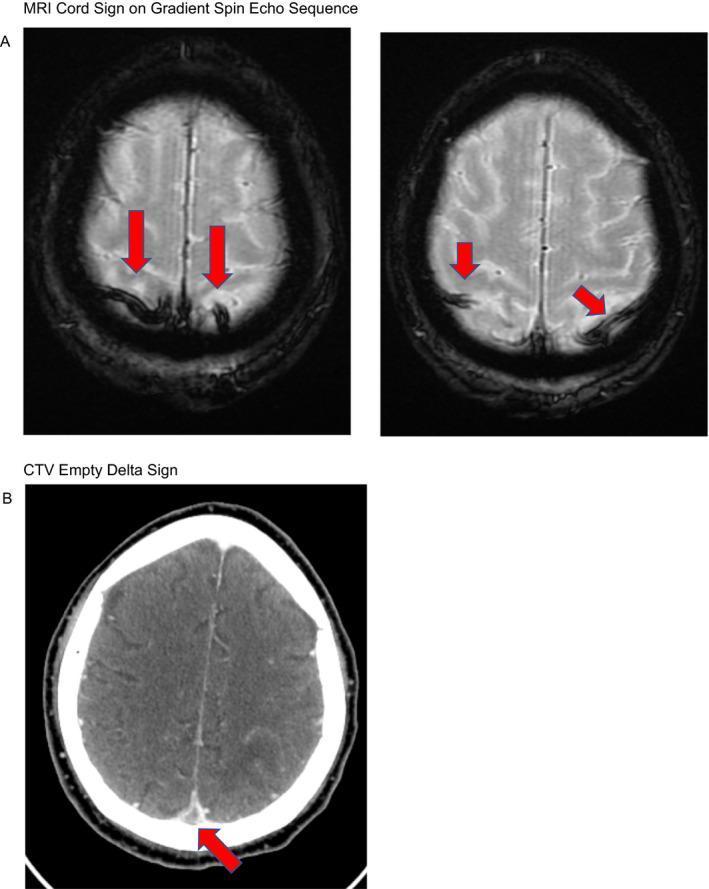
Panel A (MRI gradient echo): Red arrows show the "cord sign" — hypointense thickened cortical veins indicating acute thrombus. Panel B (CT venogram): Red arrow shows the classic "empty delta sign" — central hypodense thrombus surrounded by enhanced dural walls in the superior sagittal sinus.
CVT with Haemorrhagic Infarction (Multi-modality from Grainger & Allison)
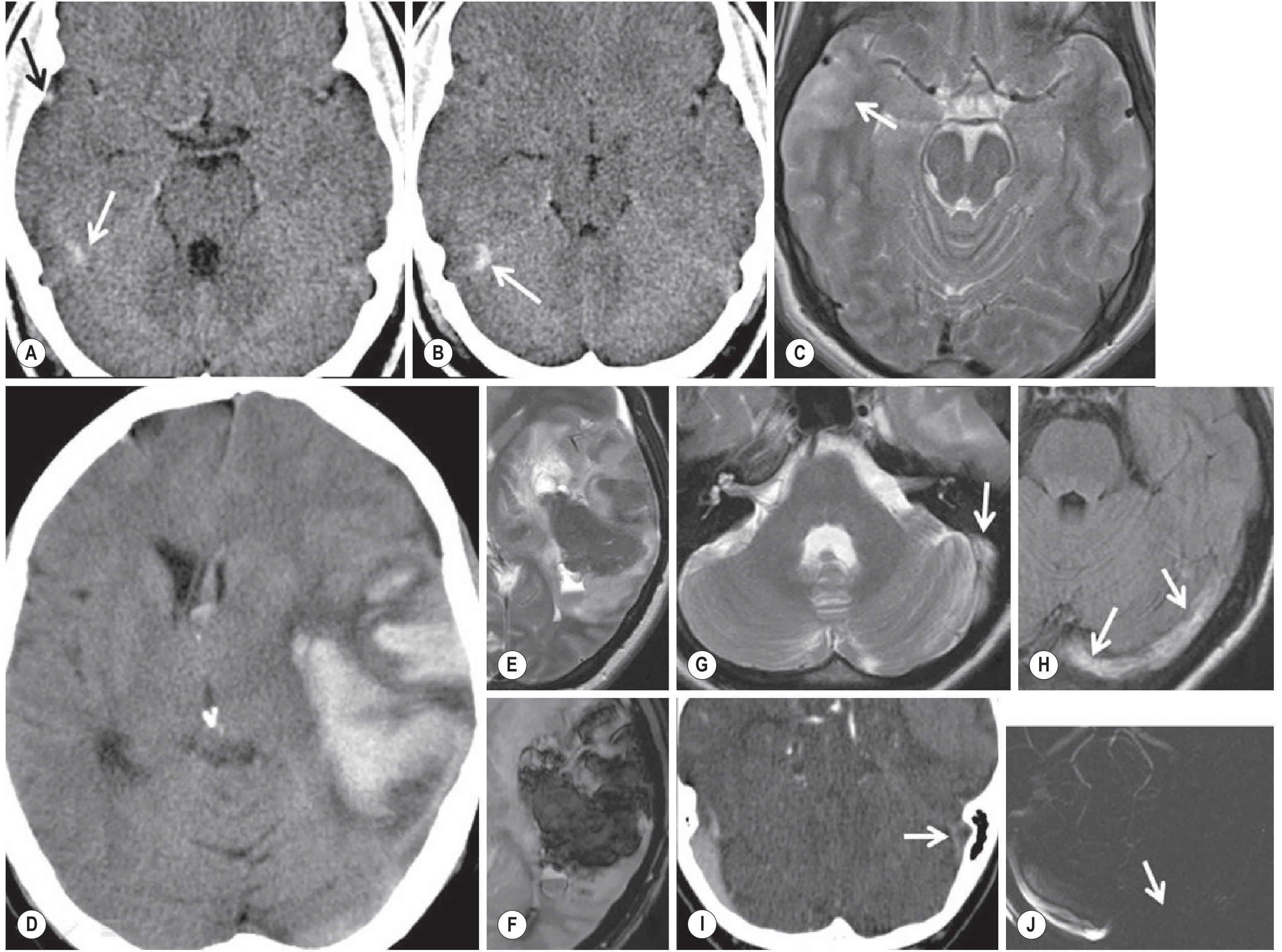
A: Cortical venous thrombosis (right vein of Labbé — serpiginous hyperdensity, black arrow; right lateral sinus, white arrows). B: Small early venous ischaemia right temporal lobe (T2W MRI). D: Large haemorrhagic left fronto-temporal venous infarct. E/F: T2/SWI — acute blood products (hypointense). G/H: Left lateral sinus thrombosis — loss of flow void on T2/FLAIR. I: CT venogram filling defect in left lateral sinus. J: SWI phase image — absent flow.
9. Diagnosis
- Clinical suspicion — headache + seizures + encephalopathy or stroke in young woman, peripartum, or OCP user
- CT/NECT — quick screening; look for dense sinus, dense cortical vein, non-arterial haemorrhage
- CT venography — excellent for major dural sinuses; shows empty delta, filling defects
- MRI + MRV — preferred combination; better for parenchymal lesions and small cortical veins
- SWI — most sensitive for cortical vein thrombosis
- DSA (conventional angiography) — now rarely needed; reserved for endovascular therapy planning
- CSF — raised opening pressure; may be xanthochromic; not required for diagnosis
- Thrombophilia screen — essential after diagnosis
MRV alone can be misleading (hypoplastic sinus vs thrombosis vs slow flow). Correlation with T1/T2/SWI is essential.
10. Treatment
Anticoagulation — cornerstone (even with haemorrhagic infarction)
This is counter-intuitive but well-established: the benefit of stopping clot propagation outweighs the risk of worsening haemorrhage.
| Phase | Drug | Notes |
|---|---|---|
| Acute | IV unfractionated heparin (UFH) or weight-adjusted LMWH SC | LMWH may have lower mortality vs UFH |
| Long-term (≥3 months) | Warfarin (INR 2.0–3.0) | Duration depends on aetiology |
| DOACs | No proven benefit over warfarin; evidence limited | May be considered (limited data) |
ICP Management
- Acetazolamide, repeated LP for raised ICP
- Head elevation, hyperventilation (short-term)
- Avoid hyperosmolar therapy if significant oedema
Anticonvulsants
- Prophylactic or therapeutic seizure medications (especially if cortical involvement/seizures present)
Antibiotics
- For septic CVT only
Escalation if deteriorating:
- Local sinus thrombolysis (urokinase/tPA via catheter) — if failing anticoagulation
- Mechanical thrombectomy of occluded sinus — endovascular option
- Decompressive craniectomy — for malignant oedema/herniation (life-saving in selective cases)
Bradley and Daroff's — "The efficacy of heparin has been shown even in patients who have evidence of intracranial hemorrhage by neuroimaging studies."
11. CVT vs Arterial Infarct — Key Differences
| Feature | Venous Infarct | Arterial Infarct |
|---|---|---|
| Territory | Non-arterial, bilateral possible | Single arterial territory |
| Haemorrhage | Common, multifocal, fragmented | Less common; uniform |
| Oedema | Vasogenic predominant, less severe | Cytotoxic, severe |
| Seizures | Very common | Less common |
| ICP rise | Common (especially SSS) | Uncommon early |
| Onset | Hours to days | Typically sudden |
| DWI restriction | Incomplete/variable | Complete/uniform in core |
| Anticoagulation | Indicated (even with haemorrhage) | Contraindicated early with haemorrhage |
12. Prognosis
- Most patients with prompt anticoagulation have good outcomes
- Mortality ~5–10% in modern series
- Recanalisation occurs in a majority
- Risk of recurrent thromboembolism — screen for underlying hypercoagulability
- Long-term anticoagulation depends on underlying cause (provoked vs unprovoked, persistent risk factors)
Sources:
- Bradley and Daroff's Neurology in Clinical Practice (Chapter 65)
- Adams and Victor's Principles of Neurology, 12th Edition (Chapter 33)
- Grainger & Allison's Diagnostic Radiology (Chapter 56)
- Goldman-Cecil Medicine, 26th Edition (Chapter 376)
- Neuroanatomy through Clinical Cases, 3rd Edition (Case 10.13)
This is a shared conversation. Sign in to Orris to start your own chat.