
Audiology tuning fork tests explain mechanisms and tests
tuning fork tests audiology Rinne Weber Schwabach mechanisms
Harrison's Principles of Internal Medicine, Twenty First Edition
Page 1037
conductive sensorineural hearing loss tuning fork interpretation
Harrison's Principles of Internal Medicine, Twenty First Edition
Page 1037
tuning fork Rinne Weber test diagram audiology
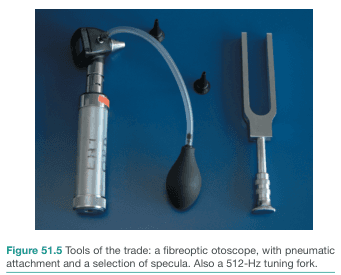
Bailey and Love's Short Practice of Surgery 28th Edition
Page 774
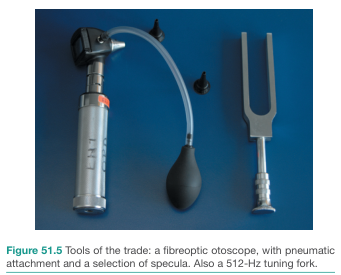
Audiology Tuning Fork Tests
Underlying Mechanisms: Air vs. Bone Conduction
| Pathway | Route | Structures Involved |
|---|---|---|
| Air Conduction (AC) | Sound waves → EAC → tympanic membrane → ossicles (malleus, incus, stapes) → oval window → cochlea → auditory nerve | Outer + middle + inner ear |
| Bone Conduction (BC) | Vibration of skull → bypasses outer and middle ear → directly stimulates cochlear fluids → auditory nerve | Inner ear only |
The Standard Tuning Fork: 512 Hz
- Low enough to produce a tone perceptible by bone conduction
- High enough to avoid tactile vibration confounding the result (lower frequencies like 128 Hz can be felt)
- Falls within the critical speech frequency range
The Tests
1. Rinne Test
- Strike the tuning fork and place the vibrating tines near the external auditory canal opening (AC position)
- Then place the stem on the mastoid process (BC position)
- Ask: "Which is louder?" or use the sequential method: hold at mastoid until no longer heard, then move to EAC — ask if sound returns
| Result | Finding | Meaning |
|---|---|---|
| AC > BC (Rinne Positive) | Normal | Normal hearing OR sensorineural hearing loss |
| BC > AC (Rinne Negative) | Abnormal | Conductive hearing loss ≥30 dB |
| Equal | Borderline | May indicate mild conductive loss |
According to Harrison's (p. 1037): "with conductive hearing loss of ≥30 dB, the bone-conduction stimulus is perceived as louder than the air-conduction stimulus."
2. Weber Test
- Strike the tuning fork and place the stem on the midline — vertex of the skull, forehead, or upper central incisor teeth
- Ask: "Where do you hear the sound — left, right, or center?"
| Result | Meaning |
|---|---|
| Midline (no lateralization) | Normal hearing bilaterally OR equal bilateral hearing loss |
| Lateralizes to the WORSE ear | Conductive hearing loss on that side |
| Lateralizes to the BETTER ear | Sensorineural hearing loss on the worse side |
- The occluded/damaged middle ear creates an environment where ambient noise is excluded, reducing "masking" in that ear
- Bone-conducted energy is not dissipated via the normal ossicular pathway, so more energy reaches the cochlea on the conductive-loss side
- This is also why plugging a normal ear with a finger causes the Weber to lateralize to that side (the occlusion effect)
3. Schwabach Test
- Place the vibrating fork stem on the patient's mastoid
- When the patient signals they no longer hear it, immediately transfer to the examiner's mastoid
| Result | Meaning |
|---|---|
| Examiner still hears it ("Schwabach shortened") | Patient has sensorineural hearing loss (reduced cochlear reserve) |
| Patient hears it longer ("Schwabach prolonged") | Patient has conductive hearing loss (less ambient noise masking) |
| Equal duration | Normal hearing |
4. Bing Test (Occlusion Test)
- Place the fork stem on the mastoid
- Alternately occlude and release the external auditory canal with a fingertip
- Ask if the sound gets louder when the ear is blocked
| Result | Meaning |
|---|---|
| Sound gets louder with occlusion (Bing positive) | Normal or sensorineural hearing loss |
| No change with occlusion (Bing negative) | Conductive hearing loss (occlusion effect already lost) |
5. Gelle Test
| Result | Meaning |
|---|---|
| Sound diminishes with pressure (Gelle positive) | Normal ossicular mobility |
| No change (Gelle negative) | Fixed ossicular chain (e.g., otosclerosis) |
Combined Interpretation Summary
| Rinne (Affected Ear) | Weber | Diagnosis |
|---|---|---|
| Positive (AC > BC) | Midline | Normal |
| Positive (AC > BC) | Lateralizes to better ear | Sensorineural loss (worse ear) |
| Negative (BC > AC) | Lateralizes to worse ear | Conductive loss (worse ear) |
| Bilateral negative | Midline or bilateral | Bilateral conductive loss |
| Positive (AC > BC) — but false negative possible | Lateralizes to better ear | Severe unilateral SNHL (mask contralateral ear) |
Clinical Pearls
- Always use a 512 Hz fork — 256 Hz causes too much tactile sensation, 1024 Hz is too quiet for BC
- Strike the fork against the knee or palm, not a hard surface (avoids overtones)
- The Rinne only detects conductive loss when the air-bone gap is ≥30 dB — smaller gaps may not be picked up
- Tuning fork tests are screening tools, not replacements for formal pure-tone audiometry
- In a noisy clinical environment, results may be unreliable; audiometry in a sound-treated booth is the gold standard
Can u also include audiology and evaluation of audio gram
audiogram pure tone audiometry interpretation air bone conduction thresholds
Harrison's Principles of Internal Medicine, Twenty First Edition
Page 1038
audiologic assessment speech audiometry tympanometry acoustic reflex
Harrison's Principles of Internal Medicine, Twenty First Edition
Page 1037
audiogram patterns conductive sensorineural hearing loss
Hugging Face pmc clinical VQA raw
Page 0
tympanometry acoustic reflex decay retrocochlear cochlear hearing loss evaluation
speech reception threshold word recognition score audiometry hearing loss severity classification
tympanogram types A B C audiogram sensorineural presbycusis noise induced
Harrison's Principles of Internal Medicine, Twenty First Edition
Page 1027
Audiologic Evaluation & Audiogram Interpretation
The Minimum Audiologic Test Battery
- Pure tone air-conduction thresholds
- Pure tone bone-conduction thresholds
- Speech reception threshold (SRT)
- Word recognition score (WRS)
- Tympanometry
- Acoustic reflexes
- Acoustic reflex decay
1. Pure Tone Audiometry
How It Works
The Audiogram Grid
| Axis | Values |
|---|---|
| X-axis (frequency) | 250 Hz → 8000 Hz (octave steps); speech range is 500–4000 Hz |
| Y-axis (intensity) | 0 dB HL (normal threshold) → 120 dB HL (profound loss); lower on page = worse |
Standard Audiogram Symbols
| Symbol | Meaning |
|---|---|
| O (red) | Right ear, air conduction |
| X (blue) | Left ear, air conduction |
| < or [ (red) | Right ear, bone conduction |
| > or ] (blue) | Left ear, bone conduction |
| Arrows ↓ | No response at maximum output |
Air-Bone Gap (ABG)
- ABG = 0 → No conductive component
- ABG ≥ 10–15 dB → Significant conductive component
- Maximum possible ABG is ~60 dB (the limit of the conductive mechanism)
2. Severity Classification of Hearing Loss
| Threshold (dB HL) | Severity |
|---|---|
| 0–25 | Normal |
| 26–40 | Mild |
| 41–55 | Moderate |
| 56–70 | Moderately severe |
| 71–90 | Severe |
| >90 | Profound |
3. Audiogram Patterns by Type of Loss
A. Normal Audiogram
- All thresholds ≤25 dB HL
- AC and BC overlap (no ABG)
- Flat across all frequencies
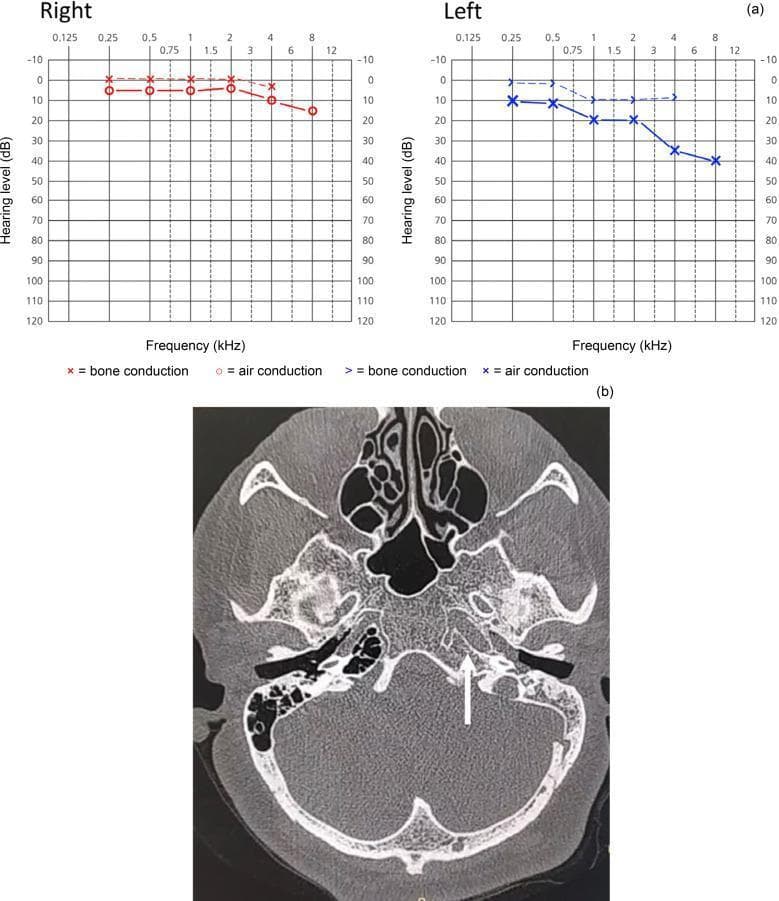
B. Conductive Hearing Loss
- BC normal (≤25 dB HL across frequencies) — cochlea and nerve intact
- AC elevated — outer/middle ear pathway blocked
- ABG present at affected frequencies
- Pattern depends on pathology:
- Mass-dominant (middle ear effusion): thresholds elevated predominantly at high frequencies
- Stiffness-dominant (early otosclerosis): elevations at low frequencies
- Mixed stiffness + mass: flat elevation across all frequencies
C. Sensorineural Hearing Loss (SNHL)
- BC and AC both elevated in parallel — no ABG
- Cochlea or auditory nerve is damaged
- Common patterns:
| Pattern | Pathology |
|---|---|
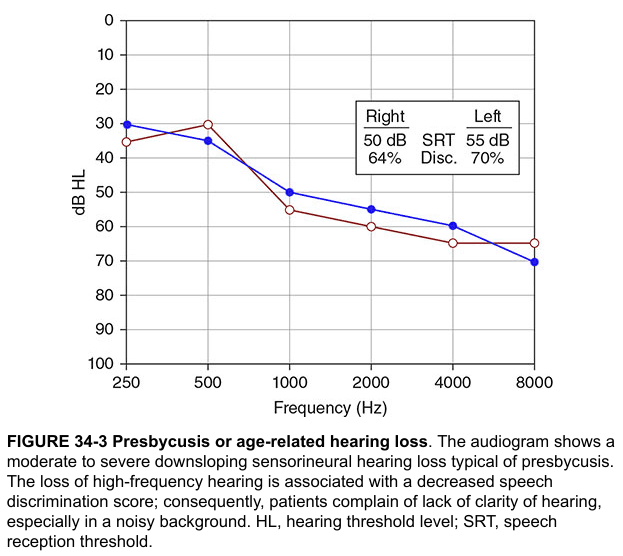
| High-frequency downsloping | Presbycusis (age-related), noise-induced |
| Notch at 4000 Hz | Noise-induced hearing loss (4 kHz notch, recovers at 8 kHz) |
| Low-frequency SNHL | Ménière's disease (early stages) |
| Flat SNHL | Sudden SNHL, autoimmune |
| Cookie-bite (mid-frequency dip) | Hereditary/genetic SNHL |
D. Presbycusis Audiogram
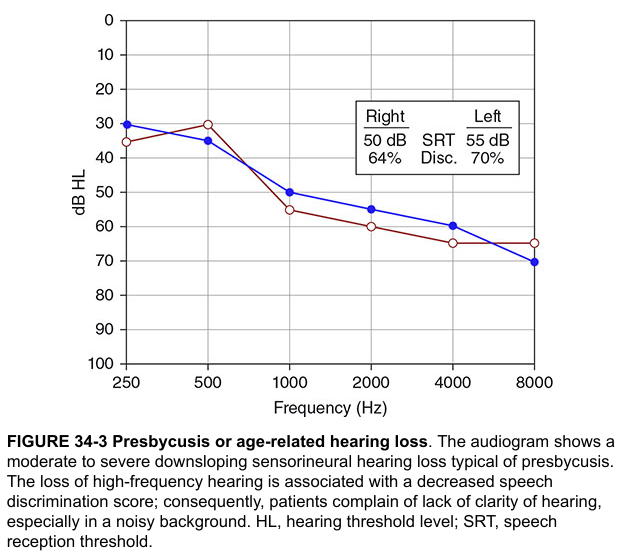
E. Mixed Hearing Loss
- Both AC and BC are elevated (SNHL component)
- ABG is still present (conductive component on top)
- Example: Chronic otitis media with superimposed presbycusis
F. Conductive Loss with Air-Bone Gap (Clinical Example)
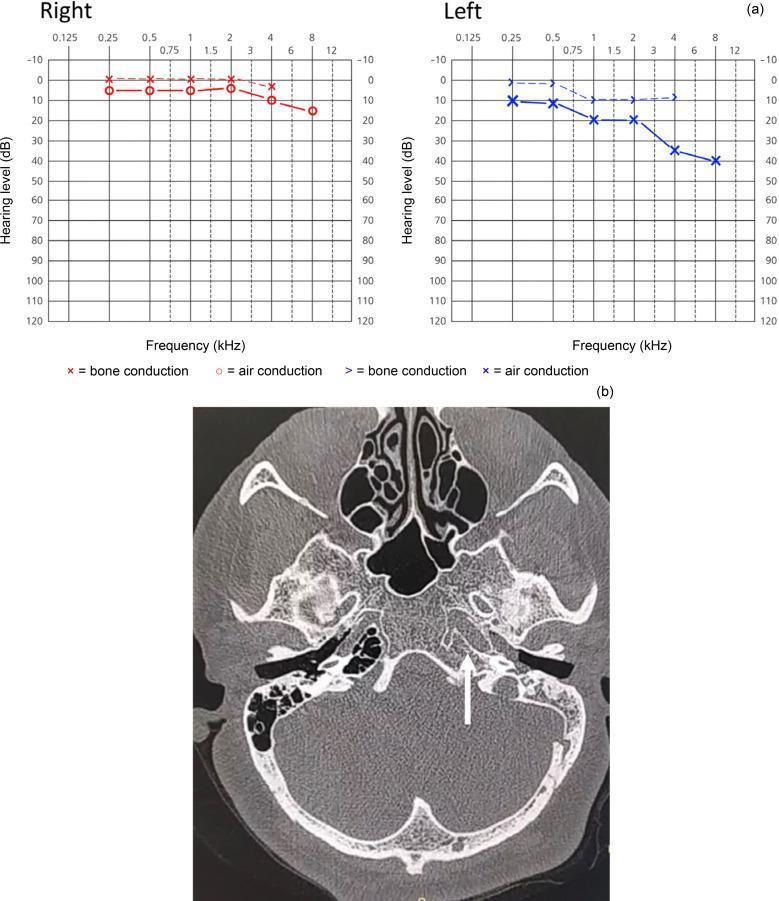
4. Speech Audiometry
A. Speech Reception Threshold (SRT)
- The lowest intensity at which the patient correctly repeats 50% of spondee words (two-syllable words with equal stress, e.g., "baseball," "hotdog")
- Should agree with the pure tone average (PTA) of 500, 1000, and 2000 Hz within ±10 dB
- Discrepancy between SRT and PTA suggests non-organic hearing loss (functional/malingering)
B. Word Recognition Score (WRS) / Speech Discrimination Score
- Monosyllabic words presented at a suprathreshold level (usually SRT + 30–40 dB)
- Expressed as percentage correct (0–100%)
- Distinguishes cochlear from retrocochlear pathology:
| WRS | Interpretation |
|---|---|
| 90–100% | Normal or mild conductive loss |
| 75–90% | Mild difficulty; mild SNHL |
| 50–75% | Moderate difficulty; moderate SNHL |
| <50% | Poor discrimination; suspect retrocochlear pathology |
| Rollover (score drops at higher intensities) | Retrocochlear (acoustic neuroma) — pathognomonic |
5. Tympanometry (Immittance Audiometry)
Tympanogram Types (Jerger Classification)
| Type | Shape | Peak | Compliance | Interpretation |
|---|---|---|---|---|
| Type A | Normal peaked curve | At 0 daPa | Normal (0.3–1.6 mL) | Normal middle ear |
| Type As ("shallow") | Low-amplitude peak | At 0 daPa | Reduced | Otosclerosis, ossicular fixation |
| Type Ad ("deep/discontinuous") | Exaggerated peak | At 0 daPa | Increased | Ossicular discontinuity, thin/flaccid TM |
| Type B | Flat, no peak | — | Very low | Middle ear effusion, TM perforation, PE tube |
| Type C | Peaked but shifted | Negative pressure (< −100 daPa) | Normal/low | Eustachian tube dysfunction |
6. Acoustic Reflexes
Reflex Testing
| Measurement | What it tests |
|---|---|
| Ipsilateral reflex | Same ear stimulus + detection |
| Contralateral reflex | Stimulus one ear, detection other |
| Reflex threshold | Lowest intensity eliciting reflex |
| Reflex decay | Sustained tone — reflex should hold for ≥10 sec |
Interpretation
| Finding | Significance |
|---|---|
| Absent reflex with conductive loss | Expected — stiffened middle ear |
| Absent reflex with normal tympanogram | Suggests facial nerve (CN VII) pathology or severe SNHL |
| Reflex decay (reflex fades in <5 sec at 500 or 1000 Hz) | Retrocochlear pathology — acoustic neuroma, CN VIII lesion |
| Elevated reflex threshold | Cochlear hearing loss |
7. Distinguishing Cochlear vs. Retrocochlear on Audiometry
| Feature | Cochlear (Sensory) | Retrocochlear (Neural) |
|---|---|---|
| WRS | Proportional to pure tone loss | Disproportionately poor |
| Rollover | Absent | Present |
| Acoustic reflex decay | Normal | Abnormal (fades <5 sec) |
| ABR (auditory brainstem response) | Normal latencies | Prolonged wave V latency or absent waves |
| Imaging | Normal | MRI may show vestibular schwannoma |
8. Integration: Tuning Fork Tests + Audiogram
| Rinne | Weber | Audiogram | Tympanogram | Likely Diagnosis |
|---|---|---|---|---|
| Positive bilateral | Midline | Normal | Type A | Normal hearing |
| Negative unilateral | Lateralizes to that ear | AC elevated, BC normal, ABG present | Type B or C | Conductive loss (effusion/otosclerosis) |
| Positive bilateral | Lateralizes to better ear | AC+BC elevated, no ABG, high freq | Type A | SNHL (presbycusis/noise) |
| Positive (false neg) | To better ear | Severe unilateral SNHL | Type A | Severe SNHL — mask contralateral |
| Negative unilateral | Midline | AC+BC elevated + ABG | Type A | Mixed hearing loss |
Key Clinical Pearls
- Pure tone audiometry defines the presence, type, and severity of loss; tuning fork tests are screening tools that must be confirmed by formal audiometry
- The SRT–PTA agreement rule (within ±10 dB) is an important validity check; larger discrepancies raise suspicion for functional hearing loss
- Rollover on WRS and acoustic reflex decay are the two most important screening signs of retrocochlear pathology — prompt MRI internal auditory canals with gadolinium if either is present
- The 4 kHz notch on audiogram is pathognomonic for noise-induced hearing loss; unlike presbycusis, it recovers slightly at 8 kHz
- Ménière's disease is the classic exception among SNHLs — it affects low frequencies first, opposite to most other SNHL causes