
syntehtic cannabinoids
Reading File
Synthetic cannabinoids are man-made chemicals that bind to cannabinoid receptors (CB1 and CB2), often with much greater potency than THC. They are commonly sold under names like "Spice" or "K2," and their clinical effects and toxicity profile differ significantly from natural cannabis.
Searching sources...
Finding Sources
Searching PubMed
synthetic cannabinoids pharmacology toxicity
Searching the Web
synthetic cannabinoids pharmacology mechanism toxicity clinical effects 2025
Now let me pull the key textbook sections in parallel:
Reading File
Reading File
Reading File
Reading File
Let me get the Rosen's extended content and Goodman & Gilman's SC interaction section:
Reading File
Reading File
Let me also fetch the cannabinoid structure image and read the Rosen's management/treatment section:
Loading Image
Reading File
I now have comprehensive information from multiple authoritative sources. Here is a full, synthesized overview:
Synthetic Cannabinoids
What Are They?
Synthetic cannabinoids (SCs) are laboratory-synthesized chemicals designed to bind cannabinoid receptors (CB1 and CB2). Unlike THC, which is a partial agonist, most SCs are full, high-efficacy CB1 agonists - making them far more potent and unpredictable than natural cannabis. They are sold as "herbal incense," "Spice," "K2," or "fake marijuana," labeled "not for human consumption" to circumvent drug laws.
- Rosen's Emergency Medicine, p. 2974
- Goodman & Gilman's Pharmacological Basis of Therapeutics, p. 2772
Chemical Structure
SCs are structurally diverse and generally bear little resemblance to THC, which is why standard urine drug screens miss them (only HU-210, a structural THC analogue, triggers a positive THC immunoassay).
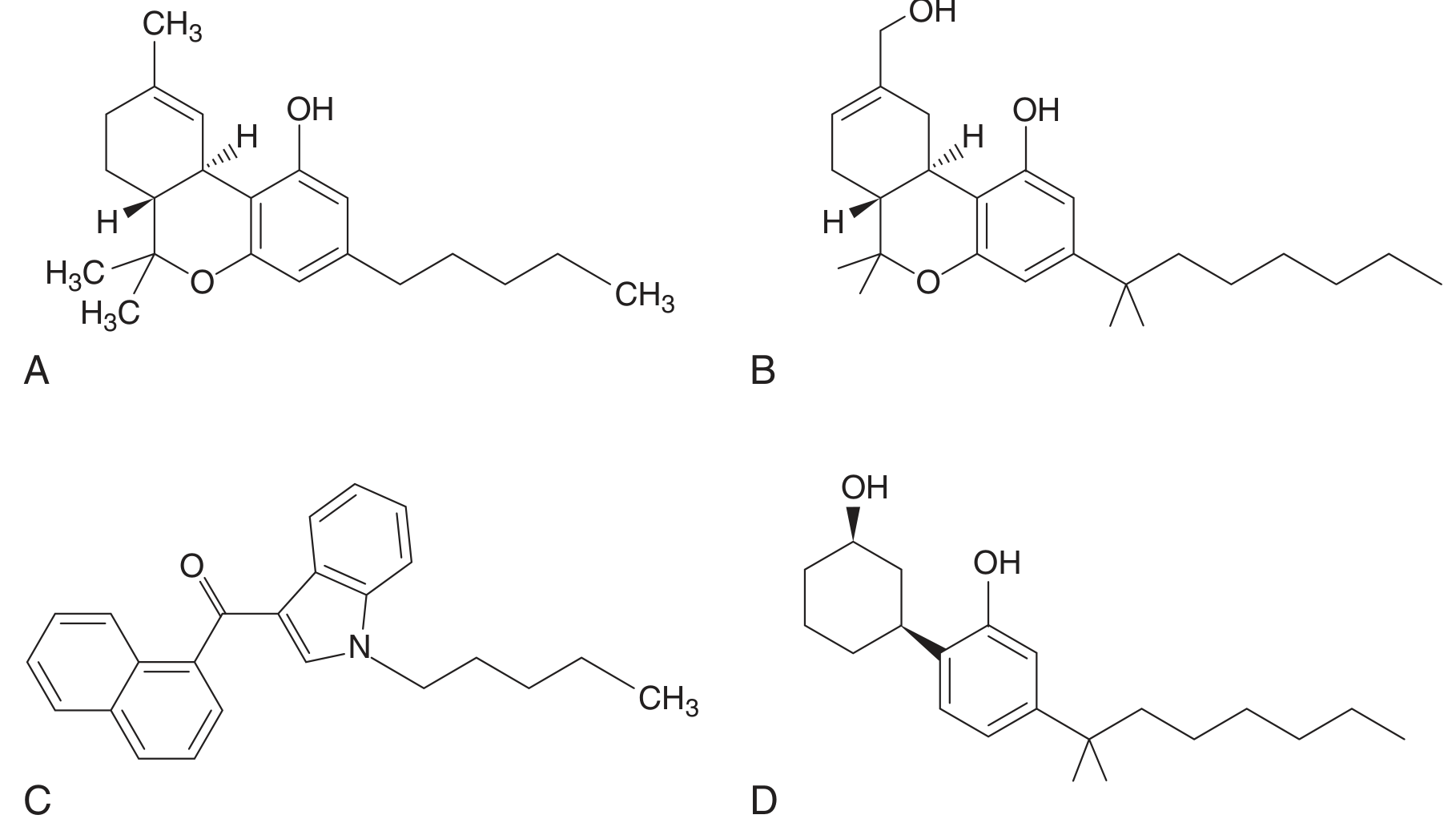
Cannabinoid structures: (A) Δ9-THC, (B) HU-210, (C) JWH-018, (D) CP-47,497 - Rosen's Emergency Medicine
Major Structural Classes
| Class | Examples |
|---|---|
| Naphthoylindoles | JWH-018, JWH-073, JWH-200 |
| Cyclohexylphenols | CP-47,497, cannabicyclohexanol |
| THC analogues | HU-210 |
| Indazole carboxamides | AB-FUBINACA, ADB-PINACA |
| Quinolone carboxylates | PB-22, 5F-PB-22 |
Pharmacology
Mechanism of Action
- CB1R (CNS) and CB2R (peripheral immune cells) are the primary targets
- SCs act as full agonists at CB1R - compared to THC's partial agonism, this produces far greater receptor activation, higher intrinsic efficacy, and more severe psychological/physiological effects
- Their "off-target" receptor activities are largely uncharacterized; they may engage serotonin, dopamine, opioid, or other receptors unpredictably - Goodman & Gilman's, p. 2772
- Because they are produced in illicit labs with minimal quality control, products may also contain contaminants (synthetic opioids, vitamin K antagonists, caffeine)
The Endocannabinoid System (Briefly)
SCs hijack the endocannabinoid system (ECS), which normally uses lipid signaling molecules (anandamide/AEA, 2-arachidonoylglycerol/2-AG) synthesized "on demand" to modulate neurotransmission. The ECS regulates stress, pain, reward, metabolism, and inflammation. Full agonism at CB1R by SCs overwhelms this modulatory system.
Potency
Synthetic cannabinoids are 2 to 100 times more potent than THC - CDC MMWR data documented a range of severe neuropsychiatric, cardiovascular, and renal effects at doses far lower than comparable cannabis.
Routes of Administration & Onset
SCs are dissolved in solvent and sprayed onto dried plant material, then typically smoked in paper (similar to marijuana). They can also be vaporized or taken as liquids.
- Onset: Within minutes of inhalation
- Duration: Generally 2-4 hours (first-generation); may be prolonged with newer agents
- Peak blood levels occur within ~8 minutes of inhalation
Generations and Clinical Features
First-Generation (JWH-018, JWH-073, HU-210, CP-47,497)
- Tachycardia
- Agitation and anxiety
- Nausea/vomiting
- Altered mentation, hallucinations
- Seizures
Second-Generation (ADB-PINACA, AB-FUBINACA)
More severe profile per Rosen's Emergency Medicine, p. 2975:
- Profound agitation and aggression followed by CNS depression
- Seizures
- Tachycardia followed by bradycardia
- Hypertension followed by hypotension
- Ischemic stroke (uncommon)
- Cardiac toxicity
General Adverse Effects Summary
| System | Effects |
|---|---|
| CNS | Agitation, anxiety, hallucinations, psychosis, seizures, coma |
| Cardiovascular | Tachycardia (most common), bradycardia, hypertension/hypotension, arrhythmias, ischemic stroke |
| Renal | Acute kidney injury |
| GI | Nausea, vomiting, cannabinoid hyperemesis syndrome |
| Psychiatric | Precipitation of psychosis (especially in predisposed individuals), paranoia |
| Hematologic | Coagulopathy (brodifacoum contamination - see below) |
Brodifacoum Contamination Outbreak
A notable hazard: in 2018, an outbreak in Illinois (160+ cases, 4 deaths) was traced to SC products contaminated with brodifacoum, a long-acting vitamin K antagonist rodenticide. Patients presented with unexplained multi-site bleeding and bruising requiring prolonged vitamin K supplementation. This illustrates the unpredictable danger of illicit SC products - Rosen's Emergency Medicine, p. 2975.
Diagnosis
- Standard urine drug screens are negative for most SCs (only HU-210 cross-reacts with THC immunoassay)
- Specific SC testing requires mass spectrometry (GC-MS or LC-MS/MS) and is not routinely available at point of care
- Diagnosis is largely clinical, based on history of use and presentation
- Differential includes: acute psychosis, opioid or sedative overdose (in children), and co-ingestion with ethanol or other drugs
Management
Treatment is supportive - there is no specific antidote:
| Symptom | Treatment |
|---|---|
| Agitation, anxiety, tachycardia | Benzodiazepines (titrated to effect) |
| Severe psychosis | Antipsychotics if necessary |
| Nausea/vomiting | Ondansetron 4-8 mg IV, metoclopramide 10-20 mg IV, or butyrophenones (haloperidol/droperidol 0.625-2.5 mg IV) |
| Cannabinoid hyperemesis | Hot showers, topical capsaicin (TRPV1 mechanism) |
| Brodifacoum coagulopathy | Vitamin K supplementation (long-term) |
| Bradycardia/hypotension | Supportive hemodynamic management |
Most patients can be discharged once awake with normal vital signs. Severe or persistent symptoms warrant hospital admission - Tintinalli's Emergency Medicine, p. 1288.
Legal Status & Regulation
- 2012 Synthetic Drug Abuse Prevention Act placed 26 SC types permanently into Schedule I (US)
- DEA emergency-scheduled JWH-018, JWH-073, JWH-200, CP-47,497, cannabicyclohexanol (2011), then AB-FUBINACA, ADB-PINACA, PB-22, 5F-PB-22 (2014)
- Manufacturers circumvent scheduling by rapidly substituting unscheduled analogues - effective regulation remains challenging
- A 2025 NYC Health Department advisory noted a renewed surge in SC-related ED visits, with arrhythmias, agitation, and unresponsiveness as dominant presentations
Withdrawal
Regular SC users can develop withdrawal syndrome, whose symptoms significantly overlap with overdose symptoms, complicating clinical assessment - NYC DOH Advisory, 2025.
Recent Evidence
A 2024 systematic review (PMID 39273431) on new psychoactive substance toxicity confirmed acute and chronic psychiatric effects including psychosis, anxiety disorders, and cognitive impairment. A 2025 review on neurological aspects of drug misuse (PMID 40425276) highlighted SC-associated ischemic stroke as an increasingly recognized complication. A 2025 systematic review (PubMed 40334326) of 49 studies confirmed SC use is linked to more severe cardiovascular and neurological complications than natural cannabis.
current guideline in management of depression with ketamine
Reading File
Ketamine (and its S-enantiomer esketamine/Spravato) represents a major recent advance in treatment-resistant depression, with rapid onset of antidepressant effect within hours. Current guidelines recommend it primarily for treatment-resistant depression (TRD) and acute suicidality.
Searching sources...
Finding Sources
Searching PubMed
ketamine esketamine treatment-resistant depression guidelines
Searching the Web
ketamine esketamine depression clinical guidelines 2024 2025 APA CANMAT treatment-resistant
Good - I have strong leads. Let me now pull the textbook content, the key PubMed abstracts, and a web extract of the CANMAT 2023 guidelines in parallel:
Finding Sources
Reading Article
PMID: 38362031
Reading Article
PMID: 38924903
Reading Web Page
https://pmc.ncbi.nlm.nih.gov/articles/PMC12579747
Excellent - the Maudsley Prescribing Guidelines has a dedicated ketamine section. Let me pull that and the CANMAT guidelines data now:
Reading File
Searching the Web
CANMAT 2023 2024 ketamine esketamine MDD guidelines recommendations level evidence
I need the Maudsley ketamine section and the CANMAT full text. Let me find the correct offset for Maudsley:
Finding Sources
Reading Web Page
https://pmc.ncbi.nlm.nih.gov/articles/PMC11351064
Now let me read the Maudsley Ketamine section directly:
Reading File
Reading File
Reading File
I now have comprehensive data from the Maudsley Guidelines, CANMAT 2023/2024, and recent meta-analyses. Let me compile the full answer:
Ketamine & Esketamine in the Management of Depression: Current Guidelines
1. Background & Mechanism
Ketamine is an uncompetitive NMDA receptor antagonist and dissociative anaesthetic that has emerged as a rapid-acting antidepressant. It is a racemic mixture of two enantiomers:
- (S)-ketamine (esketamine) - binds more potently to the NMDA receptor; approved as intranasal Spravato®
- (R)-ketamine (arketamine) - under investigation
Proposed mechanism: Blockade of NMDA receptors on GABAergic interneurons disinhibits glutamatergic neurons → acute cortical glutamate surge → AMPA receptor activation → downstream synaptogenesis and neuroplasticity via BDNF/mTOR pathways - Maudsley Prescribing Guidelines 15th Ed., p. 382.
Key clinical advantage: Antidepressant effect appears within hours of administration, distinguishing it from all conventional antidepressants, which take 2-6 weeks.
2. Regulatory Approval Status
| Agent | Route | Approved Indication | Approval |
|---|---|---|---|
| Esketamine (Spravato®) | Intranasal | TRD (add-on to oral antidepressant) | FDA 2019; EMA 2019 |
| Esketamine (Spravato®) | Intranasal | MDD with acute suicidal ideation/behavior | FDA 2020 |
| Esketamine (Spravato®) | Intranasal | TRD monotherapy | FDA January 2025 (new) |
| Racemic ketamine (IV) | IV infusion | Off-label for TRD | No formal approval |
In January 2025, the FDA granted esketamine a new indication as monotherapy for TRD, based on a phase 4 RCT (NCT04599855, 378 patients, JAMA Psychiatry 2025 - PMID 40601310) showing significant MADRS score reduction vs. placebo with 56 mg or 84 mg twice-weekly dosing.
3. Major Guideline Recommendations
CANMAT 2023 Update (Can J Psychiatry 2024; 69:641-687)
The most current major guideline:
- IV racemic ketamine: Level 1 evidence for single infusion in TRD; Level 3 for repeated infusions
- Intranasal esketamine: Level 1 evidence (multiple meta-analyses); approved as add-on to SSRI/SNRI in patients failing ≥2 adequate antidepressant trials
- Line of treatment: Both are second-line adjunctive agents (downgraded from potential first-line due to side-effect monitoring requirements and feasibility constraints)
- Rapid, mood-independent reductions in suicidal ideation noted with both; anti-suicidal effects of IV ketamine extend ~1 week after a single infusion
- Growing evidence for relapse-prevention efficacy with maintenance doses every 1-4 weeks
- Monitoring: Periodic urinalysis for cystitis recommended for long-term use; BP monitoring required - CANMAT 2023 full text
CANMAT Task Force (Racemic Ketamine)
- Third-line for TRD: Single-dose IV ketamine recommended after ≥2 antidepressant failures
- Non-IV formulations (oral, sublingual, intranasal racemic) restricted to specialists at tertiary centers only (Level 4 evidence)
- Careful assessment of need for repeated/maintenance infusions; limited evidence for ongoing use
Maudsley Prescribing Guidelines 15th Edition
"Ketamine is a novel and effective rapid-acting antidepressant... broadly as effective as ECT." TRD indication confirmed.
4. Dosing Protocol (Maudsley Guidelines, Table 3.6)
| Route | Dose | Infusion Details | Frequency |
|---|---|---|---|
| IV (gold standard) | 0.5 mg/kg (up to 1.0 mg/kg if no response); start 0.25 mg/kg in elderly | Infuse over 40 minutes | Induction: once or twice/week; Maintenance: weekly → every 2 weeks → monthly |
| SC | 0.5-1.0 mg/kg (titrate from 0.25 in elderly) | SC bolus to appropriate site | As per IV |
| IM | 0.5-1.0 mg/kg | IM bolus | As per IV |
| Oral | 1.0-3.0 mg/kg | Taken with food; lower bioavailability (~20%) | 2-3x/week |
| Sublingual | 1.0-3.0 mg/kg | Hold under tongue for 5 min then swallow | 2-3x/week |
Intranasal esketamine (Spravato®):
- Each device delivers 28 mg/spray
- Induction phase (Weeks 1-4): 56 mg or 84 mg twice weekly
- Maintenance phase (Weeks 5-8): 56 or 84 mg once weekly
- Week 9+: Once weekly or once every 2 weeks per clinical response
5. Patient Selection - Who Should Receive Ketamine/Esketamine?
Indications:
- Treatment-Resistant Depression (TRD): failed ≥2 adequate antidepressant trials of adequate dose and duration
- Major Depressive Disorder (MDD) with acute suicidal ideation or behavior (esketamine)
- Need for rapid antidepressant response (severe functional impairment, hospitalization)
Contraindications and cautions:
- Active psychosis or history of psychotic disorder
- Uncontrolled hypertension or significant cardiovascular disease (risk of transient BP spike)
- History of substance use disorder (abuse potential)
- Aneurysmal vascular disease or raised intracranial pressure
- Hepatic impairment
- Respiratory disease
- Pregnancy/breastfeeding
- Active mania (bipolar disorder - caution)
6. Adverse Effects & Monitoring
Acute/Peri-infusion
| Effect | Details |
|---|---|
| Dissociative symptoms | Perceptual distortions, depersonalization - expected; require supervision |
| Cardiovascular | Transient hypertension, tachycardia, arrhythmias - ECG required pre-treatment |
| Nausea/vomiting | Common; can pretreat with ondansetron |
| Anxiety/emergence reactions | Benzodiazepine may be used if severe |
| Laryngospasm | Rare; supervising clinician must be trained in ALS/BLS |
Monitoring Protocol (Maudsley)
- Pre-treatment: physical exam, BP, FBC, LFTs, TFTs, ECG
- During and 1 hour after every infusion: BP and HR monitoring
- Patient must not drive or operate machinery for at least 1 hour after administration
- For long-term use: Periodic urinalysis - ketamine cystitis (bladder epithelial damage, reduced capacity, ureteral stenosis) is a recognized complication of prolonged use
Long-term Concerns
- Ketamine-induced cystitis - rare in therapeutic use but documented in case reports (BMC Psychiatry 2024)
- Dependency/abuse potential - diversion risk, especially for non-IV formulations
- Psychiatric: Can induce psychotic-spectrum symptoms; careful monitoring required
7. Evidence Strength Summary
| Intervention | Evidence Level | Comment |
|---|---|---|
| Single IV ketamine (TRD) | Level 1 | Multiple RCTs + meta-analyses; rapid onset, short duration |
| Intranasal esketamine (TRD add-on) | Level 1 | FDA/EMA approved; superior to quetiapine augmentation (NEJM 2023) |
| Intranasal esketamine (TRD monotherapy) | Level 1 | FDA approved January 2025 (JAMA Psychiatry 2025) |
| Repeated IV ketamine infusions | Level 3 | Limited RCT data; relapse common without maintenance |
| Esketamine (acute suicidality) | Level 1-2 | FDA approved; mood-independent anti-suicidal effect |
| Oral/sublingual racemic ketamine | Level 3-4 | Specialists only; tertiary center required |
| Ketamine + ECT | Negative | Not shown to improve ECT outcomes - CANMAT 2023 |
A 2024 network meta-analysis (PMID 38924903, 12,105 participants, 72 RCTs) ranked ECT, ketamine, esketamine, and psilocybin as the top treatments for TRD based on combined efficacy and tolerability, with brexpiprazole and quetiapine showing no significant benefit over placebo in response rates.
8. Special Populations
- Adolescents: Open-label data shows potential benefit in adolescents with TRD; evidence is still preliminary (Kaplan & Sadock's Comprehensive Textbook of Psychiatry)
- Older adults: Titrate IV ketamine starting from 0.25 mg/kg; increased cardiovascular monitoring; 2025 review (PMID 40412361) shows emerging evidence in elderly TRD including Alzheimer's-associated depression
- Peripartum: Perinatal ketamine/esketamine during anaesthesia reduces postnatal depression risk by ~50-75% - Maudsley Guidelines, p. 382
- Bipolar depression: Evidence exists for benefit in bipolar TRD; mood stabilizer co-administration recommended to reduce switch risk
9. Practical Guidance: Esketamine Administration (Spravato®)
Esketamine must be administered in a certified healthcare setting under direct observation because of:
- Risk of dissociation, sedation, and BP changes
- REMS (Risk Evaluation and Mitigation Strategy) program requirement (USA)
- Patient must remain in the clinic for at least 2 hours post-dose for monitoring before being cleared to leave (must not drive themselves)
Key recent evidence warning: The 2024 overview of systematic reviews (PMID 38362031) noted that while ketamine/esketamine show strong therapeutic potential, overall evidence quality in existing studies remains low-to-moderate, and methodological rigor in future trials is needed for clearer guideline integration.
This is a shared conversation. Sign in to Orris to start your own chat.