
Allergic rhinitis treatment
I'll start by reading the medical library skill, then search for allergic rhinitis treatment content in parallel.
Searching sources...
Reading File
Now running parallel searches across the library and PubMed:
Finding Sources
Searching PubMed
"allergic rhinitis"[MeSH Terms] AND treatment
Searching Images
allergic rhinitis treatment stepwise approach diagram
Good. Now reading the textbook section and searching for more content in parallel:
Reading File
Finding Sources
There's a flowchart image and more textbook content. Let me read the rest of the section and fetch the ARIA flowchart + the Goldman-Cecil section in parallel:
Reading File
Reading File
Loading Image
Excellent - I have the ARIA flowchart and rich textbook content. Let me read the rest of the Scott-Brown section on immunotherapy and decongestants, and the Goldman-Cecil immunotherapy section:
Reading File
Reading File
I now have comprehensive content from two major textbooks plus the ARIA flowchart. Let me compile the full answer.
Allergic Rhinitis - Treatment
ARIA Classification (Guides Treatment Choice)
Allergic rhinitis is first classified by duration and severity before selecting therapy:
- Intermittent - symptoms <4 days/week OR <4 weeks/year
- Persistent - symptoms >4 days/week AND >4 weeks/year
- Severity: Mild vs. Moderate-Severe
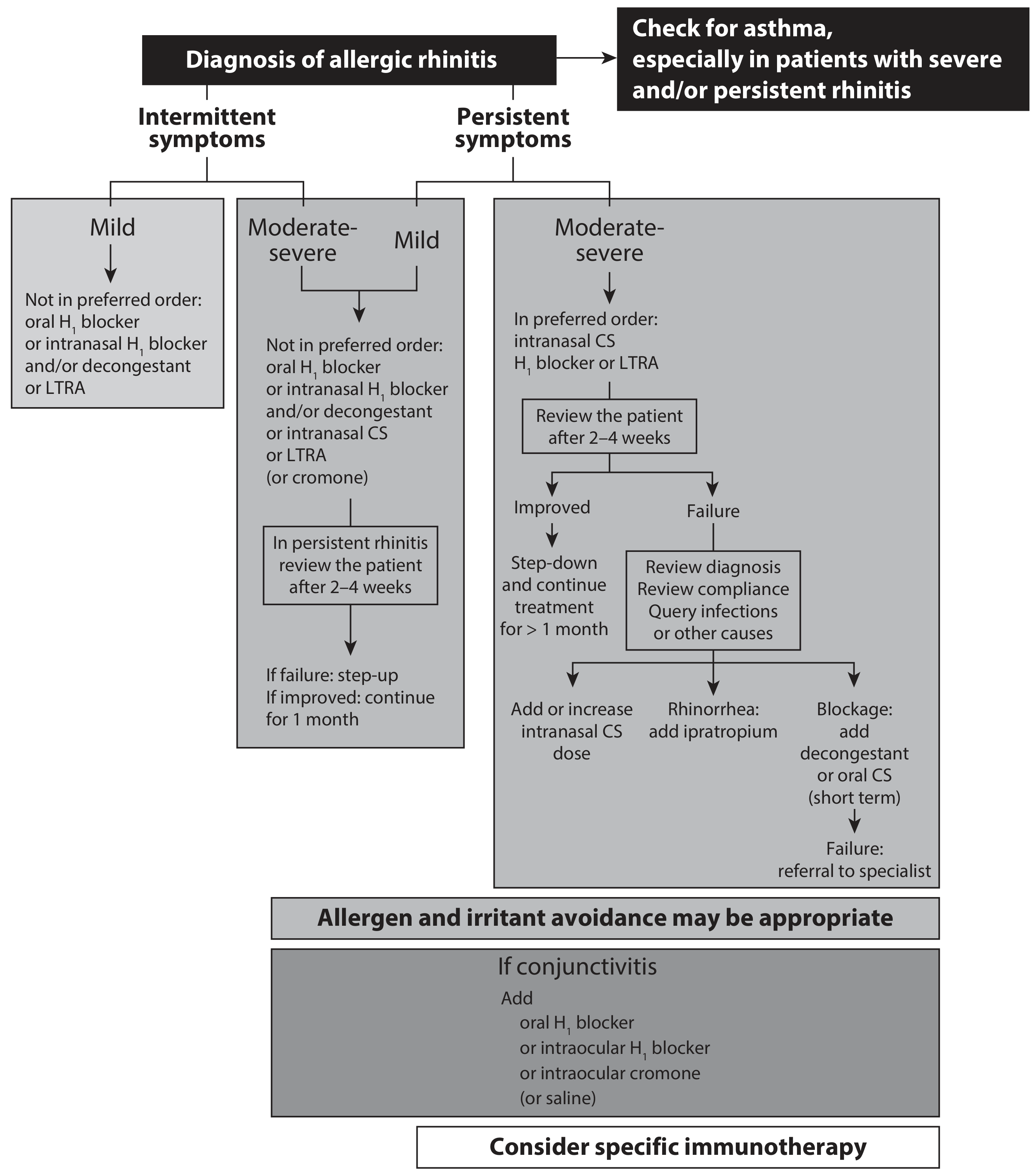
Three Pillars of Treatment
1. Allergen Avoidance
The first step in all cases. Allergen and irritant avoidance may be appropriate alongside any pharmacotherapy. For seasonal allergy (e.g., grass pollen), patients should start treatment 1 month before the pollen season to prevent the development of symptoms and nasal inflammation.
2. Pharmacotherapy
Drug Effects at a Glance (Table 91.2 - Scott-Brown's)
| Drug Class | Itch/Sneezing | Discharge | Nasal Blockage | Impaired Smell |
|---|---|---|---|---|
| Oral antihistamines | +++ | ++ | +/- | - |
| Topical corticosteroids | +++ | +++ | ++ | + |
| Oral corticosteroids | +++ | +++ | +++ | ++ |
| Antileukotrienes (LTRA) | - | ++ | + | +/- |
| Ipratropium bromide | - | +++ | - | - |
| Topical decongestants | - | - | +++ | - |
| Sodium cromoglicate | + | + | +/- | - |
A. Antihistamines (H1 Blockers)
- Primary treatment for sneezing, rhinorrhoea, and nasal/ocular itch; little effect on nasal blockage
- 1st-generation (chlorphenamine, diphenhydramine): sedating, rarely used now
- 2nd-generation oral (cetirizine, loratadine, fexofenadine, levocetirizine, desloratadine): non-sedating, once-daily, safe for long-term use including in children; 20-30% symptom reduction
- Topical intranasal antihistamines (azelastine, olopatadine): rapid onset, can be combined with topical steroids; disadvantage is bitter taste and twice-daily dosing
- Best used regularly rather than on-demand; benefit diminishes with prolonged continuous allergen exposure (e.g., perennial disease)
2024 Meta-Analysis update: A systematic review in JACI 2024 confirms that intranasal antihistamines + intranasal corticosteroids as a combination outperform either drug alone.
B. Intranasal Corticosteroids (INCs) - First-Line for Moderate-Severe Disease
- Most effective overall pharmacotherapy - 50-90% symptom reduction vs. 20-30% for oral antihistamines
- Treat all four symptom domains: sneezing, rhinorrhoea, blockage, and impaired smell
- Onset is slow - effect may not be noticed for several days and full benefit takes up to 2 weeks; patients must be counselled about this
- Available agents with doses (Goldman-Cecil):
- Triamcinolone acetonide - 2 sprays (55 µg) per nostril daily
- Mometasone furoate - 2 sprays (50 µg) per nostril daily
- Fluticasone propionate - 2 sprays (50 µg) per nostril daily
- Budesonide - 2 sprays (32 µg) per nostril daily
- Side effects: epistaxis (usually from poor spray technique, not mucosal atrophy); minor growth retardation noted with beclomethasone in children (not shown with newer agents)
- If adding an antihistamine to an INC, an intranasal antihistamine is preferred over oral
C. Leukotriene Receptor Antagonists (LTRAs)
- Montelukast - as effective as loratadine for nasal symptoms, less effective than topical nasal steroid
- Particularly useful when asthma co-exists with allergic rhinitis (licensed for this indication)
- Variable individual response - a monitored trial is appropriate
- Combination with cetirizine shows inconsistent additive benefit in studies
D. Decongestants
- Topical (xylometazoline): effective for nasal blockage; should not be used for >5-7 days due to risk of rhinitis medicamentosa (rebound congestion)
- Systemic (pseudoephedrine 30-60 mg q4-6h, max 240 mg/24h): treats stuffiness; mild stimulant; may cause rebound congestion and headache; often combined with antihistamines
E. Systemic Corticosteroids
- Reserved for severe, refractory cases or to cover short high-exposure periods
- Prednisolone 20-40 mg/day for short courses
- Depot injectable steroids: effective but not recommended - effects cannot be reversed and risk systemic side effects
F. Sodium Cromoglicate
- Modest efficacy; requires 4x daily dosing (limits compliance)
- No significant side effects - can be used in young children
- Eyedrops effective for ocular itching
G. Ipratropium Bromide
- Specifically for rhinorrhoea (+++); no effect on itch, sneezing, or blockage
- Useful add-on when rhinorrhoea is the dominant symptom
3. Allergen-Specific Immunotherapy (AIT)
- The only disease-modifying/curative option - modifies the underlying immune response
- Both subcutaneous (SCIT) and sublingual (SLIT) routes are effective
- Indicated when pharmacotherapy fails or in patients wishing to reduce long-term medication
- A 2025 umbrella systematic review (PMID 41080605) confirms efficacy across multiple AIT modalities in both children and adults
Treatment Algorithm Summary (ARIA-Based)
| Scenario | Treatment |
|---|---|
| Intermittent, mild | Oral or intranasal H1 blocker ± decongestant or LTRA |
| Intermittent/Persistent, mild | Oral H1 blocker, or intranasal H1 blocker ± decongestant, or intranasal CS, or LTRA |
| Persistent, moderate-severe | Intranasal CS (preferred) + H1 blocker or LTRA; review at 2-4 weeks |
| Inadequate response (rhinorrhoea) | Add ipratropium |
| Inadequate response (blockage) | Add decongestant or short-course oral CS |
| Failure after step-up | Refer to specialist |
| Co-existing conjunctivitis | Add oral or intraocular H1 blocker, or intraocular cromone |
| Refractory / disease modification desired | Consider allergen-specific immunotherapy |
Important Considerations
- Unified airway: Treating nasal disease with topical steroids reduces asthma symptoms, and treating lungs may reduce nasal symptoms - assess and treat both together in symptomatic patients
- Always check for asthma, especially with severe or persistent rhinitis
- Intranasal vs. oral treatment meta-analysis (JACI 2024, PMID 39251016) confirms intranasal routes generally superior for nasal outcomes
Sources: Scott-Brown's Otorhinolaryngology Head & Neck Surgery Vol. 1, pp. 1052-1054; Goldman-Cecil Medicine, p. 4167
This is a shared conversation. Sign in to Orris to start your own chat.