
For period cramps what can be done in physiotherapy new tool
dysmenorrhea physiotherapy TENS exercise
physiotherapy treatment primary dysmenorrhea period cramps 2024 2025 new techniques
dysmenorrhea physical therapy pain management
https://www.physio-pedia.com/Primary_Dysmenorrhea
PMID: 39037764
PMID: 39550537
PMID: 38442532
Physiotherapy for Period Cramps (Primary Dysmenorrhea)
1. TENS (Transcutaneous Electrical Nerve Stimulation)
- How it works: Electrodes placed on the lower abdomen deliver electrical pulses that inhibit pain signal transmission (gate control theory), trigger endogenous opioid release, and reduce uterine muscle ischemia.
- High-frequency TENS (50-120 Hz) is the most commonly used and effective form. A 2024 Cochrane systematic review (20 RCTs, 585 women) confirmed both high- and low-frequency TENS reduce pain compared to placebo (high-freq: MD -1.39; low-freq: MD -2.04), though evidence is currently low certainty.
- Parameters: Intensity set to maximum tolerable (non-painful); must be increased continuously during sessions to avoid habituation.
- Advantage: Safe, portable, self-administered after instruction - great for home use during menstruation.
2. Thermotherapy (Heat Therapy)
- How it works: Heat reduces muscle tension, promotes relaxation of abdominal muscles, and improves blood flow.
- Modalities used: Heated wraps, belts, patches, or pillows applied at 38-40°C over the lower abdomen for 30 minutes to 8-12 hours.
- Supported by multiple systematic reviews as an effective non-pharmacological method.
- Often combined with TENS for additive effects.
3. Therapeutic Exercise
| Exercise Type | Best For |
|---|---|
| Resistance exercise | Best overall pain reduction, especially >8 weeks |
| Multi-component exercise | Menstrual symptoms + pain duration reduction |
| Core stabilization | Reduces pelvic congestion, improves uterine circulation |
| Stretching | Menstrual symptom relief, improves flexibility |
| Aerobic exercise | Reduces prostaglandin levels, improves circulation |
| Mind-body (yoga/Pilates) | Pain and symptom management |
- Frequency: 1-3 sessions per week minimum; more frequent is better
- Duration per session: >30 minutes is more effective than shorter sessions
- Program length: 4-8 weeks of consistent training produces significant results
- Mechanism: Exercise raises progesterone (inversely related to prostaglandins) and improves uterine blood flow
4. Kinesio Taping
- Kinesiotaping (SMD = -1.22) and other taping methods (SMD = -1.61) both significantly reduce pain intensity in primary dysmenorrhea.
- Applied over the lower abdomen/sacral area.
- Proposed mechanisms: altered afferent input, improved local circulation, reduced muscle tension.
- Evidence certainty is currently low (GRADE), but results are promising.
5. Manual Therapy
- Spinal/lumbar manipulation and mobilization: Targets the T10-L1 and S2-S4 nerve roots that supply the uterus. Can reduce referred pain and uterine tension.
- Abdominal massage / myofascial release: Direct soft tissue work over the lower abdomen reduces muscle guarding and improves local circulation.
- Sacral massage: Particularly useful for radiating pain to the lower back.
6. Acupressure
- A 2022 meta-analysis (PMID 36686444) found auricular acupressure significantly reduces dysmenorrhea pain.
- Key points used: SP6 (Sanyinjiao), ST36, CV4 - applied during menstruation.
- Can be self-administered by patients after instruction.
7. Biofeedback and Relaxation Training
- Teaches patients to consciously reduce muscle tension and autonomic arousal.
- Particularly useful when psychological stress amplifies pain perception.
- Combines well with breathing exercises and progressive muscle relaxation.
8. Core Stability Training (Emerging Evidence)
- Increase uterine blood flow
- Minimize pelvic congestion
- Reduce referred low back pain during menstruation
Combining Modalities
- TENS + heat during acute menstrual pain
- Regular exercise program (resistance/multi-component) throughout the cycle
- Kinesio taping applied 1-2 days before and during menstruation
- Manual therapy for those with associated low back or pelvic pain
Summary Table
| Modality | Evidence Level | Best Use |
|---|---|---|
| High-frequency TENS | Cochrane SR 2024 | Acute pain during menstruation |
| Heat therapy | SR supported | Immediate symptom relief |
| Resistance exercise | Network MA 2024 | Long-term prevention |
| Multi-component exercise | Network MA 2024 | Symptom + duration reduction |
| Kinesio taping | SR+MA 2024 | Adjunct, pre-/peri-menstrual |
| Manual therapy | Clinical evidence | Low back/pelvic pain component |
| Acupressure | SR+MA 2022 | Self-management adjunct |
| Biofeedback | Clinical use | Stress-related amplification |
To develop a startup what tool exists and what doensot
What kind of startup are you focused on? · What aspect of startup development are you asking about tools for?
best tools for hardware startup development 2025 product validation funding operations
gaps missing tools hardware startup ecosystem 2025 what doesn't exist yet
Tools for a Hardware/Physical Product Startup
✅ WHAT EXISTS
1. Idea Validation & Market Research
| Tool | Purpose | Cost |
|---|---|---|
| Google Trends | Search demand for your product category | Free |
| Semrush / Ahrefs | Keyword demand, competitor analysis | Paid |
| SurveyMonkey / Typeform | Customer surveys | Free/Paid |
| Kickstarter / Indiegogo | Validate demand with pre-orders (crowdfunding) | % of funds |
| ProductHunt | Launch MVP, gauge early interest | Free |
| Exploding Topics | Spot trending product categories early | Paid |
| Jungle Scout / Helium10 | Amazon market research for physical products | Paid |
2. Product Design & Prototyping
| Tool | Purpose | Cost |
|---|---|---|
| Onshape | Cloud-native CAD (free startup program) | Free (startup) |
| SolidWorks | Industry-standard mechanical CAD | Paid |
| Fusion 360 (Autodesk) | CAD + CAM + simulation | Free (startup) |
| KiCad | PCB/electronics design (open source) | Free |
| Altium Designer | Professional PCB design | Paid |
| ANSYS / Simscale | FEA, CFD simulation (virtual stress testing) | Paid/Free tier |
| Figma | UI/UX for any screen/app component | Free/Paid |
| Keyshot | Product visualization/rendering | Paid |
3. Prototyping & Manufacturing
| Tool/Service | Purpose | Notes |
|---|---|---|
| Xometry / Fictiv | On-demand CNC, 3D printing, injection molding | Instant quotes |
| PCBWay / JLCPCB | PCB fabrication and assembly | Very affordable |
| Proto Labs | Rapid prototyping to low-volume production | US-based |
| 3D Hubs (now Hubs.com) | Distributed manufacturing network | Paid |
| Formlabs / Bambu Lab | In-house 3D printing | Hardware purchase |
| Seeed Studio / Macrofab | Electronics prototyping to production | Affordable |
4. Supply Chain & Sourcing
| Tool | Purpose |
|---|---|
| Alibaba / Global Sources | Find manufacturers and component suppliers |
| Octopart / DigiKey / Mouser | Electronic component search and sourcing |
| Sourcemap | Supply chain mapping and transparency |
| Anvyl | Production tracking and supplier management |
| Flexport | Freight, logistics, and customs management |
5. Funding & Investor Outreach
| Tool/Platform | Purpose |
|---|---|
| AngelList / Wellfound | Connect with angel investors, build a startup profile |
| Crunchbase | Research investors, funding rounds, market data |
| Pitchbook | Deep investor and deal data (expensive) |
| Republic / Wefunder | Equity crowdfunding from retail investors |
| Kickstarter / Indiegogo | Pre-order crowdfunding to prove demand |
| SBIR.gov | US gov non-dilutive grants (note: currently paused pending reauthorization as of late 2025) |
| Gust / CoFoundersLab | Accelerator applications and co-founder matching |
| DocSend | Track investor pitch deck engagement |
| Carta | Cap table management and equity tracking |
6. Operations, Team & Project Management
| Tool | Purpose |
|---|---|
| Notion / Linear | Product roadmaps, documentation, tasks |
| Jira | Engineering sprint management |
| Slack / Discord | Team communication |
| Rippling / Gusto | Payroll, HR, benefits |
| QuickBooks / Brex | Accounting, business banking for startups |
| NetSuite | ERP for scaling hardware operations |
| Arena PLM / Propel | Product lifecycle management - tracks BOM, ECOs, compliance |
7. Quality & Compliance
| Tool | Purpose |
|---|---|
| Arena QMS / Greenlight Guru | Quality management systems |
| Compliance.ai | Regulatory tracking |
| UL/CE certification bodies | Safety and market certification |
| IsoTracker | ISO 9001 compliance management |
8. Go-to-Market & Sales
| Tool | Purpose |
|---|---|
| Shopify | Direct-to-consumer e-commerce |
| Amazon FBA | Retail distribution at scale |
| HubSpot / Salesforce | CRM for B2B hardware sales |
| Faire | Wholesale marketplace for physical goods |
| Mailchimp / Klaviyo | Email marketing |
❌ WHAT DOESN'T EXIST (or is severely underdeveloped)
1. Rapid Design-to-Manufacturing Loop (US/EU)
2. Integrated Hardware BOM + Cost Modeling in Real Time
3. AI-Assisted DFM (Design for Manufacturability) in the Design Phase
4. End-to-End Hardware PLM for Early Stage Startups
5. Tariff & Trade Compliance Intelligence for Hardware Founders
6. Hardware-Specific Investor Matching
7. Regulatory Pre-Compliance Guidance (CE/FCC/UL)
8. Post-Sale Hardware Support & Repair Intelligence
Summary
I m asking for period cramps what device exists in market and what doesn't for startup
period cramp relief devices market 2025 wearable TENS heat dysmenorrhea products
femtech dysmenorrhea device startup gap market opportunity 2025 unmet needs period pain
Livia Ovira Myoovi Welme period pain device comparison review 2025
period cramp device unmet needs secondary dysmenorrhea endometriosis wearable gap 2025
Period Cramp Devices: What Exists vs. What Doesn't (Startup Opportunity Map)
Market Size (Quick Context)
- Period pain relief device market: $6.8B in 2024 → $12.6B by 2030 (9.1% CAGR)
- Broader menstrual pain products market: $8.4B in 2025 → $13.6B by 2035
- Femtech overall: $73B in 2025 → $297B by 2035 - one of the hottest sectors for femtech investment
✅ DEVICES THAT EXIST
Category 1: TENS Wearables (Most Crowded Space)
| Device | Company | Key Feature | Price |
|---|---|---|---|
| Livia | iPulse Medical | Patented SmartWave, FDA cleared, 2 electrode pads, fast-acting | ~$150 |
| Ovira (Noha) | Ovira International | 40 intensity levels, wired + wireless, discreet under clothing, stomach + back | ~$120 |
| Myoovi | UK-based | Wireless, app-controlled, quiet | ~$130 |
| Welme | Welme | Slim wearable TENS, consumer-friendly design | ~$100 |
| Matri Pro | Matri (India) | Dual-mode wired/wireless, 30 intensity levels, India's slimmest (launched May 2025) | ~$60 |
| Beurer EM50 | Beurer GmbH | TENS + heat combo, targets endometriosis pain too | ~$80 |
| TensCare iTouch | TensCare Ltd. | Clinical-grade TENS, broader body use | ~$70 |
Category 2: Heat Therapy Devices
| Device | Type | Notes |
|---|---|---|
| ThermaCare patches | Disposable heat wraps | 8-hour continuous heat, widely available |
| Beurer HK heating belt | Electric rechargeable | Reusable, targeted abdominal heat |
| Magic Bag / Wheat packs | Microwavable | Oldest, cheapest option |
| Rael Comfort Patches | Single-use adhesive heat | Discrete, worn under clothing |
Category 3: Combination Devices (Heat + TENS)
| Device | Notes |
|---|---|
| Beurer EM50 Menstrual Relax | Most established combo device on market |
| Jovi (emerging) | Heat + vibration, newer player |
| OhmBody | Heat + vibration combination |
Category 4: Neuromodulation / Brain-Based (Newest, Most Innovative)
| Device | Company | Technology | Status |
|---|---|---|---|
| Nettle | Samphire Neuroscience | Transcranial brain stimulation targeting pain + mood (PMS/PMDD/endometriosis) | CE-certified EU/UK; raised $5M seed June 2025 |
Category 5: Acupressure Devices
- Wristbands (Sea-Bands adapted for period pain)
- Manual acupressure tools for SP6 point
- Very basic, no smart integration
❌ WHAT DOESN'T EXIST (Startup Opportunity Gaps)
🚀 Gap 1: A Device That Actually Works for Endometriosis / Secondary Dysmenorrhea
🚀 Gap 2: Internal / Intravaginal Device for Targeted Uterine Pain Relief
🚀 Gap 3: AI-Personalized Adaptive TENS
- Learns your pain pattern across cycles
- Automatically adjusts stimulation parameters in real time based on pain level
- Predicts when cramps are about to peak (using cycle tracking data) and pre-activates
- Syncs with a menstrual tracking app (Clue, Flo, Natural Cycles) to build a pain model
🚀 Gap 4: Device Specifically for Menstrual Back Pain
🚀 Gap 5: Affordable Device for Emerging Markets (India, Africa, Southeast Asia)
🚀 Gap 6: Device Integrated with Hormonal/Cycle Monitoring
- Measures skin biomarkers correlated with cycle phase (estrogen, progesterone proxies)
- Activates TENS automatically when menstruation begins
- Tracks pain history over months
- Sends data to a gynecologist
🚀 Gap 7: PMDD / Mood + Pain Combined Device
🚀 Gap 8: Clinic-Grade Physiotherapy Device for Home Use
Summary Map for Your Startup Decision
| Opportunity | Difficulty | Market Size | Competition |
|---|---|---|---|
| AI-adaptive TENS device | Medium | Large | Low |
| Endometriosis-targeted device | High (regulatory) | Very Large | Very Low |
| Affordable emerging market device | Low-Medium | Enormous | Very Low |
| Back pain + cramp combo wearable | Low-Medium | Large | Low |
| Cycle-monitoring + pain relief patch | High (biomarker tech) | Large | None |
| PMDD mood + pain device | High (neurotech) | Medium | Very Low |
Diagram of elbow range of motion orthosis
Technical anatomical diagram of an elbow range of motion orthosis (hinged elbow brace), showing: lateral and medial views of the arm with the orthosis applied, labeled components including the adjustable hinge joint with degree markings (0° to 130°), upper arm cuff, forearm cuff, straps/velcro closures, dial/lock mechanism for setting flexion and extension stops. Also show a small inset arc diagram indicating elbow range of motion: full extension (0°), functional range (30°-130°), and full flexion (145°). Labels pointing to each part. Clean medical illustration style with blue and grey color scheme, white background.
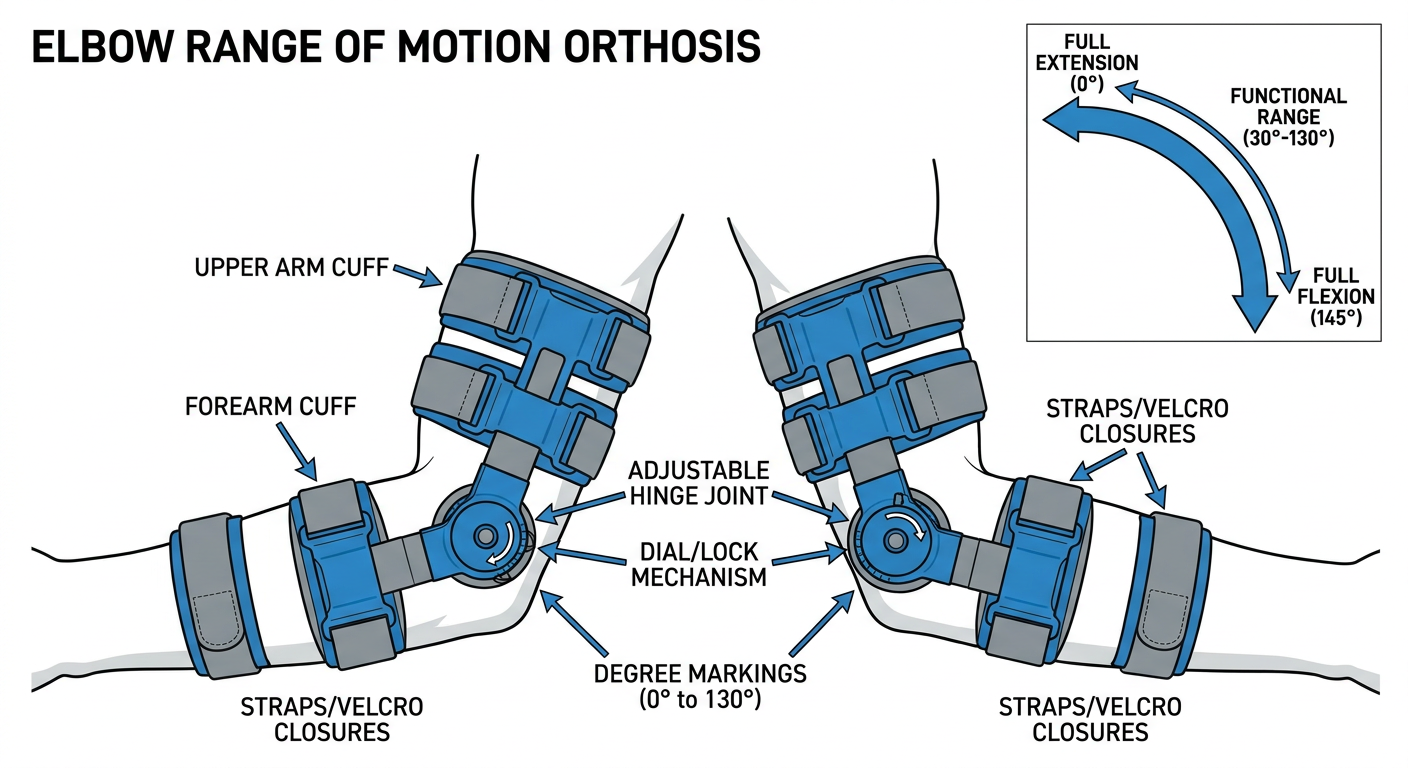
- Upper arm cuff - anchors the proximal segment of the brace to the humerus
- Forearm cuff - anchors the distal segment to the forearm/radius-ulna
- Adjustable hinged joint - the central mechanism, positioned at the lateral and medial epicondyles of the elbow, with degree markings
- Flexion/extension stop dials - allow the clinician or patient to set the allowable range (e.g., limit to 30°-90° post-surgery)
- Velcro/strap closures - secure fit and prevent migration
- ROM arc inset - shows the full elbow arc: 0° (full extension) → 145° (full flexion), with the functional range of motion (30°-130°) highlighted
Clinical Uses of Elbow ROM Orthoses
| Indication | Typical ROM Setting |
|---|---|
| Post-fracture (radial head, olecranon) | Progressive unlock: start 30°-90°, widen weekly |
| Post-elbow ligament repair (UCL/LCL) | Protect at 30°-120° |
| Elbow contracture (stiffness) | Serial static or dynamic stretch |
| Post-total elbow arthroplasty | Protect extension, limit hyperflexion |
| Cubital tunnel post-op | Limit full extension (protect ulnar nerve) |