
dark adaptation curve physiology guyton fig 51.9
Reading File
Now let me search the library for Guyton's dark adaptation content and the figure simultaneously.
Finding Sources
Finding Sources
Finding Sources
Found the exact Guyton section with Fig. 51.9. Let me read it now.
Reading File
I have the full content and the image URL for Fig. 51.9. Let me fetch it.
Loading Image
Here is Figure 51.9 from Guyton & Hall, along with a full explanation of the physiology:
Dark Adaptation Curve — Guyton & Hall Fig. 51.9
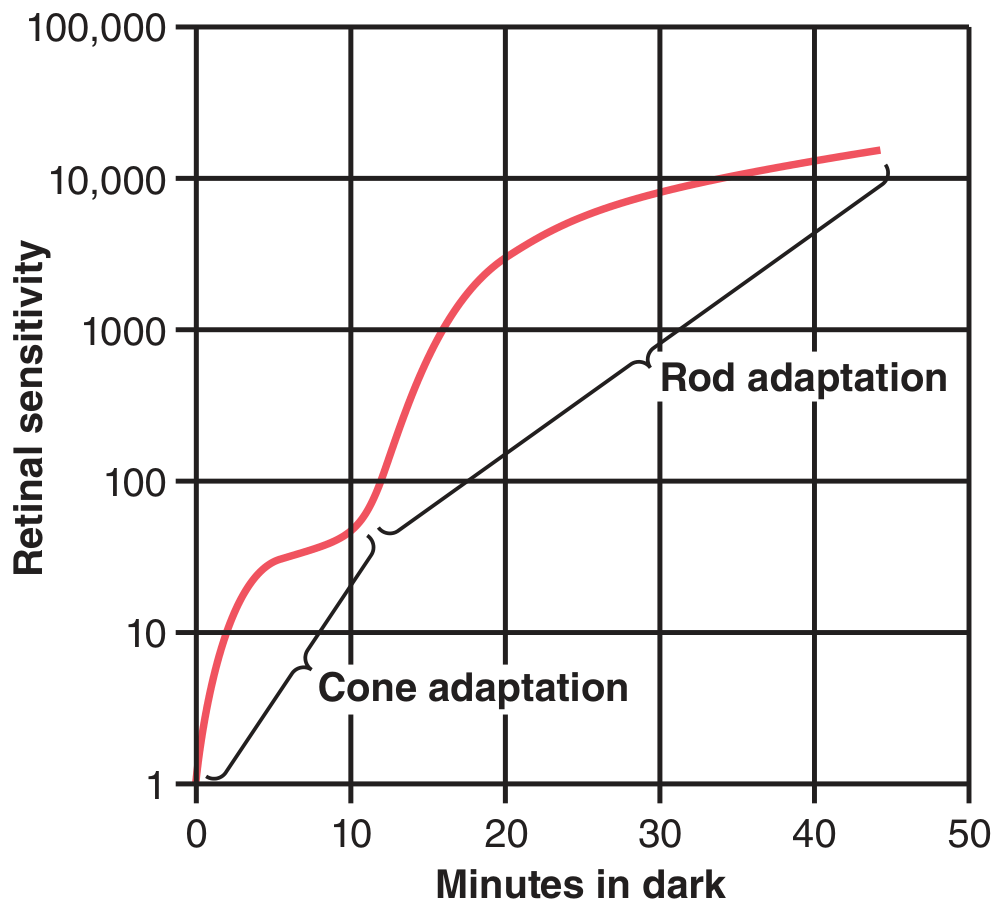
Figure 51.9 — Dark adaptation: cone adaptation vs. rod adaptation (retinal sensitivity on a log scale vs. minutes in the dark)
Physiology Explained
What is Dark Adaptation?
When a person remains in bright light for hours, large amounts of photopigment (rhodopsin in rods; iodopsin in cones) are broken down into retinal + opsins, and much of the retinal is further converted to vitamin A. This depletes photosensitive chemicals → reduced retinal sensitivity = light adaptation.
On entering darkness, the reverse occurs:
- Retinal + opsin → rhodopsin (rods) / iodopsins (cones) are regenerated
- Vitamin A → retinal, replenishing the substrate
- The final ceiling is set by the amount of available opsin
This regeneration process = dark adaptation.
The Biphasic (Two-Segment) Curve
The curve has a characteristic inflection point at ~7–10 minutes, creating two distinct segments:
| Phase | Cells | Time course | Sensitivity gain |
|---|---|---|---|
| Early (fast) phase | Cones | 0–10 min | ~30–40× |
| Late (slow) phase | Rods | 10–40+ min | up to ~25,000× total |
Why cones adapt first: All photochemical events in cones occur ~4× faster than in rods. Cone adaptation is complete within ~7 minutes.
Why rods dominate the late phase: Rods continue adapting slowly for 20–40 minutes or more, achieving a far greater total sensitivity increase than cones can. Their sensitivity is further amplified by neural convergence — 100+ rods synapse onto a single ganglion cell, allowing spatial summation.
Key Quantitative Milestones (from the text)
| Time in dark | Sensitivity increase |
|---|---|
| 1 minute | ~10-fold |
| 20 minutes | ~6,000-fold |
| 40 minutes | ~25,000-fold |
| Full range (dark→light) | 500,000–1,000,000-fold |
Other Mechanisms Contributing to Adaptation
- Pupillary dilation — rapid (~seconds), accounts for ~30-fold sensitivity change
- Neural adaptation — occurs at successive retinal and brain processing stages (bipolar cells, ganglion cells, lateral geniculate, visual cortex); works rapidly but contributes a smaller fraction of the total range
Clinical Correlate
Impaired dark adaptation (prolonged or absent rod phase) is a hallmark of:
- Vitamin A deficiency (retinal substrate unavailable → rhodopsin cannot regenerate → night blindness)
- Retinitis pigmentosa (rod degeneration → absent rod adaptation phase)
- Oguchi disease (stationary night blindness — rod function absent after 30 min dark adaptation but recovers with prolonged dark adaptation: Mizuo-Nakamura phenomenon)
Guyton and Hall Textbook of Medical Physiology, Chapter 51 (p. 637)
This is a shared conversation. Sign in to Orris to start your own chat.