
Nephrotic syndrome
Reading File
Researching nephrotic syndrome across pathophysiology, clinical presentation, diagnosis, management, and relevant imaging/histology.
search_medical_text
nephrotic syndrome etiology pathophysiology clinical features diagnosis management
Harrison's Principles of Internal Medicine, Twenty First Edition
Page 8392
GradeResponse
GradeResponse
Nephrotic Syndrome
Definition
Nephrotic syndrome is defined by the classic triad of:
| Feature | Threshold |
|---|---|
| Proteinuria | >3.5 g/day (or >40 mg/m²/hr in children) |
| Hypoalbuminemia | Serum albumin <3.5 g/dL |
| Edema | Peripheral, periorbital, ascites, pleural effusion |
Additionally associated with hyperlipidemia (high LDL, low HDL) and lipiduria (Harrison's, p. 8392).
Pathophysiology
The central defect is glomerular barrier dysfunction, leading to loss of the size- and charge-selective filtration properties of the glomerular basement membrane (GBM) and podocytes.
Glomerular injury
      ↓
Loss of podocyte integrity / GBM charge barrier
      ↓
Massive proteinuria (>3.5 g/day)
      ↓
↓ Oncotic pressure (hypoalbuminemia)
      ↓
Fluid shift into interstitium → Edema
      ↓
Compensatory hepatic lipoprotein synthesis → Hyperlipidemia
      ↓
Lipiduria (oval fat bodies, Maltese crosses under polarized light)
Sodium and water retention occurs via both the underfill mechanism (low oncotic pressure → RAAS activation) and the overfill mechanism (primary renal Na⁺ retention).
Etiology
Primary (Idiopathic) Glomerulopathies
| Cause | Key Features | Age Group |
|---|---|---|
| Minimal Change Disease (MCD) | Normal LM, effacement of foot processes on EM | Children (most common), adults |
| Focal Segmental Glomerulosclerosis (FSGS) | Segmental scarring of glomeruli; may be primary or secondary | Adults, Black patients |
| Membranous Nephropathy (MN) | Subepithelial deposits, "spike and dome" on EM; anti-PLA2R Ab | Adults (most common in white adults) |
| Membranoproliferative GN (MPGN) | Mesangial proliferation, double-contour GBM | Any age |
| IgA Nephropathy | Mesangial IgA deposits; usually nephritic but can be nephrotic | Young adults |
Secondary Causes
| Category | Examples |
|---|---|
| Diabetes mellitus | Diabetic nephropathy (most common secondary cause worldwide) |
| Systemic diseases | SLE (Class V lupus nephritis), amyloidosis, sarcoidosis |
| Infections | HBV (membranous), HCV (MPGN), HIV (collapsing FSGS), malaria |
| Malignancy | Hodgkin lymphoma (MCD), solid tumors (membranous) |
| Drugs | NSAIDs, gold, penicillamine, heroin (FSGS) |
| Hereditary | Alport syndrome, congenital nephrotic syndrome (NPHS1/NPHS2 mutations) |
Clinical Features
- Edema: Periorbital (classically worse in the morning), dependent edema, anasarca; ascites; pleural effusions
- Foamy urine: Due to heavy proteinuria
- Weight gain: Fluid retention
- Lipiduria: Oval fat bodies with Maltese cross appearance under polarized light; fatty casts on urinalysis (Harrison's, p. 8392)
Complications
| Complication | Mechanism |
|---|---|
| Hypercoagulability / Thrombosis | Loss of antithrombin III, protein C/S; renal vein thrombosis, DVT, PE |
| Infections | Loss of immunoglobulins (IgG) and complement; especially encapsulated organisms (S. pneumoniae) |
| Hyperlipidemia / Atherosclerosis | Compensatory hepatic synthesis of VLDL/LDL |
| AKI | Reduced effective circulating volume; drug toxicity |
| Vitamin D deficiency | Loss of vitamin D-binding protein |
| Hypothyroidism | Loss of thyroid-binding globulin |
Diagnosis
Workup Algorithm
- Urinalysis — proteinuria (3–4+), oval fat bodies, fatty/waxy casts
- Urine protein:creatinine ratio (UPCR) — >3.5 mg/mg confirms nephrotic-range
- 24-hour urine protein — >3.5 g/day (gold standard quantification)
- Serum albumin — <3.5 g/dL
- Lipid panel — elevated total cholesterol, LDL; low HDL
- BMP/CMP — renal function, electrolytes
- Serology panel to identify secondary causes:
- ANA, anti-dsDNA, complement (C3/C4) → SLE
- HBsAg, HCV Ab → viral
- HIV
- Serum protein electrophoresis (SPEP) → myeloma/amyloid
- Anti-PLA2R antibodies → primary membranous nephropathy
- Fasting glucose/HbA1c → diabetes
- Renal biopsy — indicated in adults to determine underlying cause and guide treatment; generally not done in children with typical MCD presentation (empiric steroids first)
Urinalysis Findings
| Finding | Significance |
|---|---|
| Proteinuria 3–4+ | Hallmark |
| Oval fat bodies | Lipid-laden tubular cells |
| Maltese crosses (polarized light) | Cholesterol crystals |
| Fatty casts | Lipiduria |
| Absence of RBC casts | Distinguishes from nephritic syndrome |
Nephrotic vs. Nephritic Syndrome
| Feature | Nephrotic | Nephritic |
|---|---|---|
| Proteinuria | Massive (>3.5 g/day) | Mild–moderate (<3.5 g/day) |
| Hematuria | Absent or microscopic | Gross hematuria, RBC casts |
| Hypertension | Variable | Common |
| Edema | Severe | Mild |
| Serum complement | Usually normal | Often low (MPGN, SLE, post-strep) |
| GFR | May be normal | Often reduced |
Management
General Measures
- Low-sodium diet (<2 g/day) to reduce edema
- Fluid restriction if symptomatic hyponatremia
- Diuretics (loop diuretics: furosemide) — may need IV if gut edema impairs absorption
- ACE inhibitors / ARBs — reduce proteinuria and intraglomerular pressure (regardless of BP)
- Statins — manage hyperlipidemia
- Anticoagulation — consider if albumin <2.5 g/dL (high VTE risk); definitely if renal vein thrombosis confirmed
Disease-Specific Treatment
| Cause | Treatment |
|---|---|
| MCD | Prednisone (1 mg/kg/day); most respond within 8 weeks; cyclophosphamide or cyclosporine for relapsing/steroid-dependent |
| FSGS (Primary) | High-dose corticosteroids; CNI (tacrolimus/cyclosporine) for steroid-resistant; sparsentan (novel dual ET/angiotensin receptor blocker) |
| Membranous Nephropathy | Observation if low risk; for high-risk: rituximab (now first-line), cyclophosphamide + steroids (Ponticelli regimen), or CNIs |
| Diabetic Nephropathy | Glycemic control, RAAS blockade, SGLT2 inhibitors (empagliflozin, dapagliflozin), finerenone |
| Lupus Nephritis (Class V) | Hydroxychloroquine + mycophenolate mofetil ± voclosporin or belimumab |
| Amyloidosis | Treat underlying cause (anti-plasma cell therapy for AL); tafamidis for ATTR |
Histology of a Secondary Cause (Amyloidosis)
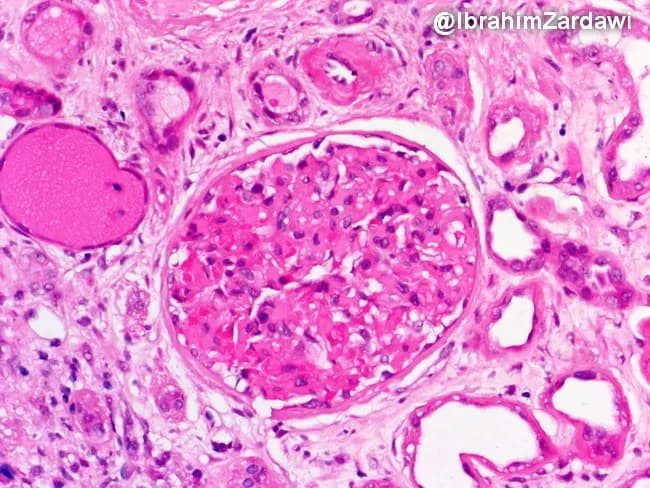
The image below demonstrates renal biopsy changes in AL amyloidosis, an important secondary cause of nephrotic syndrome:
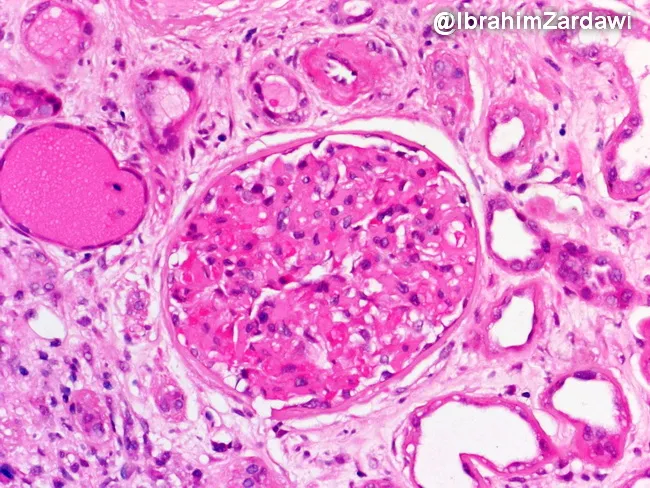
Renal biopsy (H&E): amorphous eosinophilic deposits in the interstitium and mesangial expansion with GBM thickening. Congo red staining confirms amyloid by apple-green birefringence under polarized light. This pattern underlies nephrotic-range proteinuria and progressive renal insufficiency (Webpathology).
Prognosis
Varies widely by underlying cause:
- MCD: Excellent — >90% remission with steroids; can relapse
- Primary Membranous: ~1/3 spontaneous remission, ~1/3 stable, ~1/3 progress to ESRD
- FSGS: Worst prognosis among primary causes; ~50% ESRD within 10 years if steroid-resistant
- Diabetic Nephropathy: Progressive; SGLT2 inhibitors significantly slow progression
- Amyloidosis: Depends on systemic burden and response to therapy
Key takeaway: Nephrotic syndrome is a clinical diagnosis; the underlying cause requires biopsy (in adults) and dictates treatment. Complications — especially VTE and infection — must be proactively managed regardless of etiology.
This is a shared conversation. Sign in to Orris to start your own chat.