

Interpretation
Reading File
Searching for relevant chest X-ray interpretation references to support my analysis of this image.
search_medical_image
massive pleural effusion chest X-ray white out hemithorax
Hugging Face pmc clinical VQA raw
Page 0
search_medical_text
massive pleural effusion chest X-ray findings mediastinal shift white hemithorax
Harrison's Principles of Internal Medicine, Twenty First Edition
Page 8084
GradeResponse
GradeResponse
Chest X-Ray Interpretation
Patient: Mrs. Dimple Pawar, 47Y/F | View: AP | Date: 05/04/2026
Institution: Ajinkyatara Multispeciality Hospital Pvt Ltd, Satara
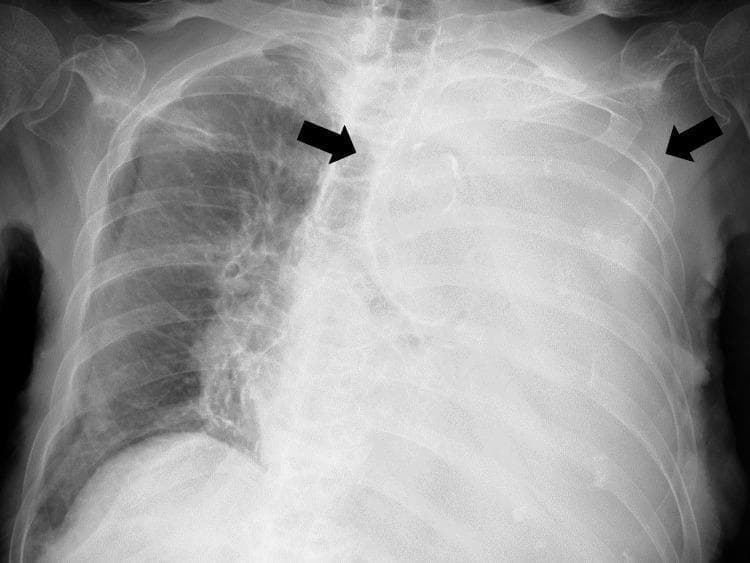
Primary Finding: Massive Left-Sided Pleural Effusion
The most striking abnormality is near-complete opacification (white-out) of the left hemithorax, obliterating:
- The left costophrenic angle
- The left hemidiaphragm
- The left cardiac border
This appearance is consistent with a massive left pleural effusion.
Systematic Analysis
| Feature | Finding |
|---|---|
| Trachea/Mediastinum | Shifted to the right (contralateral) — indicates space-occupying lesion (effusion), not collapse |
| Right lung | Relatively clear with preserved bronchovascular markings |
| Left lung | Near-complete white-out |
| Left costophrenic angle | Completely obliterated |
| Cardiac silhouette | Displaced rightward; left border obscured |
| Bones/Soft tissue | No obvious rib fractures |
| Foreign objects | Two metallic objects overlying the left anterior chest wall — likely ECG electrode clips / monitoring leads (not implants) |
Key Radiological Sign
The rightward mediastinal shift is critical:
- Shift away from opacity → massive effusion (fluid pushes mediastinum contralaterally)
- Shift toward opacity → would suggest collapse/atelectasis
- This distinction confirms the diagnosis as effusion rather than total left lung collapse
(Supported by reference case — PMC Clinical VQA: massive left-sided pleural effusion with contralateral mediastinal shift)
Differential Diagnosis for Massive Unilateral Effusion
- Malignant pleural effusion (lung primary, breast, lymphoma, mesothelioma) — most common cause in a 47F
- Parapneumonic effusion / empyema — if febrile, recent infection
- Tuberculous pleuritis — relevant given Indian setting
- Cardiac failure (usually bilateral, but can be unilateral left-sided)
- Hepatic hydrothorax / cirrhosis
- Post-traumatic hemothorax
Per Harrison's (p. 8084): determining whether effusion is transudate vs. exudate is the critical first step — requires thoracentesis with Light's criteria.
Recommended Next Steps
- Chest ultrasound — confirm effusion, estimate volume, guide thoracentesis
- Diagnostic thoracentesis — fluid for LDH, protein (Light's criteria), cytology, culture, ADA (if TB suspected)
- CT chest with contrast — evaluate underlying lung parenchyma, pleural thickening/nodularity, mediastinal nodes
- Labs — CBC, LFT, RFT, serum LDH/protein, tumor markers if malignancy suspected
⚠️ Clinical correlation required. This interpretation is for educational/support purposes and should be reviewed by a qualified radiologist.
Interpretation
This is the same chest X-ray as before. Here is the full structured interpretation:
Chest X-Ray Interpretation
Patient: Mrs. Dimple Pawar | Age/Sex: 47Y / Female
View: AP (Anteroposterior) | Date: 05/04/2026
Hospital: Ajinkyatara Multispeciality Hospital Pvt Ltd, Satara
Technical Adequacy
- Projection: AP (not PA — magnification effect on cardiac size expected)
- Rotation: Mildly rotated
- Inspiration: Adequate
- Exposure: Acceptable
Systematic Findings
1. Trachea & Mediastinum
- Trachea deviated to the right
- Mediastinum shifted rightward — indicates a left-sided space-occupying process
2. Left Hemithorax ⚠️
- Near-complete opacification / white-out of the left hemithorax
- Left hemidiaphragm — not visualized
- Left costophrenic angle — obliterated
- Left cardiac border — obscured
- Upper and mid left lung zones show patchy haziness merging into the lower white-out
3. Right Hemithorax
- Lung fields relatively clear
- Right costophrenic angle — partially blunted (possible small right-sided effusion or raised hemidiaphragm)
- Bronchovascular markings visible
4. Cardiac Silhouette
- Displaced rightward
- Cardiac size difficult to assess on AP view due to effusion and shift
5. Bones & Soft Tissues
- No obvious rib fractures or lytic lesions
- Soft tissue unremarkable
6. Foreign Bodies / Artifacts
- Two metallic artifacts overlying the left anterior chest wall — consistent with ECG electrode clips (surface leads, not implanted devices)
Radiological Interpretation
| Feature | Finding | Significance |
|---|---|---|
| Left hemithorax white-out | Near-complete opacification | Large effusion / mass / collapse |
| Mediastinal shift | Rightward (away from opacity) | Confirms effusion — rules out collapse |
| Right lung | Clear | Compensatory |
| Tracheal deviation | Rightward | Consistent with left-sided mass effect |
| Right CP angle | Mild blunting | Possible small effusion |
Mediastinal shift AWAY from the white-out = Massive Left Pleural Effusion (not collapse, where shift would be ipsilateral/toward the opacity)
Primary Diagnosis
Massive Left-Sided Pleural Effusion with rightward mediastinal shift and partial compression of left lung
Differential Diagnosis
| Priority | Etiology | Notes |
|---|---|---|
| 1 | Malignant pleural effusion | Lung ca, breast ca, lymphoma, mesothelioma — age 47F |
| 2 | Tuberculous pleuritis | Common in Indian subcontinent, exudative |
| 3 | Parapneumonic / Empyema | If febrile, raised WBC |
| 4 | Cardiac failure | Usually bilateral; less likely unilateral massive |
| 5 | Hepatic hydrothorax | R > L, associated cirrhosis |
| 6 | Hemothorax | Post-traumatic or malignant |
Recommended Workup
Urgent / Immediate:
- Chest ultrasound — confirm effusion, assess loculation, guide thoracentesis
- Diagnostic + therapeutic thoracentesis — relieve dyspnea + send fluid
Pleural Fluid Analysis:
- Protein, LDH (Light's criteria — exudate vs. transudate)
- Cytology (malignant cells)
- Culture & sensitivity, AFB smear/culture
- ADA (adenosine deaminase — if TB suspected)
- pH, glucose, cell count
Imaging:
- CT chest with contrast — post-drainage to assess underlying lung, pleural nodularity, mediastinal lymphadenopathy
Labs:
- CBC, CRP, ESR
- LFT, RFT, serum protein/albumin
- Tumor markers (CEA, CA-125, CA 19-9) if malignancy suspected
- Mantoux / IGRA
⚠️ Disclaimer: This interpretation is for clinical decision-support only. Final radiological reporting must be performed by a qualified radiologist in conjunction with clinical findings.
This is a shared conversation. Sign in to Orris to start your own chat.