

IMG_3064.jpeg
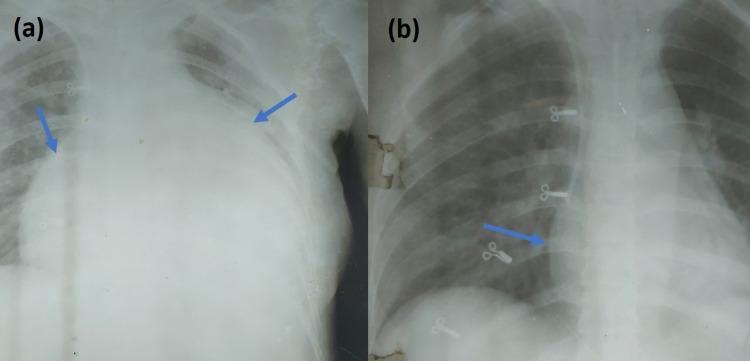
What is the diagnosis
Reading File
Finding Sources
Searching Images
pericardial effusion water bottle sign chest X-ray
Diagnosis: Pericardial Effusion — "Water Bottle Heart" Sign
The CXR on the left shows a massively enlarged, globular cardiac silhouette — the classic "water bottle" (or "flask") sign of a large pericardial effusion. The cartoon seal on the right humorously highlights this shape (seals look like water bottles!).
Key Radiographic Features
| Finding | Significance |
|---|---|
| Globally enlarged, symmetric cardiac silhouette | Fluid accumulation in pericardial sac |
| Smooth, sharply demarcated borders | Distinguishes it from cardiomegaly due to chamber dilation |
| Hilar vessels obscured | Fluid extends to obscure normal hilar contours |
| Relatively clear lung fields | Unlike CHF, no pulmonary edema — fluid is outside the heart |
| Cardiothoracic ratio > 0.5 | Often dramatically increased |
Pathophysiology
Fluid accumulates in the pericardial sac (normally 15–50 mL). When >200–300 mL accumulates (especially acutely), the cardiac silhouette takes on this characteristic rounded "water bottle" shape. The key concern is progression to cardiac tamponade, where intrapericardial pressure exceeds filling pressure, compressing the heart.
Common Causes
- Malignancy (most common in adults — lung, breast, lymphoma)
- Viral/idiopathic pericarditis
- Tuberculosis (common in endemic regions)
- Hypothyroidism
- Uremia (renal failure)
- Autoimmune (SLE, rheumatoid arthritis)
- Post-cardiac surgery / trauma
Next Steps
- Echocardiography — confirms effusion, assesses for tamponade (RA/RV diastolic collapse, respiratory variation in mitral/tricuspid flow)
- ECG — may show low voltage, electrical alternans (pathognomonic for large effusion/tamponade)
- Pericardiocentesis if hemodynamically compromised
Goldman-Cecil Medicine: "The posteroanterior radiograph shows the water-bottle sign; the hilar vessels are obscured" in massive pericardial effusion.
Generate me usmle style questions about “magnesium trap” / “the dual rule of Mg and PTH”
Reading File
Finding Sources
Finding Sources
Reading File
Reading File
Reading File
Here are 7 high-yield USMLE-style questions on the magnesium trap / dual rule of Mg and PTH:
The Dual Rule of Mg & PTH — USMLE Practice Questions
The Concept to Know:
- Mild hypomagnesemia → stimulates PTH (like hypocalcemia does)
- Severe/chronic hypomagnesemia → inhibits PTH secretion AND causes end-organ PTH resistance
- Hypocalcemia from severe hypomagnesemia cannot be corrected without first repleting magnesium
Question 1
A 54-year-old man with a 20-year history of alcohol use disorder presents with muscle cramps, perioral tingling, and a positive Trousseau sign. Labs show:
- Ca²⁺: 6.8 mg/dL (low)
- Mg²⁺: 0.5 mEq/L (low)
- PTH: 8 pg/mL (low-normal, inappropriately low)
- Phosphorus: 2.4 mg/dL (low)
The patient is given IV calcium gluconate with minimal improvement. What is the most appropriate next step?
A) Increase the calcium infusion rate
B) Administer IV magnesium
C) Give calcitriol (1,25-OH₂D₃)
D) Administer PTH(1–34) subcutaneously
E) Check 25-hydroxyvitamin D level and defer treatment
Answer & Explanation
✅ B — IV magnesium
This is classic hypomagnesemic hypocalcemia (the "magnesium trap"). Severe hypomagnesemia (<0.4 mmol/L / 0.8 mEq/L) causes:
- Impaired PTH secretion — PTH is inappropriately low despite hypocalcemia
- End-organ resistance to PTH — target tissues (kidney, bone) don't respond even if PTH is given
The key clue is that IV calcium does not correct the hypocalcemia — because the underlying hormonal machinery is broken. Magnesium repletion rapidly restores PTH secretion and end-organ responsiveness. Phosphorus is low (not high), distinguishing this from true hypoparathyroidism.
Harrison's 22E: "PTH levels are undetectable or inappropriately low in severe hypomagnesemia despite the stimulus of severe hypocalcemia, and acute repletion of magnesium leads to a rapid increase in PTH level."
Question 2
A 47-year-old woman with poorly controlled type 2 diabetes and chronic diarrhea has serum Mg²⁺ of 0.3 mEq/L. She develops symptomatic hypocalcemia. Which TWO mechanisms explain her low calcium? (Select 2)
A) Increased PTH degradation by liver enzymes
B) Impaired PTH secretion by parathyroid glands
C) Increased urinary calcium excretion driven by hyperphosphatemia
D) Cellular resistance to PTH at target organs
E) Decreased activation of the calcium-sensing receptor (CaSR)
Answer & Explanation
✅ B and D
Severe hypomagnesemia causes hypocalcemia through two distinct mechanisms:
- B — The intracellular Mg²⁺ depletion disrupts the G-protein–coupled signaling cascade in parathyroid chief cells, blocking PTH secretion
- D — Even circulating PTH fails to activate adenylyl cyclase normally at bone and renal tubules (documented by blunted urinary phosphorus and cAMP response to exogenous PTH)
Costanzo Physiology 7E: "Severe hypomagnesemia associated with chronic Mg²⁺ depletion inhibits PTH synthesis, storage, and secretion by the parathyroid glands."
Harrison's 22E: "Some patients with low calcium and magnesium levels show a blunted peripheral response to exogenous PTH."
Question 3
A 38-year-old man is admitted for alcohol detoxification. His labs show Mg²⁺ 1.4 mEq/L (mildly low; normal 1.7–2.3), Ca²⁺ 8.8 mg/dL (normal), PTH 72 pg/mL (high-normal). Which best explains the PTH level?
A) Primary hyperparathyroidism from parathyroid adenoma
B) Secondary hyperparathyroidism from chronic kidney disease
C) Mild hypomagnesemia directly stimulating PTH secretion
D) Suppression of CaSR by low ionized calcium
E) Vitamin D deficiency causing secondary hyperparathyroidism
Answer & Explanation
✅ C — Mild hypomagnesemia stimulating PTH secretion
This question tests the bimodal rule of Mg and PTH:
- Mild hypomagnesemia → stimulates PTH (parallel to how hypocalcemia does — Mg²⁺ has similar, though less potent, effects on the CaSR)
- Severe hypomagnesemia → paradoxically inhibits PTH
With normal calcium and only mildly low Mg²⁺, the elevated PTH is driven by Mg²⁺ directly stimulating the parathyroid glands. This is distinct from CKD-related secondary hyperparathyroidism, which would require evidence of renal disease.
Costanzo Physiology 7E: "Like hypocalcemia, hypomagnesemia stimulates PTH secretion... An exception is severe hypomagnesemia from chronic Mg²⁺ depletion, which inhibits PTH."
Question 4
A 61-year-old woman undergoes successful parathyroidectomy for primary hyperparathyroidism. Postoperatively, her calcium drops to 7.2 mg/dL (hungry bone syndrome). Despite calcium and calcitriol supplementation, her hypocalcemia persists. Labs reveal Mg²⁺ of 0.6 mEq/L. What is the most likely reason calcium supplementation is failing?
A) The remaining parathyroid glands are permanently atrophied
B) The calcitriol dose is insufficient to increase intestinal calcium absorption
C) Hypomagnesemia is blocking PTH secretion from the remaining parathyroid tissue
D) Hungry bone syndrome requires 6–12 months of IV calcium before resolution
E) The patient has developed autoimmune hypoparathyroidism postoperatively
Answer & Explanation
✅ C — Hypomagnesemia blocking PTH secretion
This is a classic surgical complication scenario. After parathyroidectomy, magnesium deficiency frequently develops because the hyperparathyroid state had driven renal Mg²⁺ wasting. If Mg²⁺ is not corrected preoperatively or postoperatively, the remaining parathyroid glands — though structurally intact — cannot secrete adequate PTH.
Harrison's 22E directly warns: "If magnesium deficiency is present, it can complicate the postoperative course since significant magnesium deficiency impairs the secretion of PTH. Hypomagnesemia should be corrected whenever detected."
Question 5
A 29-year-old woman with Crohn disease and poor oral intake has the following labs:
- Ca²⁺: 6.9 mg/dL ↓
- Mg²⁺: 0.3 mEq/L ↓↓
- Phosphorus: 1.8 mg/dL ↓
- PTH: 11 pg/mL (inappropriately low)
IV magnesium is started. Which of the following is an expected complication if phosphorus is not co-administered?
A) Hyperkalemia from magnesium-induced aldosterone suppression
B) Worsening hypocalcemia from PTH suppression
C) Neuromuscular symptoms or rhabdomyolysis from acute hypophosphatemia
D) Cardiac arrest from hypermagnesemia
E) Seizures from rapid osmotic shift
Answer & Explanation
✅ C — Rhabdomyolysis/neuromuscular symptoms from acute hypophosphatemia
When IV magnesium is given, it rapidly restores PTH secretion. The suddenly active PTH causes phosphaturia and phosphate shift into bone (especially in the context of hungry bone physiology), which can precipitously worsen hypophosphatemia — causing neuromuscular irritability or rhabdomyolysis.
Harrison's 22E: "In severely hypomagnesemic patients with concomitant hypocalcemia and hypophosphatemia, administration of IV magnesium alone may worsen hypophosphatemia, provoking neuromuscular symptoms or rhabdomyolysis, due to rapid stimulation of previously suppressed PTH secretion. This is avoided by administering both calcium and magnesium."
Question 6
Which of the following patients is MOST likely to have an appropriately elevated PTH despite low serum calcium?
A) A patient with Mg²⁺ of 0.25 mEq/L and Ca²⁺ of 6.5 mg/dL
B) A patient with Mg²⁺ of 1.2 mEq/L (mildly low) and Ca²⁺ of 8.2 mg/dL
C) A patient with Mg²⁺ of 4.8 mEq/L (high) and Ca²⁺ of 7.8 mg/dL
D) A patient receiving IV MgSO₄ for eclampsia (Mg²⁺ 5.0 mEq/L) with Ca²⁺ of 7.5 mg/dL
E) A patient with DiGeorge syndrome and Ca²⁺ of 6.8 mg/dL
Answer & Explanation
✅ B — Mildly low Mg²⁺ with mildly low-normal Ca²⁺
At mild hypomagnesemia, Mg²⁺ appropriately stimulates PTH secretion — so an elevated PTH in this setting is a normal compensatory response, not hypoparathyroidism.
- A — Severe hypomagnesemia inhibits PTH → PTH will be inappropriately low
- C & D — Hypermagnesemia inhibits PTH (mirrors hypercalcemia), so PTH would be suppressed
- E — DiGeorge = absent parathyroids → PTH will be low/undetectable
Question 7
A researcher studies a patient with severe chronic hypomagnesemia and injects exogenous PTH(1–34). Compared to a normal control, the patient's urinary cAMP and urinary phosphorus excretion are blunted. Which molecular mechanism best explains this finding?
A) Decreased PTH receptor expression on renal tubular cells
B) Upregulation of phosphodiesterase activity from hypocalcemia
C) Impaired Gs-protein–adenylyl cyclase coupling due to intracellular Mg²⁺ deficiency
D) Competitive inhibition of PTH receptor by elevated FGF-23
E) Downregulation of PTH receptor due to chronic PTH excess
Answer & Explanation
✅ C — Impaired Gs-protein–adenylyl cyclase coupling
PTH signals via PTH receptor → Gs protein → adenylyl cyclase → cAMP. Magnesium is a required cofactor for Gs-protein function and adenylyl cyclase activity. When intracellular Mg²⁺ is depleted, this entire signaling cascade is impaired, even if the receptor itself is normally expressed. The result is PTH resistance — documented clinically by blunted urinary phosphorus and cAMP responses to exogenous PTH.
This mechanistic insight explains why end-organ PTH resistance in hypomagnesemia is intracellular and not a receptor-level problem.
Brenner & Rector's The Kidney: "Magnesium depletion inhibits PTH secretion and causes resistance to PTH action, leading to hypocalcemia."
High-Yield Summary Table
| Mg²⁺ Status | PTH Secretion | End-Organ PTH Response | Net Effect on Ca²⁺ |
|---|---|---|---|
| Mild ↓ Mg²⁺ | ↑ (stimulated) | Normal | Ca²⁺ maintained or ↑ |
| Severe ↓ Mg²⁺ (chronic) | ↓↓ (inhibited) | Resistant (↓ cAMP response) | Ca²⁺ ↓↓ — refractory to Ca²⁺ supplementation |
| ↑ Mg²⁺ (hypermagnesemia) | ↓ (inhibited) | Normal | Ca²⁺ ↓ |
The trap: In severe hypomagnesemia, the parathyroids are "trapped" — hypocalcemia should scream for PTH, but Mg²⁺ deficiency silences the response. The fix is always magnesium first.
Create a PPTX presentation on electrolyte disturbances and Mg-PTH interactions
Reading File
Reading File
Finding Sources
Finding Sources
Finding Sources
Running Command
ls /home/daytona/workspace/ 2>/dev/null && echo "---" && ls /home/daytona/skills/pptx/
Running Command
mkdir -p /home/daytona/workspace/electrolytes-pptx
Writing File
~/electrolytes-pptx/build.js
const pptxgen = require("pptxgenjs");

const pres = new pptxgen();
pres.layout = "LAYOUT_16x9";
pres.title = "Electrolyte Disturbances & Mg–PTH Interactions";
pres.author = "Orris Medical";

// ─── COLOR PALETTE ───────────────────────────────────────────────
const C = {
  navy:    "0B1F3A",   // dominant background
  teal:    "0D9488",   // accent / headers
  tealLt:  "14B8A6",   // lighter teal
  amber:   "F59E0B",   // warning / highlight
  red:     "EF4444",   // danger / low values
  green:   "22C55E",   // normal / safe
  white:   "FFFFFF",
  offWht:  "E2E8F0",
  gray:    "94A3B8",
  darkCard:"112240",   // slightly lighter than navy for cards
  midCard: "1E3A5F",
};

// ─── HELPERS ─────────────────────────────────────────────────────
function addSlide(bgColor) {
  const s = pres.addSlide();
  s.background = { color: bgColor || C.navy };
  return s;
}

function sectionHeader(slide, title, subtitle) {
  slide.addShape(pres.ShapeType.rect, {
    x: 0, y: 0, w: 0.35, h: 5.625, fill: { color: C.teal }
  });
  slide.addText(title, {
    x: 0.6, y: 1.8, w: 8.8, h: 1,
    fontSize: 40, bold: true, color: C.white, fontFace: "Calibri"
  });
  if (subtitle) {
    slide.addText(subtitle, {
      x: 0.6, y: 2.9, w: 8.8, h: 0.6,
      fontSize: 20, color: C.tealLt, fontFace: "Calibri", italic: true
    });
  }
}

function slideTitle(slide, title) {
  slide.addShape(pres.ShapeType.rect, {
    x: 0, y: 0, w: 10, h: 0.75, fill: { color: C.teal }
  });
  slide.addText(title, {
    x: 0.3, y: 0, w: 9.4, h: 0.75, margin: 0,
    fontSize: 22, bold: true, color: C.white, valign: "middle", fontFace: "Calibri"
  });
}

function card(slide, x, y, w, h, color) {
  slide.addShape(pres.ShapeType.roundRect, {
    x, y, w, h,
    fill: { color: color || C.darkCard },
    line: { color: C.teal, width: 1.5 },
    rectRadius: 0.12
  });
}

function footer(slide, txt) {
  slide.addText(txt || "Orris Medical  |  Electrolyte Disturbances", {
    x: 0, y: 5.3, w: 10, h: 0.32,
    fontSize: 9, color: C.gray, align: "center", fontFace: "Calibri"
  });
}

// ══════════════════════════════════════════════════════════════════
// SLIDE 1 — TITLE
// ══════════════════════════════════════════════════════════════════
{
  const s = addSlide(C.navy);
  // decorative blocks
  s.addShape(pres.ShapeType.rect, { x:0, y:0, w:10, h:1.4, fill:{ color:C.teal } });
  s.addShape(pres.ShapeType.rect, { x:0, y:4.9, w:10, h:0.725, fill:{ color:C.darkCard } });
  s.addShape(pres.ShapeType.rect, { x:0, y:1.4, w:0.5, h:3.5, fill:{ color:C.amber } });

  s.addText("ELECTROLYTE DISTURBANCES", {
    x:0.7, y:0.08, w:9, h:0.65,
    fontSize:30, bold:true, color:C.white, charSpacing:4, fontFace:"Calibri"
  });
  s.addText("& Mg–PTH Interactions", {
    x:0.7, y:0.72, w:9, h:0.55,
    fontSize:22, color:C.offWht, fontFace:"Calibri", italic:true
  });
  s.addText("A Clinical & Physiology Review", {
    x:0.8, y:1.9, w:8.5, h:0.6,
    fontSize:26, bold:true, color:C.white, fontFace:"Calibri"
  });
  s.addText([
    { text:"Topics Covered:", options:{ bold:true, breakLine:true, color:C.tealLt } },
    { text:"• Hypo/Hypermagnesemia", options:{ breakLine:true, color:C.offWht } },
    { text:"• Hypo/Hypercalcemia", options:{ breakLine:true, color:C.offWht } },
    { text:"• The Dual Rule of Mg & PTH", options:{ breakLine:true, color:C.offWht } },
    { text:"• Hypo/Hyperkalemia & Mg link", options:{ breakLine:true, color:C.offWht } },
    { text:"• Clinical Scenarios & Pitfalls", options:{ color:C.offWht } },
  ], {
    x:0.8, y:2.6, w:8, h:2.2,
    fontSize:16, fontFace:"Calibri", lineSpacingMultiple:1.3
  });
  s.addText("Sources: Harrison's 22E · Costanzo Physiology 7E · Brenner & Rector · Morgan & Mikhail", {
    x:0, y:4.92, w:10, h:0.35,
    fontSize:9, color:C.gray, align:"center", fontFace:"Calibri"
  });
}

// ══════════════════════════════════════════════════════════════════
// SLIDE 2 — OVERVIEW / OUTLINE
// ══════════════════════════════════════════════════════════════════
{
  const s = addSlide(C.navy);
  slideTitle(s, "Overview — Key Electrolyte Relationships");

  const boxes = [
    { label:"Mg²⁺ & PTH", sub:"The Dual Rule", color:C.teal, x:0.3, y:1.0 },
    { label:"Mg²⁺ & K⁺", sub:"Refractory hypokalemia", color:C.amber, x:3.5, y:1.0 },
    { label:"Mg²⁺ & Ca²⁺", sub:"Hypocalcemia trap", color:C.red, x:6.7, y:1.0 },
    { label:"Hypomagnesemia", sub:"Causes & consequences", color:C.midCard, x:0.3, y:3.2 },
    { label:"Hypermagnesemia", sub:"Toxicity & treatment", color:C.midCard, x:3.5, y:3.2 },
    { label:"Clinical Pitfalls", sub:"Scenarios & corrections", color:C.midCard, x:6.7, y:3.2 },
  ];

  boxes.forEach(b => {
    s.addShape(pres.ShapeType.roundRect, {
      x:b.x, y:b.y, w:2.9, h:1.85,
      fill:{ color:b.color }, line:{ color:C.tealLt, width:1.2 }, rectRadius:0.14
    });
    s.addText(b.label, {
      x:b.x+0.1, y:b.y+0.3, w:2.7, h:0.7,
      fontSize:18, bold:true, color:C.white, align:"center", fontFace:"Calibri"
    });
    s.addText(b.sub, {
      x:b.x+0.1, y:b.y+1.0, w:2.7, h:0.5,
      fontSize:13, color:C.offWht, align:"center", fontFace:"Calibri", italic:true
    });
  });

  footer(s);
}

// ══════════════════════════════════════════════════════════════════
// SLIDE 3 — SECTION BREAK: MAGNESIUM
// ══════════════════════════════════════════════════════════════════
{
  const s = addSlide(C.teal);
  s.addShape(pres.ShapeType.rect, { x:0, y:0, w:10, h:5.625, fill:{ color:C.teal } });
  s.addText("SECTION 1", {
    x:0.6, y:1.3, w:8, h:0.5,
    fontSize:14, color:C.white, charSpacing:6, fontFace:"Calibri", bold:true
  });
  s.addText("Magnesium", {
    x:0.6, y:1.8, w:8, h:1.2,
    fontSize:56, bold:true, color:C.white, fontFace:"Calibri"
  });
  s.addText("Normal: 1.7–2.4 mg/dL  |  0.85–1.2 mmol/L  |  1.7–2.3 mEq/L", {
    x:0.6, y:3.1, w:8.5, h:0.5,
    fontSize:16, color:C.offWht, fontFace:"Calibri", italic:true
  });
  s.addText("60% bone  •  20% muscle  •  <1% extracellular", {
    x:0.6, y:3.7, w:8, h:0.4,
    fontSize:14, color:C.white, fontFace:"Calibri"
  });
}

// ══════════════════════════════════════════════════════════════════
// SLIDE 4 — HYPOMAGNESEMIA: CAUSES
// ══════════════════════════════════════════════════════════════════
{
  const s = addSlide(C.navy);
  slideTitle(s, "Hypomagnesemia — Causes  (< 1.7 mg/dL)");

  // 3 columns
  const cols = [
    {
      title: "↓ GI Absorption",
      color: C.teal,
      items: ["Malabsorption syndromes", "Prolonged diarrhea", "Short bowel syndrome", "Proton pump inhibitors (chronic)", "Nasogastric suction"]
    },
    {
      title: "↑ Renal Losses",
      color: C.amber,
      items: ["Loop & thiazide diuretics", "Alcoholism", "Cisplatin / aminoglycosides", "Osmotic diuresis (DM)", "CaSR activating mutations"]
    },
    {
      title: "Redistribution / Other",
      color: C.red,
      items: ["Hungry bone syndrome", "Refeeding syndrome", "Pancreatitis", "Hypoparathyroidism (post-op)", "Excessive sweating"]
    }
  ];

  cols.forEach((col, i) => {
    const x = 0.2 + i * 3.3;
    s.addShape(pres.ShapeType.roundRect, {
      x, y:0.85, w:3.15, h:4.55,
      fill:{ color:C.darkCard }, line:{ color:col.color, width:2 }, rectRadius:0.12
    });
    s.addShape(pres.ShapeType.roundRect, {
      x, y:0.85, w:3.15, h:0.55,
      fill:{ color:col.color }, line:{ color:col.color, width:2 }, rectRadius:0.12
    });
    s.addText(col.title, {
      x:x+0.08, y:0.88, w:3.0, h:0.48,
      fontSize:14, bold:true, color:C.white, align:"center", valign:"middle", fontFace:"Calibri"
    });
    const bullets = col.items.map((t, idx) => ({
      text: t,
      options: { bullet:{ code:"2022" }, breakLine: idx < col.items.length-1, color:C.offWht }
    }));
    s.addText(bullets, {
      x:x+0.18, y:1.5, w:2.85, h:3.7,
      fontSize:13, fontFace:"Calibri", lineSpacingMultiple:1.4
    });
  });

  footer(s);
}

// ══════════════════════════════════════════════════════════════════
// SLIDE 5 — HYPOMAGNESEMIA: CLINICAL FEATURES
// ══════════════════════════════════════════════════════════════════
{
  const s = addSlide(C.navy);
  slideTitle(s, "Hypomagnesemia — Clinical Features");

  // Large left panel
  card(s, 0.2, 0.85, 4.6, 4.5, C.darkCard);
  s.addText("Neuromuscular", {
    x:0.35, y:0.92, w:4.2, h:0.45,
    fontSize:15, bold:true, color:C.tealLt, fontFace:"Calibri"
  });
  s.addText([
    { text:"• Tetany, positive Chvostek/Trousseau", options:{ breakLine:true } },
    { text:"• Muscle cramps, weakness, fasciculations", options:{ breakLine:true } },
    { text:"• Seizures, hyperreflexia", options:{ breakLine:true } },
    { text:"• Ataxia, vertigo, nystagmus", options:{ breakLine:true } },
    { text:"• Depression, irritability, psychosis", options:{ breakLine:true } },
  ], {
    x:0.35, y:1.4, w:4.3, h:1.7,
    fontSize:13, color:C.offWht, fontFace:"Calibri", lineSpacingMultiple:1.35
  });
  s.addText("Cardiac", {
    x:0.35, y:3.15, w:4.2, h:0.42,
    fontSize:15, bold:true, color:C.amber, fontFace:"Calibri"
  });
  s.addText([
    { text:"• Prolonged PR / QT, T-wave flattening", options:{ breakLine:true } },
    { text:"• Ventricular arrhythmias, Torsades de Pointes", options:{ breakLine:true } },
    { text:"• ↑ Sensitivity to digoxin toxicity", options:{ breakLine:true } },
    { text:"• Sinus tachycardia, SVT", options:{} },
  ], {
    x:0.35, y:3.6, w:4.3, h:1.55,
    fontSize:13, color:C.offWht, fontFace:"Calibri", lineSpacingMultiple:1.35
  });

  // Right: electrolyte consequences
  card(s, 5.05, 0.85, 4.7, 4.5, C.darkCard);
  s.addText("Associated Electrolyte Disorders", {
    x:5.2, y:0.92, w:4.4, h:0.45,
    fontSize:15, bold:true, color:C.red, fontFace:"Calibri"
  });

  const pills = [
    { label:"Hypocalcemia", note:"↓ PTH secretion + PTH resistance", color:C.red },
    { label:"Hypokalemia", note:"ROMK channel disinhibition → K⁺ wasting", color:C.amber },
    { label:"Hypophosphatemia", note:"Often co-exists; worsens after Mg repletion", color:C.teal },
  ];
  pills.forEach((p, i) => {
    const py = 1.5 + i * 1.25;
    s.addShape(pres.ShapeType.roundRect, {
      x:5.15, y:py, w:4.5, h:1.1,
      fill:{ color:p.color + "33" }, line:{ color:p.color, width:1.5 }, rectRadius:0.1
    });
    s.addText(p.label, {
      x:5.28, y:py+0.08, w:4.2, h:0.4,
      fontSize:15, bold:true, color:C.white, fontFace:"Calibri"
    });
    s.addText(p.note, {
      x:5.28, y:py+0.52, w:4.2, h:0.45,
      fontSize:12, color:C.offWht, fontFace:"Calibri", italic:true
    });
  });

  s.addText("⚠  Both hypokalemia & hypocalcemia may be REFRACTORY until Mg is corrected", {
    x:5.15, y:4.9, w:4.5, h:0.38,
    fontSize:11.5, bold:true, color:C.amber, align:"center", fontFace:"Calibri"
  });

  footer(s);
}

// ══════════════════════════════════════════════════════════════════
// SLIDE 6 — THE DUAL RULE OF Mg & PTH (KEY CONCEPT)
// ══════════════════════════════════════════════════════════════════
{
  const s = addSlide(C.navy);
  slideTitle(s, "The Dual Rule of Mg & PTH — The Magnesium Trap");

  // Central concept box
  s.addShape(pres.ShapeType.roundRect, {
    x:0.2, y:0.85, w:9.6, h:0.75,
    fill:{ color:C.teal + "40" }, line:{ color:C.teal, width:2 }, rectRadius:0.1
  });
  s.addText("Mg²⁺ mirrors Ca²⁺ in controlling PTH — but with a critical paradox at severe deficiency", {
    x:0.3, y:0.88, w:9.4, h:0.68,
    fontSize:15, color:C.white, align:"center", fontFace:"Calibri", italic:true
  });

  // Three state boxes
  const states = [
    {
      title: "Mild Hypomagnesemia",
      range: "Mg²⁺ 0.8–1.7 mEq/L",
      pth: "↑ PTH Secretion",
      pthColor: C.green,
      mechanism: "Mg²⁺ acts like Ca²⁺ on CaSR: mild deficiency stimulates PTH release — a normal compensatory response",
      result: "Ca²⁺ maintained or increased",
      resultColor: C.green,
      cardColor: C.teal,
      x: 0.2
    },
    {
      title: "Severe Hypomagnesemia",
      range: "Mg²⁺ < 0.8 mEq/L (chronic)",
      pth: "↓↓ PTH Secretion",
      pthColor: C.red,
      mechanism: "Intracellular Mg²⁺ depletion disrupts Gs-protein/adenylyl cyclase → blocks PTH synthesis, storage & secretion",
      result: "Hypocalcemia REFRACTORY to Ca²⁺ supplementation",
      resultColor: C.red,
      cardColor: C.red,
      x: 3.45
    },
    {
      title: "Hypermagnesemia",
      range: "Mg²⁺ > 2.3 mEq/L",
      pth: "↓ PTH Secretion",
      pthColor: C.amber,
      mechanism: "Mg²⁺ is a CaSR agonist (less potent than Ca²⁺) — hypermagnesemia activates CaSR → suppresses PTH",
      result: "Hypocalcemia (mild)",
      resultColor: C.amber,
      cardColor: C.amber,
      x: 6.7
    }
  ];

  states.forEach(st => {
    card(s, st.x, 1.75, 3.15, 3.65, C.darkCard);
    // top color bar
    s.addShape(pres.ShapeType.roundRect, {
      x:st.x, y:1.75, w:3.15, h:0.55,
      fill:{ color:st.cardColor }, line:{ color:st.cardColor, width:1 }, rectRadius:0.1
    });
    s.addText(st.title, {
      x:st.x+0.08, y:1.78, w:3.0, h:0.48,
      fontSize:13, bold:true, color:C.white, align:"center", valign:"middle", fontFace:"Calibri"
    });
    s.addText(st.range, {
      x:st.x+0.1, y:2.35, w:2.95, h:0.38,
      fontSize:12, color:C.gray, align:"center", fontFace:"Calibri", italic:true
    });
    s.addShape(pres.ShapeType.roundRect, {
      x:st.x+0.2, y:2.75, w:2.75, h:0.45,
      fill:{ color:st.pthColor + "33" }, line:{ color:st.pthColor, width:1.5 }, rectRadius:0.08
    });
    s.addText(st.pth, {
      x:st.x+0.2, y:2.78, w:2.75, h:0.38,
      fontSize:15, bold:true, color:st.pthColor, align:"center", fontFace:"Calibri"
    });
    s.addText(st.mechanism, {
      x:st.x+0.1, y:3.28, w:2.95, h:1.1,
      fontSize:11.5, color:C.offWht, fontFace:"Calibri", lineSpacingMultiple:1.3
    });
    s.addText(st.result, {
      x:st.x+0.1, y:4.44, w:2.95, h:0.42,
      fontSize:11, bold:true, color:st.resultColor, align:"center", fontFace:"Calibri"
    });
  });

  footer(s);
}

// ══════════════════════════════════════════════════════════════════
// SLIDE 7 — TWO MECHANISMS OF HYPOCALCEMIA IN SEVERE HypoMg
// ══════════════════════════════════════════════════════════════════
{
  const s = addSlide(C.navy);
  slideTitle(s, "Why Severe Hypomagnesemia → Refractory Hypocalcemia");

  s.addText("TWO DISTINCT MECHANISMS — Both must be fixed by Mg repletion:", {
    x:0.3, y:0.88, w:9.4, h:0.42,
    fontSize:14, color:C.tealLt, fontFace:"Calibri", bold:true
  });

  // Mechanism 1
  card(s, 0.2, 1.4, 4.6, 3.8, C.darkCard);
  s.addShape(pres.ShapeType.roundRect, {
    x:0.2, y:1.4, w:4.6, h:0.55,
    fill:{ color:C.red }, line:{ color:C.red, width:1 }, rectRadius:0.1
  });
  s.addText("① Impaired PTH Secretion", {
    x:0.3, y:1.43, w:4.4, h:0.48,
    fontSize:14, bold:true, color:C.white, valign:"middle", align:"center", fontFace:"Calibri"
  });
  s.addText([
    { text:"Mg²⁺ is required intracellularly for Gs-protein function", options:{ breakLine:true } },
    { text:"\nWithout Mg²⁺:", options:{ bold:true, color:C.amber, breakLine:true } },
    { text:"• Gs–adenylyl cyclase coupling fails", options:{ breakLine:true } },
    { text:"• cAMP generation is impaired", options:{ breakLine:true } },
    { text:"• PTH synthesis, storage & exocytosis blocked", options:{ breakLine:true } },
    { text:"\nResult: PTH is UNDETECTABLE despite severe hypocalcemia", options:{ bold:true, color:C.red } },
  ], {
    x:0.35, y:2.05, w:4.3, h:2.9,
    fontSize:13, color:C.offWht, fontFace:"Calibri", lineSpacingMultiple:1.3
  });

  // Mechanism 2
  card(s, 5.1, 1.4, 4.6, 3.8, C.darkCard);
  s.addShape(pres.ShapeType.roundRect, {
    x:5.1, y:1.4, w:4.6, h:0.55,
    fill:{ color:C.amber }, line:{ color:C.amber, width:1 }, rectRadius:0.1
  });
  s.addText("② End-Organ PTH Resistance", {
    x:5.2, y:1.43, w:4.4, h:0.48,
    fontSize:14, bold:true, color:C.white, valign:"middle", align:"center", fontFace:"Calibri"
  });
  s.addText([
    { text:"Even if PTH is secreted or given exogenously:", options:{ breakLine:true } },
    { text:"\nBone & kidney fail to respond:", options:{ bold:true, color:C.amber, breakLine:true } },
    { text:"• ↓ Urinary phosphorus excretion", options:{ breakLine:true } },
    { text:"• ↓ Urinary cAMP response", options:{ breakLine:true } },
    { text:"• Ca²⁺ not released from bone", options:{ breakLine:true } },
    { text:"\nResult: Ca²⁺ supplementation FAILS — Mg repletion is the only cure", options:{ bold:true, color:C.amber } },
  ], {
    x:5.25, y:2.05, w:4.3, h:2.9,
    fontSize:13, color:C.offWht, fontFace:"Calibri", lineSpacingMultiple:1.3
  });

  // Bottom banner
  s.addShape(pres.ShapeType.roundRect, {
    x:0.2, y:5.25, w:9.6, h:0.28,
    fill:{ color:C.teal + "30" }, line:{ color:C.teal, width:1 }, rectRadius:0.06
  });
  s.addText("Harrison's 22E: "PTH levels are undetectable or inappropriately low in severe hypomagnesemia despite the stimulus of severe hypocalcemia"", {
    x:0.3, y:5.26, w:9.4, h:0.26,
    fontSize:9, color:C.gray, align:"center", fontFace:"Calibri", italic:true
  });

  footer(s);
}

// ══════════════════════════════════════════════════════════════════
// SLIDE 8 — Mg–PTH VISUAL SUMMARY TABLE
// ══════════════════════════════════════════════════════════════════
{
  const s = addSlide(C.navy);
  slideTitle(s, "Mg²⁺ & PTH — The Dual Rule at a Glance");

  const headers = ["Mg²⁺ Status", "PTH Secretion", "End-Organ Response", "Net Ca²⁺ Effect", "Clinical Action"];
  const rows = [
    ["Mild ↓ Mg²⁺\n(0.8–1.7 mEq/L)", "↑ Stimulated", "Normal", "Ca²⁺ ↔ or ↑", "Oral Mg replacement"],
    ["Severe ↓ Mg²⁺\n(< 0.8 mEq/L)", "↓↓ INHIBITED", "Resistant (↓ cAMP)", "Ca²⁺ ↓↓ — Refractory", "IV Mg FIRST — then Ca²⁺"],
    ["↑ Mg²⁺\n(Hypermagnesemia)", "↓ Inhibited (CaSR)", "Normal", "Ca²⁺ ↓ (mild)", "Remove Mg source, Ca gluconate"],
  ];

  const colW = [2.1, 1.9, 2.2, 2.2, 1.4];
  const colX = [0.1, 2.25, 4.19, 6.43, 8.69];
  const rowH = 1.1;
  const startY = 0.95;

  // Header row
  headers.forEach((h, i) => {
    s.addShape(pres.ShapeType.rect, {
      x:colX[i], y:startY, w:colW[i]-0.05, h:0.5,
      fill:{ color:C.teal }, line:{ color:C.navy, width:0.5 }
    });
    s.addText(h, {
      x:colX[i]+0.05, y:startY, w:colW[i]-0.1, h:0.5,
      fontSize:12, bold:true, color:C.white, align:"center", valign:"middle", fontFace:"Calibri"
    });
  });

  const rowColors = [C.teal+"22", C.red+"22", C.amber+"22"];
  const textColors = [
    [C.offWht, C.green, C.offWht, C.green, C.offWht],
    [C.offWht, C.red, C.red, C.red, C.amber],
    [C.offWht, C.amber, C.offWht, C.amber, C.offWht],
  ];

  rows.forEach((row, ri) => {
    const y = startY + 0.52 + ri * rowH;
    row.forEach((cell, ci) => {
      s.addShape(pres.ShapeType.rect, {
        x:colX[ci], y, w:colW[ci]-0.05, h:rowH-0.06,
        fill:{ color:rowColors[ri] }, line:{ color:C.teal+"55", width:0.5 }
      });
      s.addText(cell, {
        x:colX[ci]+0.05, y:y+0.05, w:colW[ci]-0.12, h:rowH-0.15,
        fontSize:12, color:textColors[ri][ci], align:"center", valign:"middle",
        fontFace:"Calibri", bold: ci === 1 || ci === 3
      });
    });
  });

  s.addText("⚠  The KEY Trap: Severe hypomagnesemia silences PTH despite hypocalcemia → Ca²⁺ alone will FAIL", {
    x:0.2, y:4.82, w:9.6, h:0.42,
    fontSize:13, bold:true, color:C.amber, align:"center", fontFace:"Calibri"
  });

  footer(s);
}

// ══════════════════════════════════════════════════════════════════
// SLIDE 9 — Mg & POTASSIUM LINK
// ══════════════════════════════════════════════════════════════════
{
  const s = addSlide(C.navy);
  slideTitle(s, "Hypomagnesemia → Refractory Hypokalemia");

  card(s, 0.2, 0.88, 5.9, 4.5, C.darkCard);
  s.addText("The Mg²⁺–K⁺ Connection", {
    x:0.35, y:0.95, w:5.6, h:0.45,
    fontSize:17, bold:true, color:C.amber, fontFace:"Calibri"
  });
  s.addText([
    { text:"• ~40% of patients with hypomagnesemia have hypokalemia", options:{ breakLine:true } },
    { text:"• Mg²⁺ is required to block the ROMK channel (renal outer medullary K⁺ channel)", options:{ breakLine:true } },
    { text:"• Without intracellular Mg²⁺, ROMK is disinhibited → continuous K⁺ secretion into tubular lumen", options:{ breakLine:true } },
    { text:"• Result: renal K⁺ wasting that CANNOT be corrected with K⁺ supplements alone", options:{ breakLine:true } },
    { text:"\n⚠  Hypokalemia refractory to K⁺ supplementation → ALWAYS suspect hypomagnesemia", options:{ bold:true, color:C.amber } },
  ], {
    x:0.35, y:1.5, w:5.6, h:3.6,
    fontSize:13, color:C.offWht, fontFace:"Calibri", lineSpacingMultiple:1.4
  });

  card(s, 6.3, 0.88, 3.45, 4.5, C.darkCard);
  s.addText("Clinical Clues", {
    x:6.45, y:0.95, w:3.15, h:0.45,
    fontSize:16, bold:true, color:C.tealLt, fontFace:"Calibri"
  });
  s.addText([
    { text:"Suspect Mg²⁺ deficiency in:", options:{ bold:true, breakLine:true, color:C.offWht } },
    { text:"• Alcoholism", options:{ breakLine:true, color:C.offWht } },
    { text:"• Loop/thiazide diuretics", options:{ breakLine:true, color:C.offWht } },
    { text:"• Cisplatin chemotherapy", options:{ breakLine:true, color:C.offWht } },
    { text:"• Chronic diarrhea / PPI use", options:{ breakLine:true, color:C.offWht } },
    { text:"• Diabetes (osmotic diuresis)", options:{ breakLine:true, color:C.offWht } },
    { text:"\nOrder serum Mg²⁺ with:", options:{ bold:true, breakLine:true, color:C.tealLt } },
    { text:"• Every refractory hypokalemia", options:{ breakLine:true, color:C.offWht } },
    { text:"• Every unexplained hypocalcemia", options:{ breakLine:true, color:C.offWht } },
    { text:"• Torsades de pointes", options:{ color:C.offWht } },
  ], {
    x:6.45, y:1.5, w:3.15, h:3.6,
    fontSize:12, fontFace:"Calibri", lineSpacingMultiple:1.35
  });

  footer(s);
}

// ══════════════════════════════════════════════════════════════════
// SLIDE 10 — TREATMENT: HYPOMAGNESEMIA
// ══════════════════════════════════════════════════════════════════
{
  const s = addSlide(C.navy);
  slideTitle(s, "Treatment — Hypomagnesemia");

  const treats = [
    {
      title:"Mild / Asymptomatic",
      range:"Mg²⁺ > 1.0 mEq/L, no symptoms",
      lines:[
        "Oral magnesium salts (MgCl₂, MgO, Mg[OH]₂)",
        "20–30 mmol/day (40–60 mEq/day) in divided doses",
        "Note: diarrhea common at higher oral doses",
        "Address underlying cause (diet, PPI, diuretics)"
      ],
      color: C.teal
    },
    {
      title:"Severe / Symptomatic",
      range:"Mg²⁺ < 1.0 mEq/L or seizures/arrhythmia",
      lines:[
        "IV MgCl₂ preferred over MgSO₄ (sulfate binds Ca²⁺)",
        "Continuous infusion: 50 mmol/day (100 mEq/day)",
        "Reduce by 50–75% if eGFR reduced",
        "Monitor serum Mg²⁺ every 12–24 h",
        "Replete Ca²⁺, K⁺ and PO₄³⁻ concurrently"
      ],
      color: C.red
    },
    {
      title:"⚠  Critical Pitfall",
      range:"Severe HypoMg + hypocalcemia + hypophosphatemia",
      lines:[
        "IV Mg alone → rapid PTH rebound",
        "PTH surge → phosphaturia → worsens hypophosphatemia",
        "Risk: neuromuscular symptoms, rhabdomyolysis",
        "SOLUTION: give BOTH IV Mg AND IV calcium together",
        "Monitor phosphorus closely after Mg repletion"
      ],
      color: C.amber
    }
  ];

  treats.forEach((t, i) => {
    const x = 0.2 + i * 3.3;
    s.addShape(pres.ShapeType.roundRect, {
      x, y:0.85, w:3.15, h:4.55,
      fill:{ color:C.darkCard }, line:{ color:t.color, width:2 }, rectRadius:0.12
    });
    s.addShape(pres.ShapeType.roundRect, {
      x, y:0.85, w:3.15, h:0.5,
      fill:{ color:t.color }, line:{ color:t.color, width:1 }, rectRadius:0.1
    });
    s.addText(t.title, {
      x:x+0.08, y:0.87, w:3.0, h:0.46,
      fontSize:13, bold:true, color:C.white, align:"center", valign:"middle", fontFace:"Calibri"
    });
    s.addText(t.range, {
      x:x+0.1, y:1.42, w:2.95, h:0.4,
      fontSize:11, color:C.gray, align:"center", fontFace:"Calibri", italic:true
    });
    const bullets = t.lines.map((line, li) => ({
      text:line,
      options:{ bullet:{ code:"2022" }, breakLine: li < t.lines.length-1, color:C.offWht }
    }));
    s.addText(bullets, {
      x:x+0.18, y:1.88, w:2.85, h:3.3,
      fontSize:12, fontFace:"Calibri", lineSpacingMultiple:1.4
    });
  });

  footer(s);
}

// ══════════════════════════════════════════════════════════════════
// SLIDE 11 — HYPERMAGNESEMIA
// ══════════════════════════════════════════════════════════════════
{
  const s = addSlide(C.navy);
  slideTitle(s, "Hypermagnesemia  (> 2.4 mg/dL / > 2.3 mEq/L)");

  card(s, 0.2, 0.88, 4.5, 4.5, C.darkCard);
  s.addText("Causes", {
    x:0.35, y:0.95, w:4.2, h:0.42,
    fontSize:16, bold:true, color:C.amber, fontFace:"Calibri"
  });
  s.addText([
    { text:"Usually requires renal insufficiency +", options:{ bold:true, breakLine:true } },
    { text:"• Mg-containing antacids / laxatives (large doses)", options:{ breakLine:true } },
    { text:"• IV MgSO₄ for eclampsia/pre-eclampsia", options:{ breakLine:true } },
    { text:"• Intestinal ileus with Mg cathartics retained", options:{ breakLine:true } },
    { text:"• Rhabdomyolysis / extensive tissue necrosis", options:{ breakLine:true } },
    { text:"• FHH (familial hypocalciuric hypercalcemia) — CaSR mutation causes excessive TAL reabsorption of Mg²⁺", options:{ breakLine:true } },
    { text:"• Adrenal insufficiency, hypothyroidism, hypothermia", options:{} },
  ], {
    x:0.35, y:1.45, w:4.3, h:3.8,
    fontSize:13, color:C.offWht, fontFace:"Calibri", lineSpacingMultiple:1.35
  });

  card(s, 5.0, 0.88, 4.75, 4.5, C.darkCard);
  s.addText("Clinical Features by Level", {
    x:5.15, y:0.95, w:4.4, h:0.42,
    fontSize:16, bold:true, color:C.red, fontFace:"Calibri"
  });
  const levels = [
    { mg:"4–6 mEq/L", fx:"Nausea, vomiting, flushing, hypotension", color:C.tealLt },
    { mg:"6–10 mEq/L", fx:"Loss of deep tendon reflexes, drowsiness, ECG changes (↑PR, wide QRS)", color:C.amber },
    { mg:"> 10 mEq/L", fx:"Respiratory paralysis, complete heart block, cardiac arrest", color:C.red },
  ];
  levels.forEach((lv, i) => {
    const py = 1.5 + i * 1.25;
    s.addShape(pres.ShapeType.roundRect, {
      x:5.15, y:py, w:4.5, h:1.1,
      fill:{ color:lv.color+"22" }, line:{ color:lv.color, width:1.5 }, rectRadius:0.09
    });
    s.addText(lv.mg, {
      x:5.28, y:py+0.06, w:1.6, h:0.4,
      fontSize:14, bold:true, color:lv.color, fontFace:"Calibri"
    });
    s.addText(lv.fx, {
      x:5.28, y:py+0.52, w:4.2, h:0.5,
      fontSize:12, color:C.offWht, fontFace:"Calibri"
    });
  });
  s.addText("Treatment: IV calcium gluconate (antagonizes Mg²⁺), IV fluids + furosemide, dialysis if severe", {
    x:5.15, y:4.9, w:4.5, h:0.36,
    fontSize:11.5, bold:true, color:C.tealLt, align:"center", fontFace:"Calibri"
  });

  footer(s);
}

// ══════════════════════════════════════════════════════════════════
// SLIDE 12 — SECTION BREAK: CALCIUM
// ══════════════════════════════════════════════════════════════════
{
  const s = addSlide(C.navy);
  s.addShape(pres.ShapeType.rect, { x:0, y:0, w:10, h:5.625, fill:{ color:C.navy } });
  s.addShape(pres.ShapeType.rect, { x:0, y:0, w:10, h:0.5, fill:{ color:C.amber } });
  s.addShape(pres.ShapeType.rect, { x:0, y:5.125, w:10, h:0.5, fill:{ color:C.amber } });
  s.addShape(pres.ShapeType.rect, { x:4.5, y:0.5, w:0.08, h:4.625, fill:{ color:C.amber } });
  s.addText("SECTION 2", {
    x:5.0, y:1.5, w:4.5, h:0.5,
    fontSize:14, bold:true, color:C.amber, charSpacing:5, fontFace:"Calibri"
  });
  s.addText("Calcium\nDisturbances", {
    x:5.0, y:2.0, w:4.5, h:1.8,
    fontSize:40, bold:true, color:C.white, fontFace:"Calibri"
  });
  s.addText("Normal total Ca²⁺: 8.5–10.5 mg/dL\n~50% ionized (active) • ~40% albumin-bound • ~10% complexed", {
    x:5.0, y:3.85, w:4.6, h:0.9,
    fontSize:13, color:C.offWht, fontFace:"Calibri", italic:true
  });
  s.addText("Corrected Ca²⁺ = Measured Ca²⁺ + 0.8 × (4 – Albumin)", {
    x:0.3, y:1.5, w:3.9, h:0.8,
    fontSize:15, bold:true, color:C.amber, align:"center", fontFace:"Calibri"
  });
  s.addText("for every 1 g/dL ↓ in albumin below 4, add 0.8 to total Ca²⁺", {
    x:0.3, y:2.35, w:3.9, h:0.6,
    fontSize:12, color:C.offWht, align:"center", fontFace:"Calibri", italic:true
  });
}

// ══════════════════════════════════════════════════════════════════
// SLIDE 13 — HYPOCALCEMIA
// ══════════════════════════════════════════════════════════════════
{
  const s = addSlide(C.navy);
  slideTitle(s, "Hypocalcemia — Causes & Approach");

  const groups = [
    {
      title:"↓ PTH",
      items:["Hypoparathyroidism (post-surgical)", "DiGeorge syndrome", "Autoimmune", "Severe Hypomagnesemia ★"],
      color:C.red, x:0.15
    },
    {
      title:"PTH Resistance",
      items:["Pseudohypoparathyroidism (Albright)", "Severe hypomagnesemia ★", "↓ Mg → Gs protein dysfunction"],
      color:C.amber, x:2.65
    },
    {
      title:"↓ Vitamin D",
      items:["Nutritional deficiency", "Malabsorption (Crohn, celiac)", "CKD (↓ 1α-hydroxylase)", "Liver disease (↓ 25-OH)"],
      color:C.teal, x:5.15
    },
    {
      title:"Other Causes",
      items:["Hungry bone syndrome", "Hyperphosphatemia", "Pancreatitis (Ca saponification)", "Citrate toxicity (transfusions)"],
      color:C.gray, x:7.65
    }
  ];

  groups.forEach(g => {
    s.addShape(pres.ShapeType.roundRect, {
      x:g.x, y:0.88, w:2.35, h:4.42,
      fill:{ color:C.darkCard }, line:{ color:g.color, width:2 }, rectRadius:0.1
    });
    s.addShape(pres.ShapeType.roundRect, {
      x:g.x, y:0.88, w:2.35, h:0.48,
      fill:{ color:g.color }, line:{ color:g.color, width:1 }, rectRadius:0.1
    });
    s.addText(g.title, {
      x:g.x+0.05, y:0.9, w:2.25, h:0.44,
      fontSize:13, bold:true, color:C.white, align:"center", valign:"middle", fontFace:"Calibri"
    });
    const bullets = g.items.map((item, idx) => ({
      text: item,
      options:{ bullet:{ code:"2022" }, breakLine: idx < g.items.length-1, color: item.includes("★") ? C.amber : C.offWht, bold: item.includes("★") }
    }));
    s.addText(bullets, {
      x:g.x+0.1, y:1.44, w:2.15, h:3.7,
      fontSize:12, fontFace:"Calibri", lineSpacingMultiple:1.4
    });
  });

  s.addText("★ = Remember: both ↓PTH secretion AND PTH resistance occur in severe hypomagnesemia", {
    x:0.2, y:5.28, w:9.6, h:0.28,
    fontSize:10, color:C.amber, align:"center", fontFace:"Calibri", italic:true, bold:true
  });

  footer(s);
}

// ══════════════════════════════════════════════════════════════════
// SLIDE 14 — CLINICAL SCENARIOS (USMLE-STYLE)
// ══════════════════════════════════════════════════════════════════
{
  const s = addSlide(C.navy);
  slideTitle(s, "Clinical Scenarios — Applying the Dual Rule");

  const scenarios = [
    {
      q:"A 52-year-old alcoholic has Ca²⁺ 6.8, Mg²⁺ 0.5 mEq/L, PTH 9 (inappropriately low). IV calcium given — no improvement. Next step?",
      a:"IV Magnesium — PTH secretion is blocked by severe Mg²⁺ deficiency; Ca²⁺ cannot work until Mg²⁺ is repleted",
      color:C.red
    },
    {
      q:"Post-parathyroidectomy patient develops hypocalcemia refractory to Ca²⁺ + calcitriol. Mg²⁺ = 0.6 mEq/L. Explanation?",
      a:"Hypomagnesemia prevents the remaining parathyroid tissue from secreting PTH. Correct Mg²⁺ first.",
      color:C.amber
    },
    {
      q:"Alcoholic patient: K⁺ 2.8 despite IV potassium × 2 days. ECG shows U-waves, QT prolongation. What to check?",
      a:"Serum Mg²⁺ — hypomagnesemia causes renal K⁺ wasting via ROMK disinhibition; K⁺ won't correct until Mg²⁺ is repleted",
      color:C.teal
    },
  ];

  scenarios.forEach((sc, i) => {
    const y = 0.95 + i * 1.6;
    card(s, 0.2, y, 9.6, 1.48, C.darkCard);
    s.addShape(pres.ShapeType.roundRect, {
      x:0.2, y, w:0.5, h:1.48,
      fill:{ color:sc.color }, line:{ color:sc.color, width:1 }, rectRadius:0.05
    });
    s.addText(`Q${i+1}`, {
      x:0.22, y:y+0.5, w:0.45, h:0.48,
      fontSize:13, bold:true, color:C.white, align:"center", fontFace:"Calibri"
    });
    s.addText(sc.q, {
      x:0.82, y:y+0.06, w:8.8, h:0.62,
      fontSize:13, color:C.offWht, fontFace:"Calibri", lineSpacingMultiple:1.2
    });
    s.addText("Answer: " + sc.a, {
      x:0.82, y:y+0.73, w:8.8, h:0.62,
      fontSize:12, color:sc.color, fontFace:"Calibri", bold:true, lineSpacingMultiple:1.2
    });
  });

  footer(s);
}

// ══════════════════════════════════════════════════════════════════
// SLIDE 15 — SUMMARY / KEY TAKEAWAYS
// ══════════════════════════════════════════════════════════════════
{
  const s = addSlide(C.teal);
  s.addShape(pres.ShapeType.rect, { x:0, y:0, w:10, h:5.625, fill:{ color:C.navy } });
  s.addShape(pres.ShapeType.rect, { x:0, y:0, w:10, h:0.9, fill:{ color:C.teal } });
  s.addText("KEY TAKEAWAYS", {
    x:0.3, y:0, w:9.4, h:0.9,
    fontSize:26, bold:true, color:C.white, valign:"middle", align:"center", charSpacing:5, fontFace:"Calibri"
  });

  const points = [
    { num:"1", txt:"Mg²⁺ mirrors Ca²⁺ in PTH control: MILD hypomagnesemia stimulates PTH; SEVERE hypomagnesemia INHIBITS it — the paradox", color:C.teal },
    { num:"2", txt:"Severe hypomagnesemia causes hypocalcemia via TWO mechanisms: impaired PTH secretion + end-organ PTH resistance", color:C.red },
    { num:"3", txt:"Hypocalcemia refractory to calcium supplementation → ALWAYS check Mg²⁺ and replete it first", color:C.amber },
    { num:"4", txt:"Hypokalemia refractory to potassium → check Mg²⁺ (ROMK disinhibition drives renal K⁺ wasting)", color:C.tealLt },
    { num:"5", txt:"Post-Mg repletion in severe cases: give Ca²⁺ simultaneously to prevent PTH rebound → worsening hypophosphatemia", color:C.green },
  ];

  points.forEach((p, i) => {
    const y = 1.05 + i * 0.9;
    s.addShape(pres.ShapeType.ellipse, {
      x:0.25, y:y+0.1, w:0.55, h:0.55,
      fill:{ color:p.color }, line:{ color:p.color, width:1 }
    });
    s.addText(p.num, {
      x:0.25, y:y+0.1, w:0.55, h:0.55,
      fontSize:16, bold:true, color:C.white, align:"center", valign:"middle", fontFace:"Calibri"
    });
    s.addText(p.txt, {
      x:0.95, y:y+0.08, w:8.8, h:0.6,
      fontSize:14, color:C.offWht, fontFace:"Calibri", lineSpacingMultiple:1.2
    });
  });

  s.addText("Sources: Harrison's Principles 22E · Costanzo Physiology 7E · Brenner & Rector's The Kidney · Morgan & Mikhail Clinical Anesthesiology 7E", {
    x:0, y:5.3, w:10, h:0.32,
    fontSize:9, color:C.gray, align:"center", fontFace:"Calibri"
  });
}

// ── WRITE FILE ────────────────────────────────────────────────────
pres.writeFile({ fileName: "/home/daytona/workspace/electrolytes-pptx/Electrolyte_Disturbances_Mg_PTH.pptx" })
  .then(() => console.log("SUCCESS: Presentation saved."))
  .catch(err => console.error("ERROR:", err));
Your credits are exhausted. Your daily credits reset tomorrow, or you can purchase a top-up for more.
List name of Top usmle concepts i must know
Here are the top high-yield USMLE concepts organized by system — the ones that appear repeatedly across Step 1, Step 2, and Step 3:
🧪 Biochemistry & Physiology
- Enzyme kinetics (Km, Vmax, competitive vs. non-competitive inhibition)
- DNA replication, repair mechanisms (mismatch, nucleotide excision, NHEJ)
- Lysosomal storage diseases (Gaucher, Niemann-Pick, Tay-Sachs, Fabry, Pompe)
- Urea cycle & hyperammonemia
- Glycogen storage diseases
- Collagen synthesis defects (osteogenesis imperfecta, Ehlers-Danlos, scurvy)
- Oxidative phosphorylation / electron transport chain
- HMP shunt & G6PD deficiency
⚗️ Pharmacology
- Autonomic pharmacology (cholinergic, adrenergic agonists/antagonists)
- Beta-blocker selectivity & clinical uses
- ACE inhibitors vs. ARBs — mechanism, side effects (cough, angioedema)
- Antiarrhythmics — Vaughan Williams classification
- Antibiotics — mechanism + resistance mechanisms
- Warfarin interactions & reversal
- Heparin vs. LMWH vs. direct oral anticoagulants
- Chemotherapy mechanisms (alkylating, antimetabolites, vinca alkaloids, taxanes)
- Opioid pharmacology, tolerance, withdrawal
- Immunosuppressants (cyclosporine, tacrolimus, mycophenolate, steroids)
🫀 Cardiovascular
- Heart failure (systolic vs. diastolic; HFrEF vs. HFpEF)
- Myocardial infarction — territory, ECG changes, complications
- Cardiac output equations (Fick principle)
- Starling curve & preload/afterload/contractility
- Congenital heart defects (L→R vs. R→L shunts, Eisenmenger)
- Valvular disease (murmur characteristics, timing)
- Hypertensive emergency vs. urgency
- Aortic dissection (Type A vs. B)
- Endocarditis — organisms by risk factor
- Shock types (cardiogenic, distributive, hypovolemic, obstructive) — wedge pressure
🫁 Pulmonary
- V/Q mismatch vs. diffusion limitation vs. shunt
- Obstructive (COPD, asthma) vs. restrictive lung disease — spirometry
- Hypoxemia — 5 mechanisms & A-a gradient
- Pulmonary embolism — Wells criteria, treatment
- ARDS — Berlin definition, management
- Lung cancer types — location, paraneoplastic syndromes
- Pleural effusions — Light's criteria (transudate vs. exudate)
- Pneumothorax — tension vs. spontaneous
🧠 Neurology
- Stroke — territory (MCA, ACA, PCA, basilar, lacunar)
- Spinal cord syndromes (Brown-Séquard, anterior cord, syringomyelia, tabes dorsalis, Friedreich ataxia)
- Cranial nerve palsies — location of lesion
- Dementia types (Alzheimer, Lewy body, vascular, FTD) — distinguishing features
- Multiple sclerosis — types, treatment
- Meningitis — CSF profiles (bacterial vs. viral vs. fungal vs. TB)
- Seizure types & drugs
- Headache types (migraine, cluster, tension, SAH — "thunderclap")
- Neuromuscular junction disorders (MG vs. Lambert-Eaton)
- Parkinson disease — mechanism, drugs
🩸 Hematology & Oncology
- Microcytic anemias — Fe deficiency vs. thalassemia vs. ACD vs. sideroblastic
- Hemolytic anemias — warm vs. cold AIHA, hereditary spherocytosis, G6PD
- Coagulation cascade — intrinsic vs. extrinsic; PT vs. PTT
- DIC — pathophysiology, lab findings
- Leukemias — ALL, AML, CML, CLL (distinguishing markers)
- Lymphomas — Hodgkin vs. non-Hodgkin
- Hypercoagulable states (Factor V Leiden, Protein C/S deficiency, antiphospholipid syndrome)
- Tumor markers — CEA, AFP, PSA, CA-125, β-hCG, LDH
- Oncogenes vs. tumor suppressors (p53, Rb, BRCA, APC, BCR-ABL)
🫘 Renal & Electrolytes
- Mg²⁺–PTH Dual Rule (as studied above)
- Nephron physiology — what's reabsorbed where
- Glomerulonephritis vs. nephrotic syndrome — patterns and causes
- AKI — prerenal vs. intrinsic vs. postrenal (FENa, BUN:Cr)
- CKD complications (anemia, bone disease, hyperkalemia, acidosis)
- Acid-base disorders — 4-step approach + compensation formulas
- Hyponatremia — classification and SIADH vs. DI
- Hyperkalemia — causes, EKG changes, management steps
- RTA Types I, II, IV
🦠 Microbiology & Immunology
- Gram stain chart — Gram+/- cocci, rods, anaerobes
- Encapsulated bacteria & asplenia organisms
- Exotoxins vs. endotoxins — key examples
- HIV — CD4 count and opportunistic infections
- Hepatitis serology (HBsAg, HBeAg, anti-HBs, IgM vs. IgG)
- TORCH infections — features and timing
- Immunodeficiency syndromes (SCID, Bruton, DiGeorge, Wiskott-Aldrich, CGD)
- Type I–IV hypersensitivity reactions with classic examples
- Complement pathway — classical vs. alternative; C3 deficiency vs. C5-9 deficiency
🍽️ GI & Hepatology
- Liver enzymes patterns (hepatocellular vs. cholestatic)
- Hepatitis B & C — natural history, serologic markers
- Cirrhosis complications (portal HTN, SBP, HRS, HCC)
- Bowel obstruction — location, imaging
- IBD — Crohn vs. UC (location, histology, extraintestinal)
- Pancreatitis — Ranson criteria, complications
- GI bleeding sources — upper vs. lower
- Celiac disease vs. Whipple disease vs. tropical sprue
🦴 Endocrinology
- Thyroid function tests (TSH, free T4 interpretation)
- Hypothyroidism vs. hyperthyroidism — causes and treatments
- DKA vs. HHS — pathophysiology, treatment
- Cushing syndrome vs. Addison disease — ACTH-dependent vs. independent
- Pheochromocytoma — diagnosis and pre-op management
- MEN syndromes (MEN 1, 2A, 2B)
- Calcium/PTH/Vitamin D axis — primary vs. secondary vs. tertiary hyperPTH
- Diabetes insipidus (central vs. nephrogenic) — water deprivation test
- Conn syndrome (primary hyperaldosteronism)
👶 Pediatrics & Genetics
- Inheritance patterns — autosomal dominant vs. recessive, X-linked, mitochondrial
- Imprinting disorders (Prader-Willi vs. Angelman)
- Trisomies — Down (21), Edwards (18), Patau (13) features
- Developmental milestones
- Childhood vaccines & schedule
- Febrile seizures vs. epilepsy
- Neonatal respiratory distress — surfactant deficiency, TTN, meconium aspiration
- Wilms tumor vs. neuroblastoma — age, markers, location
🧬 Pathology (High-Yield)
- Cell death — apoptosis vs. necrosis (types: coagulative, liquefactive, caseous, fat, fibrinoid, gangrenous)
- Wound healing phases
- Amyloidosis — primary vs. secondary (AA vs. AL)
- Neoplasia — benign vs. malignant; metastasis routes
- Paraneoplastic syndromes — SIADH, Cushing, hypercalcemia, LEMS
- Tumor histology markers (S-100, CD markers, keratin, vimentin, desmin)
🧘 Psychiatry
- DSM-5 criteria for major depression, bipolar, schizophrenia, GAD
- Antidepressants — SSRIs, SNRIs, TCAs, MAOIs (side effects, overdose)
- Antipsychotics — typical vs. atypical, EPS, tardive dyskinesia, NMS
- Lithium toxicity signs and levels
- Personality disorders — Cluster A/B/C
- Substance use — intoxication vs. withdrawal for each drug
- Defense mechanisms (mature vs. immature)
📊 Biostatistics (always tested)
- Sensitivity vs. specificity vs. PPV vs. NPV
- Type I (α) vs. Type II (β) error
- Relative risk vs. odds ratio vs. attributable risk
- Study designs — RCT, cohort, case-control, cross-sectional
- Bias types (selection, recall, observer)
- Number needed to treat (NNT) = 1/ARR
- Confidence intervals and p-values
These are the most repeatedly tested topics across all USMLE steps. Mastering these gives you the highest return on study time.
Generate usmle practice ques from congenital heart defect and valvular heart diseases
Reading File
Finding Sources
Finding Sources
Finding Sources
Finding Sources
Finding Sources
Finding Sources
Finding Sources
Finding Sources
Here are 20 high-yield USMLE-style questions covering congenital heart defects and valvular heart diseases:
USMLE Practice Questions
Congenital Heart Defects & Valvular Heart Diseases
PART 1 — CONGENITAL HEART DEFECTS
Question 1
A 3-week-old male infant is brought to the ER with worsening cyanosis and tachypnea. He was born at 38 weeks and appeared well initially. Exam shows a single loud S2, no murmur, and cardiomegaly on CXR. ECG shows right axis deviation and RVH. Echo reveals the aorta arising anteriorly from the right ventricle and the pulmonary artery from the left ventricle.
Which of the following maintains this infant's survival?
A) A left-to-right shunt via the ductus arteriosus
B) Right ventricular hypertrophy increasing systemic output
C) A right-to-left shunt allowing mixing of oxygenated blood
D) Ventricular septal defect decreasing pulmonary hypertension
E) Closure of the foramen ovale
Answer & Explanation
✅ C — Right-to-left shunt allowing mixing of oxygenated blood
This is Transposition of the Great Arteries (TGA) — the most common cyanotic congenital heart disease presenting in the first week of life. The aorta arises from the RV and the pulmonary artery from the LV, creating two parallel circuits with no mixing. The infant survives only because of a coexisting ASD, VSD, or patent ductus arteriosus (PDA) that allows mixing. A PGE1 (prostaglandin E1) infusion must be started immediately to keep the PDA open until balloon atrial septostomy (Rashkind) or arterial switch operation.
- The CXR classically shows an "egg on a string" appearance (narrow mediastinum)
- No murmur because there is no obstruction — just parallel circuits
Question 2
A full-term 2-day-old infant develops respiratory distress. Exam reveals bounding peripheral pulses, a widened pulse pressure, and a continuous "machine-like" murmur heard best at the left infraclavicular area. The infant was born to a mother with a rubella infection during the first trimester.
What is the most appropriate initial pharmacologic treatment?
A) Digoxin
B) Prostaglandin E1
C) Indomethacin
D) Furosemide alone
E) Propranolol
Answer & Explanation
✅ C — Indomethacin
This is a Patent Ductus Arteriosus (PDA). Key features:
- Continuous "machine-like" murmur at left infraclavicular/upper sternal border
- Bounding pulses + wide pulse pressure (from aortic run-off into pulmonary artery during diastole)
- Maternal rubella is a classic association
Indomethacin (a COX inhibitor) inhibits prostaglandin synthesis, which promotes ductal closure. If pharmacologic closure fails → surgical ligation.
Contrast: PGE1 is used to KEEP the ductus open in duct-dependent lesions (TGA, critical PS, coarctation). Here, you want to close it.
Question 3
A 7-year-old girl is found to have a fixed split S2 on routine exam. She is asymptomatic. ECG shows right bundle branch block and right axis deviation. Echo shows a defect in the upper interatrial septum.
What is the most likely diagnosis, and what is the most common long-term complication if left untreated?
A) VSD — pulmonary hypertension
B) ASD (ostium secundum) — Eisenmenger syndrome with paradoxical emboli
C) PDA — left heart failure
D) ASD (ostium primum) — AV block
E) VSD — aortic regurgitation
Answer & Explanation
✅ B — ASD (ostium secundum) — Eisenmenger syndrome with paradoxical emboli
Ostium secundum ASD (most common ASD, ~70%) presents with:
- Fixed split S2 — the hallmark (pulmonary closure is delayed and doesn't vary with respiration because L→R shunt keeps RV volume constant)
- RBBB on ECG; right axis deviation
- Often asymptomatic until adulthood
If untreated → chronic L→R shunt → pulmonary hypertension → Eisenmenger syndrome (shunt reversal → cyanosis). Also risk of paradoxical emboli (clot travels R→L through ASD → stroke).
Ostium primum ASD is associated with Down syndrome and causes left axis deviation + AV block.
Question 4
A 6-year-old child has a loud harsh holosystolic murmur at the left lower sternal border, with a palpable thrill. He has no cyanosis, but CXR shows cardiomegaly with increased pulmonary vascular markings. Echo confirms a large membranous defect.
Which statement BEST predicts the natural history of this specific defect?
A) It will likely close spontaneously by age 10
B) Large VSDs are more likely to close spontaneously than small ones
C) Large VSDs rarely close spontaneously and require surgical repair
D) Cyanosis will appear at birth
E) It is associated with a fixed split S2
Answer & Explanation
✅ C — Large VSDs rarely close spontaneously and require surgical repair
VSD — the most common congenital heart defect (20–25% of all CHD):
- Small, muscular VSDs close spontaneously in 50–70% of cases
- Large, membranous VSDs rarely close on their own and cause:
- Volume overload → cardiomegaly
- Pulmonary hypertension
- Eventually Eisenmenger syndrome if untreated
- Murmur: holosystolic, harsh, left lower sternal border ± thrill
- No cyanosis initially (L→R shunt)
Key distinction: VSD murmur = holosystolic; ASD = fixed split S2 (often no murmur or soft systolic); PDA = continuous machine-like.
Question 5
A 4-year-old boy has episodes of squatting after running. On exam he is mildly cyanotic with clubbing of fingers. A systolic ejection murmur is heard at the left sternal border. CXR shows a boot-shaped heart with decreased pulmonary vascular markings. ECG shows right axis deviation and RVH.
What are the 4 components of his diagnosis?
A) ASD, pulmonary stenosis, overriding aorta, RVH
B) VSD, pulmonary stenosis, overriding aorta, RVH
C) VSD, tricuspid atresia, overriding aorta, LVH
D) ASD, aortic stenosis, coarctation, RVH
E) VSD, pulmonary stenosis, dextrocardia, RVH
Answer & Explanation
✅ B — VSD, pulmonary stenosis, overriding aorta, RVH
This is Tetralogy of Fallot (TOF) — the most common cyanotic CHD in children past infancy.
The 4 components: VSD + Pulmonary stenosis (RV outflow obstruction) + Overriding aorta + RVH (mnemonic: VPOR or "PROVe")
Key features:
- "Tet spells" = hypercyanotic episodes triggered by exercise or crying → child squats to increase SVR, decreasing R→L shunt
- Boot-shaped heart (coeur en sabot) — upturned RV apex, small pulmonary trunk
- Murmur intensity ∝ pulmonary flow: as obstruction worsens, murmur gets shorter and softer (less flow across RVOT)
- Treatment: Knee-chest position for acute spell + IV morphine + propranolol; surgical repair
Question 6
An 8-year-old boy is found to have hypertension in the upper extremities but low blood pressure and weak pulses in the lower extremities. He has rib notching on CXR. A continuous murmur is heard between the shoulder blades.
Which associated cardiac anomaly is MOST commonly found with this condition?
A) ASD
B) VSD
C) Bicuspid aortic valve
D) Pulmonary stenosis
E) Tricuspid atresia
Answer & Explanation
✅ C — Bicuspid aortic valve
This is Coarctation of the aorta — narrowing typically just distal to the left subclavian artery (juxtaductal, post-ductal type in older children).
Classic findings:
- Upper extremity hypertension / radio-femoral delay
- Weak femoral pulses
- Rib notching (from dilated intercostal collateral arteries on CXR)
- Continuous murmur from collaterals — heard over the back
Bicuspid aortic valve is present in ~50–85% of cases — the most common associated anomaly. Also associated with Turner syndrome (45,XO).
Complication if untreated: LVH, stroke, aortic dissection, premature CAD.
Question 7
A 16-year-old with Down syndrome is evaluated for worsening dyspnea. He was not treated for a congenital heart defect as a child. Exam shows central cyanosis and clubbing. The previously loud VSD murmur has now disappeared. O₂ saturation is 82%. Echo shows severely elevated pulmonary arterial pressure.
Why did the murmur disappear?
A) The VSD closed spontaneously
B) Shunt reversal equalized pressures across the defect, decreasing turbulence
C) Left ventricular failure reduced stroke volume
D) Pulmonary valve stenosis is now protecting the pulmonary bed
E) The patient developed complete heart block
Answer & Explanation
✅ B — Shunt reversal equalized pressures across the defect, decreasing turbulence
This is Eisenmenger syndrome — the end-stage complication of any large uncorrected L→R shunt (VSD, ASD, PDA).
Mechanism:
- Chronic L→R shunt → increased pulmonary blood flow
- Pulmonary vascular remodeling → irreversible pulmonary arterial hypertension
- RV pressure exceeds LV pressure → shunt reversal (R→L)
- Deoxygenated blood enters systemic circulation → cyanosis, clubbing, polycythemia
The murmur disappears because when RV and LV pressures are equal, there is no pressure gradient across the VSD — hence no turbulent flow.
Critical: Once Eisenmenger develops, cardiac surgery is contraindicated (removing the defect would further raise RV pressure → fatal RV failure). Lung transplant + repair is the only option.
PART 2 — VALVULAR HEART DISEASE
Question 8
A 70-year-old man presents with exertional syncope, angina, and dyspnea for 3 months. Exam shows a harsh crescendo-decrescendo systolic murmur best heard at the right upper sternal border radiating to the carotids. S2 is soft and single. Carotid pulses are weak with a delayed upstroke (pulsus parvus et tardus). Pulse pressure is narrowed.
What is the most likely cause of this valvular lesion in this patient?
A) Rheumatic fever
B) Age-related calcification of a tricuspid aortic valve
C) Calcification of a congenital bicuspid aortic valve
D) Infective endocarditis
E) Marfan syndrome
Answer & Explanation
✅ B — Age-related calcification of a tricuspid aortic valve
This is Aortic Stenosis (AS). The classic triad is:
- Syncope
- Angina
- Dyspnea (heart failure) — mnemonic: SAD
Survival after symptom onset without intervention:
- Syncope: ~3 years
- Angina: ~5 years
- Heart failure: ~1–2 years
Causes by age:
- < 60 years → bicuspid aortic valve (congenital)
- > 70 years → senile calcification of a normal tricuspid valve
- Any age with history of rheumatic fever (but also causes MR/MS)
Exam findings: Soft/absent A2, pulsus parvus et tardus, narrow pulse pressure, sustained apical impulse. Braunwald's Heart Disease: "pulsus parvus et tardus" — small volume and delayed carotid upstroke.
Question 9
A 45-year-old woman from Southeast Asia presents with progressive dyspnea and hemoptysis. She has a history of streptococcal pharyngitis as a child. On exam, she has an irregular pulse. Auscultation reveals a loud S1, an opening snap, and a low-pitched rumbling diastolic murmur at the apex. CXR shows left atrial enlargement.
What is the pathophysiology of her opening snap, and when is it heard?
A) Aortic valve opens abnormally, heard in early systole
B) Calcified mitral leaflets snap open in early diastole due to high LA pressure
C) Tricuspid valve snaps open in mid-diastole
D) Aortic valve closes prematurely in mid-systole
E) Pulmonic valve opens audibly due to pulmonary hypertension
Answer & Explanation
✅ B — Calcified mitral leaflets snap open in early diastole due to high LA pressure
This is Mitral Stenosis (MS) from rheumatic heart disease (RHD is the most common cause worldwide).
Key auscultatory sequence: S1 → S2 → Opening Snap (OS) → Diastolic rumble
- Opening snap: high LA pressure snaps open the restricted, fused mitral leaflets in early diastole
- S2–OS interval: the shorter this interval, the more severe the stenosis (higher LA pressure closes the gap)
- Diastolic rumble: low-pitched, heard best at apex with bell in left lateral decubitus position
- Loud S1: because mitral leaflets are still widely apart at the beginning of systole (high LA pressure keeps them open until ventricular contraction snaps them shut)
Complications: atrial fibrillation (LA enlargement), systemic emboli, pulmonary hypertension, hemoptysis.
Question 10
A 35-year-old man presents with dyspnea on exertion. He had rheumatic fever at age 12. Exam reveals a holosystolic murmur at the apex radiating to the axilla, an S3 gallop, and a displaced hyperdynamic apical impulse. CXR shows cardiomegaly with pulmonary vascular congestion.
What maneuver would INCREASE the intensity of this murmur?
A) Standing up quickly
B) Valsalva maneuver (straining phase)
C) Squatting
D) Isometric handgrip exercise
E) Inspiration
Answer & Explanation
✅ D — Isometric handgrip exercise
This is Mitral Regurgitation (MR). Classic features:
- Holosystolic murmur, apex → axilla (or back depending on jet direction)
- Displaced, hyperdynamic apex (LV volume overload)
- S3 (rapid LV filling from LA overfilling)
Maneuvers increasing MR:
- Isometric handgrip / squatting / leg raise / phenylephrine → ↑ afterload (SVR) → more blood regurgitates backward into LA
- Any maneuver increasing preload or afterload worsens MR
Maneuvers decreasing MR:
- Valsalva, standing (↓ preload) → ↓ LV size → less regurgitation
- Amyl nitrite (↓ afterload, ↓ preload) → decreases MR
Contrast with aortic stenosis (crescendo-decrescendo, increases with squatting, decreases with Valsalva/standing).
Question 11
A 55-year-old man has a blowing, high-pitched, decrescendo diastolic murmur heard best at the left sternal border with the patient leaning forward in expiration. He has a head that bobs with each heartbeat, bounding carotid pulses, and nail bed pulsations when slight pressure is applied. BP is 160/50 mmHg.
Which of the following physical exam findings is correctly named?
A) Hill sign — brachial SBP exceeds femoral SBP by > 20 mmHg
B) Duroziez sign — to-and-fro murmur over the femoral artery
C) Quincke sign — capillary pulsations in the nail bed
D) de Musset sign — bobbing head with heartbeat
E) All of the above
Answer & Explanation
✅ E — All of the above
This is Aortic Regurgitation (AR) — chronic severe form. The wide pulse pressure (160/50 = PP of 110) and all the eponymous signs are from the large stroke volume ejected into the aorta followed by rapid diastolic run-off back into the LV:
| Sign | Finding |
|---|---|
| de Musset | Head bobbing with each heartbeat |
| Corrigan/water-hammer pulse | Bounding carotid pulse, rapid collapse |
| Quincke | Nail bed capillary pulsations |
| Duroziez | To-and-fro murmur over femoral artery |
| Hill | Popliteal SBP > brachial SBP by > 20 mmHg |
| Traube | Pistol-shot sounds over femoral artery |
| Müller | Uvular pulsations |
Braunwald's Heart Disease: "The head may bob with each heartbeat (de Musset sign), and water hammer pulses with abrupt distention and quick collapse are evident."
Question 12
A 28-year-old woman presents for evaluation of a murmur found on routine exam. She has no symptoms. Auscultation reveals a midsystolic click followed by a late systolic murmur at the apex. When she squats, the click moves later in systole.
What is the underlying pathology?
A) Thickened aortic valve leaflets from rheumatic disease
B) Prolapse of the mitral leaflet into the left atrium during systole
C) Papillary muscle rupture after myocardial infarction
D) Annular calcification of the mitral valve
E) Vegetation on the anterior mitral leaflet
Answer & Explanation
✅ B — Prolapse of the mitral leaflet into the left atrium during systole
This is Mitral Valve Prolapse (MVP) — the most common valvular disease in developed countries; more common in young women and those with Marfan syndrome.
Pathophysiology: redundant, myxomatous mitral leaflets balloon into the LA during systole → creates the midsystolic click (leaflets reach their limit of prolapse) followed by a late systolic murmur (MR).
Key maneuver rule for MVP:
- ↓ preload (Valsalva, standing) → smaller LV → leaflets prolapse earlier → click moves earlier, murmur becomes longer and louder
- ↑ preload (squatting, leg raise) → larger LV → leaflets prolapse later → click moves later, murmur becomes shorter
MVP is the exception to the general rule: most murmurs increase with increased preload, but MVP's click moves in the opposite direction from other murmurs.
Question 13
A 65-year-old man with a history of IV drug use develops acute onset fever, rigors, and confusion. On exam, he has a new holosystolic murmur at the lower left sternal border that increases with inspiration (Carvallo sign). He has evidence of right heart failure and pulsatile liver.
Which organism is MOST likely responsible?
A) Streptococcus viridans
B) Staphylococcus aureus
C) Enterococcus faecalis
D) HACEK organisms
E) Streptococcus bovis
Answer & Explanation
✅ B — Staphylococcus aureus
This is Tricuspid valve endocarditis — the valve most commonly affected in IV drug users.
Key findings:
- Carvallo sign: murmur increases with inspiration (more RV filling → more tricuspid regurgitation)
- Pulsatile liver (from TR)
- Right heart failure signs
- Septic pulmonary emboli (multiple cavitary lung nodules on CXR)
Organism by risk factor:
| Setting | Organism |
|---|---|
| IVDU (tricuspid) | S. aureus |
| Native valve | Strep. viridans |
| Prosthetic valve (early < 60d) | S. aureus, S. epidermidis |
| Prosthetic valve (late > 60d) | Strep. viridans |
| Colorectal cancer | S. bovis (S. gallolyticus) |
| Dental procedure | Strep. viridans |
| GU/GI procedure | Enterococcus |
Question 14
A 72-year-old man has moderate aortic stenosis (valve area 1.0 cm²). He is now asymptomatic. Echocardiography shows an EF of 55%. What is the appropriate management?
A) Emergent aortic valve replacement
B) TAVR within 2 weeks
C) Watchful waiting with annual echocardiography
D) Start nitrates for symptom prevention
E) Balloon valvuloplasty as a bridge to surgery
Answer & Explanation
✅ C — Watchful waiting with annual echocardiography
In asymptomatic AS with preserved EF (≥50%), regardless of severity, the guidelines recommend observation with serial echocardiograms (every 1–5 years depending on severity).
Valve replacement (surgical AVR or TAVR) is indicated when ANY of the following occur:
- Symptoms develop (SAD triad: syncope, angina, dyspnea)
- EF drops below 50%
- Very severe AS (valve area <0.6 cm²) with planned surgery
Avoid vasodilators (nitrates, ACE-I, diuretics) in AS because they reduce preload/afterload → can precipitate syncope. The LV is preload-dependent in severe AS.
Question 15
A 58-year-old woman with rheumatic heart disease has severe mitral stenosis (MVA 0.8 cm²) with moderate mitral regurgitation. She is in NYHA Class III. Echo shows no left atrial thrombus and no significant valve calcification. The valve leaflets are pliable.
What is the treatment of choice?
A) Medical management with beta-blockers and diuretics
B) Mitral valve replacement (mechanical)
C) Percutaneous mitral balloon commissurotomy (PMBC)
D) Open surgical commissurotomy
E) Mitral valve repair
Answer & Explanation
✅ C — Percutaneous mitral balloon commissurotomy (PMBC)
PMBC (also called percutaneous mitral balloon valvotomy, PMBV) is the procedure of choice for symptomatic severe MS when:
- Valve leaflets are pliable (non-calcified)
- No significant MR (≤ moderate, as here — this is borderline but still reasonable)
- No LA thrombus on echo
PMBC splits the fused commissures, increasing valve area without open surgery.
Contraindications to PMBC → go to surgery (MVR):
- Severe MR (> moderate)
- LA thrombus
- Heavily calcified valve
- Subvalvular fusion
Medical therapy (beta-blockers, diuretics, anticoagulation for AF) is for symptom management only — it does not alter the mechanical obstruction.
Question 16
A 40-year-old man with Marfan syndrome has chronic severe aortic regurgitation. He is asymptomatic. Echo shows LV end-systolic dimension of 54 mm and EF of 48%.
What is the next best step?
A) Start ACE inhibitor and monitor
B) Refer for aortic valve replacement
C) Reassure and schedule follow-up in 2 years
D) Start beta-blocker for symptom prevention
E) Echocardiography in 6 months
Answer & Explanation
✅ B — Refer for aortic valve replacement
In chronic severe AR, surgery is indicated in asymptomatic patients when:
- EF < 55% (this patient: EF 48%) ← triggered
- LV end-systolic diameter (LVESD) ≥ 50 mm (this patient: 54 mm) ← triggered
- Both thresholds are met here
The dilated LV compensates initially, but once EF begins to fall or LVESD crosses these thresholds, irreversible myocardial damage is imminent. Surgery must be done before the LV reaches a point of no return.
Vasodilators (ACE-I, nifedipine) are used as a bridge when surgery is not yet indicated, but this patient has already met surgical thresholds.
Question 17
A 62-year-old woman presents with exertional dyspnea. She has a history of an inferior wall MI 3 years ago. On exam: a new holosystolic murmur at the apex, S3, and signs of pulmonary edema. Echo shows a posteriorly directed MR jet with restricted motion of the posterior mitral leaflet.
What is the mechanism of her mitral regurgitation?
A) Myxomatous degeneration causing leaflet prolapse
B) Rheumatic fusion of mitral commissures
C) Posterior papillary muscle dysfunction from ischemia/infarction
D) Vegetation on the anterior leaflet
E) Annular dilation from LV enlargement
Answer & Explanation
✅ C — Posterior papillary muscle dysfunction from ischemia/infarction
This is ischemic mitral regurgitation — a common and important complication of MI, particularly inferior wall MI (which supplies the posterior papillary muscle via the RCA).
Mechanism: The infarcted/ischemic posterior papillary muscle fails to maintain normal chordal tension → mitral leaflet fails to coapt properly → MR.
Key distinction from acute papillary muscle rupture (post-MI day 2–7): rupture causes acute, catastrophic pulmonary edema and shock with a loud murmur; dysfunction is more chronic and better tolerated.
- Anterior papillary muscle → dual blood supply (LAD + LCX) → less commonly infarcted
- Posterior papillary muscle → single supply (RCA) → more vulnerable
Question 18
A 30-year-old pregnant woman (28 weeks) with known rheumatic MS develops sudden onset rapid irregular palpitations, dyspnea at rest, and orthopnea. Exam shows an irregularly irregular pulse at 130 bpm. On auscultation there is a loud S1 and a diastolic rumble. She is in acute respiratory distress.
What is the MOST important immediate pharmacologic intervention?
A) IV amiodarone to restore sinus rhythm
B) IV heparin for anticoagulation
C) IV metoprolol to slow ventricular rate
D) Emergent cardioversion under general anesthesia
E) Start warfarin and await therapeutic INR
Answer & Explanation
✅ C — IV metoprolol to slow ventricular rate
This is new-onset atrial fibrillation with rapid ventricular response complicating rheumatic mitral stenosis in pregnancy — a high-risk combination.
Why MS + AF is so dangerous:
- MS already impairs LV filling (diastolic obstruction)
- Fast AF shortens diastolic filling time → acute ↑ LA pressure → flash pulmonary edema
- Pregnancy increases blood volume and heart rate → already stresses the narrowed valve
Immediate priority: Rate control with IV beta-blocker (metoprolol or esmolol) to slow ventricular rate and increase diastolic filling time. This is urgent to relieve pulmonary edema.
- Cardioversion may be needed if hemodynamically unstable, but rate control comes first in stable patients
- Amiodarone: avoid in pregnancy (fetal thyroid toxicity)
- Anticoagulation is needed (AF + MS = highest embolic risk), but it doesn't address the acute hemodynamic crisis
Question 19
A 68-year-old man with calcific aortic stenosis and severe AS (AVA 0.6 cm²) develops acute severe MR from papillary muscle rupture after an MI. He is in cardiogenic shock. Which hemodynamic profile would you expect?
A) ↑ PCWP, ↓ CO, ↑ SVR, normal PA pressure
B) ↑ PCWP, ↓ CO, ↑ SVR, giant V waves on PCWP tracing
C) ↓ PCWP, ↓ CO, ↓ SVR, tachycardia
D) Normal PCWP, ↓ CO, normal SVR
E) ↑ RA pressure, ↓ PCWP, ↓ CO
Answer & Explanation
✅ B — ↑ PCWP, ↓ CO, ↑ SVR, giant V waves on PCWP tracing
Acute severe MR (e.g., papillary rupture) causes:
- Sudden large volume regurgitation into a non-dilated, non-compliant LA → dramatically ↑ PCWP
- Giant V waves on pulmonary capillary wedge pressure tracing — pathognomonic for acute MR (large systolic pressure wave in LA from regurgitant jet)
- ↓ Forward CO → cardiogenic shock → compensatory ↑ SVR
This profile distinguishes acute MR from:
- Cardiogenic shock from pump failure: ↑ PCWP, ↓ CO, ↑ SVR, but no V waves
- Cardiac tamponade: equalization of pressures (RA = PCWP = PA diastolic), pulsus paradoxus
- Hypovolemic shock: ↓ PCWP, ↓ CO
Question 20
Which of the following correctly matches the murmur with its BEST heard location and characteristic change with a maneuver?
| Murmur | Location | Maneuver | Effect | |
|---|---|---|---|---|
| A | AS | RUSB | Valsalva | Louder |
| B | MVP | Apex | Squatting | Click moves earlier |
| C | HCM | LLSB | Valsalva | Louder |
| D | MR | Apex | Standing | Louder |
| E | AR | RUSB | Leaning forward | Softer |
Answer & Explanation
✅ C — HCM | LLSB | Valsalva | Louder
Hypertrophic Cardiomyopathy (HCM) has a dynamic LVOT obstruction murmur that behaves uniquely:
| Maneuver | Effect on HCM | Mechanism |
|---|---|---|
| Valsalva (strain) | ↑ Louder | ↓ preload → smaller LV → more obstruction |
| Standing quickly | ↑ Louder | ↓ preload |
| Squatting | ↓ Softer | ↑ preload → less obstruction |
| Isometric handgrip | ↓ Softer | ↑ afterload → less obstruction |
Why the others are wrong:
- A: AS decreases with Valsalva (like most murmurs)
- B: Squatting makes the MVP click move later (not earlier)
- D: Standing decreases MR (less preload)
- E: AR is heard best at left sternal border (not RUSB) leaning forward in expiration — softer is wrong (leaning forward increases the murmur)
Quick Reference Summary
| Defect | Murmur | Key Feature |
|---|---|---|
| VSD | Holosystolic, LLSB | Most common CHD |
| ASD | Fixed split S2 | RBBB, paradoxical emboli |
| PDA | Continuous machine-like | Indomethacin closes |
| TOF | Systolic ejection, LLSB | Boot-shaped heart, tet spells |
| TGA | None / single S2 | Egg on string; PGE1 to keep open |
| Coarctation | Continuous back | Rib notching, bicuspid AoV |
| AS | Crescendo-decrescendo, RUSB → carotids | Pulsus parvus et tardus |
| AR | Decrescendo diastolic, LSB | Wide PP, water hammer pulse |
| MS | Mid-diastolic rumble, apex | Opening snap, loud S1 |
| MR | Holosystolic, apex → axilla | S3, displaced PMI |
| MVP | Midsystolic click + late systolic | Click moves later with squatting |
| HCM | Dynamic LVOT, LLSB | Louder with Valsalva |
Rib notching important causes
Finding Sources
Searching Images
rib notching chest X-ray coarctation of aorta
Your credits are exhausted. Your daily credits reset tomorrow, or you can purchase a top-up for more.
This is a shared conversation. Sign in to Orris to start your own chat.