

Comment on the x ray
Reading File
I'll search for relevant imaging findings related to what's visible in this chest X-ray.
search_medical_image
chest X-ray right lung opacity consolidation pleural effusion
Hugging Face pmc clinical VQA raw
Page 0
search_medical_text
right lung consolidation opacity pleural effusion chest X-ray findings differential diagnosis
Harrison's Principles of Internal Medicine, Twenty First Edition
Page 3804
GradeResponse
GradeResponse
X-Ray Analysis — Saroj Ku. Sahoo, 57M (05/04/2026)
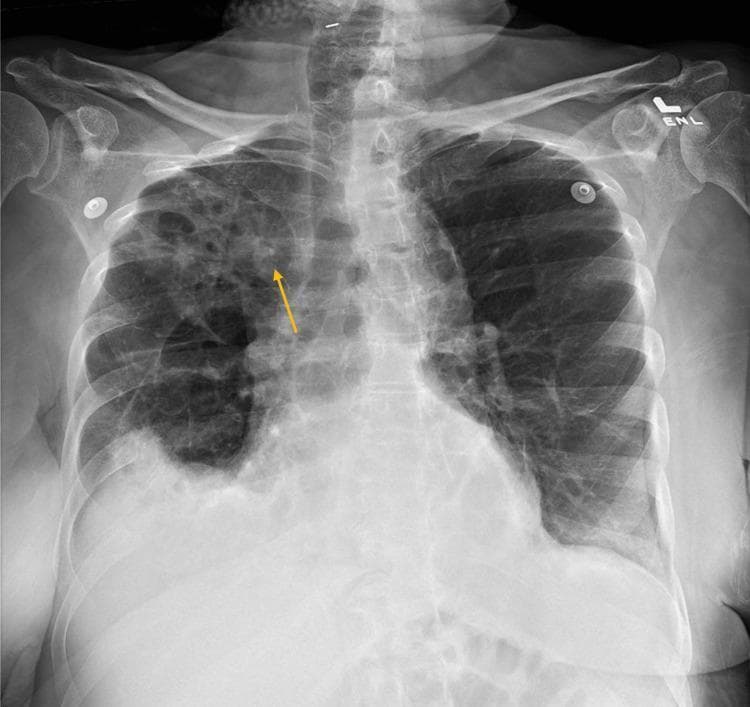
This is a partial AP chest X-ray focused on the right hemithorax. Here are the key findings:
Observations
Right lung (prominent side):
- There is a large, dense homogeneous opacity occupying the right lower and mid zones with blunting of the right costophrenic angle — this is the most striking finding and is strongly consistent with a moderate-to-large right pleural effusion
- The right upper zone shows relatively preserved lung markings
- The person's finger is pointing to the right lower chest, drawing attention to the effusion/opacity
Left lung (partially visible):
- Appears relatively clear with preserved lung markings
- No obvious consolidation or effusion on the visible portion
Mediastinum/Bones:
- Bony structures (clavicle, ribs, scapula) appear grossly intact
- Mediastinal shift, if any, is difficult to assess on this partial view
Differential Diagnosis for Right-Sided Opacity/Effusion
| Diagnosis | Supporting Features |
|---|---|
| Pleural effusion (most likely) | Homogeneous opacity, blunted costophrenic angle, meniscus sign |
| Pneumonia with parapneumonic effusion | Common in this age group, may coexist |
| Malignant effusion | Age 57, needs further workup if cause unclear |
| Consolidation/Collapse | If airspace disease rather than fluid |
| Empyema | If infective process suspected clinically |
Key Points (Harrison's, p. 3804)
- In consolidation with effusion, physical exam may show dull to flat percussion, reduced fremitus, and absent breath sounds at the base
- Clinical context is critical — fever/cough suggests infectious etiology; absence suggests malignancy or transudative cause
Recommended Next Steps
- PA and lateral chest X-ray (erect) — to better characterize the effusion
- Ultrasound chest — to confirm effusion, estimate volume, and guide thoracocentesis
- CT chest — if malignancy or complex collection is suspected
- Pleural fluid analysis (Light's criteria) — to differentiate exudate vs. transudate
- Clinical correlation — fever, weight loss, history of TB/malignancy/cardiac disease
⚠️ This analysis is for educational/clinical support purposes. Formal radiological reporting by a qualified radiologist is required for patient management decisions.
This is a shared conversation. Sign in to Orris to start your own chat.