
Flowchart of Pathogenesis of diebetic retinopaty . Take reference from datta , zia & khurana
pathogenesis diabetic retinopathy mechanisms Datta Khurana Zia
Eye Care Of The Patient With Diabetes Mellitus
Page 34
diabetic retinopathy biochemical pathways polyol pathway PKC VEGF pericyte loss
Eye Care Of The Patient With Diabetes Mellitus
Page 34
A detailed medical flowchart titled "Pathogenesis of Diabetic Retinopathy" showing the following sequence clearly with arrows and labeled boxes: Top: "HYPERGLYCEMIA (Chronic)" Four parallel biochemical pathways branching from hyperglycemia: 1. Sorbitol/Polyol Pathway → Osmotic stress, NADPH depletion, Oxidative stress 2. Advanced Glycation End-products (AGEs) → Crosslinking of proteins, Basement membrane thickening 3. Protein Kinase C (PKC) Activation → Increased vascular permeability, Neovascularization 4. Oxidative Stress → Free radical damage, Endothelial cell injury These four pathways converge into: "Retinal Microvascular Changes" - Pericyte loss - Basement membrane thickening - Endothelial cell damage - Increased vascular permeability Then arrow down to two parallel boxes: Left: "NON-PROLIFERATIVE DIABETIC RETINOPATHY (NPDR)" - Microaneurysms - Dot & blot hemorrhages - Hard exudates - Cotton wool spots - Venous beading - IRMA (Intraretinal Microvascular Abnormalities) Right: "Retinal Ischemia → VEGF Release (Vascular Endothelial Growth Factor)" Both converge to: "PROLIFERATIVE DIABETIC RETINOPATHY (PDR)" - Neovascularization (NVD / NVE) - Vitreous hemorrhage - Tractional retinal detachment - Rubeosis iridis Bottom box (complication): "DIABETIC MACULAR EDEMA (DME)" - Breakdown of Blood-Retinal Barrier - Macular thickening - Visual loss Clean clinical diagram style, white background, use color-coded boxes (blue for hyperglycemia, orange for biochemical pathways, red for complications, green for retinal changes), professional medical textbook appearance, clear readable fonts, well-organized layout
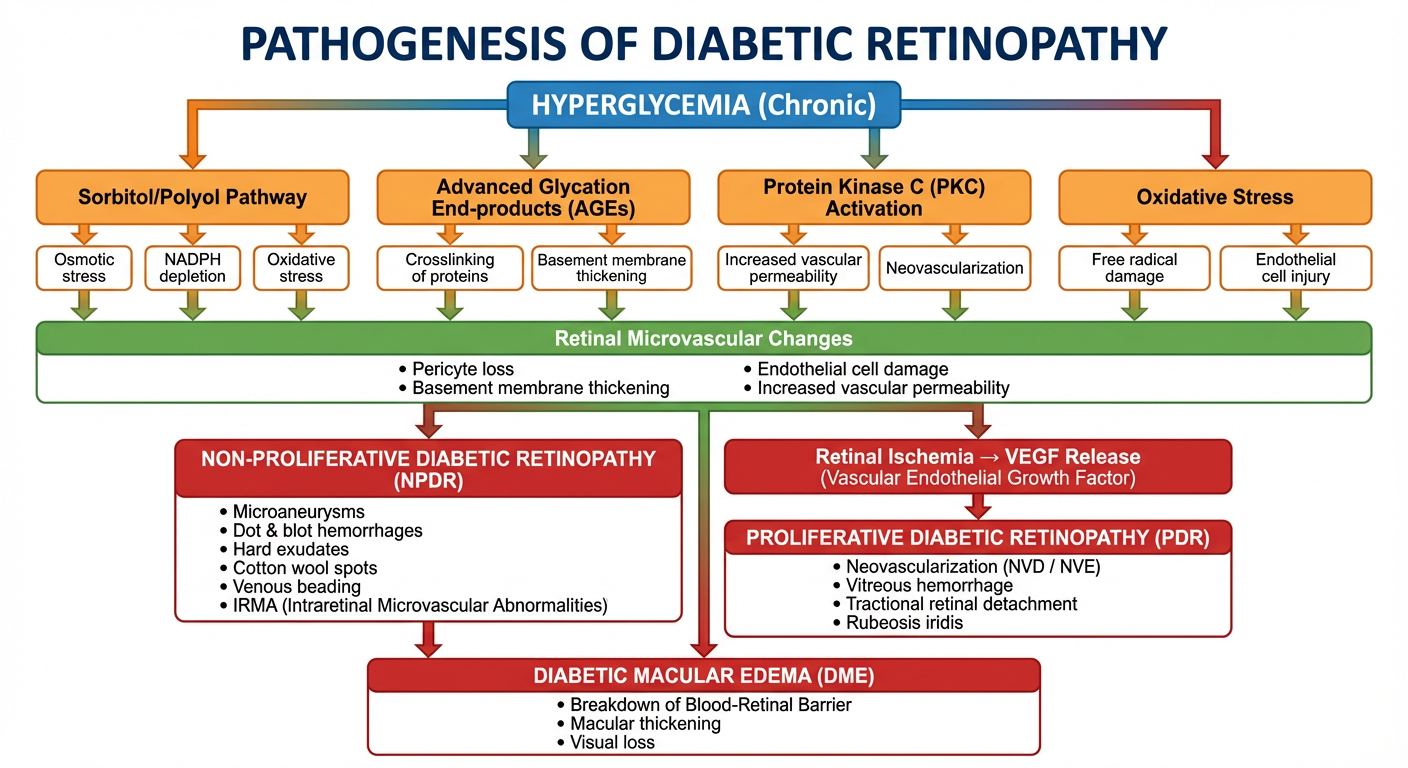
Pathogenesis of Diabetic Retinopathy
🔴 Starting Point: Chronic Hyperglycemia
1️⃣ Four Key Biochemical Pathways (Parallel)
| Pathway | Mechanism | Effect |
|---|---|---|
| Sorbitol / Polyol Pathway | Excess glucose → Sorbitol via Aldose Reductase | Osmotic stress, NADPH depletion, oxidative damage |
| Advanced Glycation End-products (AGEs) | Non-enzymatic glycation of proteins | BM thickening, crosslinking, pericyte dysfunction |
| Protein Kinase C (PKC) Activation | Diacylglycerol accumulation activates PKC | ↑ Vascular permeability, VEGF upregulation |
| Oxidative Stress | Free radical overproduction | Endothelial cell injury, mitochondrial dysfunction |
2️⃣ Retinal Microvascular Changes
- Pericyte loss (earliest histological change)
- Basement membrane thickening
- Endothelial cell damage
- Breakdown of the Blood-Retinal Barrier (BRB)
- Increased vascular permeability
3️⃣ Non-Proliferative Diabetic Retinopathy (NPDR)
- Microaneurysms (earliest clinical sign)
- Dot & blot hemorrhages
- Hard exudates (lipid leakage)
- Cotton-wool spots (nerve fiber layer infarcts)
- Venous beading
- IRMA (Intraretinal Microvascular Abnormalities)
4️⃣ Retinal Ischemia → VEGF Release
- Capillary non-perfusion → retinal hypoxia
- VEGF secreted → drives neovascularization
5️⃣ Proliferative Diabetic Retinopathy (PDR)
- NVD (Neovascularization at Disc) / NVE (elsewhere)
- Vitreous hemorrhage
- Tractional retinal detachment
- Rubeosis iridis (iris neovascularization) → Neovascular glaucoma
6️⃣ Diabetic Macular Edema (DME) (Can occur at any stage)
- BRB breakdown → fluid accumulation in macula
- Macular thickening → central visual loss
References: Khurana AK – Comprehensive Ophthalmology; Datta & Zia – Eye Care of the Patient with Diabetes Mellitus (p. 34); supported by established biochemical pathway literature (sorbitol pathway, AGEs, PKC, VEGF).