
Cushing’s syndrome
"Cushing syndrome"[MeSH Terms] AND diagnosis
python3 -c " import pdfplumber path = '/home/daytona/workspace/attachments/213e9c31-4ee1-4ac8-93ed-ebf3a21a0277/Part 24 -The Endocrine System - Nelson 2024 (1).pdf' with pdfplumber.open(path) as pdf: print(f'Total pages: {len(pdf.pages)}') # Search for Cushing's syndrome pages for i, page in enumerate(pdf.pages): text = page.extract_text() or '' if 'Cushing' in text: print(f'Page {i+1}: Cushing found') "
Cushing syndrome clinical features moon face buffalo hump
python3 << 'EOF' import pdfplumber, re path = '/home/daytona/workspace/attachments/213e9c31-4ee1-4ac8-93ed-ebf3a21a0277/Part 24 -The Endocrine System - Nelson 2024 (1).pdf' with pdfplumber.open(path) as pdf: print(f'Total pages: {len(pdf.pages)}') for i, page in enumerate(pdf.pages[:10]): text = page.extract_text() or '' if text.strip(): print(f'\n=== PAGE {i+1} ===') print(text[:300]) EOF
python3 << 'EOF' import pdfplumber path = '/home/daytona/workspace/attachments/213e9c31-4ee1-4ac8-93ed-ebf3a21a0277/Part 24 -The Endocrine System - Nelson 2024 (1).pdf' with pdfplumber.open(path) as pdf: print(f'Total pages: {len(pdf.pages)}') for i, page in enumerate(pdf.pages): text = page.extract_text() or '' if 'Cushing' in text: print(f'Page {i+1}: snippet -> {text[:100]}') EOF
python3 << 'EOF' import subprocess, sys path = '/home/daytona/workspace/attachments/213e9c31-4ee1-4ac8-93ed-ebf3a21a0277/Part 24 -The Endocrine System - Nelson 2024 (1).pdf' result = subprocess.run(['pdftotext', '-layout', path, '-'], capture_output=True, text=True, timeout=60) text = result.stdout # find Cushing pages idx = text.find('Cushing') if idx >= 0: print(f'Found at index {idx}') print(text[max(0,idx-200):idx+2000]) else: print('Not found') print(text[:500]) EOF
python3 << 'EOF' import subprocess path = '/home/daytona/workspace/attachments/213e9c31-4ee1-4ac8-93ed-ebf3a21a0277/Part 24 -The Endocrine System - Nelson 2024 (1).pdf' result = subprocess.run(['pdftotext', '-layout', path, '-'], capture_output=True, text=True, timeout=60) text = result.stdout # Find the dedicated Cushing section import re positions = [m.start() for m in re.finditer(r'Cushing', text)] print(f'Found {len(positions)} occurrences of Cushing') for pos in positions[:10]: snippet = text[max(0,pos-50):pos+100].replace('\n', ' ') print(f' pos {pos}: ...{snippet}...') EOF
python3 << 'EOF' import subprocess path = '/home/daytona/workspace/attachments/213e9c31-4ee1-4ac8-93ed-ebf3a21a0277/Part 24 -The Endocrine System - Nelson 2024 (1).pdf' result = subprocess.run(['pdftotext', '-layout', path, '-'], capture_output=True, text=True, timeout=60) text = result.stdout # Extract the main Cushing section starting at pos 226775 section = text[226500:231500] print(section) EOF
python3 << 'EOF' import subprocess, re path = '/home/daytona/workspace/attachments/213e9c31-4ee1-4ac8-93ed-ebf3a21a0277/Part 24 -The Endocrine System - Nelson 2024 (1).pdf' result = subprocess.run(['pdftotext', '-layout', path, '-'], capture_output=True, text=True, timeout=60) text = result.stdout # Find the adrenal/Cushing section with more detail # Look for "Cushing Syndrome" as a chapter heading matches = [(m.start(), m.group()) for m in re.finditer(r'Cushing Syndrome|Cushing syndrome|CUSHING SYNDROME|Hypercortisolism', text)] for pos, match in matches: snippet = text[max(0,pos-100):pos+200].replace('\n',' ') print(f'pos {pos} ({match}): {snippet[:250]}') print() EOF
python3 << 'EOF' import subprocess path = '/home/daytona/workspace/attachments/213e9c31-4ee1-4ac8-93ed-ebf3a21a0277/Part 24 -The Endocrine System - Nelson 2024 (1).pdf' result = subprocess.run(['pdftotext', '-layout', path, '-'], capture_output=True, text=True, timeout=60) text = result.stdout # Extract Chapter 619 Cushing Syndrome section = text[1100986:1130000] print(section) EOF
Cushing Syndrome
Definition
Etiology & Classification
1. Exogenous (Iatrogenic) — Most Common Overall
2. ACTH-Dependent (80–85% of endogenous cases)
| Cause | Key Facts |
|---|---|
| Cushing disease (pituitary corticotroph adenoma) | ~70% of endogenous CS; almost always a microadenoma <5 mm; ♀ > ♂ overall, but prepubertal males > females |
| Ectopic ACTH secretion | ~10% of endogenous CS; in children: associated with islet cell carcinoma of the pancreas, neuroblastoma, ganglioneuroblastoma, hemangiopericytoma, Wilms tumor, thymic carcinoid; causes the highest cortisol and most severe hypokalemia |
| Ectopic CRH secretion | Extremely rare |
3. ACTH-Independent (~15–20% of endogenous cases)
| Cause | Key Facts |
|---|---|
| Adrenal adenoma | Most common adrenal cause in children >7 yr |
| Adrenocortical carcinoma | ~8% of CS; poor prognosis; virilization often co-exists |
| PPNAD (Primary Pigmented Nodular Adrenocortical Disease) | <1%; normal-sized glands with black/brown nodules; associated with Carney complex (PRKAR1A gene, chr 17q22–24); classic paradoxical rise on high-dose dexamethasone suppression test |
| BMAH (Bilateral Macronodular Adrenal Hyperplasia) | <1%; ARMC5 tumor-suppressor gene abnormal in ~40% |
| McCune-Albright syndrome | GNAS (Gsα) somatic activating variant |
Pediatric note: In children under 5 years, adrenal causes (carcinoma, McCune-Albright) predominate over pituitary causes.
Pathophysiology
Clinical Manifestations
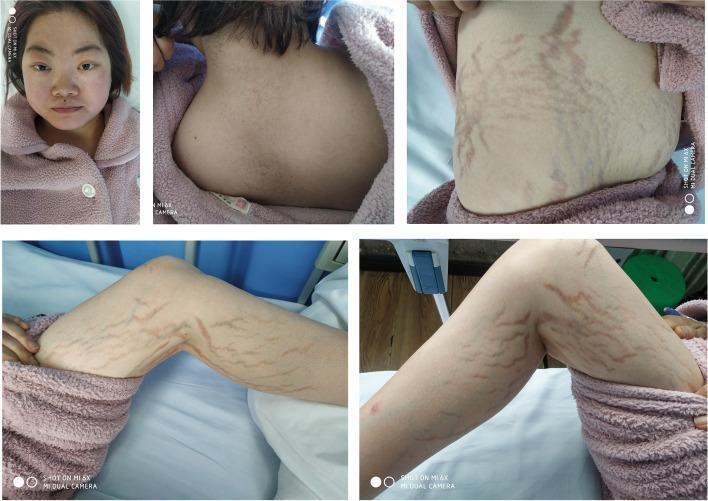
Table: Presenting Signs and Symptoms (Nelson 2024, Table 619.2)
| System | Features |
|---|---|
| Dermatologic | Moon facies (rounded, flushed), facial plethora, acne, easy bruising, supratemporal and supraclavicular fat pads, hirsutism, fine downy hair, violaceous striae (unusual in children <7 yr), fungal infections, acanthosis nigricans |
| Growth | Growth deceleration + weight gain; central obesity; "buffalo hump" (nonspecific) |
| Cardiovascular | Hypertension, coagulopathy |
| Metabolic | Hyperglycemia → frank diabetes, dyslipidemia, insulin resistance |
| Gonadal | Amenorrhea, virilization (clitoromegaly, pubic hair, deepened voice), gynecomastia; pubertal arrest or delay |
| Musculoskeletal | Osteoporosis, pathologic fractures, proximal muscle weakness |
| Neuropsychiatric | Depression, anxiety, mood swings, irritability, fatigue, headache |
| Other | Nephrolithiasis, increased susceptibility to infection |
In infants, generalized obesity is common and findings are more dramatic. In older children, truncal/facial obesity with relative limb sparing is typical.
Laboratory Findings & Diagnosis
Screening Tests (require ≥2 abnormal results to confirm)
| Test | Details |
|---|---|
| Late-night salivary cortisol | Circadian rhythm is lost in CS; midnight cortisol >4.4 μg/dL strongly suggests the diagnosis. Can be collected at home. |
| 24-hour urinary free cortisol (UFC) | Expressed per gram creatinine (corrects for body size and collection completeness). Elevated in CS. |
| Overnight dexamethasone suppression test (DST) | 25–30 μg/kg (max 2 mg) at 11 PM → 8 AM cortisol <5 μg/dL is normal. Failure to suppress = abnormal. Measure dexamethasone level to confirm adequate dosing. |
Distinguishing the Cause
-
Measure plasma ACTH (two samples)
- ACTH <10 pg/mL → ACTH-independent → CT/MRI of adrenals
- ACTH >20 pg/mL → ACTH-dependent → pituitary MRI + further testing
- ACTH 10–20 pg/mL (indeterminate) → CRH stimulation test
-
High-dose dexamethasone suppression test (HDDSST): 30 μg/kg/24 hr × 2 days then 120 μg/kg/24 hr × 2 days. Suppression of cortisol with the larger dose (not smaller) = pituitary Cushing disease. ACTH-independent disease shows no suppression.
-
CRH stimulation: Patients with ACTH-dependent CS show an exaggerated ACTH and cortisol response; adrenal tumor patients show no response.
-
Bilateral Inferior Petrosal Sinus Sampling (BIPSS) after CRH stimulation: the gold standard to distinguish Cushing disease from ectopic ACTH. High petrosal:peripheral ACTH ratio confirms pituitary origin.
-
Imaging:
- CT detects virtually all adrenal tumors >1.5 cm
- Pituitary MRI (with gadolinium) for adenomas — but 50% of Cushing disease patients have no visible abnormality on MRI; and 10% of the general population have incidental pituitary findings
Confirmed CS → ACTH measurement
├── <10 pg/mL (ACTH-independent) → CT/MRI adrenals
│   └── Unilateral mass → adenoma/carcinoma
│   └── Bilateral → macronodular or micronodular hyperplasia
│
└── >20 pg/mL (ACTH-dependent) → Pituitary MRI + HDDSST + CRH test
    ├── Adenoma >6 mm + concordant tests → Surgery (Cushing disease confirmed)
    ├── Adenoma <6 mm or discordant tests → BIPSS
    └── Negative pituitary imaging → CT/MRI neck/chest/abdomen/pelvis + octreoscan/PET → ectopic ACTH tumor
Differential Diagnosis
- Simple obesity: children are tall, cortisol suppresses normally with dexamethasone, nighttime salivary cortisol is normal
- Pseudo-Cushing states (may show false-positive cortisol tests): major depression, alcoholism, morbid obesity, poorly controlled diabetes
- Glucocorticoid resistance (Chrousos syndrome): elevated cortisol + ACTH without typical CS phenotype; presents with hypertension, hypokalemia, precocious pseudopuberty
- Exogenous steroid use (always exclude first with careful history)
Treatment
Cushing Disease (Pituitary)
- Transsphenoidal pituitary microsurgery is the treatment of choice in children
- Overall success rate: 60–98% (initial remission); long-term success 50–98%
- Low postoperative cortisol predicts long-term remission
- Relapse: reoperation or pituitary radiotherapy
- Pasireotide (somatostatin analog): approved for adults with persistent/recurrent disease post-surgery or surgical contraindication — inhibits ACTH secretion
- Cyproheptadine (serotonin antagonist): rarely used in children; remissions not sustained
Adrenal Causes
- Surgical resection (laparoscopic adrenalectomy where possible)
- For bilateral adrenalectomy: requires lifelong adrenal replacement therapy; risk of Nelson syndrome (~25% of adults post-bilateral adrenalectomy) — Nelson syndrome = markedly elevated ACTH with skin hyperpigmentation from unresected pituitary adenoma
Adrenal Steroidogenesis Inhibitors (preoperative or adjunct)
| Drug | Mechanism |
|---|---|
| Mitotane | Cytotoxic to adrenocortical cells; FDA-approved |
| Osilodrostat | Cortisol synthesis inhibitor; FDA-approved |
| Metyrapone | 11β-hydroxylase inhibitor |
| Ketoconazole / Levoketoconazole | Inhibits multiple steroidogenic enzymes; levoketoconazole in advanced development |
| Aminoglutethimide | Blocks cholesterol side-chain cleavage |
| Etomidate (IV) | For acute severe hypercortisolism |
| Mifepristone | Glucocorticoid receptor antagonist; used in limited cases |
Postoperative Management
- Replace cortisol 10 mg/m²/24 hr in three divided doses after immediate postoperative period — until HPA axis recovers (may take up to 30 months)
- Monitor for sepsis, pancreatitis, thrombosis, poor wound healing
- Expect catch-up growth and pubertal progress, but bone density remains abnormal and adult height is often compromised
- Check for GH deficiency post-treatment and treat if present
Genetics Summary (Fig. 619.1, Nelson 2024)
| Cause | Key Genes |
|---|---|
| Cushing disease | USP8, MEN1, CDKIs, CDKN1B/p27, AIP, DICER1 |
| PPNAD / Carney complex | PRKAR1A (chr 17q22–24), PDE11A, PDE8B, PRKACA |
| BMAH | ARMC5, MEN1, GNAS1, PDE11A, PDE8B |
| Adrenal adenoma | PRKACA (somatic activating variant), CTNNB1 |
| McCune-Albright | GNAS (somatic Gsα activating variant) |
| Ectopic ACTH | RET, MEN1 |
Recent Evidence (PubMed 2024–2025)
- A 2024 systematic review and meta-analysis (PMID 38888685) addressed the challenge of differentiating true Cushing syndrome from non-neoplastic hypercortisolism (pseudo-Cushing), highlighting the diagnostic conundrum in clinical practice.
- A 2025 meta-analysis on ectopic Cushing syndrome (PMID 40455890) characterized survival probabilities — ectopic CS carries a significantly worse prognosis than pituitary or adrenal forms.
- A 2024 meta-analysis (PMID 38840128) documented a spectrum of thyroid dysfunction in CS, including suppressed TSH and altered thyroid hormone metabolism.