
Exotosis of bone
Reading File
Searching for information on bone exostosis (osteochondroma and related lesions) across definition, pathology, imaging, and management.
search_medical_text
exostosis bone osteochondroma definition pathology classification
Bailey and Love's Short Practice of Surgery 28th Edition
Page 605
search_medical_text
exostosis diagnosis imaging treatment management complications
search_medical_image
bone exostosis osteochondroma radiograph imaging
Hugging Face pmc clinical VQA raw
Page 0
GradeResponse
GradeResponse
GradeResponse
Exostosis of Bone
An exostosis is a benign bony outgrowth projecting from the surface of a bone. The most clinically significant and common form is the osteochondroma.
Definition & Pathology
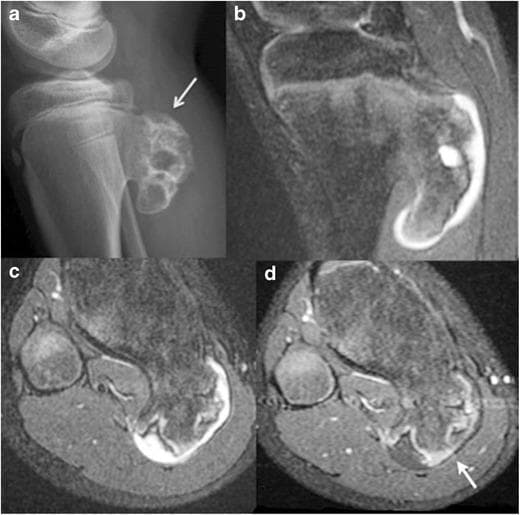
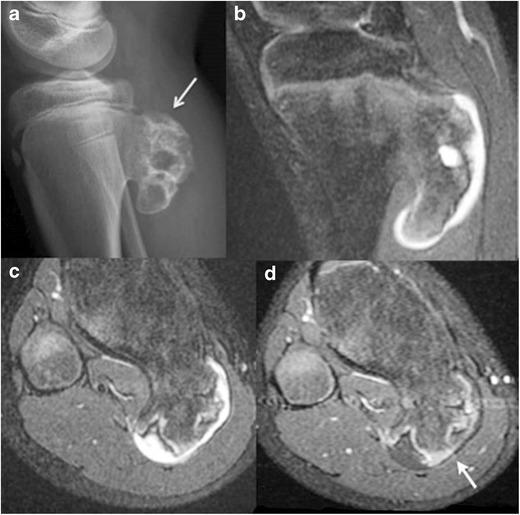
An osteochondroma is a cartilage-capped bony projection that arises from the surface of a bone, growing away from the nearest joint toward the diaphyseal region. It is considered a developmental lesion (hamartoma) rather than a true neoplasm.
Macroscopic features:
- Pedunculated — with a narrow stalk
- Sessile — broad-based, without a stalk
A hallmark feature is corticomedullary continuity: the cortex and medullary cavity of the host bone are directly continuous with the stalk of the osteochondroma.
Classification
| Type | Description |
|---|---|
| Solitary osteochondroma | Single lesion; most common |
| Hereditary Multiple Exostoses (HME) | Multiple osteochondromas; autosomal dominant; EXT1/EXT2 gene mutations |
| Subungual exostosis | Arises beneath the nail plate, typically the great toe |
| Turret exostosis | Post-traumatic outgrowth on phalanges |
| Bizarre parosteal osteochondromatous proliferation (BPOP) | Reactive lesion, often in hands/feet |
Imaging
Radiograph
- Bony projection with cortical and medullary continuity with host bone
- Grows away from the epiphysis
- May show chondroid calcifications in the cap
MRI (gold standard for cartilage cap)
- Cap appears hyperintense on T2-weighted sequences (hyaline cartilage)
- Cap thickness is the critical measurement:
- < 1.5–2 cm in adults → benign
- > 2 cm → raises concern for malignant transformation to secondary chondrosarcoma
Common Sites
- Distal femur, proximal tibia, proximal humerus (near physes of long bones)
- Pelvis, scapula, vertebrae (less common)
- Stops growing at skeletal maturity
Complications
| Complication | Notes |
|---|---|
| Mechanical symptoms | Restricted range of motion, bursitis over lesion |
| Nerve impingement | Paresthesia, weakness depending on location |
| Vascular pseudoaneurysm | Rare, from repeated trauma to adjacent vessels |
| Fracture | Of the stalk |
| Infarction | Rare |
| Malignant transformation | To secondary chondrosarcoma |
Malignant Transformation
- Solitary osteochondroma: < 1% risk
- Hereditary multiple exostoses: 1–3% risk
Warning signs:
- Growth or new pain after skeletal maturity
- Cartilage cap > 2 cm on MRI
- Irregular calcification pattern on imaging
(Bailey and Love's Short Practice of Surgery, 28th Ed., p. 605)
Management
| Scenario | Management |
|---|---|
| Asymptomatic, skeletally immature | Observation; serial monitoring |
| Symptomatic (pain, mechanical, neurovascular) | Surgical excision |
| Concern for malignant transformation | Urgent surgical excision with wide margins |
| HME | Excision of symptomatic/growing lesions; orthopedic correction of deformities |
Surgical principles:
- Excise at the base, including the cartilage cap and overlying perichondrium (incomplete removal risks recurrence)
- Recurrence after complete excision is rare for solitary lesions
Key Takeaways
- Osteochondromas are the most common benign bone tumor (~35% of all benign bone tumors)
- Corticomedullary continuity is the pathognomonic radiological sign
- MRI cartilage cap thickness is the most reliable indicator for malignant transformation
- Solitary lesions carry very low malignant risk; multiple exostoses (HME) carry higher risk
This is a shared conversation. Sign in to Orris to start your own chat.