
Give me only the very high-yield points regarding peripheral blood smear relevant for NEET PG 2026.
peripheral blood smear findings RBC morphology high yield
Harrison's Principles of Internal Medicine, Twenty First Edition
Page 1714
blood smear abnormal cells anemia diagnosis schistocytes target cells
Harrison's Principles of Internal Medicine, Twenty First Edition
Page 1717
peripheral blood smear RBC morphology abnormalities
Harrison's Principles of Internal Medicine, Twenty First Edition
Page 1725
🔬 Peripheral Blood Smear — High-Yield for NEET PG 2026
📌 TECHNIQUE
- Examine at the feathered edge — RBCs lie in a single layer, just barely touching, not overlapping
- Stain used: Leishman's stain (most common in India); also Wright-Giemsa, Romanowsky stains
- Order of examination: Platelets → RBCs → WBCs (smallest to largest)
🔴 RBC MORPHOLOGY — Classic "One Condition = One Cell" Links
| Cell / Finding | Shape | Key Disease(s) |
|---|---|---|
| Schistocytes (helmet cells) | Fragmented, helmet-shaped | Microangiopathic hemolytic anemia (MAHA) — TTP, HUS, DIC, prosthetic heart valve |
| Target cells (codocytes) | Bull's eye | Thalassemia, HbC disease, liver disease, iron deficiency, post-splenectomy |
| Sickle cells (drepanocytes) | Crescent/sickle | Sickle cell anemia |
| Spherocytes | Small, dense, no central pallor | Hereditary spherocytosis, autoimmune hemolytic anemia (AIHA) |
| Elliptocytes (ovalocytes) | Elliptical | Hereditary elliptocytosis; also iron deficiency, megaloblastic anemia, thalassemia |
| Dacrocytes (teardrop cells) | Teardrop | Myelofibrosis (classic), thalassemia, severe iron deficiency, MDS |
| Acanthocytes (spur cells) | Irregular spicules (irreversible) | Abetalipoproteinemia, liver disease, uremia, post-splenectomy |
| Echinocytes (burr cells) | Regular spicules (reversible) | Renal failure (uremia), malnutrition, artifact |
| Stomatocytes | Mouth/slit-shaped pallor | Hereditary stomatocytosis, alcoholic liver disease |
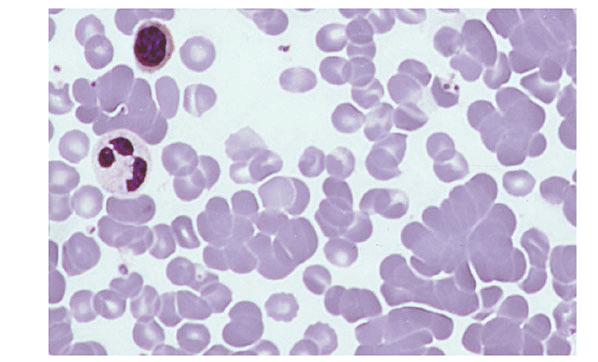
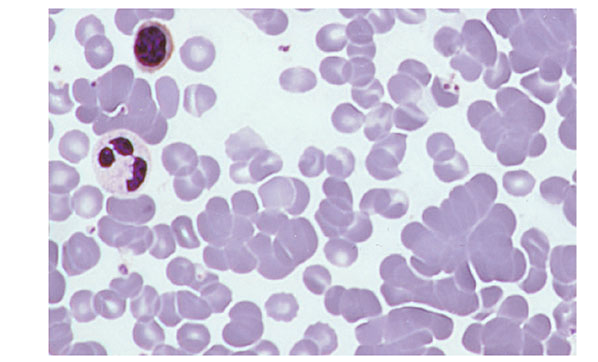
| Rouleaux formation | Stacked coins | Multiple myeloma, Waldenström's macroglobulinemia, high ESR states |
| Hypochromic microcytic RBCs | Small, pale, increased central pallor | Iron deficiency anemia, thalassemia trait |
| Macrocytes / Oval macrocytes | Large cells; oval in megaloblastic | Megaloblastic anemia (B12/folate deficiency), liver disease, hypothyroidism |
| Bite cells (degmacytes) | Cells with "bite" taken out | G6PD deficiency (Heinz body removal by spleen) |
| Pencil cells | Elongated thin cells | Severe iron deficiency anemia |
💡 Special RBC Inclusions
| Inclusion | Significance |
|---|---|
| Howell-Jolly bodies | Nuclear remnants; seen post-splenectomy, megaloblastic anemia, hemolytic anemia |
| Heinz bodies | Denatured Hb; seen in G6PD deficiency (requires crystal violet stain, NOT Romanowsky) |
| Basophilic stippling | Lead poisoning (coarse stippling), thalassemia, megaloblastic anemia |
| Pappenheimer bodies | Iron granules; seen in sideroblastic anemia, post-splenectomy |
| Malaria parasites | P. vivax (enlarged RBCs, Schüffner's dots), P. falciparum (ring forms, multiple rings/cell, banana-shaped gametocytes) |
| Cabot rings | Figure-8 ring remnants; megaloblastic anemia |
⚪ WBC FINDINGS on PBS
| Finding | Disease |
|---|---|
| Hypersegmented neutrophils (≥5 lobes or any cell with ≥6 lobes) | Megaloblastic anemia (pathognomonic) |
| Auer rods | AML (especially M3 — APL; Faggot cells = multiple Auer rods) |
| Smudge cells (basket cells) | CLL |
| Blast cells | AML / ALL (>20% blasts = AML) |
| Reed-Sternberg cells | Hodgkin's lymphoma (not typically on routine PBS) |
| Pelger-Huët anomaly | Bilobed/pince-nez neutrophils; MDS, congenital |
| Leukemoid reaction vs CML | Both show left shift; CML has basophilia + LAP score LOW; leukemoid reaction has HIGH LAP score |
🟡 PLATELET FINDINGS on PBS
| Finding | Disease |
|---|---|
| Thrombocytopenia + schistocytes | TTP, HUS, DIC |
| Giant platelets | Bernard-Soulier syndrome, ITP |
| Absent platelets | Severe ITP, aplastic anemia |
🔑 One-Liner Classics (Frequently Asked in MCQs)
- Pencil cells + hypochromia + microcytosis → Iron deficiency anemia
- Teardrop cells + leukoerythroblastic picture → Myelofibrosis
- Schistocytes + thrombocytopenia + fever + neurological symptoms → TTP (treat with plasma exchange)
- Smudge cells → CLL (most common leukemia in elderly)
- Auer rods in blast cells → AML (Auer rods NEVER seen in ALL)
- Howell-Jolly bodies in routine smear → Suggests hyposplenism/asplenia
- Hypersegmented neutrophils → earliest and most sensitive sign of megaloblastic anemia on PBS
- Basophilic stippling + microcytic anemia + child with cognitive delay → Lead poisoning
- Oval macrocytes + hypersegmented neutrophils → Megaloblastic anemia
- Rouleaux + very high ESR + lytic bone lesions → Multiple myeloma
- Target cells + hemolytic anemia in Mediterranean population → Thalassemia / HbC / G6PD
Sources: Harrison's Principles of Internal Medicine, 21st Edition (pp. 1714, 1717, 1725)
Convert all the above information to an Anki card. Front portion should show peripherals layer. The back portion should be everything in the above in a single line. Provide proper punctuation and spaces so that one can easily read and understand. Give it to me in an import-ready format to be imported to AnkiDroid app. It should be in a format where I can directly copy and paste it in a different text file and then import it into AnkiDroid app.
.txt file where each line = one card, with Tab separating Front from Back. Here is the import-ready content:- Copy everything between the
---lines below. - Paste into a plain text file (e.g.,
PBS_Anki.txt). - In AnkiDroid →
⋮→ Import → select the file. - Choose field separator: Tab, and you're done.
Peripheral Blood Smear — What layer do you examine, which stain is used, and what is the order of examination?	Examine at the feathered edge where RBCs lie in a single layer just barely touching; Stain: Leishman's stain (India), Wright-Giemsa / Romanowsky also used; Order of examination: Platelets → RBCs → WBCs (smallest to largest).

Schistocytes (helmet cells) — PBS finding	Fragmented, helmet-shaped RBCs; seen in Microangiopathic Hemolytic Anemia (MAHA): TTP, HUS, DIC, and prosthetic heart valve hemolysis.

Target cells (codocytes) — PBS finding	Bull's-eye appearance; seen in Thalassemia, HbC disease, liver disease, iron deficiency anemia, and post-splenectomy.

Sickle cells (drepanocytes) — PBS finding	Crescent- / sickle-shaped RBCs; pathognomonic for Sickle Cell Anemia.

Spherocytes — PBS finding	Small, dense RBCs with no central pallor; seen in Hereditary Spherocytosis and Autoimmune Hemolytic Anemia (AIHA).

Elliptocytes (ovalocytes) — PBS finding	Elliptical RBCs; classic for Hereditary Elliptocytosis; also seen in iron deficiency, megaloblastic anemia, and thalassemia.

Dacrocytes (teardrop cells) — PBS finding	Teardrop-shaped RBCs; classic for Myelofibrosis; also seen in thalassemia, severe iron deficiency, and MDS.

Acanthocytes (spur cells) — PBS finding	Irregularly spiculated RBCs — irreversible change; seen in Abetalipoproteinemia, liver disease (uremia), and post-splenectomy.

Echinocytes (burr cells) — PBS finding	Regularly spiculated RBCs — reversible change; seen in Renal Failure (uremia), malnutrition, and as a smear artifact.

Stomatocytes — PBS finding	RBCs with mouth- / slit-shaped central pallor; seen in Hereditary Stomatocytosis and alcoholic liver disease.

Rouleaux formation — PBS finding	RBCs stacked like coins; seen in Multiple Myeloma, Waldenström's Macroglobulinemia, and any high-ESR state.

Hypochromic microcytic RBCs — PBS finding	Small, pale RBCs with increased central pallor; seen in Iron Deficiency Anemia and Thalassemia trait.

Macrocytes / Oval macrocytes — PBS finding	Large RBCs; oval macrocytes are classic for Megaloblastic Anemia (B12 / folate deficiency); also seen in liver disease and hypothyroidism.

Bite cells (degmacytes) — PBS finding	RBCs with a "bite" taken out; seen in G6PD Deficiency after Heinz body removal by the spleen.

Pencil cells — PBS finding	Elongated, thin, pencil-shaped RBCs; seen in Severe Iron Deficiency Anemia.

Howell-Jolly bodies — RBC inclusion	Nuclear remnants inside RBCs; seen post-splenectomy, in megaloblastic anemia, and in hemolytic anemia; their presence on a routine smear suggests hyposplenism or asplenia.

Heinz bodies — RBC inclusion	Denatured hemoglobin precipitates inside RBCs; seen in G6PD Deficiency; requires Crystal Violet stain — NOT visible on routine Romanowsky stain.

Basophilic stippling — RBC inclusion	Coarse basophilic dots inside RBCs; coarse stippling is classic for Lead Poisoning; also seen in thalassemia and megaloblastic anemia.

Pappenheimer bodies — RBC inclusion	Iron granules inside RBCs; seen in Sideroblastic Anemia and post-splenectomy.

Malaria parasites — PBS finding	P. vivax: enlarged RBCs with Schüffner's dots; P. falciparum: multiple ring forms per cell, banana-shaped gametocytes, does NOT enlarge RBCs.

Cabot rings — RBC inclusion	Figure-of-8 or ring-shaped remnants inside RBCs; seen in Megaloblastic Anemia.

Hypersegmented neutrophils — PBS WBC finding	Neutrophils with ≥5 lobes, or any cell with ≥6 lobes; pathognomonic for Megaloblastic Anemia; earliest and most sensitive PBS sign of B12 / folate deficiency.

Auer rods — PBS WBC finding	Pink rod-shaped cytoplasmic inclusions in blast cells; seen exclusively in AML (NEVER in ALL); multiple Auer rods in a single cell = Faggot cells, classic for AML-M3 (APL).

Smudge cells (basket cells) — PBS WBC finding	Fragile, smeared lymphocytes; pathognomonic for CLL (most common leukemia in the elderly).

Pelger-Huët anomaly — PBS WBC finding	Bilobed / pince-nez–shaped neutrophils with condensed chromatin; seen in MDS and as a congenital variant.

Leukemoid reaction vs CML — PBS distinction	Both show marked leukocytosis with left shift; CML has basophilia and a LOW LAP (leukocyte alkaline phosphatase) score; Leukemoid reaction has a HIGH LAP score.

Giant platelets — PBS platelet finding	Abnormally large platelets on smear; seen in Bernard-Soulier Syndrome and ITP.

Thrombocytopenia + schistocytes — PBS combined finding	Triad of schistocytes, thrombocytopenia, and fever with neurological symptoms = TTP; treat with Plasma Exchange (NOT platelet transfusion).

Pencil cells + hypochromia + microcytosis — PBS one-liner	Classic for Iron Deficiency Anemia.

Teardrop cells + leukoerythroblastic picture — PBS one-liner	Classic for Myelofibrosis (immature WBCs and nucleated RBCs also seen on smear).

Smudge cells on PBS — one-liner	CLL — most common leukemia in the elderly.

Auer rods in blast cells — one-liner	AML; Auer rods are NEVER seen in ALL.

Howell-Jolly bodies on routine smear — one-liner	Suggests Hyposplenism or functional / anatomical Asplenia.

Basophilic stippling + microcytic anemia + child with cognitive delay — PBS one-liner	Classic for Lead Poisoning.

Oval macrocytes + hypersegmented neutrophils — PBS one-liner	Classic for Megaloblastic Anemia (B12 or folate deficiency).

Rouleaux + very high ESR + lytic bone lesions — PBS one-liner	Classic for Multiple Myeloma.

Target cells + hemolytic anemia in Mediterranean population — PBS one-liner	Classic for Thalassemia, HbC disease, or G6PD deficiency.
- Field separator: Tab
- Note type: Basic (Front / Back)
- Allow HTML: Off (no HTML used here)
- Each line = one card; the part before the Tab = Front, after the Tab = Back.
Convert all these 37 cards into one single card. Front portion is peripheral smear, and back portion is the rest of the information with proper punctuation and spacing.
.txt file, and import into AnkiDroid with Tab as field separator.Peripheral Blood Smear TECHNIQUE: Examine at the feathered edge; Stain: Leishman's (India) / Wright-Giemsa / Romanowsky; Order: Platelets → RBCs → WBCs. | RBC MORPHOLOGY: Schistocytes (helmet cells) → MAHA: TTP, HUS, DIC, prosthetic valve. | Target cells (codocytes) → Thalassemia, HbC, liver disease, iron deficiency, post-splenectomy. | Sickle cells (drepanocytes) → Sickle cell anemia. | Spherocytes → Hereditary spherocytosis, AIHA. | Elliptocytes → Hereditary elliptocytosis; also iron deficiency, megaloblastic anemia, thalassemia. | Dacrocytes (teardrop cells) → Myelofibrosis (classic), thalassemia, severe iron deficiency, MDS. | Acanthocytes (spur cells) → Irregular spicules, irreversible → Abetalipoproteinemia, liver disease, post-splenectomy. | Echinocytes (burr cells) → Regular spicules, reversible → Renal failure, malnutrition, artifact. | Stomatocytes → Slit-shaped pallor → Hereditary stomatocytosis, alcoholic liver disease. | Rouleaux → Stacked coins → Multiple myeloma, Waldenström's, high ESR states. | Hypochromic microcytic RBCs → Iron deficiency anemia, thalassemia trait. | Oval macrocytes → Megaloblastic anemia (B12/folate deficiency), liver disease, hypothyroidism. | Bite cells (degmacytes) → G6PD deficiency (Heinz body removal by spleen). | Pencil cells → Severe iron deficiency anemia. | RBC INCLUSIONS: Howell-Jolly bodies → Nuclear remnants → Post-splenectomy, megaloblastic anemia, hemolytic anemia; presence on routine smear = hyposplenism/asplenia. | Heinz bodies → Denatured Hb → G6PD deficiency; requires Crystal Violet stain, NOT Romanowsky. | Basophilic stippling → Coarse = Lead poisoning (classic); also thalassemia, megaloblastic anemia. | Pappenheimer bodies → Iron granules → Sideroblastic anemia, post-splenectomy. | Cabot rings → Figure-of-8 remnants → Megaloblastic anemia. | Malaria parasites → P. vivax: enlarged RBCs + Schüffner's dots; P. falciparum: multiple ring forms/cell + banana-shaped gametocytes, no RBC enlargement. | WBC FINDINGS: Hypersegmented neutrophils (≥5 lobes / any cell ≥6 lobes) → Megaloblastic anemia; earliest and most sensitive PBS sign. | Auer rods → AML only, NEVER ALL; multiple Auer rods in one cell = Faggot cells → AML-M3 (APL). | Smudge cells (basket cells) → CLL; most common leukemia in the elderly. | Pelger-Huët anomaly → Bilobed/pince-nez neutrophils → MDS, congenital variant. | Leukemoid reaction vs CML → Both: leukocytosis + left shift; CML: basophilia + LOW LAP score; Leukemoid reaction: HIGH LAP score. | PLATELET FINDINGS: Giant platelets → Bernard-Soulier syndrome, ITP. | Thrombocytopenia + schistocytes + fever + neuro symptoms → TTP → treat with Plasma Exchange (NOT platelet transfusion). | ONE-LINERS: Pencil cells + hypochromia + microcytosis → Iron deficiency anemia. | Teardrop cells + leukoerythroblastic picture → Myelofibrosis. | Smudge cells → CLL. | Auer rods in blasts → AML; never in ALL. | Howell-Jolly bodies on routine smear → Hyposplenism/asplenia. | Basophilic stippling + microcytic anemia + child with cognitive delay → Lead poisoning. | Oval macrocytes + hypersegmented neutrophils → Megaloblastic anemia. | Rouleaux + high ESR + lytic bone lesions → Multiple myeloma. | Target cells + hemolytic anemia in Mediterranean population → Thalassemia / HbC / G6PD deficiency.
| pipe symbols act as visual section separators so the back is easy to read when reviewing in AnkiDroid.