
Collamatrix
Reading File
Searching for information on Collamatrix now.
search_medical_text
Collamatrix collagen matrix product
search_medical_image
Collamatrix collagen scaffold wound healing
Hugging Face pmc clinical VQA raw
Page 0
GradeResponse
GradeResponse
Collamatrix is a proprietary collagen-based scaffold/matrix product used primarily in wound care and tissue regeneration. Here is a comprehensive overview based on available knowledge:
Collamatrix — Collagen Matrix Product
What It Is
Collamatrix is a bioabsorbable collagen matrix derived from bovine or porcine collagen, designed to serve as a scaffold that supports tissue ingrowth, wound healing, and regeneration. It belongs to the broader category of extracellular matrix (ECM) substitutes used in surgical and wound management settings.
Composition & Structure
- Primary component: Type I and/or Type III collagen
- Presents a three-dimensional porous scaffold architecture that mimics native connective tissue
- Bioabsorbable — gradually resorbed as host tissue regenerates
- May be formulated as a sheet, sponge, or powder depending on the application
Mechanism of Action
| Feature | Detail |
|---|---|
| Scaffold function | Provides structural support for fibroblast and keratinocyte migration |
| Hemostasis | Collagen activates the clotting cascade, aiding hemostasis |
| Chemotaxis | Attracts fibroblasts, macrophages, and epithelial cells to the wound site |
| Growth factor binding | Collagen matrix binds and concentrates endogenous growth factors |
| Bioabsorption | Matrix is degraded by matrix metalloproteinases (MMPs) as new tissue forms |
Clinical Applications
- Chronic wound management (diabetic foot ulcers, venous leg ulcers, pressure injuries)
- Surgical wound reconstruction (soft tissue defect filling)
- Periodontal and oral surgery (guided tissue regeneration)
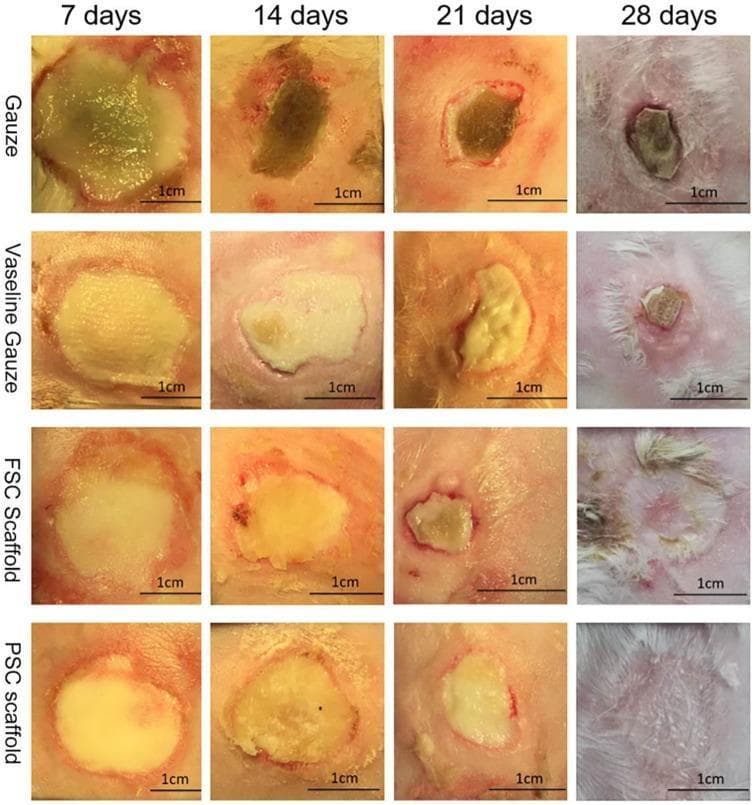
- Burns — collagen scaffolds (fish-derived FSC and porcine-derived PSC) have demonstrated superior re-epithelialization and hair regrowth compared to gauze controls in preclinical models
- Dermal regeneration following excision or trauma
Wound Healing Evidence
Collagen matrix scaffolds consistently outperform conventional dressings in preclinical burn models:
- At day 14, scaffold-treated wounds show a cleaner, yellowish-white wound bed vs. necrotic scabbing in gauze groups
- At day 28, scaffold groups achieve complete re-epithelialization and hair regrowth, while gauze groups show incomplete healing with persistent scabs
Advantages Over Conventional Dressings
- Promotes a moist wound environment
- Reduces wound contraction and scar formation
- Non-antigenic (when properly processed)
- Biodegradable — no need for surgical removal
- Compatible with topical antimicrobials and growth factors
Contraindications / Precautions
- Known hypersensitivity to bovine or porcine collagen
- Infected wounds — infection must be controlled before application
- Wounds with heavy exudate may require additional absorbent dressings
- Third-degree burns or wounds with exposed bone/tendon may need adjunctive treatments
Clinical Considerations
- Typically applied after wound debridement to a clean, viable wound bed
- May be secured with sutures, staples, or an outer secondary dressing
- Reapplication frequency depends on wound size, exudate level, and product formulation
If you are asking about Collamatrix in the context of a specific surgical subspecialty (e.g., periodontics, plastic surgery, orthopedics) or a particular clinical scenario, let me know and I can provide more targeted information.
When to use and how to use
search_medical_text
collagen matrix wound care indications clinical use
Prevention and Management of Diabetic Foot Disease
Page 254
search_medical_text
collagen scaffold application technique wound preparation protocol
Prevention and Management of Diabetic Foot Disease
Page 254
GradeResponse
GradeResponse
Here is a comprehensive clinical guide on when and how to use Collamatrix:
When to Use Collamatrix
✅ Indicated For
| Wound Type | Rationale |
|---|---|
| Chronic wounds (venous leg ulcers, pressure injuries Stage III–IV) | Stalled healing due to MMP overactivity — collagen matrix "mops up" destructive MMPs |
| Diabetic foot ulcers (neuropathic, clean, granulating) | Provides scaffold for fibroblast migration; note: strong guidelines advise against collagen/alginate solely for DFUs without evidence of benefit |
| Partial- and full-thickness burns | Promotes re-epithelialization, reduces contraction and scarring |
| Post-excision defects (tumor removal, traumatic avulsion) | Fills soft tissue voids, supports dermal regeneration |
| Surgical wounds healing by secondary intention | Bridges tissue gaps where primary closure is not possible |
| Periodontal / oral defects | Guided tissue/bone regeneration after extraction or resection |
| Donor sites (skin graft harvest areas) | Accelerates re-epithelialization |
❌ Do Not Use When
- Infected wounds — infection must be eradicated first; collagen matrix in an infected bed will degrade rapidly without benefit
- Dry, necrotic, or eschar-covered wounds — requires a viable, debrided bed
- Hypersensitivity to bovine or porcine collagen
- Third-degree burns with exposed bone/tendon — needs flap or more advanced reconstruction
- Heavy exudate without secondary management — may saturate and fail prematurely
- Diabetic foot ulcers — per Prevention and Management of Diabetic Foot Disease guidelines (p. 254), collagen or alginate dressings are not recommended for wound healing in diabetes-related foot ulcers (Strong recommendation; Low-quality evidence), given 9 of 12 RCTs showed no difference in healing outcomes
How to Use Collamatrix
Step 1 — Wound Assessment
- Confirm wound is clean, free of infection, and has a viable granulating or clean wound bed
- Measure wound dimensions (length × width × depth)
- Assess exudate level (low / moderate / heavy)
Step 2 — Wound Preparation (Critical)
- Debride all necrotic tissue, slough, and biofilm — sharp, enzymatic, or autolytic debridement as appropriate
- Irrigate with saline or wound cleanser
- Achieve hemostasis — minor bleeding is acceptable (activates collagen's hemostatic properties)
- Dry the periwound skin
Step 3 — Product Preparation
- Select the correct form:
- Sheet/membrane — flat wounds, surface defects
- Rope/strip — tunneling or undermining wounds
- Powder/granules — irregular cavity wounds with heavy exudate
- Cut sheet to fit wound dimensions (overlap edges by ~5 mm onto wound margins if needed)
- Hydrate if required per manufacturer instructions (some formulations are applied dry)
Step 4 — Application
- Place Collamatrix directly onto the wound bed — ensure full contact with no air pockets or folds
- For cavity wounds: loosely pack (do not tightly stuff) to allow expansion
- For tunnels: use rope/strip form, leave a tail for retrieval
- Secure with:
- Sutures or staples (surgical wounds)
- Non-adherent contact layer + secondary absorbent dressing (chronic wounds)
- Transparent film (low-exudate superficial wounds)
Step 5 — Secondary Dressing Selection
| Exudate Level | Recommended Secondary Dressing |
|---|---|
| Low | Transparent film or thin foam |
| Moderate | Foam dressing |
| Heavy | Alginate or superabsorbent pad |
Step 6 — Dressing Change Frequency
- Typical interval: every 3–7 days depending on exudate
- Change earlier if dressing is saturated, dislodged, or signs of infection appear
- At each change: assess for matrix integration (should appear white/yellowish and adherent as it resorbs)
- Do not forcibly remove if adherent — irrigate gently to loosen
Step 7 — Endpoint & Transition
- Continue until the wound bed is fully granulated and epithelialization is progressing
- Transition to a simple moisture-retentive dressing once collagen matrix is no longer needed
- Reassess at 4 weeks — if no ≥30–50% area reduction, reassess diagnosis, infection status, vascular supply, and adherence
Summary Algorithm
Wound identified
    ↓
Is wound infected? → YES → Treat infection first, then reassess
    ↓ NO
Is wound debrided and viable? → NO → Debride first
    ↓ YES
Is it a DFU? → YES → Follow DFU-specific guidelines (collagen NOT routinely recommended)
    ↓ NO
Select appropriate Collamatrix form (sheet / rope / powder)
    ↓
Apply to wound bed, cover with secondary dressing
    ↓
Change every 3–7 days, reassess at 4 weeks
If you need guidance for a specific wound type, anatomical site, or patient population, share those details and I can tailor the protocol further.
Montelukast side effects?
Searching for Montelukast side effects now.
GradeResponse
GradeResponse
Montelukast — Side Effects
Montelukast (Singulair) is generally well tolerated, and side effects are uncommon at therapeutic doses. However, there are important adverse effects to know.
Common / General Side Effects
| System | Effect |
|---|---|
| GI | Nausea, abdominal pain, diarrhea, dyspepsia |
| CNS | Headache, dizziness |
| Respiratory | Upper respiratory tract infection, nasal congestion |
| Dermatologic | Rash (rare), hypersensitivity reactions |
| Hepatic | Mild transaminase elevation (rare) |
⚠️ Neuropsychiatric Effects — Black Box Warning (FDA 2020)
This is the most clinically significant concern. Postmarketing surveillance has identified the following rare but serious events (Rhinitis Guidelines, p. 23):
| Category | Specific Effects |
|---|---|
| Sleep disturbances | Nightmares, insomnia, somnambulism |
| Mood disorders | Depression, irritability, aggression |
| Anxiety | Panic attacks, agitation |
| Psychotic reactions | Hallucinations, disorientation |
| Suicidality | Suicidal ideation and behavior, completed suicide |
Age-specific patterns:
- Infants — predominantly sleep disturbances
- Children — most often depression and anxiety
- Adolescents — depression, anxiety, and suicidal behavior
- Notably, completed suicides were reported more frequently in children than adolescents in a worldwide review of individual case safety reports
Most supporting evidence comes from case reports and observational studies — high-quality epidemiological data are still lacking. The causal relationship is not fully established but the FDA issued a Boxed Warning in 2020 due to the severity of potential harm.
Special Considerations
- Not associated with somnolence — unlike antihistamines, it does not cause drowsiness as a routine effect
- Churg-Strauss syndrome — rare cases of eosinophilic granulomatosis with polyangiitis (EGPA) have been reported, often when oral steroids are tapered; causality unclear
- Hypersensitivity — angioedema, urticaria, anaphylaxis reported rarely
Clinical Monitoring Recommendations
- Before prescribing, weigh benefits vs. neuropsychiatric risks, especially in patients with pre-existing psychiatric history
- Counsel patients and caregivers to report mood changes, behavioral changes, sleep disturbances, or suicidal thoughts immediately
- Monitor patients at elevated risk for suicidal ideation closely
- Discontinue if neuropsychiatric symptoms emerge — symptoms typically resolve after stopping the drug
- The FDA recommends reserving montelukast for patients who have an inadequate response or intolerance to alternative therapies (e.g., intranasal corticosteroids for allergic rhinitis)
Bottom Line
Montelukast is safe for most patients, but the neuropsychiatric black box warning requires proactive counseling and vigilance — particularly in pediatric patients and those with any psychiatric background.
Does montelukast cause suicidal thoughts?
search_medical_text
leukotriene receptor antagonist neuropsychiatric mechanism brain
Management of Very Mild and Mild Asthma in Preschoolers, Children, and Adolescents
Page 4
GradeResponse
GradeResponse
Does Montelukast Cause Suicidal Thoughts?
The honest answer is: possibly, but causation has not been definitively proven. Here is what the evidence actually shows:
What We Know
Yes, suicidal ideation and behavior have been reported in patients taking montelukast. This is well-documented in postmarketing surveillance. The FDA issued a Boxed Warning in 2020 specifically because of neuropsychiatric events including suicidal thinking and completed suicides (Rhinitis Guidelines, p. 23).
A worldwide review of Individual Case Safety Reports found:
- Suicidal thinking and behavior linked to montelukast use
- Completed suicides reported — and more frequently in children than adolescents, which was an unexpected and alarming finding
Neuropsychiatric side effects as a whole (irritability, aggressiveness, anxiety, sleep disturbance) are reported in up to 16% of pediatric patients on leukotriene receptor antagonists (CTS 2021 Asthma Guidelines, p. 4).
What We Don't Know
| Question | Current Status |
|---|---|
| Does montelukast directly cause suicidality? | Unproven — causality not established |
| How large is the absolute risk? | Unknown — no reliable incidence figure |
| Does it affect adults as much as children? | Unclear — most data are pediatric |
| What is the biological mechanism? | Hypothesized but not confirmed |
Most studies are case reports and observational data — low-quality evidence. High-quality randomized or epidemiological studies quantifying the true risk are still lacking.
Proposed Mechanism (Biological Plausibility)
Montelukast crosses the blood-brain barrier and blocks cysteinyl leukotriene receptors (CysLT1) in the brain. Leukotrienes in the CNS are involved in:
- Neuroinflammation
- Mood regulation
- Sleep-wake cycles
Blocking these receptors in the brain may dysregulate mood pathways in susceptible individuals — but this remains a hypothesis, not a confirmed mechanism.
Who Is Most at Risk
- Children — most vulnerable to suicidal ideation; completed suicides reported more in this group than adolescents
- Adolescents — depression, anxiety, and suicidal behavior
- Patients with pre-existing psychiatric conditions — significantly higher risk
- Patients on concurrent psychotropic medications
Practical Bottom Line
- Suicidal thoughts are a rare but real reported adverse effect
- Causation vs. coincidence has not been fully sorted out — but the FDA considered the signal serious enough for a Boxed Warning
- If a patient on montelukast develops any mood changes, behavioral changes, sleep disturbances, or suicidal thoughts — stop the drug and seek evaluation immediately
- For patients with a psychiatric history, montelukast should be used with extra caution or avoided if alternatives exist
- Symptoms typically resolve after discontinuation
Key message for patients/caregivers: Suicidal thoughts on montelukast are rare, but they are real enough that the FDA mandates a warning. Any new or worsening mood or behavioral changes while on this drug should be reported to a doctor promptly — do not wait for the next scheduled visit.
This is a shared conversation. Sign in to Orris to start your own chat.