

Is that a fracture
Reading File
I'll analyze this right shoulder AP X-ray for fracture findings, and search for reference imaging to support the analysis.
search_medical_image
shoulder fracture AP X-ray proximal humerus clavicle

Hugging Face pmc clinical VQA raw
Page 0
search_medical_text
proximal humerus fracture AP shoulder X-ray diagnosis classification
Bailey and Love's Short Practice of Surgery 28th Edition
Page 457
GradeResponse
GradeResponse
X-ray Analysis — Right Shoulder AP (57M, 05/04/2026)
Looking at this AP shoulder radiograph carefully:
What the Green Circle Marks
The green annotation points to the superior aspect of the right shoulder, near the acromioclavicular (AC) joint region / lateral clavicle. This area warrants careful scrutiny.
Findings
Proximal Humerus:
- The humeral head appears to be inferiorly displaced / subluxed relative to the glenoid — there is a noticeable gap between the humeral head and the glenoid fossa, which is abnormal. This pattern is classic for a "drooping shoulder" seen with:
- Proximal humerus fracture with associated muscle inhibition
- Shoulder dislocation (inferior/subglenoid)
- The cortical outline of the surgical neck region shows possible disruption, suggesting a surgical neck fracture of the proximal humerus
Marked Area (green circle):
- The green circle highlights what appears to be a lucent defect or cortical irregularity in the region of the superior humeral head / anatomical neck — this could represent a fracture line
Using the Neer Classification (Bailey & Love, p. 457), proximal humerus fractures are assessed across four parts: articular head, lesser tuberosity, greater tuberosity, and shaft. The apparent inferior displacement suggests at minimum a 2-part surgical neck fracture.
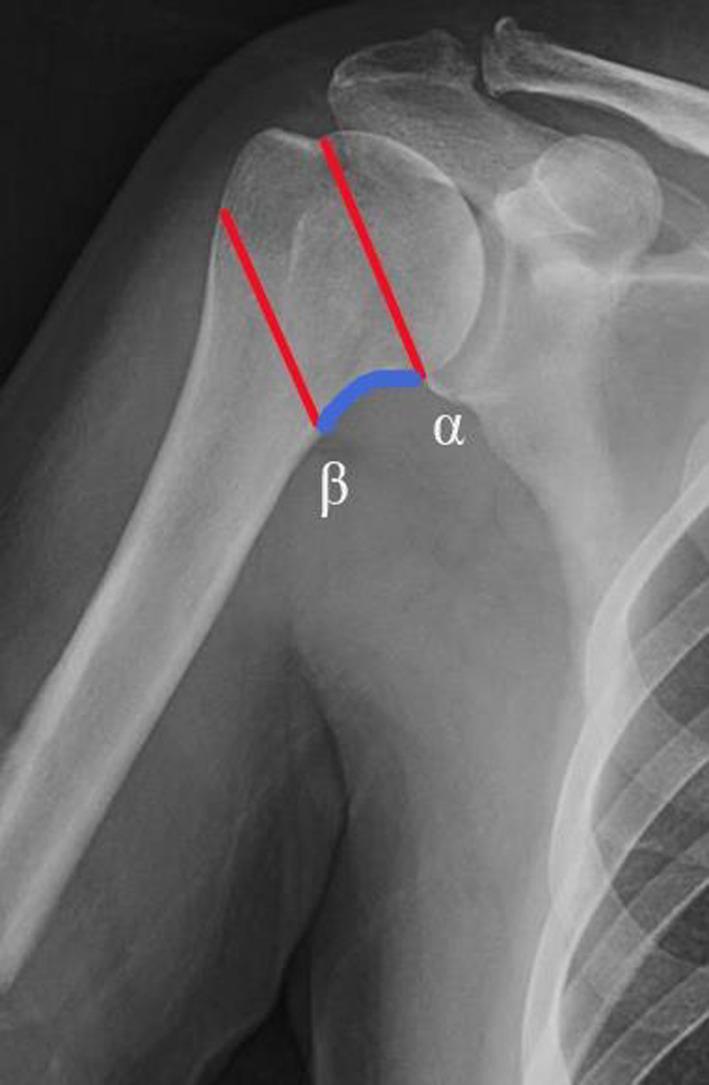
Reference: Annotated AP shoulder X-ray showing anatomical neck (α), surgical neck (β), and medial calcar zones — key fracture classification landmarks
Impression
Yes, this is highly suspicious for a fracture — most likely a proximal humerus fracture (surgical neck) with inferior subluxation of the humeral head. The green circle appears to highlight an additional focal cortical irregularity at the humeral head/anatomical neck.
Next Steps
- Orthogonal views — Y-scapular or axillary lateral view to confirm displacement and rule out dislocation
- CT scan — if surgical planning is needed (better characterizes fragment number and displacement)
- Orthopedic referral — urgent, given the apparent displacement
- Arm immobilization in a sling pending formal assessment
⚠️ This analysis is for informational support only. A formal radiological and orthopedic evaluation by a qualified clinician is essential before any clinical decisions are made.
This is a shared conversation. Sign in to Orris to start your own chat.