
Cutaneous drugs reaction derma
Reading File
Now let me search the medical library for cutaneous drug reactions comprehensively.
Finding Sources
Finding Sources
Searching PubMed
"cutaneous drug reactions"[MeSH Terms] AND "drug hypersensitivity"[MeSH Terms]
Found good sources. Let me read the dermatology textbook sections on cutaneous drug reactions.
Finding Sources
Reading File
Finding Sources
Reading File
Finding Sources
Finding Sources
Reading File
Reading File
Excellent content found. Let me get more from the main drug reactions section and the Dermatology 5e textbook.
Reading File
Finding Sources
Reading File
Loading Image
Reading File
Reading File
I now have comprehensive content. Let me compile the full, detailed answer.
Cutaneous Drug Reactions (Adverse Cutaneous Drug Reactions / CARs)
The skin is one of the most common targets for adverse drug reactions. Up to 8% of hospitalized patients experience cutaneous adverse reactions (CARs), which account for ~2% of dermatology consultations and ~5% of inpatient dermatology admissions. Fatalities from drug reactions (systemic + cutaneous) in inpatients range from 0.1%-0.3%.
Pathomechanisms
The central immunologic event in severe cutaneous drug reactions involves a drug-MHC complex that activates CD8+ T cells, which then cause keratinocyte cell death via apoptosis and necroptosis:
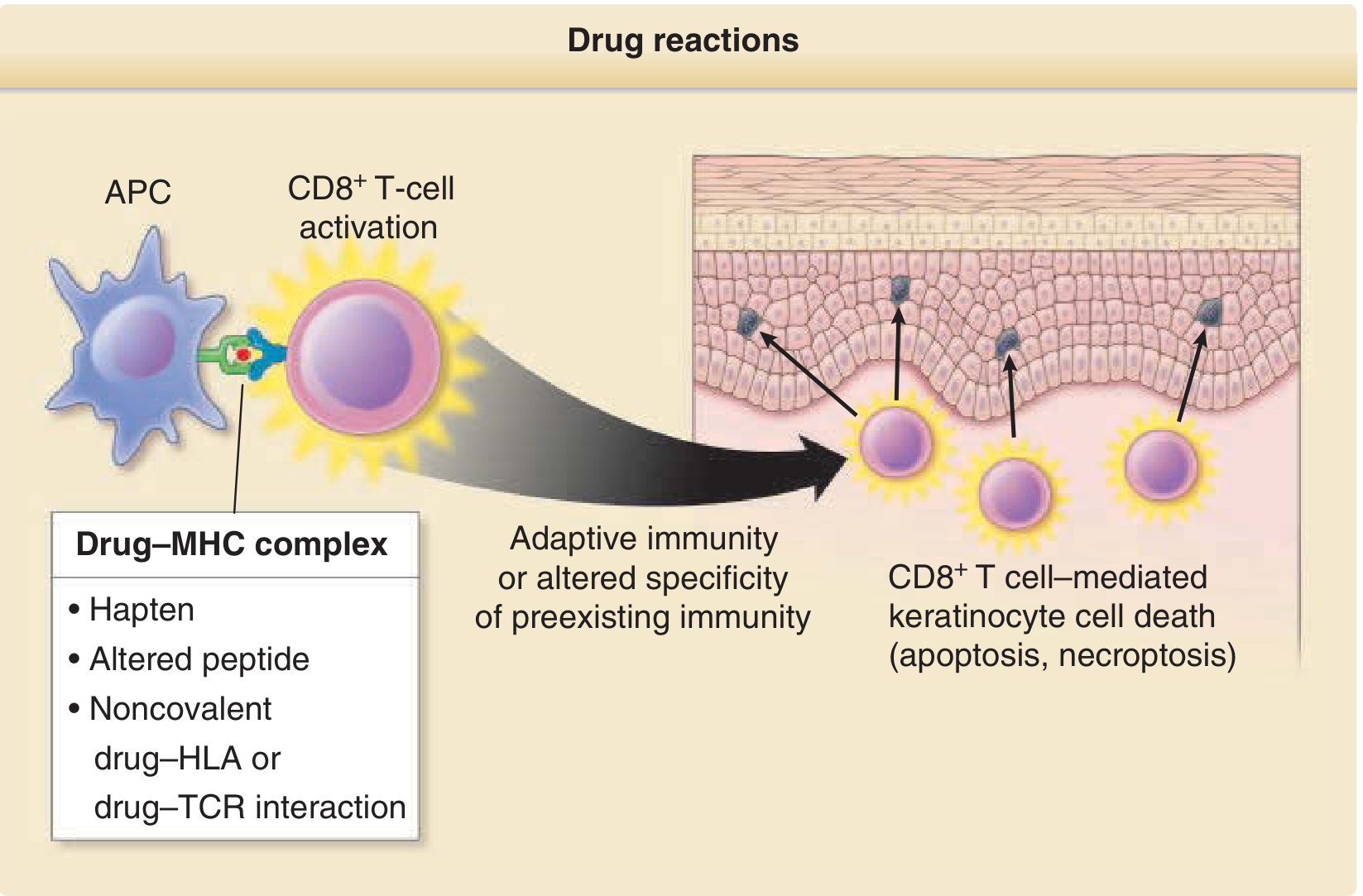
Figure: Canonical or aberrant activation of T cells triggered by a culprit drug results in T cell-mediated keratinocyte cell death in severe drug reactions such as SJS and TEN. (Fitzpatrick's Dermatology)
Three proposed models of T-cell activation:
- Hapten model - drug acts as a hapten, binding covalently to protein, forming a complete antigen
- Altered peptide model - drug modifies self-peptides presented by MHC
- Pharmacologic interaction (p-i concept) - drug binds noncovalently to drug-HLA or drug-TCR, triggering immune response without prior sensitization
Classification of Cutaneous Drug Reactions
Non-Severe (Common) Reactions
| Type | Features | Common Culprits |
|---|---|---|
| Exanthematous (Morbilliform) | Most common; maculopapular, measles-like; starts centrally, spreads peripherally; begins 4-21 days after starting drug | Penicillins, ampicillin, sulfonamides, allopurinol, carbamazepine |
| Urticaria / Angioedema | Transient, pruritic, edematous wheals; can be IgE-mediated (within 1 hour) or delayed | NSAIDs, aspirin, penicillin, opioids, ACE inhibitors (angioedema) |
| Fixed Drug Eruption (FDE) | Discrete, recurrent lesions at the same site each time the drug is taken; post-inflammatory hyperpigmentation; CD8+ TRM cells persist at sites | Tetracycline, NSAIDs, sulfonamides, paracetamol, trimethoprim |
| Lichenoid | Purple, flat-topped papules resembling lichen planus | Antimalarials, gold, thiazides, captopril, NSAIDs |
| Photosensitivity | Phototoxic (dose-dependent, UVA) vs. photoallergic (immunologic, UVA) | Tetracyclines (phototoxic), fluoroquinolones, amiodarone, thiazides |
| Acneiform | Follicular eruption without comedones | Corticosteroids, androgens, epidermal growth factor receptor (EGFR) inhibitors |
| Psoriasiform | Psoriasis-like plaques; may precipitate or worsen psoriasis | Beta-blockers, lithium, antimalarials, TNF inhibitors |
| Drug-Induced Lupus | ANA+, anti-histone antibodies; resolves on stopping drug | Hydralazine, procainamide, isoniazid, minocycline |
| Hyperpigmentation | Diffuse or localized skin/mucous membrane pigmentation | Minocycline (blue-gray), amiodarone, antimalarials, bleomycin |
Severe Cutaneous Adverse Reactions (SCARs)
SCARs are potentially life-threatening immune-mediated reactions. The main SCARs are:
- Anaphylaxis
- Acute Generalized Exanthematous Pustulosis (AGEP)
- DRESS / DIHS
- Generalized Bullous Fixed Drug Eruption
- Stevens-Johnson Syndrome (SJS)
- Toxic Epidermal Necrolysis (TEN)
- Anticoagulant-induced skin necrosis
1. Stevens-Johnson Syndrome (SJS) / Toxic Epidermal Necrolysis (TEN)
SJS and TEN are on a spectrum:
- SJS: epidermal detachment <10% BSA
- SJS/TEN overlap: 10-30% BSA
- TEN: >30% BSA
Key features:
- Prodrome: fever, flu-like symptoms, burning eyes
- Targetoid lesions - atypical flat targets with dusky center
- Painful mucosal erosions (oral, ocular, genital) in >90%
- Nikolsky sign positive (skin shears off with lateral pressure)
- Epidermis separates at the dermal-epidermal junction
- Mortality: SJS ~5%, TEN ~25-30%
Pathomechanism: CD8+ T cells accumulate along the dermal-epidermal junction, causing interface dermatitis with keratinocyte apoptosis. Granulysin released by cytotoxic T cells is a key mediator of keratinocyte death.
Common drugs: Allopurinol (#1 worldwide), aromatic anticonvulsants (carbamazepine, phenytoin, phenobarbital), sulfonamides, lamotrigine, oxicam NSAIDs, nevirapine
Genetic predisposition: Strong HLA associations -
- HLA-B*5801 + allopurinol (Han-Chinese, Korean, Thai)
- HLA-B*1502 + carbamazepine (Han-Chinese)
2. DRESS (Drug Reaction with Eosinophilia and Systemic Symptoms) / DIHS
Also called Drug-Induced Hypersensitivity Syndrome (DIHS)
| Feature | Details |
|---|---|
| Onset | 2-8 weeks after starting drug (long latency is distinctive) |
| Rash | Maculopapular/morbilliform, may be >50% BSA (in 45-80%) |
| Facial edema | Very characteristic |
| Fever | >38°C in nearly all |
| Lymphadenopathy | Present |
| Eosinophilia | Hallmark; >1,500/mm³ |
| Atypical lymphocytes | Lymphocytosis with atypical forms |
| Liver involvement | Elevated LFTs; can cause fatal hepatitis |
| Herpesvirus reactivation | HHV-6, HHV-7, EBV, CMV reactivation is characteristic |
| Late sequelae | Autoimmune diseases (Hashimoto thyroiditis, SLE, Type 1 diabetes) months later |
Common drugs: Aromatic anticonvulsants (carbamazepine, phenytoin, phenobarbital), allopurinol, sulfonamides, dapsone, minocycline, lamotrigine
Genetic risk: HLA-B13:01 + dapsone (Asians); HLA-A31:01 + carbamazepine (Europeans)
3. Acute Generalized Exanthematous Pustulosis (AGEP)
- Acute onset of hundreds of non-follicular, sterile pustules on an erythematous background
- Usually starts on face/intertriginous areas, spreads rapidly
- Fever, neutrophilia
- Onset: within 48 hours (much faster than DRESS)
- Resolves spontaneously in ~2 weeks after stopping drug
- Less severe than SJS/TEN or DRESS
- Culprits: Aminopenicillins (#1), cephalosporins, macrolides, diltiazem, hydroxychloroquine
4. Fixed Drug Eruption (FDE)
- Well-demarcated, round/oval, dusky red/violaceous plaques
- Occur at the exact same site with each drug exposure
- Burn/sting, then leave post-inflammatory hyperpigmentation
- Common sites: lips, genitals, perianal region, hands
- Mechanism: CD8+ resident memory T cells (TRM) persisting at prior lesion sites
Features Suggesting a SCAR (Red Flags)
| Cutaneous | Systemic | Laboratory |
|---|---|---|
| Skin pain | High fever | Marked eosinophilia |
| Confluent erythema | Lymphadenopathy | Atypical lymphocytes |
| Facial edema | Arthralgia/arthritis | Leukopenia |
| Blisters / epidermal detachment | Shortness of breath / stridor | Abnormal LFTs / renal function |
| Mucosal erosions | Hypotension | Thrombocytopenia |
| Necrosis | Other visceral involvement | Neutrophilia |
| Palpable purpura | ||
| Urticaria | ||
| Swelling of lips/tongue |
(Adapted from Roujeau & Stern, N Engl J Med 1994)
Immunologic Classification (Gell & Coombs)
| Type | Mechanism | Examples |
|---|---|---|
| Type I (IgE-mediated) | Mast cell degranulation | Urticaria, anaphylaxis (penicillin) |
| Type II (Cytotoxic) | IgG/IgM + complement | Drug-induced hemolytic anemia, thrombocytopenia |
| Type III (Immune complex) | IgG-drug complexes in vessels | Serum sickness, vasculitis, drug fever |
| Type IV (Delayed T-cell) | CD4+/CD8+ T cells | Contact dermatitis, FDE, SJS/TEN, DRESS, AGEP |
Non-immunologic mechanisms also exist: pharmacologic (pseudoallergic reactions to NSAIDs/aspirin via COX-1 inhibition with leukotriene excess), cumulative toxicity, phototoxicity.
Risk Factors
- Immunosuppression: HIV-infected patients have 10-50x greater risk of exanthematous eruptions to sulfonamides
- Specific HLA alleles (see above)
- Polypharmacy (elderly patients)
- Impaired renal, hepatic, or cardiac function (affects drug metabolism)
- Prior drug reaction history
Diagnosis
Approach: Clinical characteristics + chronologic factors (timeline of drug exposure) + literature search
Investigations:
- IgE-specific assays (RAST/ImmunoCAP) - for IgE-mediated reactions
- Prick/intradermal skin tests - for urticaria/angioedema; contraindicated in SJS/TEN
- Patch testing (48h under occlusion on upper back) - for delayed reactions; variable sensitivity
- Lymphocyte transformation test - limited clinical utility
- CBC with differential (eosinophilia, atypical lymphocytes), LFTs, renal function, urinalysis
Rechallenge: Carries risk of more severe reaction; contraindicated after SCARs
Management Principles
- Identify and stop the culprit drug - most critical step, especially in SCARs
- Supportive care - wound care (SJS/TEN), IV fluids, nutritional support, ophthalmology consultation (mucosal involvement)
- Urticaria/angioedema: Antihistamines (H1 blockers); systemic corticosteroids for severe cases; epinephrine for anaphylaxis
- Morbilliform eruptions: Topical corticosteroids, antihistamines; usually self-limited once drug stopped
- SJS/TEN: ICU/burn unit care; cyclosporin (gaining evidence), IVIG (controversial), etanercept; avoid systemic corticosteroids in TEN (increased infection risk)
- DRESS: Systemic corticosteroids are first-line; prolonged taper (3+ months) to prevent relapse; monitor for herpesvirus reactivation and autoimmune sequelae
- AGEP: Stop culprit; topical corticosteroids; spontaneous resolution within ~2 weeks
Drugs With Highest Rates of Cutaneous Reactions
Based on large epidemiological data (Arndt & Jick), the drugs with the highest rates of cutaneous reactions per 1,000 patients include:
- Amoxicillin (~51/1,000)
- Trimethoprim-sulfamethoxazole (~59/1,000)
- Ampicillin (~52/1,000)
- Semisynthetic penicillins
- Aromatic anticonvulsants
- Allopurinol
- Sulfonamides
Low-risk drugs (rates ≤3/1,000) include: prednisone, codeine, warfarin, regular insulin, digoxin, morphine.
Newer Targeted Therapies & Immune Checkpoint Inhibitors (ICIs)
- EGFR inhibitors (cetuximab, erlotinib): Papulopustular acneiform eruption in 50-80%; xerosis, nail changes
- Anti-PD-1/PD-L1 checkpoint inhibitors (nivolumab, pembrolizumab): Wide range of immune-related adverse events (irAEs) - maculopapular rash, pruritus, lichenoid reactions, bullous disorders, vitiligo
- BRAF/MEK inhibitors: Keratoacanthoma-like tumors, hyperproliferative lesions, photosensitivity
- Tyrosine kinase inhibitors (TKIs): Hand-foot skin reaction, hair changes
Sources:
- Dermatology 2-Volume Set 5e (Bolognia et al.), Chapter 21 - Cutaneous Drug Reactions
- Fitzpatrick's Dermatology, Chapter 13 - Drug Reactions
- Barash & Stoelting's Clinical Anesthesia, 9e
This is a shared conversation. Sign in to Orris to start your own chat.