
Discuss different types of placental abnormalities and their significance.
I'll start by reading the medical library skill, then search for comprehensive information on placental abnormalities.
Reading File
Now I'll search the library and PubMed in parallel for placental abnormalities.
Finding Sources
Finding Sources
Searching PubMed
placental abnormalities classification clinical significance
Excellent - multiple authoritative sources found. Now I'll read them in parallel.
Reading File
Reading File
Reading File
Reading File
Good content found. Now I'll search for more detailed sections - particularly on abruption, molar pregnancy, chorioamnionitis, and vascular abnormalities, plus fetch the diagram image.
Finding Sources
Finding Sources
Loading Image
Reading File
Finding Sources
Finding Sources
Reading File
Finding Sources
Reading File
Reading File
Finding Sources
I now have extensive information from multiple authoritative textbooks. Let me also look at the Robbins pathology content on placental infections and the Creasy content on placenta accreta spectrum for completeness.
Reading File
Reading File
I now have rich, comprehensive content from multiple authoritative textbooks. Let me compile the full detailed answer.
Placental Abnormalities: Types and Clinical Significance
The placenta is the critical interface between mother and fetus, and its structural or functional abnormalities carry serious consequences ranging from preterm birth and fetal growth restriction (FGR) to life-threatening hemorrhage and malignant transformation. Below is a systematic overview organized by category.
1. Abnormalities of Implantation
Placenta Previa
Placenta previa occurs when the blastocyst implants in the lower uterine segment, with the placenta completely or partially overlying the internal cervical os.
Types:
- Complete (central) previa - placenta fully covers the os
- Partial previa - partially covers the os
- Marginal previa - placental edge within 2 cm of the os
Significance:
- Painless third-trimester bleeding is the hallmark presentation
- The median gestational age at first bleed is approximately 30 weeks, with delivery occurring about 20 days later on average
- Complete previa requires cesarean section to avert fatal maternal/fetal hemorrhage during vaginal delivery
- Over 50% of women with antepartum bleeding from previa deliver before term
- Strong association with placenta accreta spectrum (up to 60% of accreta cases have co-existing previa)
(Robbins Pathologic Basis of Disease; Creasy & Resnik's Maternal-Fetal Medicine)
Placenta Accreta Spectrum (PAS)
PAS is caused by complete or focal absence of the decidua basalis, allowing chorionic villi to invade directly into or through the myometrium. The spectrum has three grades:
| Grade | Definition |
|---|---|
| Accreta | Villi adhere to myometrium without invasion (~0.2% of pregnancies) |
| Increta | Villi invade into myometrium |
| Percreta | Villi penetrate full thickness of myometrium, reaching serosa or adjacent organs (bladder, bowel) |
Risk factors: Prior cesarean section (most important), prior uterine surgery, placenta previa, uterine scarring
Significance:
- Failure of placental separation at birth causes severe, potentially life-threatening postpartum hemorrhage
- Planned preterm cesarean hysterectomy (leaving the placenta in situ) is the recommended approach
- MRI features include disorganized placental vasculature, loss of the uterine-placental zone, and bladder tenting
- Ultrasound findings include: bridging/tornado vessels (71% for accreta), loss of retroplacental clear zone (85% for increta), placental lacunae with turbulent flow (82% for percreta)
(Robbins Pathologic Basis of Disease; Grainger & Allison's Diagnostic Radiology)
2. Umbilical Cord and Vascular Anomalies
Vasa Previa
Vasa previa is a condition in which umbilical cord vessels run through the fetal membranes (velamentous insertion) within 20 mm of the internal cervical os.
- Incidence: 1 per 2,000-5,000 singleton deliveries; 1 per 200-300 multifetal deliveries
- Pathogenesis: Essentially all cases are associated with velamentous cord insertion; also associated with succenturiate placental lobes, low-lying placentation, and IVF
- Significance: When membranes rupture, the unprotected fetal vessels rupture too, leading to rapid fetal exsanguination - the perinatal mortality without antenatal diagnosis is ~56%, dropping to <3% with prenatal detection
- Diagnosis: Color Doppler transvaginal ultrasound demonstrating vessels within 2 cm of the endocervical os
- Management: Elective cesarean delivery before membrane rupture; reevaluation at 30-32 weeks is recommended for cases identified in the first/second trimester
(Creasy & Resnik's Maternal-Fetal Medicine)
Velamentous Cord Insertion
The umbilical vessels separate within the fetal membranes before reaching the placental disc (rather than inserting centrally into the placenta). This increases the risk of cord vessel trauma, bleeding during delivery, PROM, and preterm birth.
Single Umbilical Artery
Normally the cord has two arteries and one vein. A single umbilical artery (absent one artery) is associated with congenital anomalies, chromosomal abnormalities, and FGR.
Cord Length Abnormalities
- Long cord (>90 cm): Prone to prolapse, nuchal coiling, and true knots - cord compression between the presenting part and the bony pelvis can cause fetal hypoxia/anoxia; if oxygen deficiency persists >5 minutes, neonatal brain damage may result
- Short cord (<30 cm): Risk of premature placental separation during delivery
(The Developing Human - Clinically Oriented Embryology)
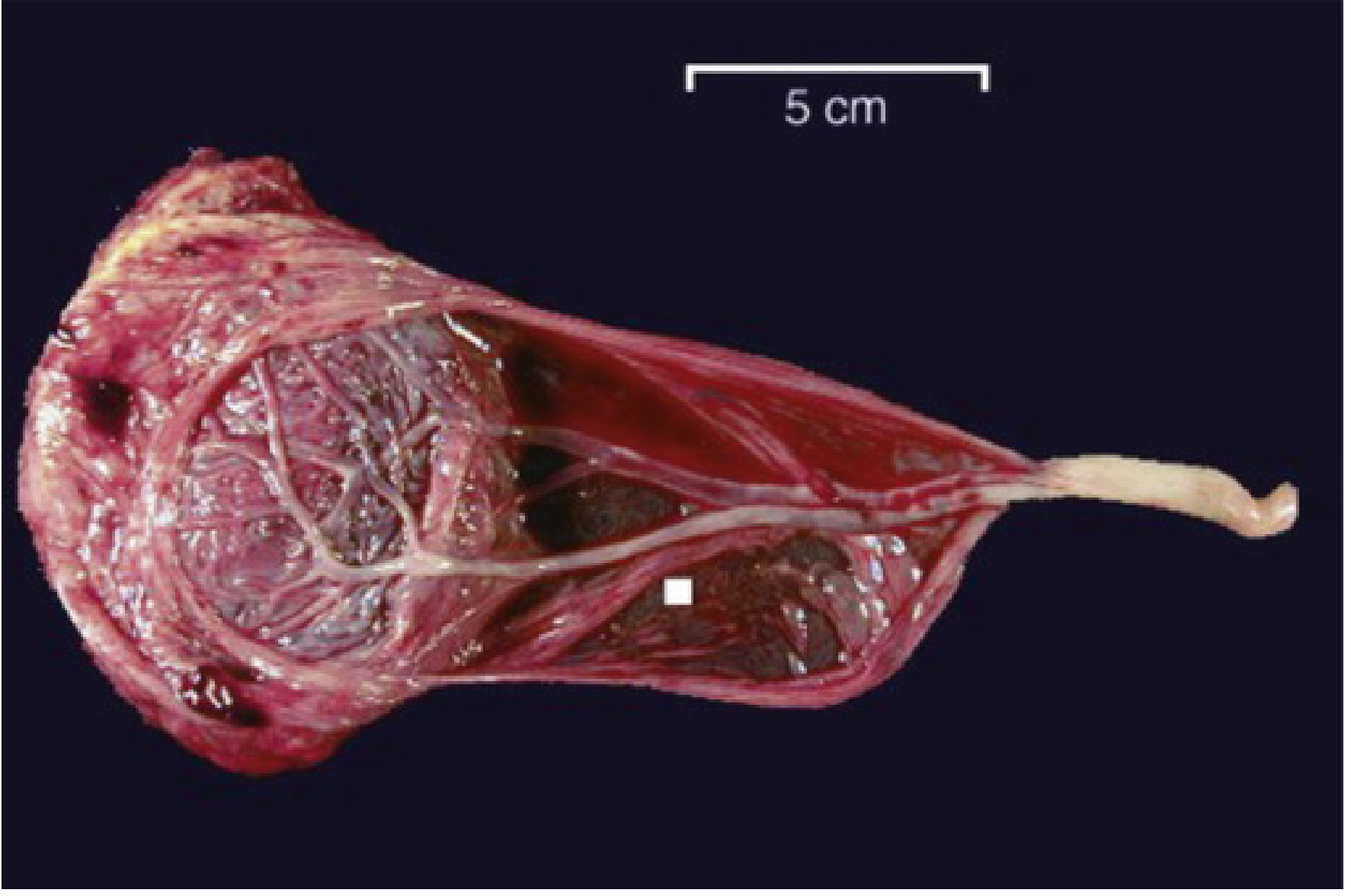
3. Placental Abruption (Abruptio Placentae)
Placental abruption is the abnormal premature separation of the placenta from the implantation site. It occurs most frequently between 24-26 weeks and complicates approximately 1% of pregnancies.
Types by hemorrhage pattern:
- Revealed (external) hemorrhage - blood tracks through membranes and exits via the cervix
- Concealed hemorrhage - blood collects behind the placenta (retroplacental hematoma); this pattern is more dangerous as the extent of blood loss is not apparent
Risk factors: Advanced maternal age, hypertension, trauma, cocaine use, prior abruption
Clinical features: Painful vaginal bleeding (as opposed to the painless bleeding of previa), uterine tenderness, fetal distress
Imaging:
- Ultrasound: Retroplacental hypoechoic zone >2 cm raises suspicion; however, sensitivity is only ~25% - ultrasound should not be used to exclude abruption
- CT (trauma context): Full-thickness low-attenuation areas making an acute angle with the myometrium; high-attenuation amniotic fluid suggests hemorrhage; hemorrhage may be preplacental, retroplacental, or intraplacental
Significance: Major cause of preterm delivery, fetal hypoxia, stillbirth, and maternal DIC. Histologically, the section through the placenta shows nodular ischemia and infarction above clots.
(Roberts and Hedges' Clinical Procedures in Emergency Medicine; Grainger & Allison's Diagnostic Radiology)
4. Placental Infections
Infections reach the placenta by two routes:
Ascending Infection (most common)
- Virtually always bacterial
- Localized chorioamnionitis - neutrophilic infiltrate of the chorion-amnion (maternal inflammatory response)
- The fetal response is a vasculitis of the umbilical or chorionic plate vessels (fetal inflammatory response)
- Significance: Premature rupture of membranes (PROM), preterm delivery, cloudy/purulent amniotic fluid; intense fetal inflammatory responses are associated with perinatal morbidity and increased risk of cerebral palsy
Hematogenous (Transplacental) Infection
- TORCH group: Toxoplasmosis, Others (syphilis, TB, listeriosis), Rubella, CMV, Herpes simplex
- Produces chronic villitis (chronic inflammatory cell infiltrates in chorionic villi)
- Associated with symmetric FGR and long-term neurodevelopmental disability
(Robbins, Cotran & Kumar Pathologic Basis of Disease)
5. Placental Causes of Fetal Growth Restriction (FGR)
Placental insufficiency is an important cause of asymmetric (disproportionate) FGR - where brain growth is relatively spared at the expense of the body (brain-sparing effect).
Causes of uteroplacental insufficiency include:
- Single umbilical artery or abnormal cord insertion
- Placental abruption and infarction
- Placenta previa
- Placental thrombosis
- Chronic villitis of unknown etiology
- Multiple gestation
- Maternal vascular malperfusion (MVM): Characterized by placental hypoplasia (<10th percentile for gestational age), placental infarcts, abnormal spiral artery remodeling, and ischemic villous changes - strongly linked to preeclampsia
Significance: SGA infants face significant perinatal morbidity including cerebral dysfunction, learning disabilities, hearing and visual impairment. In adulthood, there is increased cardiovascular risk.
(Robbins Pathologic Basis of Disease; Creasy & Resnik's Maternal-Fetal Medicine)
6. Gestational Trophoblastic Disease (GTD)
GTD encompasses a spectrum from benign molar pregnancy to malignant tumors.
Hydatidiform Mole (Complete vs. Partial)
| Feature | Complete Mole | Partial Mole |
|---|---|---|
| Karyotype | Diploid (46,XX or 46,XY) | Triploid (e.g., 69,XXY) |
| Genetic origin | All paternal (androgenesis) | Egg + 2 sperm (excess paternal) |
| Villous edema | All villi affected | Some villi affected |
| Trophoblast proliferation | Diffuse, circumferential | Focal, slight |
| Fetal parts | Absent | May be present |
| Serum hCG | Markedly elevated (may exceed 100,000 IU/L) | Less elevated |
| Risk of choriocarcinoma | ~2.5% | Rare |
Incidence: ~1 in 1,000-2,000 pregnancies in the US; higher in Southeast Asia; higher at reproductive extremes (teenagers and >40 years)
Clinical: Uterus "too large for dates," absent fetal heart sounds, very high hCG, first-trimester vaginal bleeding
Morphology: Uterine cavity expanded by thin-walled, translucent cystic structures; in advanced complete moles the uterine cavity may be filled with a mass resembling a "bunch of grapes"
Management: Uterine curettage followed by serial hCG monitoring for 6-12 months; persistent elevation of hCG signals invasive mole or choriocarcinoma
Invasive Mole and Choriocarcinoma
- Invasive mole penetrates into or through the myometrium
- Choriocarcinoma is a highly malignant tumor of trophoblastic cells; highly chemosensitive (methotrexate-based regimens are curative in most cases)
(Robbins & Kumar Basic Pathology; Robbins, Cotran & Kumar Pathologic Basis of Disease)
7. Preeclampsia-Related Placental Pathology
Preeclampsia (hypertension + proteinuria/end-organ damage after 20 weeks) has its roots in placental dysfunction:
- Decidual arteriopathy: Abnormal remodeling of spiral arteries - characterized by fibrinoid necrosis of vessel walls and sub-endothelial foamy macrophages (acute atherosis)
- Leads to uteroplacental ischemia, systemic endothelial dysfunction, and a cascade involving vasospasm, DIC, renal failure, pulmonary edema, and the HELLP syndrome
- Complicates 3-5% of pregnancies; accounts for >50,000 maternal deaths yearly worldwide
- Following delivery, hypertension and proteinuria usually resolve within 1-2 weeks, but ~20% of affected women develop hypertension and microalbuminuria within 7 years, and there is a two-fold increase in long-term cardiovascular risk
(Robbins, Cotran & Kumar Pathologic Basis of Disease)
8. Miscellaneous Placental Structural Abnormalities
| Abnormality | Description | Significance |
|---|---|---|
| Succenturiate lobe | One or more accessory placental lobes separate from the main disc | Risk of vasa previa; retained lobe postpartum causing hemorrhage/infection |
| Battledore placenta | Cord inserts at the placental margin | Generally no major consequence; slightly increased bleeding risk |
| Chorioangioma | Vascular tumor of the placenta | Large tumors cause fetal hydrops, polyhydramnios, high-output cardiac failure |
| Placental infarcts | Areas of ischemic necrosis due to spiral artery occlusion | Small peripheral infarcts are normal; extensive central infarcts indicate maternal vascular malperfusion and are associated with FGR and stillbirth |
| Perivillous fibrin deposition | Excess fibrin around villi | Reduces placental reserve; associated with recurrent pregnancy loss |
| Retained products of conception | Residual placental tissue post-delivery | Postpartum hemorrhage and infection; appears as heterogeneous vascular mass on ultrasound |
(Creasy & Resnik's Maternal-Fetal Medicine; Grainger & Allison's Diagnostic Radiology)
Summary: Clinical Impact by Category
| Category | Key Risk |
|---|---|
| Placenta previa | Antepartum hemorrhage, preterm birth |
| Placenta accreta spectrum | Massive postpartum hemorrhage, hysterectomy |
| Vasa previa | Fetal exsanguination at membrane rupture |
| Placental abruption | Fetal hypoxia, DIC, preterm birth |
| Placental infections | PROM, preterm birth, cerebral palsy |
| Uteroplacental insufficiency | Asymmetric FGR, stillbirth |
| Hydatidiform mole | Risk of choriocarcinoma (complete >partial) |
| Preeclampsia-related | Maternal multi-organ failure, fetal growth restriction |
Ultrasound - including color Doppler transvaginal scanning - is the cornerstone of antenatal diagnosis for all structural placental abnormalities. MRI provides complementary detail for depth of invasion in PAS and for characterizing hemorrhage in abruption.
This is a shared conversation. Sign in to Orris to start your own chat.