
Skull bone anatomy
Reading File
Finding Sources
Searching Images
skull bone anatomy diagram
Finding Sources
Finding Sources
Reading File
Finding Sources
Reading File
Reading File
Finding Sources
Reading File
Finding Sources
Reading File
Reading File
Loading Image
Loading Image
Loading Image
Now I have rich textbook content and excellent diagrams. Let me also fetch the middle cranial fossa image and the skull base diagram.
Finding Sources
Loading Image
Reading File
I now have comprehensive content from Gray's Anatomy for Students and other sources. Let me compile the full answer.
Skull Bone Anatomy
The skull (cranium) is a complex bony structure that encloses and protects the brain, houses the sensory organs, and forms the skeleton of the face. It is divided into two functional parts: the neurocranium and the viscerocranium.
Overview: Bones of the Skull
The skull is comprised of 8 cranial bones and 14 facial bones. The cranial bones are:
| Bone | Count | Type |
|---|---|---|
| Frontal | 1 | Flat |
| Parietal | 2 | Flat |
| Temporal | 2 | Irregular |
| Occipital | 1 | Flat |
| Sphenoid | 1 | Irregular |
| Ethmoid | 1 | Irregular |
Each bone consists of solid inner and outer cortical layers (tables) separated by cancellous bone — the diploe. The bones of the temporal region are the thinnest of the skull (averaging 2–6 mm total thickness in adults).
— ROSEN's Emergency Medicine, p. 368; Cummings Otolaryngology, p. 191
Part 1: Neurocranium
The neurocranium is the bony case enclosing the brain. It has two components:
A. Calvaria (Skullcap)
Formed by intramembranous ossification of head mesenchyme. The flat bones are:
- Frontal bone — forms the forehead and roof of the orbits
- Two parietal bones — form the sides and roof of the cranial cavity
- Squamous part of the occipital bone — forms the posterior skull
- Squamous and tympanic parts of the temporal bones
During fetal life, these bones are separated by fibrous joints — sutures and fontanelles:
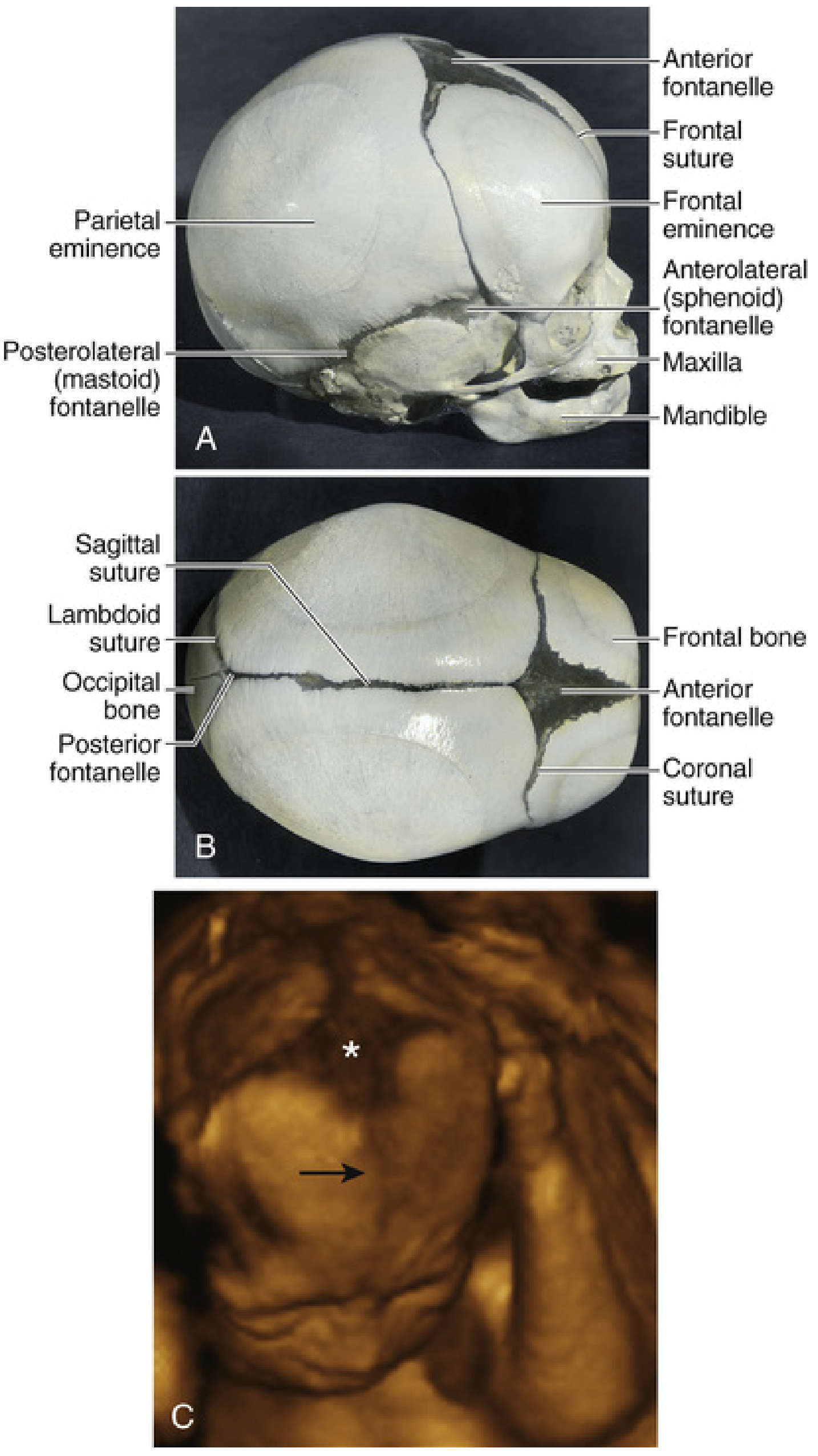
Six fontanelles are present at birth:
- Anterior fontanelle (diamond-shaped, at junction of frontal, sagittal, and coronal sutures) — closes by end of year 2
- Posterior fontanelle (triangular, at lambda) — closes by 2–3 months
- Two anterolateral (sphenoid) fontanelles — close within first few months
- Two posterolateral (mastoid) fontanelles — close by end of year 1
Major sutures of the adult calvaria:
- Coronal suture — frontal ↔ parietal
- Sagittal suture — between the two parietals
- Lambdoid suture — parietal/temporal ↔ occipital
- Squamosal suture — temporal ↔ parietal
B. Cranial Base (Chondrocranium)
Formed by endochondral ossification, beginning with the occipital bone, then body of sphenoid, then ethmoid. The cranial base consists of:
- Occipital bone (from parachordal/basal plate cartilage)
- Body and lesser wings of sphenoid (from hypophyseal cartilage and ala orbitalis)
- Ethmoid (from trabeculae cranii)
- Petrous and mastoid parts of temporal bone (from otic capsules)
— The Developing Human, pp. 921–926
Part 2: Cranial Fossae
The floor of the cranial cavity (skull base) is divided into three fossae:
Anterior Cranial Fossa
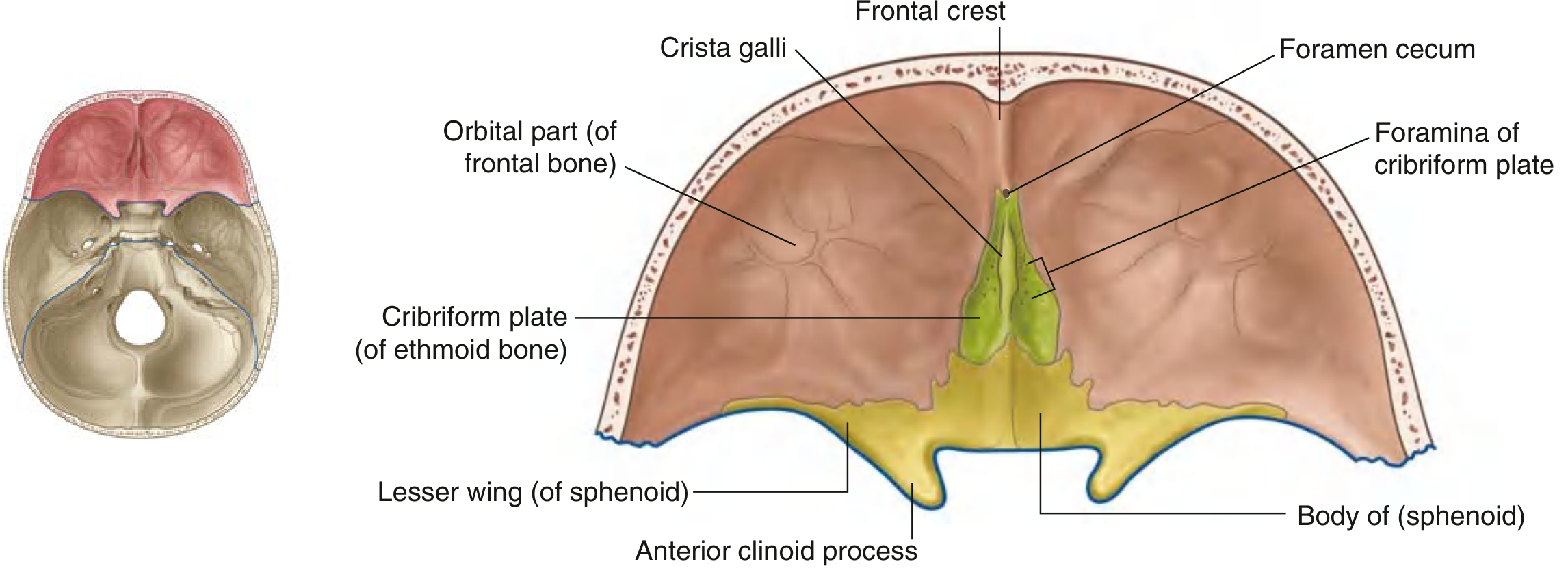
Bones forming it: Frontal (anterior/lateral), Ethmoid (midline), Sphenoid — body and lesser wings (posterior)
Sits above: Nasal cavity and orbits. Contains the frontal lobes of the cerebrum.
Key features:
- Frontal crest — attachment for falx cerebri; leads to foramen cecum (emissary veins to nasal cavity)
- Crista galli (ethmoid) — second attachment point for falx cerebri
- Cribriform plate (ethmoid) — sieve-like, transmits olfactory nerve fibers [CN I] from nasal mucosa to olfactory bulb
- Orbital part of frontal bone — forms the roof of the orbits
Boundary with middle fossa: Anterior edge of the prechiasmatic sulcus across the sphenoid body.
Middle Cranial Fossa
Bones forming it: Sphenoid (body + greater wings) and temporal bone (squamous + petrous parts)
Key features:
- Sella turcica (Turkish saddle) — depression in the sphenoid body housing the pituitary gland; flanked by the cavernous sinuses
- Anterior clinoid processes — attachment for tentorium cerebelli; border the optic canals
- Optic canal — transmits optic nerve [CN II] and ophthalmic artery
- Superior orbital fissure — between greater and lesser sphenoid wings; transmits CN III, IV, V₁, VI, and ophthalmic veins
- Foramen rotundum — maxillary division of trigeminal [V₂]
- Foramen ovale — mandibular division [V₃] + lesser petrosal nerve
- Foramen spinosum — middle meningeal artery
- Tegmen tympani — thin bony roof of the middle ear (petrous temporal)
- Arcuate eminence — overlies the superior semicircular canal
Posterior Cranial Fossa
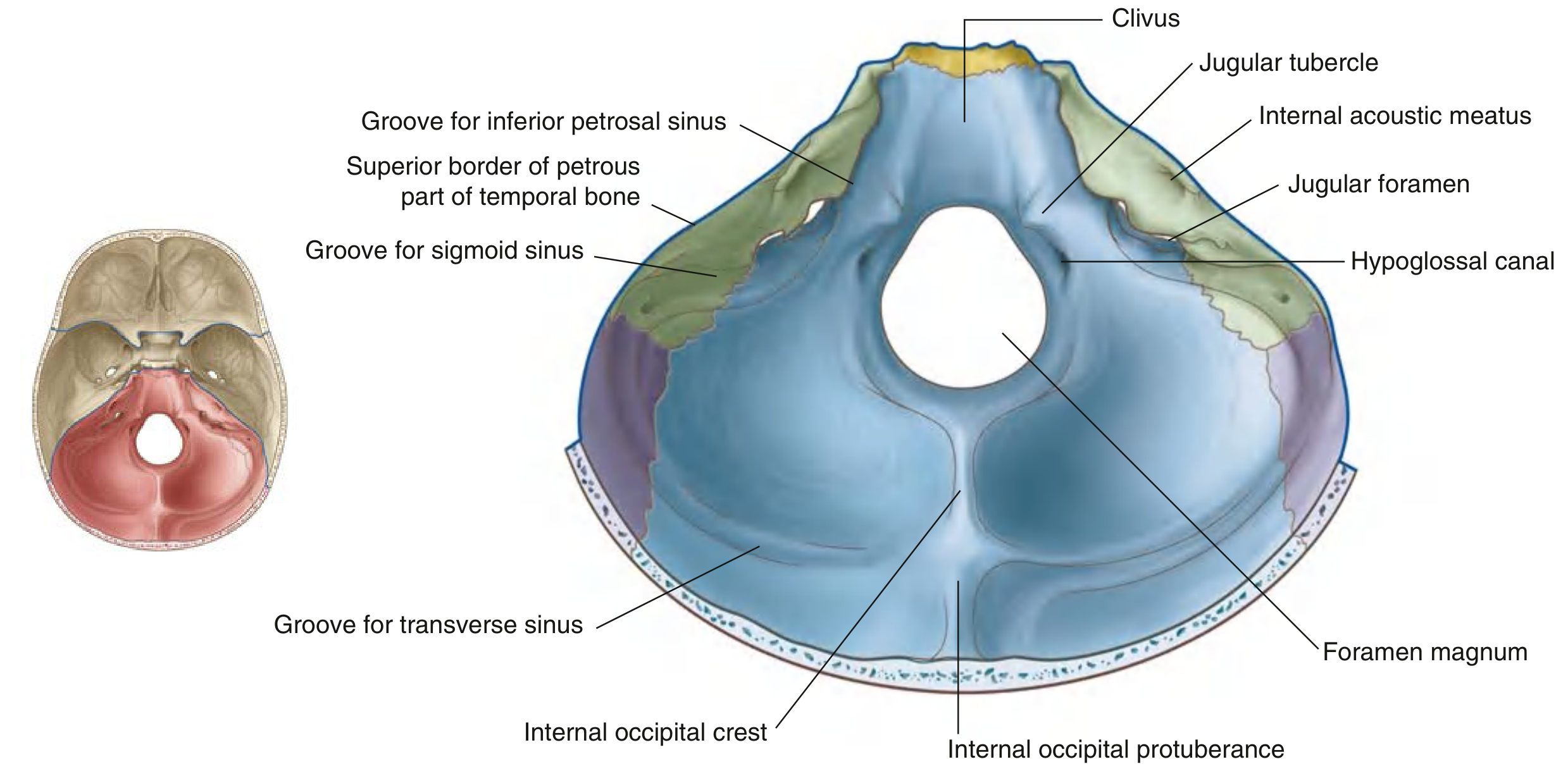
The largest and deepest of the three fossae. Contains the brainstem (midbrain, pons, medulla) and cerebellum.
Bones forming it: Mostly temporal and occipital, with small contributions from sphenoid and parietal bones.
Key features:
- Clivus — slope from foramen magnum to dorsum sellae; formed by sphenoid body + basilar occipital
- Foramen magnum — largest foramen; transmits: spinal cord → brainstem junction, vertebral arteries, meninges, spinal roots of CN XI
- Internal acoustic meatus (petrous temporal) — CN VII (facial), CN VIII (vestibulocochlear), labyrinthine artery
- Jugular foramen (between temporal and occipital) — CN IX, X, XI; inferior petrosal sinus + sigmoid sinus → internal jugular vein
- Hypoglossal canal — CN XII + meningeal branch of ascending pharyngeal artery
- Internal occipital protuberance — meeting point of transverse, superior sagittal, and straight sinuses (confluence of sinuses)
— Gray's Anatomy for Students, pp. 1001–1007
Part 3: Key Foramina Summary Table
| Foramen | Fossa | Structures |
|---|---|---|
| Foramen cecum | Anterior | Emissary veins (nasal → sagittal sinus) |
| Cribriform plate foramina | Anterior | CN I (olfactory) |
| Optic canal | Middle | CN II, ophthalmic artery |
| Superior orbital fissure | Middle | CN III, IV, V₁, VI; ophthalmic veins |
| Foramen rotundum | Middle | CN V₂ (maxillary) |
| Foramen ovale | Middle | CN V₃ (mandibular), lesser petrosal n. |
| Foramen spinosum | Middle | Middle meningeal artery |
| Foramen magnum | Posterior | Brainstem, vertebral aa., CN XI spinal roots |
| Internal acoustic meatus | Posterior | CN VII, VIII; labyrinthine a. |
| Jugular foramen | Posterior | CN IX, X, XI; sigmoid & inferior petrosal sinuses |
| Hypoglossal canal | Posterior | CN XII |
Part 4: Individual Bones — Key Points
| Bone | Key Features |
|---|---|
| Frontal | Forehead + orbital roofs; frontal sinuses; frontal crest internally |
| Parietal | Lateral vault walls; marked by middle meningeal artery grooves internally |
| Temporal | Squamous, petrous, tympanic, mastoid parts; contains middle/inner ear structures, houses CN VII and CN VIII |
| Occipital | Foramen magnum; external occipital protuberance; condyles articulating with C1 (atlas) |
| Sphenoid | "Bat-shaped" central bone; lesser wings (anterior fossa), greater wings (middle fossa), sella turcica, pterygoid processes |
| Ethmoid | Between orbits; cribriform plate, crista galli, superior/middle conchae; forms part of nasal septum |
Part 5: Skull Base Overview
The skull base is formed from five bones: frontal, ethmoid, temporal (paired), sphenoid, and occipital. It has its longest diameter in the AP plane and is typically 3–5 mm thick, except the much thicker petrous temporal bone. The skull base contains numerous foramina that provide exits for cranial nerves and routes for vascular structures — and can also serve as pathways for disease spread (perineural invasion, infection).
— Cummings Otolaryngology, p. 191
This is a shared conversation. Sign in to Orris to start your own chat.