
Angina -Perioperative management
Reading File
Now I'll search the library for perioperative management of angina in parallel:
Finding Sources
Finding Sources
Searching PubMed
"angina" AND "perioperative management" AND "noncardiac surgery"
Finding Sources
Finding Sources
Searching PubMed
"coronary artery disease" AND "perioperative" AND "noncardiac surgery"
Excellent — several key sources found. Let me now read the most comprehensive sections in parallel:
Reading File
Reading File
Reading File
Good content from Morgan & Mikhail. Let me now read more from that source (the perioperative recommendations table) and from Barash's anesthesia on the cardiovascular assessment, plus Harrison's on revascularization:
Reading File
Reading File
Reading File
Excellent — I now have rich content from multiple authoritative sources. Let me also read the Barash section on stress testing and the Sabiston section:
Reading File
Reading File
I have comprehensive content. Let me fetch the key perioperative assessment flowchart image and also get some additional content on intraoperative and postoperative management:
Loading Image
Finding Sources
I now have all the content needed for a comprehensive answer. Let me compile it:
Perioperative Management of Angina
1. Preoperative Risk Stratification
Step 1: Urgency of Surgery
- Emergency surgery: Proceed immediately. Use clinical risk factors to guide perioperative monitoring; no cardiac workup required.
- Elective/urgent surgery: Full stepwise evaluation is warranted.
Step 2: Screen for Active Cardiac Conditions (Unstable Angina = Major Risk)
Patients with any of the following active cardiac conditions must be evaluated and stabilized before elective surgery:
- Unstable angina (ACS) — highest priority; treat per ACS guidelines first
- Decompensated heart failure
- Significant arrhythmias
- Severe valvular disease
"The presence of unstable angina has been associated with a high perioperative risk of myocardial infarction (MI). The perioperative period is associated with a hypercoagulable state and surges in catecholamines." — Barash, Cullen, and Stoelting's Clinical Anesthesia, 9e
"Chronic stable (mild to moderate) angina does not seem to increase perioperative risk substantially." — Morgan and Mikhail's Clinical Anesthesiology, 7e
Step 3: Estimate MACE Risk (Clinical + Surgical)
Use the Revised Cardiac Risk Index (RCRI) — 6 independent predictors:
- High-risk surgery (intraperitoneal, intrathoracic, suprainguinal vascular)
- History of ischemic heart disease
- History of congestive heart failure
- History of cerebrovascular disease
- Diabetes mellitus on insulin
- Preoperative creatinine >2.0 mg/dL
RCRI score ≥3 = elevated risk; consider further evaluation or β-blocker therapy.
The ACS NSQIP risk calculator is endorsed as an alternative or supplement to RCRI.
2. Perioperative Assessment Algorithm
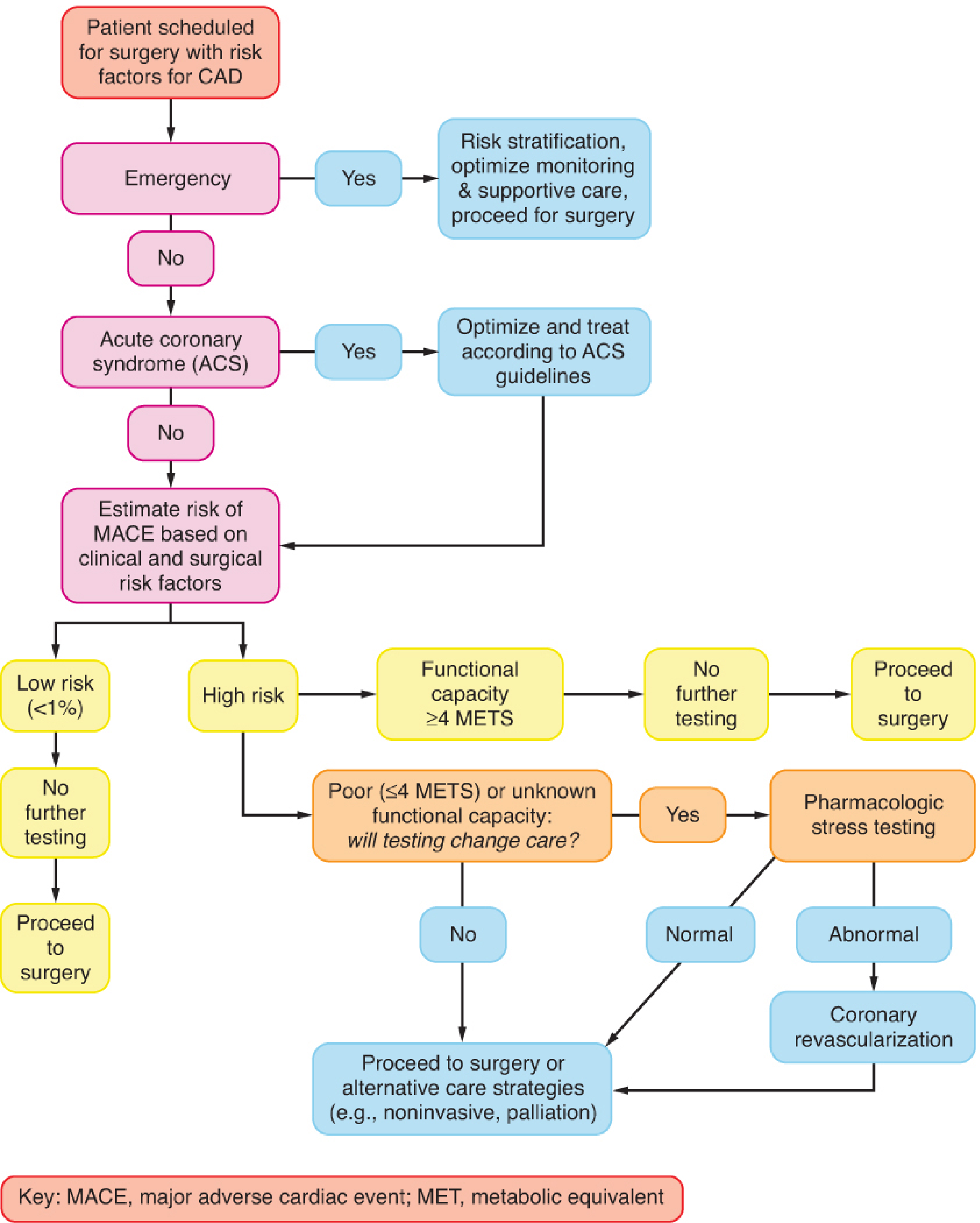
Figure: Stepwise approach to perioperative cardiac assessment for patients with CAD. Modified from ACC/AHA 2014 guideline. — Barash, Clinical Anesthesia, 9e
Functional Capacity Assessment (METs)
- ≥4 METs without symptoms: Proceed to surgery — no further testing needed
- <4 METs or unknown capacity: Further testing warranted only if it will change management
| MET Level | Example Activity |
|---|---|
| 1–2 METs | Eating, dressing, walking slowly |
| 4 METs | Climbing a flight of stairs, walking on level ground at 4 mph |
| >10 METs | Strenuous sports (swimming, tennis) |
3. Preoperative Investigations
| Test | Indication |
|---|---|
| 12-lead ECG | Known CAD, arrhythmia, PAD, cerebrovascular disease; any patient with non-low-risk surgery |
| Echocardiography (TTE) | Dyspnea of unknown origin; prior HF with worsening symptoms; LVEF <35% associated with highest MACE risk |
| Exercise ECG stress test | Suspected CAD; sensitivity 70–80%, specificity 60–75% |
| Pharmacologic stress test (DSE or MPI) | Patients unable to exercise with poor functional capacity (<4 METs) and ≥3 RCRI factors; perform only if results will change management |
| Coronary angiography | If stress test is abnormal and revascularization is being considered |
"A normal dobutamine stress echocardiogram (DSE) or myocardial perfusion imaging (MPI) result suggests a low risk for perioperative cardiac complications." — Barash, Clinical Anesthesia, 9e
4. Perioperative Medication Management
β-Blockers (ACC/AHA Recommendations)
| Recommendation | Class | LOE |
|---|---|---|
| Continue β-blockers in patients already on them chronically | I | B |
| Do NOT start β-blockers on the day of surgery | III: Harm | B |
| In patients with ≥3 RCRI factors, may begin β-blockers before surgery | IIb | B |
| If initiating, begin ≥1 day before surgery to assess safety/tolerability | IIb | B |
"Acutely initiating therapy with β-blockers in at-risk patients who will undergo surgery is no longer recommended." — Morgan and Mikhail's Clinical Anesthesiology, 7e
Key concern: The POISE trial demonstrated that initiating high-dose metoprolol reduced MI but significantly increased stroke and all-cause mortality.
Statins
| Recommendation | Class | LOE |
|---|---|---|
| Continue statins in patients currently on them | I | B |
| Initiate statins in patients undergoing vascular surgery | IIa | B |
| Acute perioperative statin withdrawal is associated with adverse outcomes | — | — |
Antiplatelet Therapy (Aspirin/DAPT)
- Chronic aspirin for CAD: continue perioperatively in most cases unless bleeding risk outweighs benefit
- DAPT in patients with coronary stents: critical — see stent timing below
Nitrates
- Continue long-acting nitrates perioperatively
- Administer sublingual GTN if angina occurs; have IV nitrates available in high-risk cases
- Avoid hypotension (especially with neuraxial anesthesia)
ACE Inhibitors / ARBs
- Continue in patients with HF or LV dysfunction
- Many anesthesiologists hold on the morning of surgery to prevent refractory intraoperative hypotension — an individualized decision
5. Coronary Revascularization Before Noncardiac Surgery
| Recommendation | Class | LOE |
|---|---|---|
| Revascularization is recommended when indicated by existing CPGs (i.e., independent of surgery) | I | C |
| Revascularization NOT recommended solely to reduce perioperative cardiac events | III: No Benefit | B |
Timing of Elective Surgery After PCI
| Intervention | Minimum Delay |
|---|---|
| Balloon angioplasty | 14 days |
| Bare-metal stent (BMS) | 30 days |
| Drug-eluting stent (DES) — optimal | 365 days |
| DES — may consider | 180 days (IIb) |
| Never: within DAPT window if DAPT must be stopped | III: Harm |
"Elective noncardiac surgery should not be performed in patients in whom DAPT will need to be discontinued perioperatively within 30 days after BMS or within 12 months after DES implantation." — Morgan and Mikhail's Clinical Anesthesiology, 7e
6. Intraoperative Management
Anesthetic Goals
- Avoid tachycardia — most important determinant of myocardial O₂ demand; heart rate <80 bpm is the target
- Avoid hypotension — maintain coronary perfusion pressure (MAP ≥65 mmHg)
- Prevent hypertension — avoids increased afterload and wall stress
- Avoid hypothermia — causes shivering and catecholamine surges
Monitoring
- ST-segment monitoring is mandatory: lead II (inferior MI) + lead V5 (anterior MI) detects ~95% of intraoperative ischemia
- Invasive arterial line for high-risk patients undergoing major surgery
- PA catheter / TEE: reserved for high-risk patients with known severe ventricular dysfunction
Anesthetic Technique
- Both regional and general anesthesia are acceptable; neither has been conclusively proven superior
- Neuraxial (epidural/spinal) provides excellent analgesia, blunts sympathetic response — but risk of hypotension must be managed, particularly in tight coronary stenosis
- Avoid high-dose inhalational agents that may cause excessive vasodilation
Treatment of Intraoperative Ischemia
| Trigger | Intervention |
|---|---|
| Tachycardia | β-blocker (IV esmolol/metoprolol) |
| Hypertension | Deepen anesthesia, nitroglycerin, labetalol |
| Hypotension | Vasopressor (phenylephrine), fluid, reduce anesthetic depth |
| ST depression/elevation | IV nitroglycerin; optimize HR and BP |
| Refractory ischemia | Consider stopping surgery; urgent cardiology consult |
7. Postoperative Management
- Troponin monitoring: measure in patients with signs/symptoms suggesting myocardial injury; routine surveillance in high-risk patients is debated but increasingly practiced (MINS — myocardial injury after noncardiac surgery)
- Continue or restart all cardiac medications (β-blockers, statins, nitrates, antiplatelets) promptly
- Adequate analgesia is critical — inadequate pain control causes catecholamine surges and tachycardia
- Epidural analgesia post-major vascular/thoracic surgery blunts sympathoadrenal response
- Monitor for: MI, arrhythmias, acute HF
- Resume DAPT as soon as surgical hemostasis is secured in patients with coronary stents
8. Special Situations
Unstable Angina / NSTEMI Before Planned Surgery
- Postpone all non-emergency surgery
- Treat as ACS: anticoagulation, antiplatelets, β-blockers, nitrates, statins
- Revascularize if indicated; re-assess timing of surgery after stabilization (DES stent timing applies)
Vasospastic (Prinzmetal's) Angina
- Calcium channel blockers and nitrates are the mainstay — continue perioperatively
- Avoid vasoconstrictors (ergotamine, high-dose vasopressors) that may trigger spasm
- Avoid hyperventilation (causes coronary vasoconstriction)
Combination Therapy Caution
"Patients with ventricular dysfunction may not tolerate the combined negative inotropic effect of a β-blocker and a calcium channel blocker together; an ACE inhibitor or ARB is better tolerated. The additive effect of a β-blocker and calcium channel blocker on the AV node may precipitate heart block in susceptible patients." — Morgan and Mikhail's Clinical Anesthesiology, 7e
Summary
| Phase | Key Action |
|---|---|
| Preop | Risk stratify (RCRI/MACE), assess functional capacity, identify unstable angina, optimize medications, determine stent timing |
| Intraop | Avoid tachycardia/hypotension, ST monitoring, continue cardiac drugs, treat ischemia aggressively |
| Postop | Restart medications promptly, adequate analgesia, troponin surveillance, early cardiology involvement if needed |
Sources:
- Morgan and Mikhail's Clinical Anesthesiology, 7e — Chapter 21 (Preoperative Management/CAD)
- Barash, Cullen, and Stoelting's Clinical Anesthesia, 9e — Chapter 23 (Cardiovascular System/Preoperative Assessment)
- Sabiston Textbook of Surgery, 21e — Chapter 19 (Perioperative Cardiac Assessment)
- Harrison's Principles of Internal Medicine, 22e — Perioperative Cardiac Risk Assessment
This is a shared conversation. Sign in to Orris to start your own chat.