
Hi
Hi! How can I help you today?
Oral cavity histology
Reading File
Finding Sources
Finding Sources
Finding Sources
Finding Sources
Excellent — found dedicated oral cavity histology sections in two histology textbooks. Let me read them in parallel.
Reading File
Reading File
Good data retrieved. Let me get more content from Junqueira's (tongue, teeth, salivary glands sections) and search for images in parallel.
Reading File
Searching Images
oral cavity mucosa histology stratified squamous epithelium
Searching Images
tongue lingual papillae taste buds histology
Searching Images
salivary gland acini serous mucous histology
Reading File
I have rich content from two authoritative histology textbooks. Let me fetch the most relevant images to include in the answer.
Loading Image
Loading Image
Loading Image
I now have comprehensive content and images for a thorough answer. Let me compile it.
Oral Cavity Histology
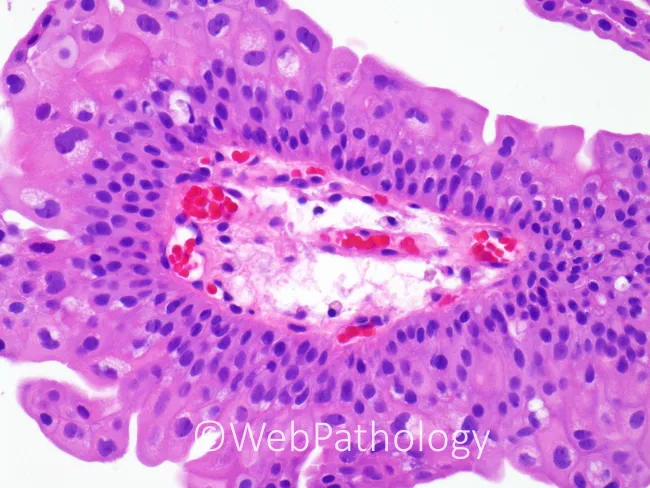
1. Oral Mucosa — Overview
The oral cavity is lined by oral mucosa, which is divided into three functional types based on location:
| Type | Location | Epithelium |
|---|---|---|
| Masticatory mucosa | Gingiva, hard palate | Stratified squamous keratinized or parakeratinized |
| Lining mucosa | Cheeks, soft palate, floor of mouth, lips (inner) | Stratified squamous nonkeratinized |
| Specialized mucosa | Dorsal tongue | Contains lingual papillae with taste buds |
Key features of oral epithelium:
- Resembles skin in its layered organization (basal → spinous → granular → superficial), but unlike skin, nonkeratinized cells retain their nuclei even in the shed superficial layer
- The lamina propria underlies the epithelium; it contains blood vessels, nerves, and immune cells (antigen-presenting cells are present throughout)
- Lining mucosa overlies a submucosa with diffuse lymphoid tissue and minor salivary glands
2. Lip (Mucocutaneous Junction)
The lip is a classic histology specimen because it shows three distinct surfaces in one section:
- Outer skin surface — thin keratinized epidermis, hair follicles, sebaceous glands, sweat glands
- Vermilion zone (red margin) — very thin parakeratinized stratified squamous epithelium; no glands; deep connective tissue papillae packed with capillaries and sensory endings give the characteristic red color and tactile sensitivity
- Inner oral surface (labial mucosa) — thick nonkeratinized stratified squamous epithelium; many minor labial salivary glands in submucosa
The core of the lip is striated skeletal muscle (orbicularis oris), enabling the mobility needed for speech and ingestion.
3. Tongue
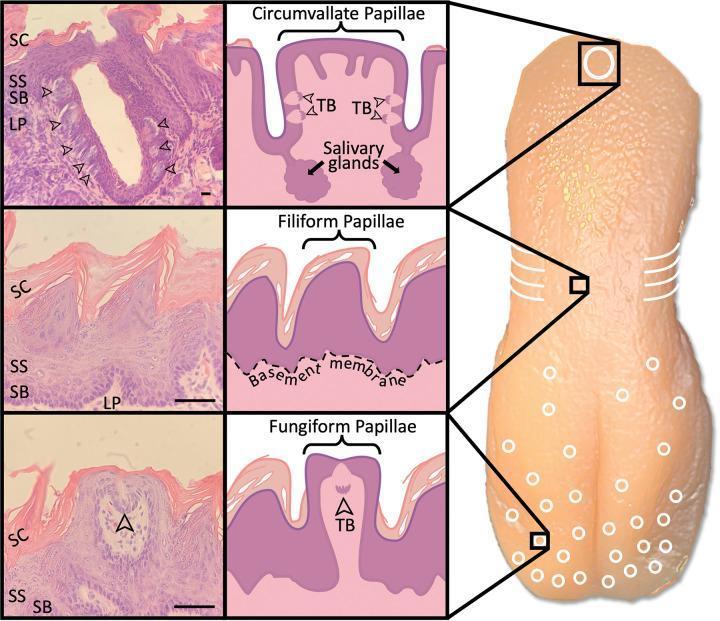
Lingual Papillae (4 types on dorsal surface)
| Papilla | Epithelium | Taste Buds | Notes |
|---|---|---|---|
| Filiform | Keratinized SSE | ✗ None | Most numerous; mechanical function |
| Fungiform | Nonkeratinized SSE | ✓ On dorsal surface | Mushroom-shaped; scattered among filiform |
| Foliate | Nonkeratinized SSE | ✓ On lateral walls | Leaf-like folds on lateral tongue edges |
| Circumvallate (Vallate) | Nonkeratinized SSE | ✓ On lateral walls | 8–12 large papillae; V-shaped row; surrounded by a trench; von Ebner glands open into trench |
Taste Buds
- Barrel-shaped intraepithelial structures; open to the surface via a taste pore
- Contain neuroepithelial (Type II) gustatory cells synapsing with basal sensory neurons and supporting (Type I) cells
- Five basic tastes detected: sweet, salty, bitter, sour, umami
- Sweet, bitter, umami → G-protein-coupled receptors (T1R, T2R families)
- Sour and salty → ion channels (H⁺ on acid-sensing channels; Na⁺ channels)
Lingual Tonsil
- Aggregations of diffuse lymphatic tissue and lymphoid nodules at the base of the tongue (posterior 1/3)
- Covered by nonkeratinized SSE with deep crypts
4. Teeth
Each tooth has:
- Enamel — covers the anatomic crown; hardest substance in the body; composed of parallel enamel rods (hydroxyapatite crystals); produced by ameloblasts (lost after eruption); formation regulated by amelogenin, ameloblastin, enamelin
- Dentin — makes up the bulk; deposited by odontoblasts as predentin → mineralized under dentin phosphoprotein (DPP) and dentin sialoprotein (DSP); contains dentinal tubules with odontoblast processes
- Cementum — bone-like; covers the root; provides attachment for periodontal ligament (Sharpey's fibers connect cementum to alveolar bone)
- Pulp cavity — centrally located; loose connective tissue, blood vessels, nerves; lined by odontoblasts
5. Salivary Glands
Basic Unit: The Salivon
Acinus → Intercalated duct → Striated duct → Excretory duct
| Duct | Lining | Function |
|---|---|---|
| Intercalated duct | Simple cuboidal | Drains acinar secretion |
| Striated duct | Simple columnar with basal striations | Electrolyte reabsorption (basal membrane infoldings with mitochondria) |
| Excretory duct | Stratified cuboidal/columnar | Final conduit to oral cavity |
Myoepithelial cells surround acini and intercalated ducts — they contract to expel secretion.
Acinar Types
| Type | Appearance | Secretion |
|---|---|---|
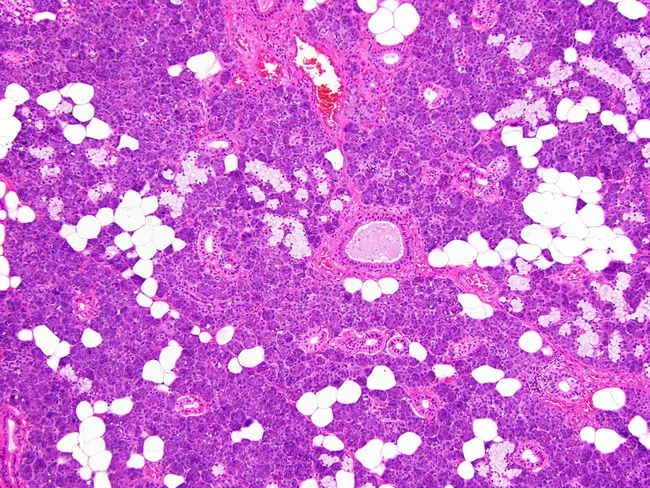
| Serous | Pyramidal cells, round basal nuclei, basophilic cytoplasm (zymogen granules), narrow lumen | Watery protein-rich fluid (amylase, lysozyme) |
| Mucous | Pale cytoplasm, flattened basal nuclei, wide lumen | Viscous mucin |
| Mixed | Mucous center + serous demilunes at periphery (actually an artifact of fixation — cells shrink) | Both |
Major Salivary Glands
| Gland | Acinar type | Special feature |
|---|---|---|
| Parotid | Pure serous | Adipose tissue interspersed throughout |
| Submandibular | Mixed — predominantly serous | Serous and mucous acini visible |
| Sublingual | Mixed — predominantly mucous | Serous component as demilunes |
Saliva contains: water, IgA, amylase, mucins, lysozyme, electrolytes (Na⁺, K⁺, Cl⁻, HCO₃⁻).
6. Tonsils
The palatine tonsils (and lingual tonsil) are aggregations of lymphoid tissue beneath the stratified squamous epithelium of the posterior oral cavity and oropharynx. They contain lymphoid follicles with germinal centers, predominantly producing IgA antibodies (secretory IgA undergoes transcytosis into the oral lumen via secretory component produced by epithelial cells), providing mucosal immune defense.
Sources: Histology: A Text and Atlas with Correlated Cell and Molecular Biology, pp. 1490–1492 | Junqueira's Basic Histology, 17e, pp. 736–737, 800
This is a shared conversation. Sign in to Orris to start your own chat.