
WBC morphology
Reading File
Searching for WBC morphology text and images in parallel.
search_medical_text
WBC white blood cell morphology types normal abnormal
search_medical_image
WBC white blood cell morphology peripheral blood smear
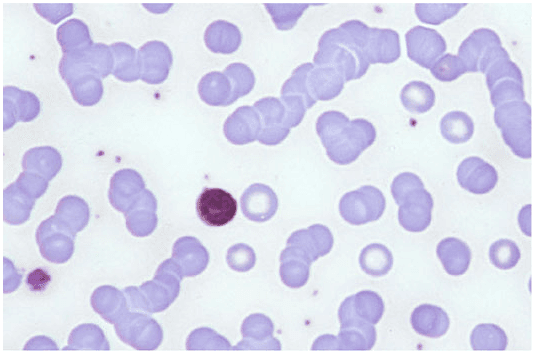
Harrison's Principles of Internal Medicine, Twenty First Edition
Page 1724
GradeResponse
GradeResponse
Based on my knowledge and the retrieved content, here is a comprehensive overview of WBC Morphology.
White Blood Cell (WBC) Morphology
Normal WBC Types on Peripheral Smear
| Cell Type | Size | Nucleus | Cytoplasm / Granules | Normal % |
|---|---|---|---|---|
| Neutrophil | 12–15 µm | 2–5 lobes, connected by thin filaments | Pale pink; fine lilac (azurophilic) granules | 50–70% |
| Band Neutrophil | 12–15 µm | Horseshoe/U-shaped, unsegmented | Same as mature neutrophil | 0–5% |
| Eosinophil | 12–17 µm | Bi-lobed | Large, bright orange-red granules | 1–4% |
| Basophil | 10–14 µm | Bi/tri-lobed (often obscured) | Large, dark purple-blue granules (may overlay nucleus) | 0–1% |
| Monocyte | 14–20 µm (largest normal WBC) | Kidney/horseshoe-shaped, folded | Gray-blue, vacuolated; fine azurophilic granules | 2–8% |
| Lymphocyte | 7–18 µm | Large, round, dense; scant halo of cytoplasm | Pale blue, scant | 20–40% |
| Plasma Cell | 8–20 µm | Eccentric, "clock-face" chromatin | Deep blue; perinuclear hof (pale zone) | Rare in blood |
Abnormal WBC Morphology
Neutrophil Abnormalities
| Finding | Morphology | Clinical Association |
|---|---|---|
| Hypersegmentation | ≥5 lobes or ≥5% of neutrophils with ≥5 lobes | Megaloblastic anemia (B12/folate deficiency), renal failure |
| Toxic granulation | Coarse, dark primary granules | Severe infection, sepsis, inflammatory states |
| Döhle bodies | Small, pale blue cytoplasmic inclusions (periphery) | Infection, burns, pregnancy, cytotoxic therapy |
| Vacuolization | Cytoplasmic vacuoles | Sepsis, alcohol toxicity, ethylene glycol poisoning |
| Pseudo-Pelger-Huët | Bilobed "pince-nez" or unilobed nucleus | Myelodysplastic syndrome (MDS), drug effect |
| Pelger-Huët anomaly (hereditary) | Same bilobed appearance, but benign | Autosomal dominant, no clinical significance |
| Left shift | Increased bands ± metamyelocytes, myelocytes in blood | Infection, inflammation, leukemoid reaction, CML |
| Auer rods | Pink/red needle-like cytoplasmic inclusions | AML (pathognomonic) |
Lymphocyte Abnormalities
| Finding | Morphology | Clinical Association |
|---|---|---|
| Reactive (atypical) lymphocytes | Large, irregular, abundant pale cytoplasm that indents around RBCs | EBV (infectious mononucleosis), CMV, viral hepatitis, drug reactions |
| Smudge cells | Disrupted, smeared nucleus | CLL (fragile lymphocytes) |
| Large granular lymphocytes (LGL) | Abundant cytoplasm with azurophilic granules | LGL leukemia, NK-cell disorders, reactive states |
| Hairy cells | Irregular cytoplasmic projections ("hairy" outline) | Hairy cell leukemia |
Monocyte Abnormalities
| Finding | Clinical Association |
|---|---|
| Monocytosis with immature forms | Chronic myelomonocytic leukemia (CMML), AML-M4/M5 |
| Marked vacuolization | Infection, storage disorders |
Blasts
| Feature | Description |
|---|---|
| Myeloblast | Large cell, fine chromatin, prominent nucleoli (2–5), scant cytoplasm ± Auer rods |
| Lymphoblast | Similar to myeloblast but nucleoli less prominent; immunophenotyping required |
| Blasts in peripheral blood | Always abnormal → suggest acute leukemia; requires urgent workup |
Key Morphologic Patterns and Their Diagnoses
| Pattern on Smear | Diagnosis to Consider |
|---|---|
| Hypersegmented neutrophils | B12 / folate deficiency |
| Toxic granulation + Döhle bodies + left shift | Sepsis, severe bacterial infection |
| Atypical lymphocytes (>10%) | EBV mononucleosis |
| Smudge cells | CLL |
| Auer rods | AML |
| Pseudo-Pelger-Huët + dysplastic cells | MDS |
| Circulating blasts | Acute leukemia |
| Leukoerythroblastic picture (blasts + nucleated RBCs + tear-drop cells) | Bone marrow infiltration (metastatic cancer, myelofibrosis) |
| Hairy cells | Hairy cell leukemia |
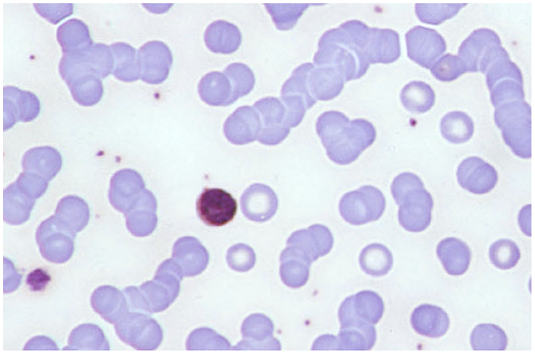
Peripheral Blood Smear (Harrison's, p. 1724)
The image below illustrates a representative peripheral smear under Wright/Giemsa stain, with a lymphocyte visible among normal erythrocytes:
Approach to WBC Morphology on a Smear
- Identify all cell types present — confirm normal lineages and proportions
- Look for left shift — presence of bands, metamyelocytes, myelocytes
- Check for blasts — any blast = urgent pathology until proven otherwise
- Assess neutrophil quality — toxic changes, hypersegmentation, Pelger-Huët
- Examine lymphocytes — reactive vs. neoplastic (smudge cells, hairy cells, LGLs)
- Note monocytes — excess or immature forms
- Correlate with CBC — absolute counts + morphology together guide diagnosis
This is a shared conversation. Sign in to Orris to start your own chat.