

Read it and give diagnosis
Reading File
Searching for information on BIRADS III breast ultrasound findings and fibroadenoma to provide a thorough explanation.
search_medical_text
BIRADS III breast ultrasound hypoechoic lesion fibroadenoma diagnosis management
Use of Transcutaneous and Percutaneous Ablation for the Treatment of Benign and Malignant Tumors of the Breast
Page 1
search_medical_image
breast ultrasound fibroadenoma hypoechoic oval well-defined lesion
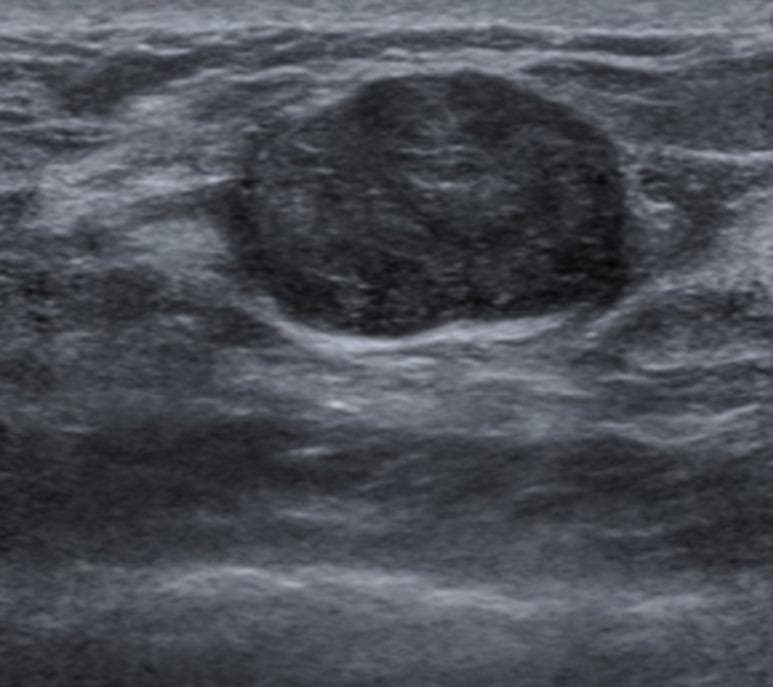
Hugging Face pmc clinical VQA raw
Page 0
GradeResponse
GradeResponse
Scanning Report Summary
Patient: Mrs. Shyba | Age: 40 yrs | Female
Investigation: Ultrasonogram of Left Breast (8 MHz high-frequency transducer)
Findings
| Parameter | Result |
|---|---|
| Lesion shape | Well-defined, oval |
| Echogenicity | Hypoechoic |
| Size | 38 × 19 mm |
| Location | Left breast parenchyma, 2–3 o'clock position |
| Cystic areas / Calcification | None |
| Rest of breast parenchyma | Normal |
| Skin & subcutaneous tissue | Normal |
| Duct dilatation | None |
| Axillary lymph nodes | No significant lymphadenopathy |
Radiologist's Impression
BI-RADS III — Possibly Fibroadenoma
What This Means
BI-RADS III (Probably Benign)
- BI-RADS 3 means the lesion has a >98% likelihood of being benign and a malignancy risk of <2%.
- It does not mean cancer is ruled out — it means the features are most consistent with a benign process.
Fibroadenoma
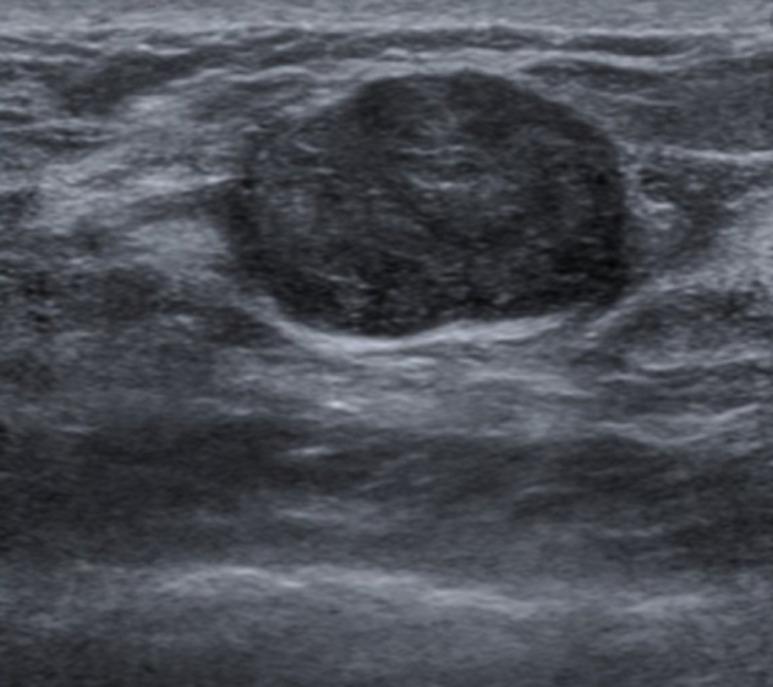
The most common benign breast tumor in women, especially those of reproductive age. The ultrasound features in this report are classic:
- Oval shape (wider than tall)
- Well-defined smooth margins
- Hypoechoic (darker than surrounding tissue)
- No calcification or cystic change
- No lymph node involvement
This matches a typical fibroadenoma on ultrasound:
Recommended Next Steps (Standard Protocol for BI-RADS III)
- Short-interval follow-up ultrasound in 6 months — to confirm stability of the lesion.
- If stable at 6 months → repeat at 12 months, then 24 months → can be downgraded to BI-RADS II (benign).
- Core needle biopsy may be considered if:
- The lesion grows significantly
- The patient has high anxiety or requests tissue confirmation
- Clinical features raise additional concern
- Treatment is not mandatory for a confirmed benign fibroadenoma unless it causes symptoms (pain, cosmetic concern). Options include percutaneous excision or ultrasound-guided cryoablation if treatment is preferred.
Important: This interpretation is for educational purposes only. Mrs. Shyba should follow up with her referring physician, Dr. P.K. Shajahan, for clinical correlation and a management plan tailored to her individual situation.
This is a shared conversation. Sign in to Orris to start your own chat.