
What is the diagnosis of spastic quadriparesis with feature of myopathy winging of scapula
Reading File
Now let me search the medical library for this clinical scenario in parallel:
Finding Sources
Finding Sources
Finding Sources
Searching the Web
spastic quadriparesis myopathy features winging of scapula diagnosis differential
Let me search more specifically in the textbooks for conditions combining UMN + myopathy + scapular winging:
Finding Sources
Finding Sources
Finding Sources
Finding Sources
Finding Sources
Searching the Web
spastic quadriparesis myopathy winging scapula diagnosis "Emery Dreifuss" OR "X-linked" OR "mitochondrial" neurology
Now let me read the relevant textbook section on FSH muscular dystrophy and scapular winging from Bradley's Neurology, and also search for the specific combination in neurology textbooks:
Reading File
Finding Sources
Excellent — the textbooks are pointing toward key diagnoses. Let me read the relevant sections about FSH dystrophy with spasticity and the Emery-Dreifuss section:
Reading File
Reading File
Now I have comprehensive information to provide a thorough answer. Let me also fetch the scapular winging image for visual clarity:
Loading Image
The combination of spastic quadriparesis (UMN signs) + myopathic features + winging of scapula is a distinctive triad that points to a specific set of diagnoses. Here is a structured analysis:
Diagnosis: Spastic Quadriparesis + Myopathy + Winging of Scapula
This unusual combination — upper motor neuron signs (spasticity) co-existing with myopathic features and scapular winging — immediately narrows the differential to conditions that can affect both the CNS and skeletal muscle simultaneously.
Most Likely Diagnosis: Emery-Dreifuss Muscular Dystrophy (EDMD)
EDMD is the classic condition linking muscle disease with features that can mimic spastic quadriparesis, particularly through its rigid spine/contracture phenotype and cardiac involvement mimicking central dysfunction.
Classic triad of EDMD:
- Early joint contractures — elbows, Achilles tendons, posterior cervical muscles → produces a stiff, "spastic-like" posture
- Slowly progressive humero-peroneal (scapuloperoneal) muscle weakness and wasting → causes scapular winging
- Cardiac conduction defects/cardiomyopathy → fatal if untreated
The "spasticity" may actually represent rigid spine syndrome (neck contractures prevent flexion, mimicking UMN rigidity) combined with myopathic weakness. Scapular winging is a direct consequence of scapular fixator muscle weakness (serratus anterior, rhomboids).
Genetics:
- X-linked (EMD gene, emerin protein) — most common
- Autosomal dominant (LMNA gene, Lamin A/C)
- Rare types: FHL1 (Xq26), nesprin-1/2, SUN1/2
Second Key Diagnosis: Facioscapulohumeral Muscular Dystrophy (FSHD) with CNS involvement
FSHD is the third most common muscular dystrophy and is the textbook cause of scapular winging with myopathy.
Classic features:
- Facial weakness (difficulty whistling, blowing balloons, sleeping with eyes partially open)
- Scapular winging — inferomedial corner juts backward characteristically; the whole scapula may slide upward (see image above from Bradley & Daroff's Neurology)
- Asymmetric weakness (very characteristic — the clinician may wrongly suspect a nerve lesion)
- Weak wrist extensors but strong flexors; weak ankle dorsiflexors but strong plantar flexors
- Autosomal dominant, chromosome 4q35 (D4Z4 repeat contraction, DUX4 gene)
A rare subset of FSHD patients do develop CNS features including pyramidal signs and epilepsy (Coats disease, sensorineural hearing loss — the "FSHD plus" syndrome). However, spastic quadriparesis is not a typical feature of pure FSHD.
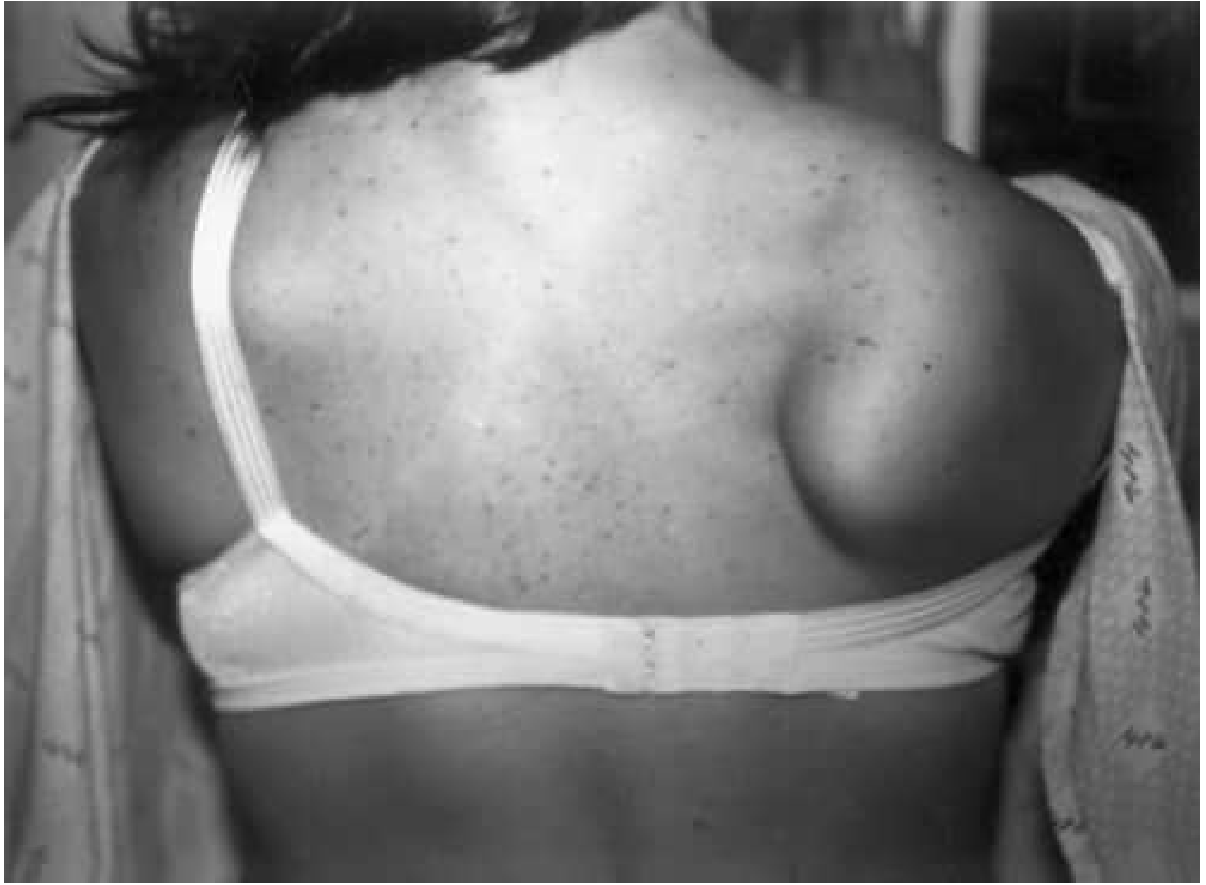
Third Consideration: Scapuloperoneal Syndrome
- A group of disorders with shoulder-girdle and anterior-leg weakness (scapular winging + foot drop)
- Can be myopathic (scapuloperoneal dystrophy — desmin, FHL1 mutations) or neurogenic (Davidenkow syndrome — TRPV4 mutations, anterior horn cell disease)
- Related to FSHD but lacks facial weakness
- EMG/NCS and muscle biopsy differentiate myopathic from neurogenic forms
Fourth Consideration: Mitochondrial Myopathy (e.g., MELAS)
Mitochondrial diseases can cause:
- Myopathy (proximal weakness, exercise intolerance)
- UMN signs / stroke-like episodes (spastic quadriparesis from cortical infarcts)
- Scapular winging (from periscapular muscle involvement)
- Plus: hearing loss, ophthalmoplegia, cardiomyopathy, lactic acidosis
MELAS (Mitochondrial Encephalomyopathy, Lactic Acidosis, Stroke-like episodes) is the mitochondrial condition most likely to present with this combination.
Key Distinguishing Features
| Feature | EDMD | FSHD | Scapuloperoneal Syndrome | Mitochondrial Myopathy |
|---|---|---|---|---|
| Scapular winging | ✓ | ✓ (prominent, asymmetric) | ✓ | ✓ |
| Myopathic features | ✓ | ✓ | ✓ | ✓ |
| Spasticity/UMN signs | Via contractures | Rare "FSHD plus" | Neurogenic variants | Via stroke-like episodes |
| Facial weakness | Absent | Present (key feature) | Absent | Variable |
| Cardiac involvement | Mandatory (fatal if missed) | Absent (usually) | Absent | Yes (cardiomyopathy) |
| Joint contractures | Early, prominent | Late/mild | Variable | Absent |
| Genetics | EMD / LMNA | 4q35 D4Z4 | Desmin / FHL1 / TRPV4 | Mitochondrial DNA |
Investigative Workup
- Serum CK — mildly elevated in EDMD; markedly elevated in FSHD/LGMD
- EMG/NCS — confirms myopathic vs. neurogenic pattern
- MRI spine/brain — to characterize UMN lesion (if structural) or stroke-like lesions (mitochondrial)
- Muscle biopsy — emerin immunostaining (EDMD), ragged-red fibers (mitochondrial)
- Genetic testing — targeted panel (EMD, LMNA, FHL1 for EDMD; D4Z4 Southern blot for FSHD)
- ECG + Echo — mandatory if EDMD suspected (life-threatening arrhythmias)
- Serum lactate/pyruvate, mtDNA — if mitochondrial disease suspected
Summary
The combination of spastic quadriparesis + myopathic features + winging of scapula is most consistent with:
- Emery-Dreifuss Muscular Dystrophy — if spasticity is from contractures/rigid spine + cardiac involvement is present
- FSHD ("FSHD plus") — if facial weakness accompanies scapular winging + CNS features
- Mitochondrial myopathy (MELAS) — if UMN signs come from stroke-like episodes + systemic features
The key discriminating test is muscle biopsy with immunohistochemistry and genetic panel testing, combined with cardiac evaluation to rule out life-threatening EDMD cardiomyopathy.
Sources: Bradley and Daroff's Neurology in Clinical Practice; Adams and Victor's Principles of Neurology, 12th Ed.
This is a shared conversation. Sign in to Orris to start your own chat.