
Explaim tort in simple language for norcet 11 in handwritten Notes
tort law nursing NORCET 11 exam important concepts
https://wtcs.pressbooks.pub/nursingmhcc/chapter/5-4-laws-tor…
Handwritten-style nursing study notes on lined paper with a yellow highlighter effect. Title at top in large bold handwriting: "TORT LAW - NORCET 11" with a hand-drawn underline. Content written in neat blue pen handwriting style: Section 1 header (red): "What is a TORT?" - A civil wrong that causes harm/injury to a person - Act of commission (doing something wrong) OR omission (failing to do something) - Court imposes liability (compensation) - Mnemonic box: "TORT = Civil Wrong = COMPENSATION" Section 2 header (red): "2 TYPES OF TORTS" Left box labeled "1. INTENTIONAL TORTS" with star: • Assault - threatening to harm (no touch needed) • Battery - actual harmful touch WITHOUT consent • False Imprisonment - illegal restraint of patient • Slander - spoken false statements • Libel - WRITTEN false statements • Fraud - false documentation • Breach of Confidentiality Right box labeled "2. UNINTENTIONAL TORTS" with star: • Negligence - failure to use ordinary care • Malpractice = Negligence by a LICENSED professional Section 3 header (green): "4 ELEMENTS OF MALPRACTICE (DDBH)" • D - Duty (nurse had responsibility) • D - Dereliction (nurse failed the duty) • B - Breach caused Damage • H - Harm/Injury to patient Small sticky note drawn: "Remember: Malpractice = Negligence + License" Bottom banner: "NORCET 11 KEY POINTS" with arrow pointing to: Intentional = KNEW harm would happen | Unintentional = Did NOT intend harm Notebook paper background with faint blue horizontal lines, margin line in red on left side, slightly worn paper texture.
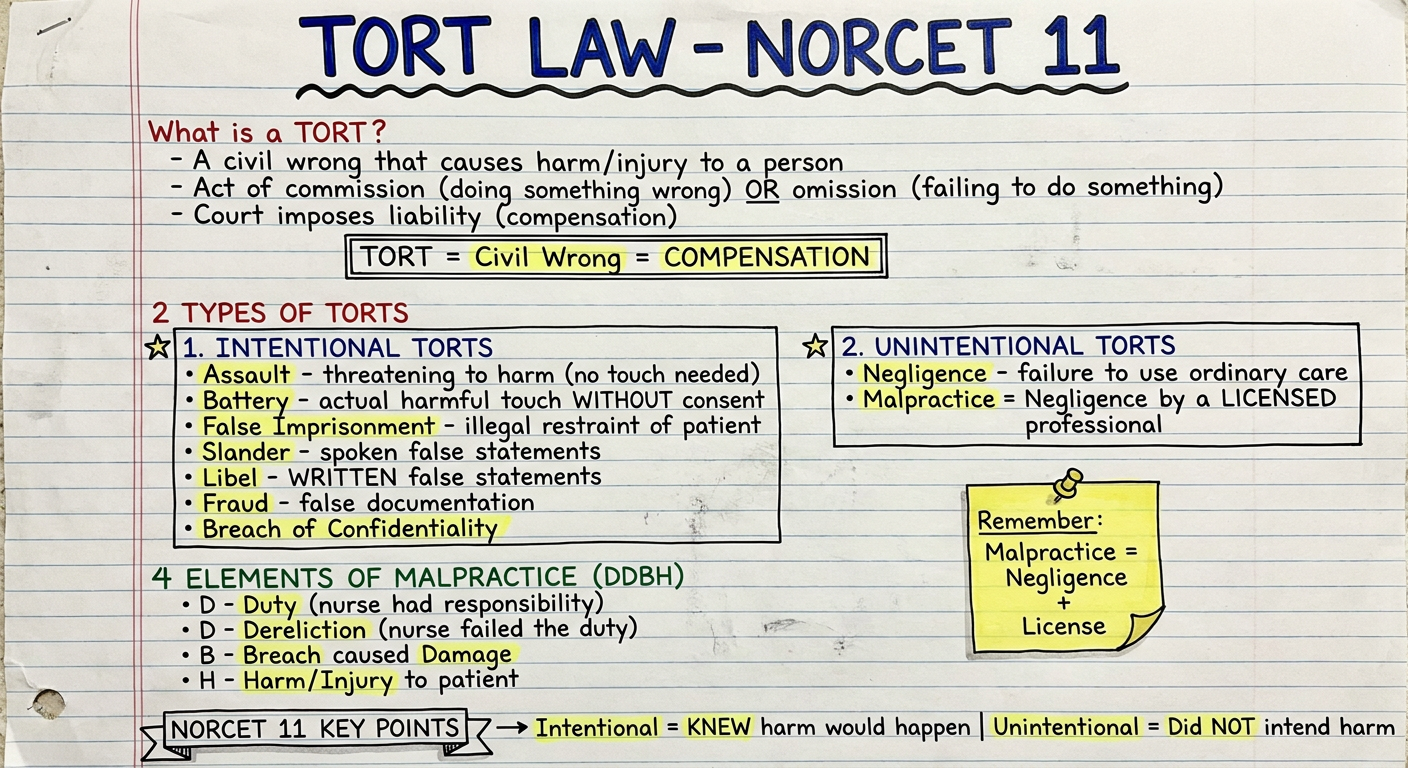
TORT - Simple Explanation for NORCET 11
What is a TORT?
- Act of Commission = doing something wrong (e.g., giving wrong medicine)
- Act of Omission = failing to do something (e.g., not checking patient vitals)
2 Types of Torts
| TYPE | MEANING | EXAMPLES |
|---|---|---|
| Intentional | Defendant KNEW harm would result | Assault, Battery, False Imprisonment, Slander, Libel, Fraud |
| Unintentional | Did NOT intend harm, but was careless | Negligence, Malpractice |
Intentional Torts - Quick Points
| TORT | SIMPLE MEANING | TRICK |
|---|---|---|
| Assault | Threatening harm (no touch needed) | "Fear only" |
| Battery | Touching patient WITHOUT consent | "Touch = Battery" |
| False Imprisonment | Illegal restraint of patient | "Restraint without order" |
| Slander | Spoken false statements about someone | "Slander = Spoken" |
| Libel | Written false statements | "Libel = Letter/Written" |
| Fraud | False documentation for personal gain | "Fake charting" |
Unintentional Torts
- Negligence = Failure to exercise ordinary/reasonable care
- Malpractice = Negligence done by a licensed professional (nurse, doctor)
- Duty - nurse had a duty to the patient
- Dereliction - nurse failed that duty
- Direct Cause - failure directly caused the harm
- Damages - actual harm/injury occurred
NORCET 11 High-Yield Points
- Slander = Spoken | Libel = Written (most asked!)
- Battery can happen even if no physical harm occurs
- Malpractice = Negligence + needs a licensed professional
- Restraining a patient without proper order = False Imprisonment
- Documenting care not given = Fraud
Exllaim myocardial infraction for norcer 11 if i am 10 yrs old
myocardial infarction heart attack diagram blocked coronary artery
Summary : This illustration explains myocardial infarction (heart attack), showing the anatomical location of a blocked artery and the resulting muscle damage in the heart. illustration: Scene Overview : • Main subject is a human heart, depicted in color with visible coronary arteries. • An inset magnifies a section of an artery, highlighting a blockage (occlusion) within the vessel. • The area of muscle damage on the heart is labeled. • Text labels include "Myocardial Infarction," "Block in Artery," "Muscle Damage," and "Heart Attack." • The color palette uses reds, yellows, and purples to differentiate blood vessels, muscle, and damaged areas. Technical Details : • No scale bar or magnification is provided. • The illustration is schematic, not a real photograph or scan. • Labels are overlaid directly on the image for clarity. Spatial Relationships : • The blocked artery is shown in close-up in the inset, with a clear connection to the affected region of the heart muscle. • The muscle damage is localized to a specific area of the heart, corresponding to the blocked artery. Analysis : • The figure visually links a blocked coronary artery to localized muscle damage in the heart, illustrating the pathophysiology of myocardial infarction (heart attack). • The inset clarifies the cause (arterial blockage) and its effect (muscle damage), supporting understanding of the condition.
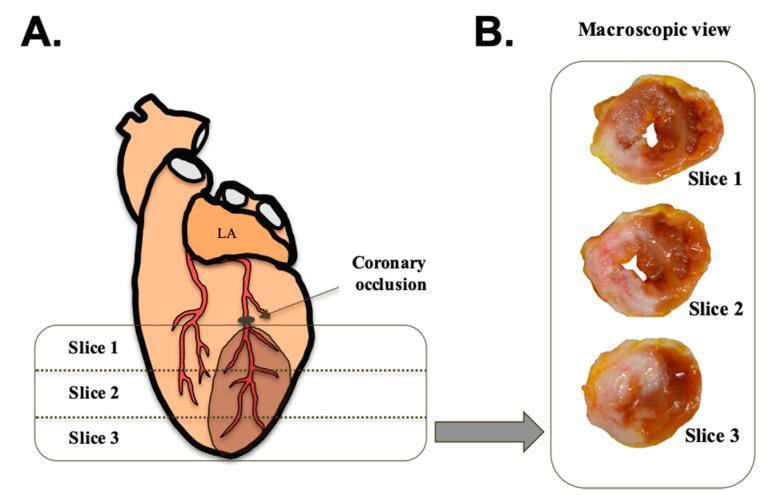
This medical figure illustrates the methodology and visual findings of an experimental myocardial infarction model. Panel A is an anatomical diagram showing a heart with a coronary occlusion placed on a coronary artery distal to the left atrium (LA). A shaded brown region extending inferiorly from the occlusion site represents the infarcted area. The diagram indicates the levels of three transverse ventricular sections labeled Slice 1, Slice 2, and Slice 3. Panel B displays corresponding macroscopic clinical photographs of these three cross-sectional heart slices stained with thioflavin-S under white light. The macroscopic view demonstrates the progression of tissue damage: Slice 1 (proximal) shows a localized area of pale, healthy tissue alongside darker necrotic regions; Slice 2 and Slice 3 (distal) exhibit increasingly larger areas of dark, necrotic tissue, indicating the transmural extent of the infarction throughout the left ventricle. This material is designed for cardiovascular pathology education, specifically illustrating the spatial relationship between arterial ligation and the resulting downstream myocardial necrosis.
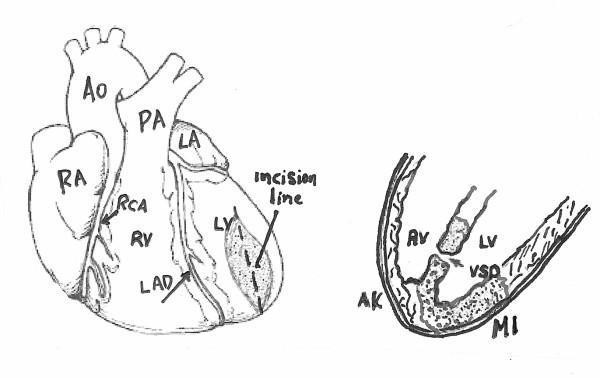
This medical illustration consists of two diagrams depicting cardiac anatomy and pathology associated with myocardial infarction and surgical intervention. The left panel shows an anterior view of the heart with major structures labeled: Right Atrium (RA), Right Ventricle (RV), Left Atrium (LA), Left Ventricle (LV), Aorta (Ao), and Pulmonary Artery (PA). The coronary vasculature is highlighted, specifically the Right Coronary Artery (RCA) and Left Anterior Descending (LAD) artery. An 'incision line' is indicated on the apex of the left ventricle over a shaded area representing infarcted tissue. The right panel is a cross-sectional diagram focusing on the ventricular chambers. It illustrates a Ventricular Septal Defect (VSD), which is a communication between the left and right ventricles. Also labeled are the Aortic Valve (AV), an area of Myocardial Infarction (MI) in the ventricular wall, and adjacent Akinetic (AK) tissue. The illustration serves to demonstrate the anatomical location for a ventriculotomy used to repair post-infarction ventricular septal rupture.
Colorful fun handwritten-style nursing study notes on lined notebook paper, drawn as if explaining to a 10-year-old child. Bright colors, simple drawings, cartoon style with cute small hearts, stars, and lightning bolt doodles. Title at top in big bold colorful letters: "HEART ATTACK (Myocardial Infarction)" with small hand-drawn red heart with a crack in it. Section 1 - bright blue header box: "WHAT IS MI? (Simple Story!)" Handwritten text in fun style: "Imagine your heart is like a HOUSE and blood vessels are WATER PIPES. When a pipe gets BLOCKED by fat/cholesterol = no water reaches part of the house = that part DIES! That is MI!" Small cute drawing label: "Blocked pipe = MI" Section 2 - orange header: "CAUSES - Remember 3 Cs!" • Clot (thrombus) in coronary artery - MOST COMMON! • Cholesterol plaque (atherosclerosis) • Coronary artery spasm Section 3 - red header: "SYMPTOMS - ABCDE!" A - Aching/crushing chest pain (like elephant sitting on chest) B - Breathlessness C - Cold sweat D - Dizziness / Nausea / Vomiting E - Extreme fatigue, jaw/arm/shoulder pain Star note: "Pain does NOT go away with rest! (unlike angina)" Section 4 - green header: "DIAGNOSIS - 3 BFFs!" • ECG - ST elevation (STEMI) or no elevation (NSTEMI) • Troponin - MOST SPECIFIC marker (rises in 3-6 hrs) • CPK-MB - rises in 4-8 hrs, peaks 24 hrs Section 5 - purple header: "TREATMENT - MONA" M - Morphine (pain relief) O - Oxygen N - Nitrates (vasodilation) A - Aspirin (anti-platelet) + Heparin + PCI (stent) Bottom sticky note doodle: "STEMI = ST goes UP on ECG = Emergency PCI needed!" "NSTEMI = No ST rise but Troponin HIGH" Notebook paper background with blue lines, red margin, slightly colorful, fun cartoon doodles of tiny hearts and stars scattered around margins. Handwritten in multiple bright ink colors - blue, red, green, purple.
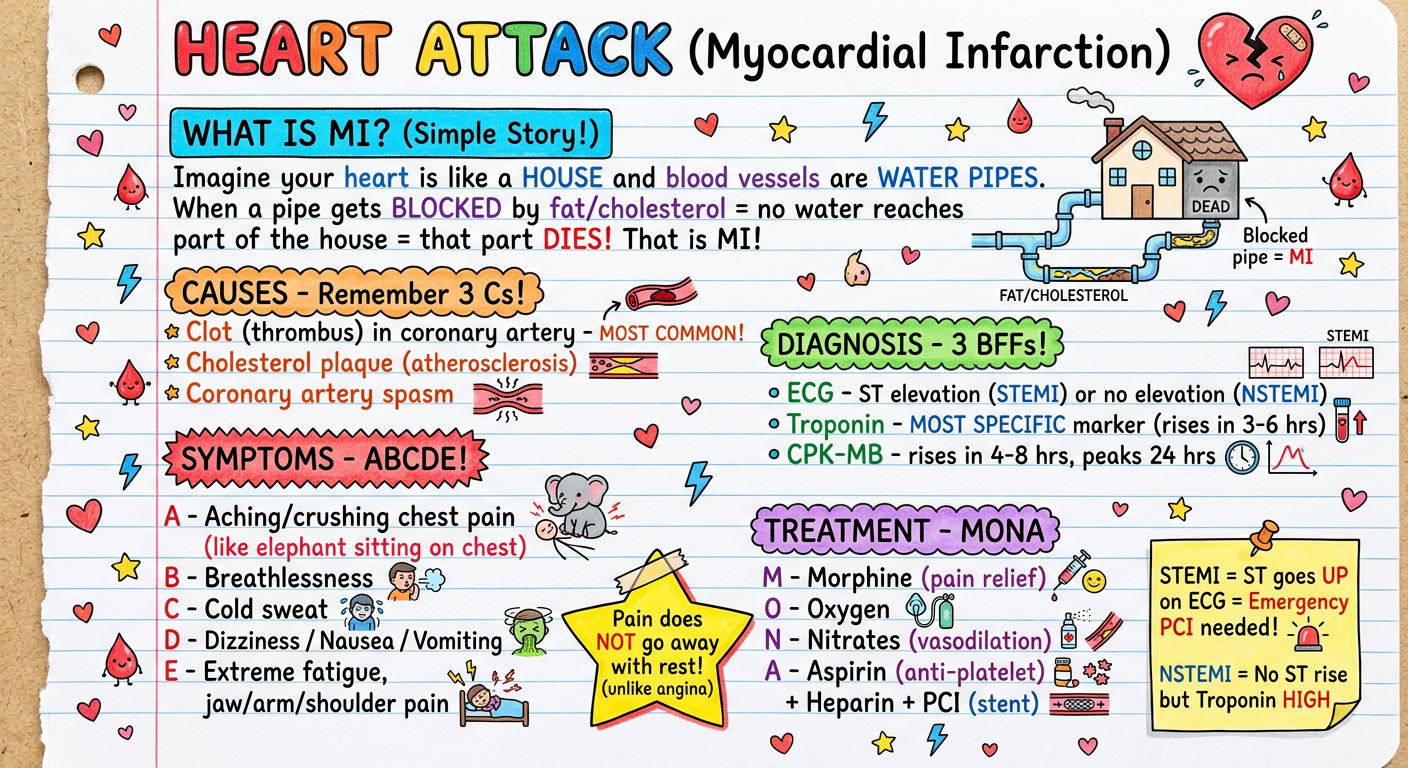
Myocardial Infarction (MI / Heart Attack) - Like You're 10!
The Simple Story 🫀
- Myo = muscle | Cardial = heart | Infarction = death of tissue
- The blocked blood vessel is called a coronary artery
CAUSES - Remember "3 Cs"
| Cause | What happens |
|---|---|
| Clot (Thrombus) | Blood clot blocks the artery - MOST COMMON |
| Cholesterol Plaque | Fat builds up over years (atherosclerosis), plaque ruptures |
| Coronary Spasm | Artery suddenly squeezes shut |
SYMPTOMS - Remember "ABCDE"
| Letter | Symptom |
|---|---|
| A | Aching, crushing chest pain (like an elephant sitting on chest) |
| B | Breathlessness |
| C | Cold sweat + pale/ashen skin |
| D | Dizziness, nausea, vomiting |
| E | Extreme fatigue, pain radiating to jaw, left arm, shoulder |
KEY POINT for NORCET: Pain does NOT go away with rest (unlike angina). It lasts >30 mins!
DIAGNOSIS - The 3 Best Friends
- STEMI = ST segment goes UP on ECG = big heart attack = emergency!
- NSTEMI = ST doesn't go up, but troponin is high = smaller heart attack
- Rises: 3-6 hours after MI
- Peaks: 12-24 hours
- Returns to normal: 7-10 days
- Rises: 4-8 hours
- Peaks: 24 hours
- Returns to normal: 48-72 hours
TREATMENT - "MONA" (Give in order!)
| Letter | Drug | Why |
|---|---|---|
| M | Morphine | Pain relief |
| O | Oxygen | Increase O2 to heart |
| N | Nitrates (GTN) | Open up the blood vessels |
| A | Aspirin | Stop blood clot from growing |
NORCET 11 High-Yield Points (Don't forget these!)
- Most common site of MI = Left Anterior Descending (LAD) artery = "Widow Maker"
- Troponin = most specific and sensitive marker for MI
- ST elevation on ECG = STEMI = needs immediate PCI or thrombolysis
- Killip Classification = grades severity of heart failure after MI (Killip I to IV)
- Silent MI (no chest pain) = common in diabetics and elderly
- Best position for MI patient = Semi-Fowler's position (45 degrees)
Explain myocardial infraction for norcet 11 handwritten notes
Detailed handwritten nursing exam study notes on realistic lined notebook paper with red margin line on left. Written in neat blue and black ink pen handwriting. Multiple colored headings using red, green, purple ink. Title at very top center in large bold red underlined handwriting: "MYOCARDIAL INFARCTION (MI)" with subtitle below in smaller writing "Heart Attack - NORCET 11 Notes" SECTION 1 - bold green box heading: "DEFINITION" Handwritten: "Death (necrosis) of myocardial muscle due to prolonged ischemia caused by complete blockage of coronary artery" Underlined note: "Ischemia > 20-40 mins → irreversible cell death" SECTION 2 - bold red heading: "TYPES" • STEMI - ST Elevation MI → complete occlusion → emergency PCI • NSTEMI - Non-ST Elevation MI → partial occlusion → medical management • Subendocardial MI - inner layer only • Transmural MI - full thickness of heart wall SECTION 3 - bold blue heading: "CAUSES (Risk Factors)" Modifiable: HTN, Diabetes, Smoking, Obesity, Hyperlipidemia, Stress Non-modifiable: Age (>45M, >55F), Male sex, Family history SECTION 4 - bold purple heading: "CLINICAL FEATURES" Chief complaint: Severe crushing chest pain, radiates to L arm/jaw/shoulder • NOT relieved by rest or nitrates • Duration > 30 mins • Associated: Dyspnea, diaphoresis, nausea/vomiting, palpitations, anxiety • "Silent MI" - diabetics, elderly, women (atypical) SECTION 5 - bold orange heading: "DIAGNOSIS - 3 KEY TESTS" 1. ECG: - STEMI: ST elevation + Q wave development - NSTEMI: ST depression / T wave inversion - Hyperacute T waves (earliest sign) 2. Cardiac Biomarkers table: | Marker | Rises | Peaks | Normal | | Troponin I/T | 3-6 hr | 12-24 hr | 7-10 days | | CPK-MB | 4-8 hr | 18-24 hr | 48-72 hr | | LDH | 24-48 hr | 3-6 days | 8-14 days | Circled: "Troponin = MOST SPECIFIC & SENSITIVE ★" 3. Echo: wall motion abnormality SECTION 6 - bold red heading: "TREATMENT - MONA + H" M - Morphine 2-4mg IV (pain + preload reduction) O - Oxygen (keep SpO2 >94%) N - Nitrates (GTN sublingual) A - Aspirin 300mg loading dose H - Heparin (anticoagulation) + Thrombolysis (if PCI not available within 2 hrs) + Primary PCI - GOLD STANDARD treatment for STEMI SECTION 7 - bold green heading: "NORCET KEY POINTS ★★★" • Best position: Semi-Fowler's (45°) • Most common artery: LAD = "Widow Maker" • Earliest ECG change: Hyperacute T wave • Most specific marker: Troponin I • Killip Class I-IV (severity grading) • Dressler's syndrome = post-MI pericarditis (2-10 wks later) Bottom right: small hand-drawn ECG wave showing ST elevation with arrow labeled "STEMI pattern" Realistic notebook paper texture, blue horizontal lines, red vertical margin, slightly worn edges, authentic handwritten look with ink variations
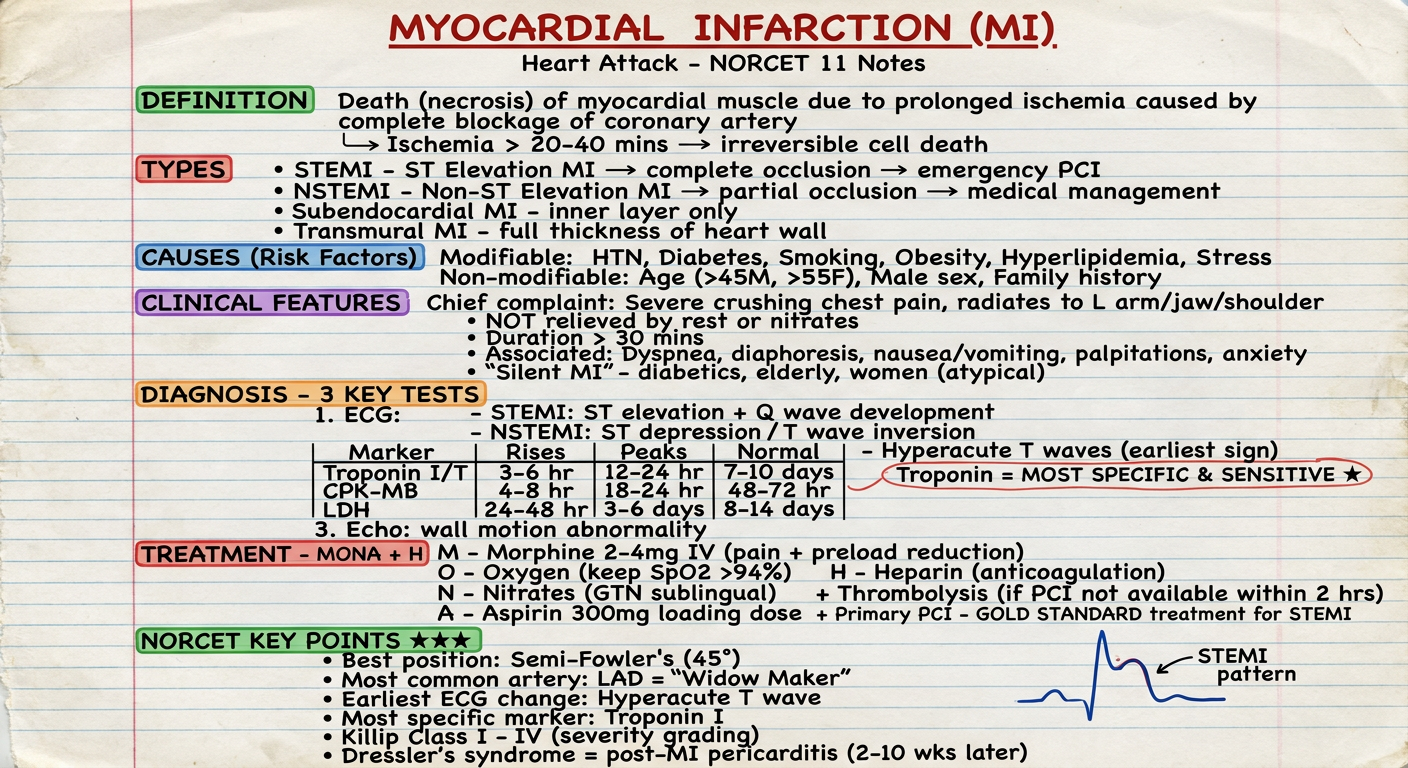
Handwritten nursing study notes page 2 on realistic lined notebook paper with red margin. Neat blue and black ink pen handwriting with colored subheadings. Top reads "MI Notes - Page 2 (NORCET 11)" underlined in red. SECTION 1 - bold red heading: "COMPLICATIONS OF MI" Early (within 24-48 hrs): • Arrhythmias - MOST COMMON complication (VF = most lethal) • Cardiogenic shock (Killip Class IV) • Acute LVF / Pulmonary edema • Cardiac arrest Late (days to weeks): • Dressler's Syndrome - fever + pericarditis (2-10 weeks after MI) • Ventricular aneurysm • Mural thrombus → systemic embolism • Mitral regurgitation (papillary muscle rupture) • Ventricular septal rupture SECTION 2 - bold blue heading: "KILLIP CLASSIFICATION (★ NORCET FAVORITE)" Class I - No heart failure signs - mortality 6% Class II - Mild HF, basal rales, S3 gallop - mortality 17% Class III - Severe HF, pulmonary edema - mortality 38% Class IV - Cardiogenic shock, BP<90 - mortality 67-81% SECTION 3 - bold green heading: "NURSING MANAGEMENT" Assessment: • Monitor VS every 15 min during acute phase • Continuous ECG monitoring (watch for arrhythmias!) • Monitor urine output (>30 ml/hr = adequate perfusion) • O2 saturation monitoring Interventions: • Bed rest - complete rest for first 24 hrs • Semi-Fowler's position (45°) - reduces cardiac workload • IV access - large bore cannula • NPO initially, then light diet • Reassurance - reduce anxiety (↓O2 demand) • Bowel care - avoid straining (Valsalva can worsen) Patient Education: • Lifestyle modification, medications, warning signs • Cardiac rehab program SECTION 4 - bold purple heading: "DRUG THERAPY SUMMARY" Acute Phase: MONA + Heparin + Clopidogrel Long-term: • Beta-blockers (metoprolol) - reduce O2 demand • ACE inhibitors - prevent remodeling • Statins - lower cholesterol • Aspirin 75mg daily - lifelong • Nitrates PRN SECTION 5 - bold orange heading: "QUICK MNEMONICS ★" MONA = Morphine, Oxygen, Nitrates, Aspirin "HEART" for MI risk factors: H - Hypertension E - Elevated cholesterol A - Age/Atherosclerosis R - Race/family history / smoking T - Type 2 diabetes Troponin Timeline box (hand drawn): 3hr → 6hr → 12-24hr → 7-10 days [Rises] → [Detected] → [PEAK] → [Normal] Bottom corner - small hand-drawn note: "LAD occlusion = Anterior MI (most common & serious)" Realistic notebook paper look, blue ruled lines, red margin line, authentic handwriting style
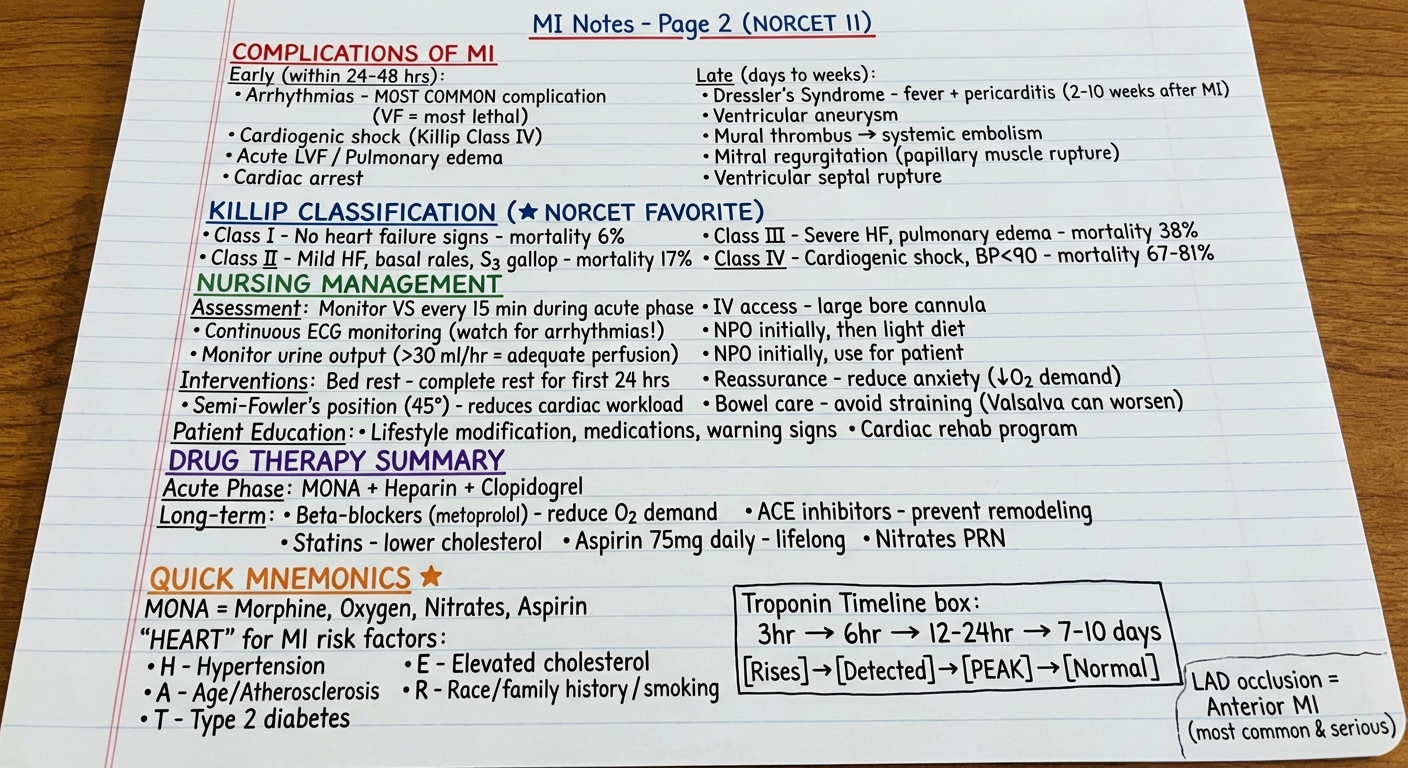
🫀 Myocardial Infarction (MI) - NORCET 11 Notes
Definition
Types of MI
| Type | ECG Finding | Vessel |
|---|---|---|
| STEMI | ST elevation + Q wave | Complete occlusion |
| NSTEMI | ST depression / T-wave inversion | Partial occlusion |
| Subendocardial | Inner layer only | Partial |
| Transmural | Full wall thickness | Complete |
Clinical Features
- Severe crushing/squeezing chest pain, radiating to left arm, jaw, shoulder
- Pain lasts >30 minutes, NOT relieved by rest or GTN
- Dyspnea, cold sweats (diaphoresis), nausea/vomiting
- Silent MI (no chest pain) - seen in diabetics, elderly, women
Diagnosis
| Marker | Rises | Peaks | Returns Normal |
|---|---|---|---|
| Troponin I/T ★ | 3-6 hrs | 12-24 hrs | 7-10 days |
| CPK-MB | 4-8 hrs | 18-24 hrs | 48-72 hrs |
| LDH | 24-48 hrs | 3-6 days | 8-14 days |
Troponin = MOST SPECIFIC and SENSITIVE marker for MI
- Earliest change: Hyperacute T waves
- STEMI: ST elevation, then Q wave develops
- NSTEMI: ST depression / T-wave inversion
Treatment - MONA + H
| Drug | Dose | Purpose |
|---|---|---|
| Morphine | 2-4 mg IV | Pain relief + reduces preload |
| Oxygen | Keep SpO2 >94% | Increase O2 delivery |
| Nitrates (GTN) | Sublingual | Vasodilation |
| Aspirin | 300 mg loading | Anti-platelet |
| Heparin | IV infusion | Anticoagulation |
- Primary PCI = Gold standard for STEMI (within 90 minutes)
- Thrombolysis = if PCI not available within 2 hours
Complications
- Arrhythmias - most common (VF = most lethal!)
- Cardiogenic shock
- Acute left ventricular failure / Pulmonary edema
- Dressler's Syndrome = fever + pericarditis (2-10 weeks after MI) ★
- Ventricular aneurysm
- Mitral regurgitation (papillary muscle rupture)
Killip Classification (NORCET Favorite!)
| Class | Features | Mortality |
|---|---|---|
| I | No HF signs | 6% |
| II | Mild HF, basal rales, S3 | 17% |
| III | Severe HF, pulmonary edema | 38% |
| IV | Cardiogenic shock, BP <90 | 67-81% |
Nursing Management (KEY for NORCET)
- Position: Semi-Fowler's (45 degrees)
- Complete bed rest for first 24 hours
- Continuous ECG monitoring for arrhythmias
- Monitor urine output (>30 mL/hr = adequate perfusion)
- Avoid straining/Valsalva - use stool softeners
- Reassurance to reduce anxiety (reduces O2 demand)
NORCET 11 High-Yield Points ★★★
- Most common coronary artery involved = LAD ("Widow Maker")
- Most specific marker = Troponin I
- Most common complication = Arrhythmia
- Most lethal arrhythmia = Ventricular Fibrillation (VF)
- Gold standard treatment = Primary PCI
- Best nursing position = Semi-Fowler's (45°)
- Dressler's Syndrome = post-MI pericarditis (2-10 weeks later)
- Silent MI = Diabetics + Elderly + Women
- Long-term drugs = Aspirin + Beta-blocker + ACE inhibitor + Statin
Create a PDF quick reference card for MI signs/symptoms and MONA treatment
ls -la /tmp/workspace/ 2>/dev/null || mkdir -p /tmp/workspace && echo "workspace ready"
mkdir -p /tmp/workspace/mi-reference-card && cat > /tmp/workspace/mi-reference-card/create_pdf.py << 'PYEOF' from reportlab.lib.pagesizes import A4 from reportlab.lib import colors from reportlab.lib.styles import getSampleStyleSheet, ParagraphStyle from reportlab.lib.units import mm, cm from reportlab.platypus import SimpleDocTemplate, Paragraph, Spacer, Table, TableStyle, HRFlowable from reportlab.lib.enums import TA_CENTER, TA_LEFT, TA_JUSTIFY from reportlab.platypus import KeepTogether from reportlab.lib.colors import HexColor # ── colour palette ────────────────────────────────────────────────────────── RED = HexColor('#C0392B') DARK_RED = HexColor('#922B21') ORANGE = HexColor('#E67E22') BLUE = HexColor('#2471A3') DARK_BLUE = HexColor('#1A5276') GREEN = HexColor('#1E8449') PURPLE = HexColor('#6C3483') YELLOW_BG = HexColor('#FDFBE6') LIGHT_RED = HexColor('#FADBD8') LIGHT_BLU = HexColor('#D6EAF8') LIGHT_GRN = HexColor('#D5F5E3') LIGHT_PUR = HexColor('#E8DAEF') LIGHT_ORG = HexColor('#FDEBD0') GREY_BG = HexColor('#F2F3F4') WHITE = colors.white BLACK = colors.black CARD_BG = HexColor('#FAFAFA') W, H = A4 # 595 x 842 pt # ── document ───────────────────────────────────────────────────────────────── doc = SimpleDocTemplate( '/tmp/workspace/mi-reference-card/MI_Quick_Reference.pdf', pagesize=A4, leftMargin=15*mm, rightMargin=15*mm, topMargin=12*mm, bottomMargin=12*mm, ) styles = getSampleStyleSheet() def S(name, **kw): return ParagraphStyle(name, **kw) # shared paragraph styles TITLE = S('title_main', fontName='Helvetica-Bold', fontSize=22, textColor=WHITE, alignment=TA_CENTER, spaceAfter=2) SUB = S('subtitle', fontName='Helvetica', fontSize=10, textColor=WHITE, alignment=TA_CENTER) SEC_HDR = S('sec_hdr', fontName='Helvetica-Bold', fontSize=11, textColor=WHITE, alignment=TA_CENTER) BODY = S('body', fontName='Helvetica', fontSize=9, textColor=BLACK, leading=14) BODY_B = S('body_bold', fontName='Helvetica-Bold', fontSize=9, textColor=BLACK, leading=14) SMALL = S('small', fontName='Helvetica', fontSize=8, textColor=HexColor('#555555'), leading=12) BULLET = S('bullet', fontName='Helvetica', fontSize=9, textColor=BLACK, leading=13, leftIndent=8, bulletIndent=0, bulletFontName='Helvetica') MONO_B = S('drug_name', fontName='Helvetica-Bold', fontSize=10, textColor=WHITE, alignment=TA_CENTER) DRUG_D = S('drug_desc', fontName='Helvetica', fontSize=8, textColor=HexColor('#222222'), leading=12) WARN = S('warn', fontName='Helvetica-Bold', fontSize=9, textColor=DARK_RED, alignment=TA_CENTER) NOTE = S('note', fontName='Helvetica-Oblique', fontSize=8, textColor=HexColor('#555555'), alignment=TA_CENTER) FOOTER = S('footer', fontName='Helvetica-Oblique', fontSize=7.5, textColor=HexColor('#888888'), alignment=TA_CENTER) # ── helper: section header bar ─────────────────────────────────────────────── def header_bar(text, bg): t = Table([[Paragraph(text, SEC_HDR)]], colWidths=[165*mm]) t.setStyle(TableStyle([ ('BACKGROUND', (0,0), (-1,-1), bg), ('ROUNDEDCORNERS', [4,4,4,4]), ('TOPPADDING', (0,0), (-1,-1), 5), ('BOTTOMPADDING',(0,0), (-1,-1), 5), ])) return t def bullet_row(emoji, text_bold, text_rest, bg=WHITE): return [Paragraph(emoji, BODY), Paragraph(f'<b>{text_bold}</b> {text_rest}', BODY)] # ═══════════════════════════════════════════════════════════════════ # TITLE BANNER # ═══════════════════════════════════════════════════════════════════ title_data = [[ Paragraph('🫀 MYOCARDIAL INFARCTION', TITLE), ],[ Paragraph('Quick Reference Card — NORCET 11', SUB), ],[ Paragraph('Signs & Symptoms | MONA Treatment | Biomarkers | Key Nursing Points', NOTE), ]] title_tbl = Table(title_data, colWidths=[165*mm]) title_tbl.setStyle(TableStyle([ ('BACKGROUND', (0,0), (-1,-1), DARK_RED), ('ROUNDEDCORNERS',[6,6,6,6]), ('TOPPADDING', (0,0), (-1,-1), 8), ('BOTTOMPADDING', (0,0), (-1,-1), 8), ('ALIGN', (0,0), (-1,-1), 'CENTER'), ])) # ═══════════════════════════════════════════════════════════════════ # ROW 1 LEFT: DEFINITION | RIGHT: TYPES # ═══════════════════════════════════════════════════════════════════ def_data = [ [header_bar('📖 DEFINITION', DARK_BLUE)], [Paragraph('<b>Myocardial Infarction (MI)</b> = irreversible death (necrosis) of heart muscle due to prolonged ischemia from coronary artery blockage.', BODY)], [Spacer(1, 3)], [Paragraph('⏱ Ischemia >20–40 min → irreversible cell death', BODY_B)], [Spacer(1, 3)], [Paragraph('• Plaque rupture → thrombus → complete/partial occlusion', BULLET)], [Paragraph('• Most common artery: <b>LAD ("Widow Maker")</b>', BULLET)], ] def_tbl = Table(def_data, colWidths=[80*mm]) def_tbl.setStyle(TableStyle([ ('BACKGROUND', (0,0), (-1,-1), LIGHT_BLU), ('ROUNDEDCORNERS', [4,4,4,4]), ('TOPPADDING', (0,0), (-1,-1), 4), ('BOTTOMPADDING', (0,0), (-1,-1), 4), ('LEFTPADDING', (0,1), (-1,-1), 6), ('RIGHTPADDING', (0,0), (-1,-1), 6), ])) types_data = [ [header_bar('📊 TYPES OF MI', PURPLE)], [Table([ [Paragraph('<b>STEMI</b>', BODY_B), Paragraph('ST elevation on ECG\nComplete occlusion\n→ Emergency PCI', SMALL)], [Paragraph('<b>NSTEMI</b>', BODY_B), Paragraph('No ST elevation\nPartial occlusion\n→ Medical Rx', SMALL)], [Paragraph('<b>Transmural</b>', BODY_B), Paragraph('Full wall thickness', SMALL)], [Paragraph('<b>Subendo-\ncardial</b>', BODY_B), Paragraph('Inner layer only', SMALL)], ], colWidths=[22*mm, 52*mm], style=TableStyle([ ('BACKGROUND', (0,0), (0,-1), HexColor('#EBD5F5')), ('BACKGROUND', (1,0), (1,-1), WHITE), ('GRID', (0,0), (-1,-1), 0.3, HexColor('#CCCCCC')), ('TOPPADDING', (0,0), (-1,-1), 3), ('BOTTOMPADDING', (0,0), (-1,-1), 3), ('LEFTPADDING', (0,0), (-1,-1), 4), ('FONTNAME', (0,0), (-1,-1), 'Helvetica'), ('FONTSIZE', (0,0), (-1,-1), 8), ('VALIGN', (0,0), (-1,-1), 'TOP'), ]))], ] types_tbl = Table(types_data, colWidths=[80*mm]) types_tbl.setStyle(TableStyle([ ('BACKGROUND', (0,0), (-1,-1), LIGHT_PUR), ('ROUNDEDCORNERS', [4,4,4,4]), ('TOPPADDING', (0,0), (-1,-1), 4), ('BOTTOMPADDING', (0,0), (-1,-1), 4), ('LEFTPADDING', (0,0), (-1,-1), 4), ('RIGHTPADDING', (0,0), (-1,-1), 4), ])) row1 = Table([[def_tbl, types_tbl]], colWidths=[82*mm, 83*mm], style=TableStyle([('VALIGN',(0,0),(-1,-1),'TOP'), ('LEFTPADDING',(0,0),(-1,-1),0), ('RIGHTPADDING',(0,0),(-1,-1),0), ('TOPPADDING',(0,0),(-1,-1),0), ('BOTTOMPADDING',(0,0),(-1,-1),0), ('COLPADDING',(0,0),(-1,-1),4), ])) # ═══════════════════════════════════════════════════════════════════ # SIGNS & SYMPTOMS (full width) # ═══════════════════════════════════════════════════════════════════ sym_rows = [ ['🔴', 'Chest Pain', 'Severe crushing/squeezing — "elephant on chest", radiates to L arm, jaw, shoulder. Lasts >30 min. NOT relieved by rest or GTN.'], ['🔵', 'Dyspnea', 'Shortness of breath due to reduced cardiac output'], ['🟡', 'Diaphoresis', 'Cold, clammy sweating'], ['🟠', 'Nausea / Vomiting', 'Due to vagal stimulation'], ['🟣', 'Palpitations', 'Arrhythmias — feeling of irregular/fast heartbeat'], ['⚪', 'Anxiety / Sense of doom', '"Feeling of impending death"'], ['🟤', 'Pallor / Cyanosis', 'Poor perfusion — pale or bluish skin'], ['⭐', 'Silent MI', 'NO chest pain! — seen in diabetics, elderly, women'], ] sym_header = [ Paragraph('', BODY), Paragraph('<b>Symptom</b>', BODY_B), Paragraph('<b>Description</b>', BODY_B) ] sym_table_data = [sym_header] + [ [Paragraph(r[0], BODY), Paragraph('<b>'+r[1]+'</b>', BODY), Paragraph(r[2], SMALL)] for r in sym_rows ] sym_inner = Table(sym_table_data, colWidths=[6*mm, 38*mm, 116*mm]) sym_inner.setStyle(TableStyle([ ('BACKGROUND', (0,0), (-1,0), RED), ('TEXTCOLOR', (0,0), (-1,0), WHITE), ('FONTNAME', (0,0), (-1,0), 'Helvetica-Bold'), ('FONTSIZE', (0,0), (-1,-1), 8.5), ('GRID', (0,0), (-1,-1), 0.3, HexColor('#CCCCCC')), ('ROWBACKGROUNDS',(0,1), (-1,-1), [WHITE, LIGHT_RED]), ('TOPPADDING', (0,0), (-1,-1), 3), ('BOTTOMPADDING', (0,0), (-1,-1), 3), ('LEFTPADDING', (0,0), (-1,-1), 4), ('VALIGN', (0,0), (-1,-1), 'MIDDLE'), ])) sym_section = Table([ [header_bar('🩺 SIGNS & SYMPTOMS', RED)], [sym_inner], ], colWidths=[165*mm]) sym_section.setStyle(TableStyle([ ('BACKGROUND', (0,0), (-1,-1), LIGHT_RED), ('ROUNDEDCORNERS',[4,4,4,4]), ('TOPPADDING', (0,0), (-1,-1), 4), ('BOTTOMPADDING',(0,0), (-1,-1), 4), ('LEFTPADDING', (0,0), (-1,-1), 4), ('RIGHTPADDING', (0,0), (-1,-1), 4), ])) # ═══════════════════════════════════════════════════════════════════ # MONA TREATMENT (4 columns) # ═══════════════════════════════════════════════════════════════════ def mona_card(letter, drug, dose, purpose, bg, tc): inner = Table([ [Paragraph(letter, S('ml', fontName='Helvetica-Bold', fontSize=28, textColor=WHITE, alignment=TA_CENTER))], [Paragraph(drug, S('dn', fontName='Helvetica-Bold', fontSize=10, textColor=WHITE, alignment=TA_CENTER))], [Paragraph(dose, S('dd', fontName='Helvetica', fontSize=8, textColor=HexColor('#EEEEEE'), alignment=TA_CENTER))], [Spacer(1,3)], [Paragraph(purpose,S('dp', fontName='Helvetica', fontSize=8, textColor=BLACK, alignment=TA_CENTER, leading=11))], ], colWidths=[37*mm]) inner.setStyle(TableStyle([ ('BACKGROUND', (0,0), (0,2), bg), ('BACKGROUND', (0,3), (0,4), HexColor('#FAFAFA')), ('TOPPADDING', (0,0), (-1,-1), 4), ('BOTTOMPADDING', (0,0), (-1,-1), 4), ('ALIGN', (0,0), (-1,-1), 'CENTER'), ])) outer = Table([[inner]], colWidths=[39*mm]) outer.setStyle(TableStyle([ ('BOX', (0,0), (-1,-1), 1.2, bg), ('ROUNDEDCORNERS', [5,5,5,5]), ('LEFTPADDING', (0,0), (-1,-1), 0), ('RIGHTPADDING', (0,0), (-1,-1), 0), ('TOPPADDING', (0,0), (-1,-1), 0), ('BOTTOMPADDING',(0,0), (-1,-1), 0), ])) return outer m_card = mona_card('M', 'MORPHINE', '2–4 mg IV', 'Pain relief\nReduces preload\nDecreases anxiety', HexColor('#C0392B'), WHITE) o_card = mona_card('O', 'OXYGEN', 'SpO₂ target >94%', 'Increase O₂ delivery\nto ischemic myocardium', HexColor('#2471A3'), WHITE) n_card = mona_card('N', 'NITRATES', 'GTN 0.4mg sublingual', 'Vasodilation\nReduces preload\n& afterload', HexColor('#1E8449'), WHITE) a_card = mona_card('A', 'ASPIRIN', '300 mg loading dose', 'Anti-platelet\nPrevents clot\nexpansion', HexColor('#D35400'), WHITE) mona_row = Table([[m_card, o_card, n_card, a_card]], colWidths=[41*mm,41*mm,41*mm,41*mm]) mona_row.setStyle(TableStyle([ ('VALIGN', (0,0),(-1,-1),'TOP'), ('ALIGN', (0,0),(-1,-1),'CENTER'), ('LEFTPADDING', (0,0),(-1,-1), 1), ('RIGHTPADDING', (0,0),(-1,-1), 1), ('TOPPADDING', (0,0),(-1,-1), 0), ('BOTTOMPADDING',(0,0),(-1,-1), 0), ])) plus_hep = Table([[ Paragraph('➕ HEPARIN (IV anticoagulation) | ➕ CLOPIDOGREL 300mg (antiplatelet) | ⭐ Primary PCI = GOLD STANDARD for STEMI (target ≤90 min)', S('ph', fontName='Helvetica-Bold', fontSize=9, textColor=WHITE, alignment=TA_CENTER)) ]], colWidths=[165*mm]) plus_hep.setStyle(TableStyle([ ('BACKGROUND', (0,0),(-1,-1), DARK_BLUE), ('TOPPADDING', (0,0),(-1,-1), 5), ('BOTTOMPADDING', (0,0),(-1,-1), 5), ('ROUNDEDCORNERS',[4,4,4,4]), ])) mona_section = Table([ [header_bar('💊 MONA TREATMENT (Give in Order!)', HexColor('#922B21'))], [mona_row], [Spacer(1,4)], [plus_hep], ], colWidths=[165*mm]) mona_section.setStyle(TableStyle([ ('BACKGROUND', (0,0),(-1,-1), LIGHT_ORG), ('ROUNDEDCORNERS',[4,4,4,4]), ('TOPPADDING', (0,0),(-1,-1), 4), ('BOTTOMPADDING', (0,0),(-1,-1), 4), ('LEFTPADDING', (0,0),(-1,-1), 4), ('RIGHTPADDING', (0,0),(-1,-1), 4), ])) # ═══════════════════════════════════════════════════════════════════ # ROW 3: BIOMARKERS | NURSING KEY POINTS # ═══════════════════════════════════════════════════════════════════ bio_rows = [ ['Marker', 'Rises', 'Peaks', 'Normal'], ['Troponin I/T ★', '3–6 hr', '12–24 hr', '7–10 days'], ['CPK-MB', '4–8 hr', '18–24 hr', '48–72 hr'], ['LDH', '24–48 hr', '3–6 days', '8–14 days'], ['Myoglobin', '1–3 hr', '6–9 hr', '24–36 hr'], ] bio_inner = Table(bio_rows, colWidths=[22*mm,16*mm,17*mm,17*mm]) bio_inner.setStyle(TableStyle([ ('BACKGROUND', (0,0),(-1,0), GREEN), ('TEXTCOLOR', (0,0),(-1,0), WHITE), ('FONTNAME', (0,0),(-1,0), 'Helvetica-Bold'), ('BACKGROUND', (0,1),(0,-1), LIGHT_GRN), ('FONTNAME', (0,1),(0,-1), 'Helvetica-Bold'), ('FONTSIZE', (0,0),(-1,-1), 8), ('GRID', (0,0),(-1,-1), 0.4, HexColor('#AAAAAA')), ('ALIGN', (0,0),(-1,-1), 'CENTER'), ('ROWBACKGROUNDS',(0,1),(-1,-1), [WHITE, LIGHT_GRN]), ('TOPPADDING', (0,0),(-1,-1), 3), ('BOTTOMPADDING', (0,0),(-1,-1), 3), ])) troponin_note = Table([[ Paragraph('★ Troponin = MOST SPECIFIC & SENSITIVE marker for MI', S('tn', fontName='Helvetica-Bold', fontSize=8, textColor=DARK_RED, alignment=TA_CENTER)) ]], colWidths=[73*mm]) troponin_note.setStyle(TableStyle([ ('BACKGROUND',(0,0),(-1,-1), HexColor('#FDEDEC')), ('BOX', (0,0),(-1,-1), 1, RED), ('TOPPADDING',(0,0),(-1,-1), 4), ('BOTTOMPADDING',(0,0),(-1,-1),4), ])) bio_section = Table([ [header_bar('🔬 CARDIAC BIOMARKERS', GREEN)], [bio_inner], [Spacer(1,3)], [troponin_note], ], colWidths=[77*mm]) bio_section.setStyle(TableStyle([ ('BACKGROUND', (0,0),(-1,-1), LIGHT_GRN), ('ROUNDEDCORNERS',[4,4,4,4]), ('TOPPADDING', (0,0),(-1,-1), 4), ('BOTTOMPADDING', (0,0),(-1,-1), 4), ('LEFTPADDING', (0,0),(-1,-1), 4), ('RIGHTPADDING', (0,0),(-1,-1), 4), ])) nurs_bullets = [ ('📍', 'Position:', 'Semi-Fowler\'s (45°) — reduces cardiac workload'), ('❤', 'Monitor:', 'Continuous ECG — watch for arrhythmias (VF most lethal!)'), ('💧', 'Urine output:', '>30 mL/hr = adequate perfusion'), ('😴', 'Activity:', 'Complete bed rest for first 24 hrs'), ('😮\u200d💨', 'O₂:', 'Maintain SpO₂ >94%'), ('📝', 'Avoid:', 'Straining/Valsalva — use stool softeners'), ('🧡', 'Reassure:', 'Reduces anxiety → reduces O₂ demand'), ('💊', 'Dressler\'s:', 'Post-MI pericarditis (2–10 wks) — fever + chest pain'), ('🏥', 'Killip IV:', 'Cardiogenic shock — mortality ~67–81%'), ] nurs_rows = [[Paragraph(b[0],SMALL), Paragraph(f'<b>{b[1]}</b> {b[2]}', SMALL)] for b in nurs_bullets] nurs_inner = Table(nurs_rows, colWidths=[6*mm, 76*mm]) nurs_inner.setStyle(TableStyle([ ('ROWBACKGROUNDS',(0,0),(-1,-1),[WHITE, LIGHT_BLU]), ('TOPPADDING', (0,0),(-1,-1), 2), ('BOTTOMPADDING',(0,0),(-1,-1), 2), ('LEFTPADDING', (0,0),(-1,-1), 3), ('FONTSIZE', (0,0),(-1,-1), 8), ('GRID', (0,0),(-1,-1), 0.2, HexColor('#DDDDDD')), ('VALIGN', (0,0),(-1,-1),'MIDDLE'), ])) nurs_section = Table([ [header_bar('🏥 NURSING KEY POINTS', DARK_BLUE)], [nurs_inner], ], colWidths=[88*mm]) nurs_section.setStyle(TableStyle([ ('BACKGROUND', (0,0),(-1,-1), LIGHT_BLU), ('ROUNDEDCORNERS',[4,4,4,4]), ('TOPPADDING', (0,0),(-1,-1), 4), ('BOTTOMPADDING', (0,0),(-1,-1), 4), ('LEFTPADDING', (0,0),(-1,-1), 4), ('RIGHTPADDING', (0,0),(-1,-1), 4), ])) row3 = Table([[bio_section, nurs_section]], colWidths=[82*mm, 83*mm], style=TableStyle([ ('VALIGN',(0,0),(-1,-1),'TOP'), ('LEFTPADDING',(0,0),(-1,-1),0), ('RIGHTPADDING',(0,0),(-1,-1),0), ('TOPPADDING',(0,0),(-1,-1),0), ('BOTTOMPADDING',(0,0),(-1,-1),0), ('COLPADDING',(0,0),(-1,-1),4), ])) # ═══════════════════════════════════════════════════════════════════ # BOTTOM HIGHLIGHT BAR — NORCET HIGH-YIELD # ═══════════════════════════════════════════════════════════════════ hy_items = [ '⭐ LAD = "Widow Maker"', '⭐ Troponin = Most Specific', '⭐ VF = Most Lethal Arrhythmia', '⭐ Primary PCI = Gold Standard', '⭐ Earliest ECG = Hyperacute T waves', '⭐ Silent MI → Diabetics/Elderly', ] hy_cols = [Table([[Paragraph(i, S('hy', fontName='Helvetica-Bold', fontSize=8, textColor=WHITE, alignment=TA_CENTER))]], colWidths=[26*mm], style=TableStyle([ ('BACKGROUND',(0,0),(-1,-1), HexColor('#922B21')), ('ROUNDEDCORNERS',[3,3,3,3]), ('TOPPADDING',(0,0),(-1,-1),4), ('BOTTOMPADDING',(0,0),(-1,-1),4), ])) for i in hy_items] hy_row = Table([hy_cols], colWidths=[27.5*mm]*6) hy_row.setStyle(TableStyle([ ('LEFTPADDING',(0,0),(-1,-1),1), ('RIGHTPADDING',(0,0),(-1,-1),1), ('TOPPADDING',(0,0),(-1,-1),0), ('BOTTOMPADDING',(0,0),(-1,-1),0), ('ALIGN',(0,0),(-1,-1),'CENTER'), ])) hy_section = Table([ [header_bar('🎯 NORCET 11 HIGH-YIELD POINTS', HexColor('#641E16'))], [hy_row], ], colWidths=[165*mm]) hy_section.setStyle(TableStyle([ ('BACKGROUND', (0,0),(-1,-1), HexColor('#FDEDEC')), ('ROUNDEDCORNERS',[4,4,4,4]), ('TOPPADDING', (0,0),(-1,-1), 5), ('BOTTOMPADDING', (0,0),(-1,-1), 5), ('LEFTPADDING', (0,0),(-1,-1), 4), ('RIGHTPADDING', (0,0),(-1,-1), 4), ])) # ── footer ─────────────────────────────────────────────────────────────────── footer = Paragraph( 'Sources: Guyton & Hall Medical Physiology • Rosen\'s Emergency Medicine • Braunwald\'s Heart Disease | NORCET 11 Exam Prep', FOOTER) # ═══════════════════════════════════════════════════════════════════ # BUILD STORY # ═══════════════════════════════════════════════════════════════════ story = [ title_tbl, Spacer(1, 5), row1, Spacer(1, 5), sym_section, Spacer(1, 5), mona_section, Spacer(1, 5), row3, Spacer(1, 5), hy_section, Spacer(1, 4), footer, ] doc.build(story) print("PDF created successfully!") PYEOF echo "Script written."
cd /tmp/workspace/mi-reference-card && python create_pdf.py 2>&1
ls -lh /tmp/workspace/mi-reference-card/MI_Quick_Reference.pdf
MI Quick Reference
PDF Document · PDF
| Section | Contents |
|---|---|
| Definition & Types | STEMI vs NSTEMI vs Transmural vs Subendocardial |
| Signs & Symptoms | All 8 symptoms with descriptions, including Silent MI |
| MONA Treatment | 4 colour-coded cards (M-O-N-A) with drug, dose & purpose |
| + Additional Rx | Heparin, Clopidogrel, Primary PCI (Gold Standard ≤90 min) |
| Cardiac Biomarkers | Troponin / CPK-MB / LDH / Myoglobin - rise, peak, normal times |
| Nursing Key Points | Position, monitoring, urine output, Dressler's syndrome |
| NORCET 11 High-Yield | 6 star points most likely to appear in exam |