
Cerebellum
Reading File
The query is quite broad - "Cerebellum" could mean anatomy, physiology, clinical syndromes, pathology, or more. Let me clarify before diving deep.
Asking for Preferences
What aspect of the cerebellum are you interested in?
Searching the medical library for cerebellar anatomy now.
Finding Sources
Finding Sources
Great results. I'll pull from the best anatomy-focused sources: Neuroanatomy through Clinical Cases, Neuroscience Exploring the Brain, and Eric Kandel's Principles of Neural Science - all at once.
Reading File
Reading File
Reading File
Good content found. Now let me read the detailed anatomy sections from the best sources - specifically the anatomy coverage from Neuroanatomy through Clinical Cases and Neuroscience Exploring the Brain.
Reading File
Reading File
I have rich content. Let me now fetch the key anatomy images and read a bit more of the detailed anatomy from Neuroanatomy through Clinical Cases.
Reading File
Loading Image
Loading Image
Excellent - I have great content and images. Let me now fetch the microstructure circuit diagram and the dorsal/ventral views diagram.
Loading Image
Reading File
I now have comprehensive anatomy content and detailed diagrams. Let me compile the full, well-structured response.
The Cerebellum: Anatomy & Structure
Location and General Appearance
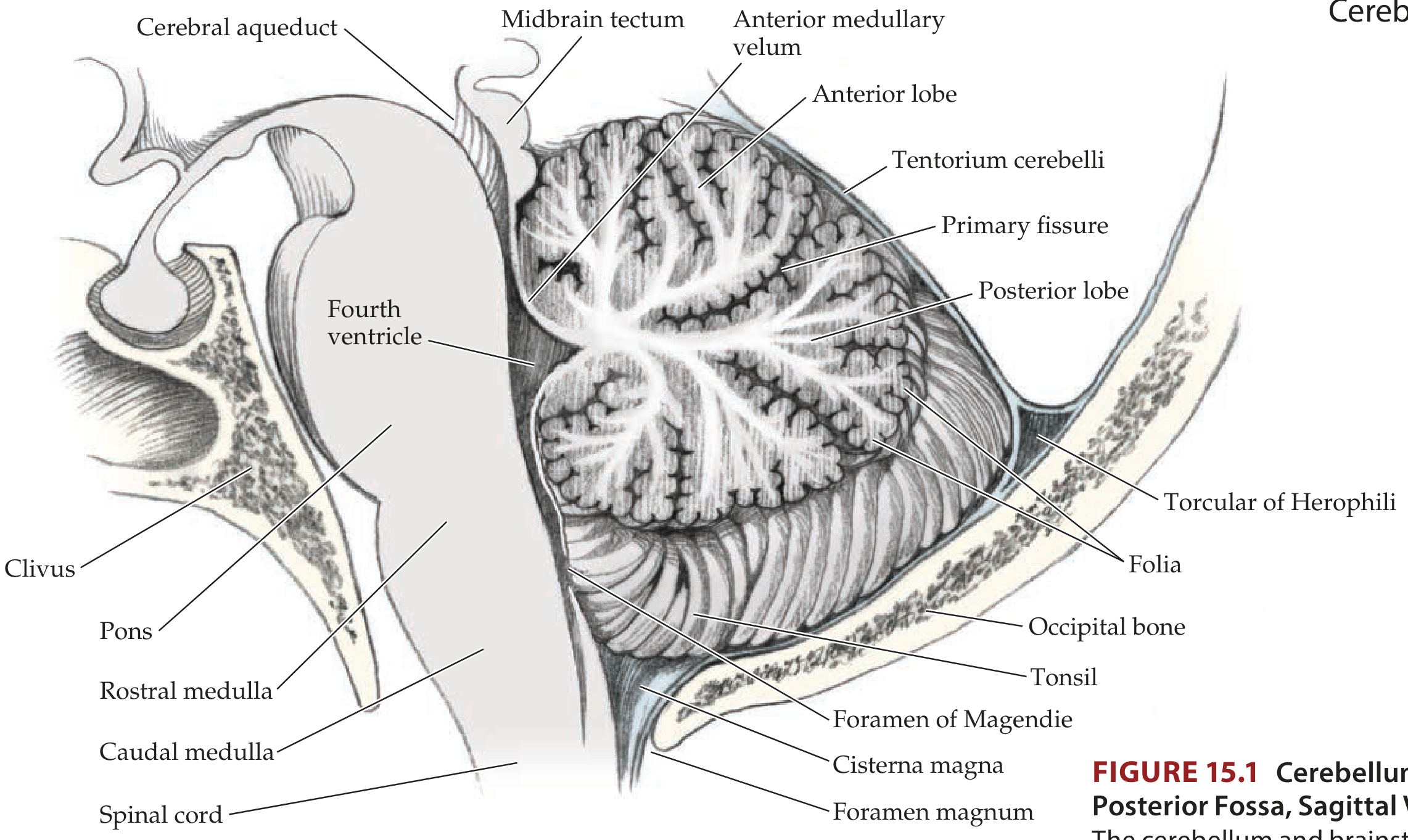
The cerebellum is the largest structure in the posterior fossa, situated dorsal to the pons and rostral medulla, forming the roof of the fourth ventricle. On midsagittal section, the branching pattern of central white matter surrounded by cortical gray matter resembles a tree, historically called the arbor vitae ("tree of life"). Instead of gyri, the surface ridges are called folia ("leaves").
Lobes
The cerebellum is divided by fissures into three lobes:
| Lobe | Boundary | Key Structures |
|---|---|---|
| Anterior lobe | Anterior to primary fissure | Superior vermis |
| Posterior lobe | Between primary and posterolateral fissures | Lateral hemispheres, most of vermis |
| Flocculonodular lobe | Posterior to posterolateral fissure | Flocculi + nodulus (most phylogenetically ancient) |
The primary fissure (deepest) separates the anterior from the posterior lobe on the dorsal surface. On the ventral inferior surface, the posterolateral fissure separates the posterior lobe from the flocculonodular lobe. The two flocculi connect to the midline nodulus (the most inferior part of the vermis) by thin pedicles.
The cerebellar tonsils sit on the inferior surface - clinically important because mass lesions or severe intracranial hypertension can force them through the foramen magnum (tonsillar herniation), compressing the medulla and its respiratory centers, causing death.
Functional Regions (Medial to Lateral)
Three functional divisions run in parallel, from medial to lateral:
| Region | Function | Motor pathways influenced |
|---|---|---|
| Vermis + flocculonodular lobe | Proximal limb/trunk coordination; balance; vestibulo-ocular reflexes | Anterior corticospinal, reticulospinal, vestibulospinal, tectospinal tracts; MLF |
| Intermediate hemispheres | Distal limb coordination | Lateral corticospinal tract, rubrospinal tract |
| Lateral hemispheres | Motor planning for extremities; cognition | Lateral corticospinal tract |
Clinically: midline lesions cause truncal ataxia and eye movement abnormalities; lateral lesions cause ipsilateral limb (appendicular) ataxia.
Peduncles
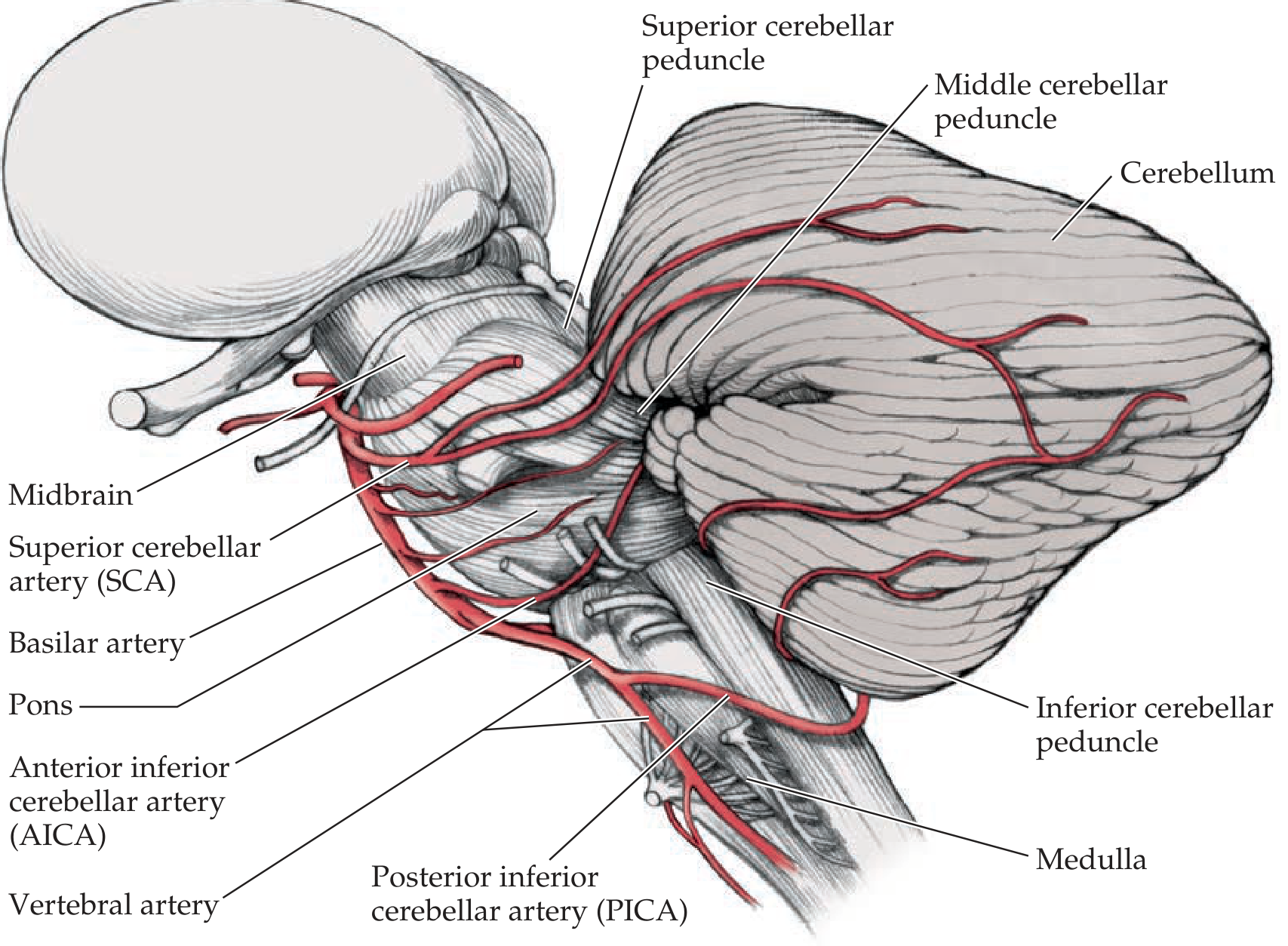
The cerebellum attaches to the brainstem by three white matter peduncles that form the walls of the fourth ventricle:
| Peduncle | Alternative name | Main direction | Key connections |
|---|---|---|---|
| Superior cerebellar peduncle | Brachium conjunctivum | Output | Decussates in midbrain at level of inferior colliculi; carries output to thalamus (and then motor cortex) |
| Middle cerebellar peduncle | Brachium pontis | Input | Massive input from pontine nuclei (corticopontine fibers) |
| Inferior cerebellar peduncle | Restiform body | Input | Spinal cord (spinocerebellar tracts), vestibular nuclei, inferior olivary nucleus |
Deep Cerebellar Nuclei
All cerebellar output is relayed through the deep cerebellar nuclei (also called the roof nuclei). From lateral to medial:
Mnemonic: "Don't Eat Greasy Foods"
- Dentate nucleus - largest; receives from lateral hemispheres; output via superior cerebellar peduncle to VL thalamus → motor cortex (motor planning)
- Emboliform nucleus - receives from intermediate hemispheres
- Globose nucleus - receives from intermediate hemispheres
- Fastigial nucleus - most medial; receives from vermis and flocculonodular lobe; projects to vestibular and reticular nuclei
(The emboliform + globose together are sometimes called the interposed nuclei.)
Cerebellar Cortex: Three Layers
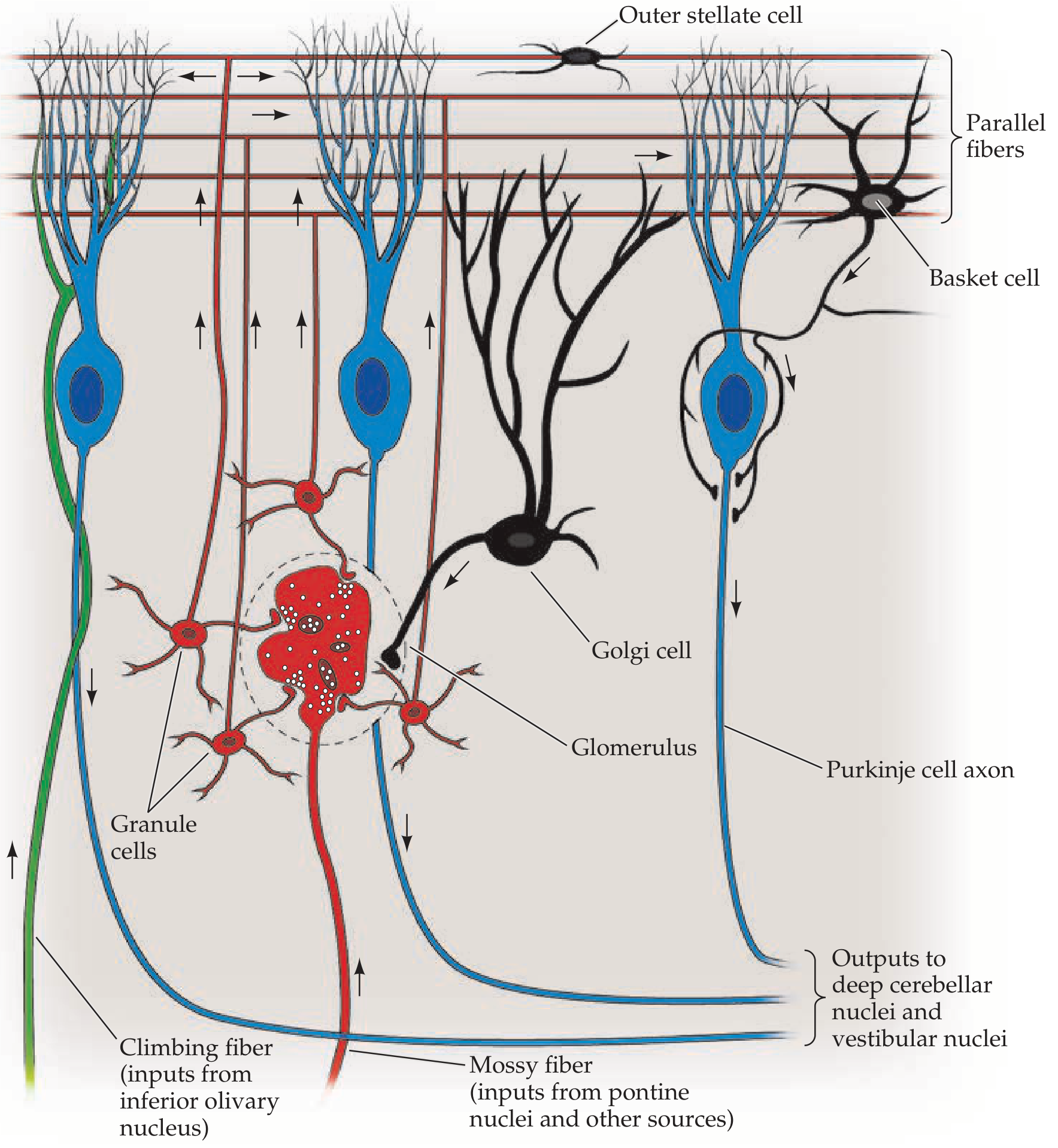
The cortex is uniform throughout the cerebellum, organized into repeating microcircuit units across three layers:
1. Molecular Layer (outermost)
- Contains Purkinje cell dendrites, parallel fibers, stellate cells, and basket cells
- Parallel fibers (axons of granule cells) run perpendicular to Purkinje cell dendritic trees
2. Purkinje Cell Layer (middle)
- Single row of large Purkinje cells - the sole output neurons of the cerebellar cortex
- Purkinje cells are GABAergic (inhibitory); their axons project to the deep cerebellar nuclei
3. Granule Cell Layer (innermost)
- Packed with tiny granule cells - the most numerous neurons in the entire brain
- Contains cerebellar glomeruli: specialized synaptic complexes where mossy fiber terminals, granule cell dendrites, and Golgi cell axon terminals interact
Afferent Fiber Systems (Inputs)
Two major input systems:
Mossy Fibers
- Arise from pontine nuclei (corticopontine pathway), spinal cord, reticular formation, vestibular nuclei
- Synapse on granule cell dendrites in glomeruli
- Each mossy fiber contacts ~450 granule cells
- Granule cells → parallel fibers → excite Purkinje cells
Climbing Fibers
- Arise exclusively from the inferior olivary nucleus (medulla)
- Each climbing fiber synapses on just one Purkinje cell, but makes ~300 synaptic contacts on its dendrites
- Powerful modulator of Purkinje cell responsiveness; key for motor learning (long-term depression of parallel fiber synapses)
Cerebellar Microcircuit
Interneurons:
- Basket cells (molecular layer): form "basket" synapses around Purkinje cell bodies - lateral inhibition
- Stellate cells (molecular layer): inhibit Purkinje cell dendrites - lateral inhibition
- Golgi cells (granule cell layer): receive parallel fiber excitation → feedback inhibition onto granule cells (sharpens temporal resolution of input signals)
Vascular Supply
Three paired arteries supply the cerebellum:
| Artery | Origin | Territory |
|---|---|---|
| SCA (superior cerebellar artery) | Basilar artery, near junction with posterior cerebral artery | Superior cerebellar surface, deep nuclei, superior peduncle |
| AICA (anterior inferior cerebellar artery) | Basilar artery | Anterior inferior surface, middle peduncle, inner ear |
| PICA (posterior inferior cerebellar artery) | Vertebral artery | Posterior inferior surface, inferior peduncle, dorsolateral medulla |
Summary: Key Structural Principles
- No direct connections to lower motor neurons - the cerebellum acts exclusively via connections to motor cortex and brainstem
- Ipsilateral organization - cerebellar lesions cause ipsilateral deficits (double crossing: cortex → pons crosses → cerebellar output crosses back)
- Uniform cortical microcircuit - the same circuit repeats throughout; different regions perform similar computations on different inputs
- Purkinje cells are the sole output of the cortex, always inhibitory, always targeting deep nuclei
- The cerebellum contains >50% of all neurons in the brain despite being only ~10% of total brain volume
Sources: Neuroanatomy through Clinical Cases, 3rd Ed. | Neuroscience: Exploring the Brain, 5th Ed. | Principles of Neural Science (Kandel), 6th Ed.
Hlo
Your credits are exhausted. You can purchase a top-up or subscribe to a plan to continue using Orris. If you're already subscribed, your daily credits will reset tomorrow.
This is a shared conversation. Sign in to Orris to start your own chat.