


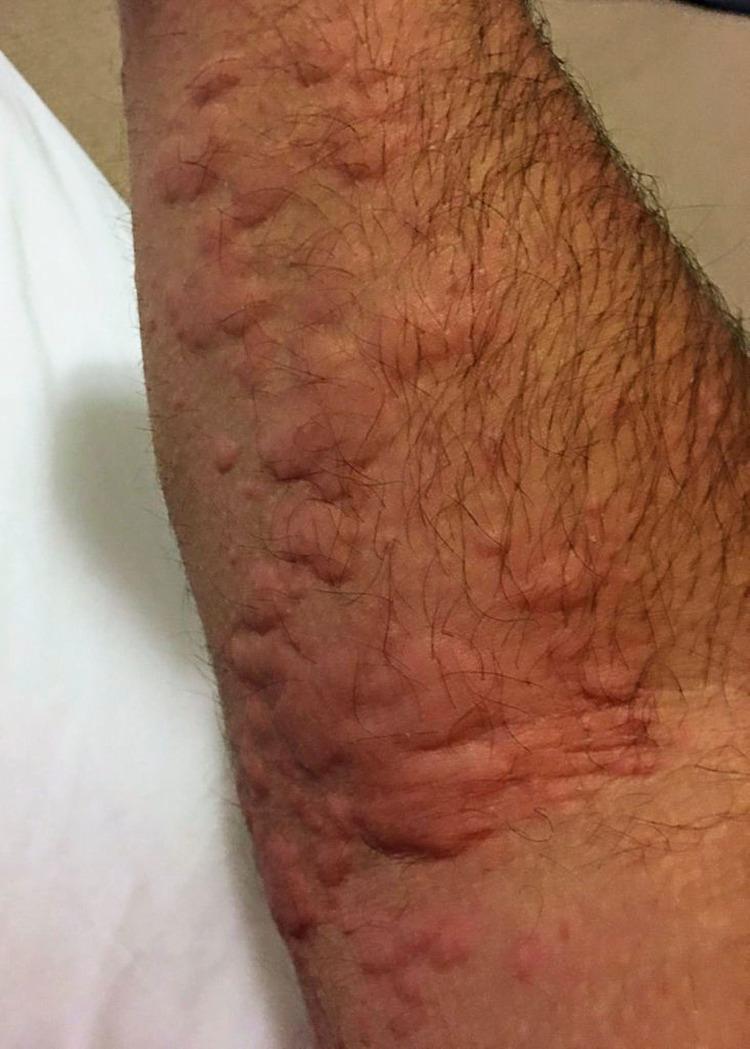
Occasionally this kind of rash occurs in an 40 year old male
Reading File
Searching for information on recurrent urticarial rash on the arm with wheals — the image shows raised, skin-colored wheals consistent with urticaria. I'll search for urticaria diagnosis, causes, and management in parallel.
search_medical_text
urticaria wheals recurrent episodic causes diagnosis adult
Definition, Classification, Diagnosis, and Management of Urticaria
Page 12

search_medical_text
chronic urticaria management treatment antihistamines
Definition, Classification, Diagnosis, and Management of Urticaria
Page 23
GradeResponse
GradeResponse
GradeResponse
Assessment
The images show urticaria (hives) — raised, skin-colored to slightly erythematous wheals distributed across the forearm. The second photo more clearly shows the elevated, edematous nature of the lesions. This is a classic urticarial eruption.
Here's a reference image of urticarial wheals for comparison:
Diagnosis: Chronic Intermittent Urticaria
Since episodes recur occasionally (not a single episode), this fits the definition of chronic urticaria — wheals or angioedema occurring for >6 weeks — possibly with an intermittent/recurrent course. Chronic spontaneous urticaria (CSU) can recur after months or years of full remission (per Definition, Classification, Diagnosis, and Management of Urticaria, p. 12).
Key Features on the Images
- Wheals: raised, edematous plaques/papules on the forearm
- Skin-colored to slightly pink — consistent with early or resolving lesions
- No excoriation or scaling — rules out eczema, psoriasis
- Episodic / transient — wheals typically resolve within 24 hours
Common Triggers to Investigate
| Category | Examples |
|---|---|
| Allergic | Foods (nuts, shellfish, eggs), drugs (NSAIDs, antibiotics) |
| Physical | Pressure, heat, cold, exercise (dermographism, cholinergic urticaria) |
| Infectious | H. pylori, parasites, viral infections |
| Autoimmune | Thyroid autoantibodies, IgE receptor autoantibodies |
| Idiopathic | Most common — no identifiable trigger (~50% of CSU) |
Management
Step 1 (First-line): 2nd-generation H₁-antihistamines — non-sedating, taken daily (not just when symptomatic):
- Cetirizine 10 mg, Loratadine 10 mg, Fexofenadine 180 mg, Levocetirizine 5 mg, Bilastine 20 mg
Step 2: Up-dosing antihistamine up to 4× standard dose if inadequate control
Step 3: Add omalizumab (anti-IgE monoclonal antibody) — highly effective for CSU refractory to antihistamines
Step 4: Short courses of systemic corticosteroids for acute severe flares (not for long-term use)
When to Refer / Investigate Further
- Recurrent angioedema (lip/tongue/throat swelling) → urgent allergy/immunology referral
- Systemic symptoms (fever, joint pain, weight loss) → rule out urticarial vasculitis or systemic disease
- Basic workup: CBC, ESR/CRP, thyroid function + anti-TPO antibodies, H. pylori testing
Bottom line: This 40-year-old male most likely has chronic spontaneous urticaria with intermittent flares. The first step is daily non-sedating antihistamines and a trigger diary. If episodes are frequent or severe, referral to a dermatologist or allergist is appropriate.
⚠️ This is educational information only. A physician should evaluate in person for formal diagnosis and treatment.
This is a shared conversation. Sign in to Orris to start your own chat.