

Interpret
Reading File
Searching for relevant imaging references on knee X-ray interpretation and osteoarthritis grading.
search_medical_image
knee X-ray osteoarthritis joint space narrowing osteophytes
Hugging Face pmc clinical VQA raw
Page 0
search_medical_text
knee osteoarthritis radiographic grading Kellgren-Lawrence joint space narrowing osteophytes sclerosis
Harrison's Principles of Internal Medicine, Twenty First Edition
Page 10416
GradeResponse
GradeResponse
Knee X-Ray Interpretation
Patient: Swagatika Patel | Age: 34 years | Sex: Female | Side: Left knee (marked "L")
Views: AP (anteroposterior) + Lateral
Key Radiographic Findings
AP View:
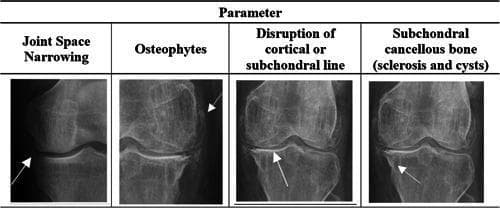
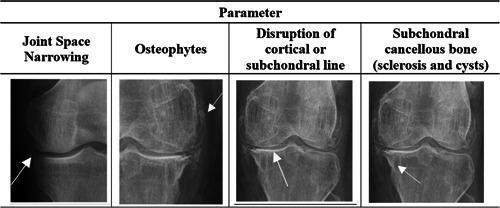
- Medial joint space narrowing — the medial tibiofemoral compartment shows reduced joint space compared to the lateral compartment, indicating preferential medial cartilage loss
- Osteophytes — bony outgrowths visible at the medial and lateral femoral condyles and tibial margins
- Subchondral sclerosis — increased bone density (whiteness) at the medial tibial plateau and femoral condyle
- Varus alignment — the knee demonstrates mild varus (bow-leg) angulation, consistent with medial compartment predominance
Lateral View:
- Osteophytes at the posterior femoral condyle and anterior tibial plateau
- No obvious fracture, dislocation, or loose bodies identified
- Patellofemoral joint appears relatively preserved
Kellgren-Lawrence Grading
Based on the above findings (definite joint space narrowing, definite osteophytes, subchondral sclerosis), this is consistent with:
| Grade | Description |
|---|---|
| 0 | Normal |
| 1 | Doubtful narrowing, possible osteophytes |
| 2 | Definite osteophytes, possible narrowing |
| 3 | Moderate multiple osteophytes, definite narrowing, some sclerosis ← likely here |
| 4 | Large osteophytes, severe narrowing, severe sclerosis, bony deformity |
This X-ray is most consistent with KL Grade 2–3, representing moderate osteoarthritis.
Clinical Correlation
This degree of OA at age 34 is early-onset and warrants investigation for secondary causes:
- Obesity / high BMI
- Prior trauma or meniscal injury
- Inflammatory arthritis (RA, seronegative spondyloarthropathy)
- Metabolic disorders (gout, pseudogout, hemochromatosis)
- Osteonecrosis
Impression
Left knee osteoarthritis, medial compartment predominant, KL Grade 2–3. Clinical correlation with symptoms (pain, stiffness, functional limitation) and physical examination is essential. Consider weight management, physiotherapy, NSAIDs, and orthopedic referral for further evaluation.
⚕️ This interpretation is for educational/informational purposes. Formal radiological and clinical evaluation by a qualified physician is required for diagnosis and management decisions.
identify the osteophyte in this imag3
Looking at the X-ray image for osteophyte locations.
search_medical_image
knee osteophyte location identification AP lateral X-ray femoral condyle tibial plateau
Hugging Face pmc clinical VQA raw
Page 0
GradeResponse
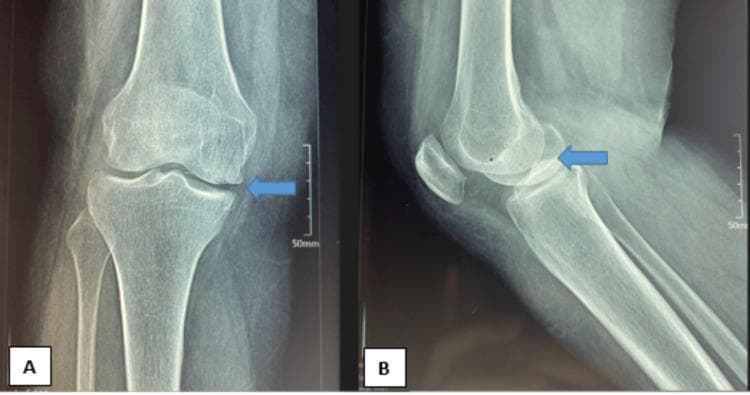
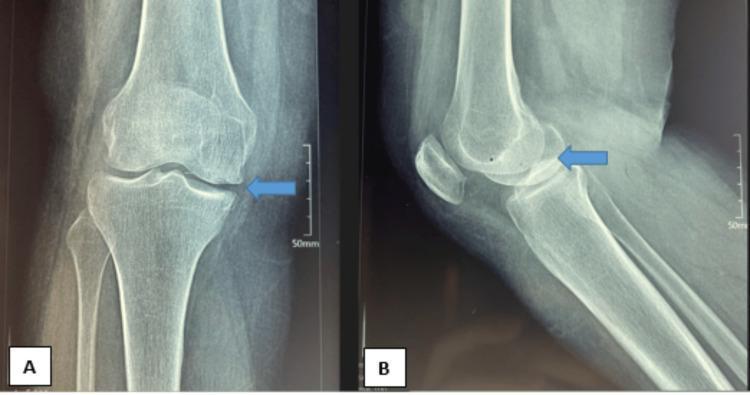
Here is where the osteophytes are located in Swagatika Patel's knee X-ray:
Osteophyte Locations Identified
AP (Anteroposterior) View — Left panel:
| Location | Finding |
|---|---|
| Medial femoral condyle | Bony spur projecting downward/inward at the inner margin of the femur |
| Lateral femoral condyle | Smaller spur at the outer femoral margin |
| Medial tibial plateau | Prominent osteophyte projecting medially off the tibial rim — most visible in this view |
| Lateral tibial plateau | Subtle marginal spur on the outer tibial edge |
Lateral View — Right panel:
| Location | Finding |
|---|---|
| Posterior femoral condyle | Posterior lipping/spur at the back of the femoral condyle |
| Anterior tibial plateau | Bony projection off the anterior tibial margin |
| Posterior tibial plateau | Small posterior tibial spur (most characteristic on lateral view) |
Reference Image for Comparison
What Osteophytes Represent
Osteophytes are reactive bony outgrowths at joint margins, formed as the body attempts to redistribute mechanical load in response to cartilage loss. In this patient:
- The medial tibial plateau osteophyte is the most prominent, consistent with medial compartment OA
- Their presence across multiple sites confirms KL Grade 2–3 as previously assessed
⚕️ Formal radiological reporting by a qualified radiologist/orthopedic surgeon is required for clinical decisions.
This is a shared conversation. Sign in to Orris to start your own chat.