
Roof arc angle in Hip
Reading File
The Roof Arc Angle (Wiberg's Acetabular Index / CE Angle) in hip radiology measures acetabular coverage of the femoral head. A normal value is >25°; values <20° indicate dysplasia.
Searching sources...
Finding Sources
Finding Sources
There's a highly relevant result from Rockwood & Green's about roof arc angles in the context of hip/acetabular fractures. Let me read that section plus the Miller's Review section on acetabular index.
Reading File
Reading File
Let me also fetch the diagram image and read the figure of roof arc measurement from Rockwood & Green's.
Loading Image
Finding Sources
Reading File
Reading File
Let me fetch the roof arc measurement diagram from Campbell's.
Loading Image
Reading File
Now I have everything needed for a complete, well-sourced answer. Let me compile it.
Roof Arc Angle in Hip (Acetabular Fractures)
The Roof Arc Angle is a radiographic measurement developed by Matta et al. to determine whether an acetabular fracture has violated the weight-bearing dome of the acetabulum. It guides the decision between operative vs. nonoperative management.
How It Is Measured
The measurement is performed on all three standard radiographic views with the leg out of traction and the femoral head concentrically reduced:
- Draw a vertical line through the geometric center of the femoral head (perpendicular to the horizontal).
- Draw a second line from the geometric center of the femoral head to the point where the fracture line intersects the acetabular articular surface.
- The angle between these two lines = the Roof Arc Angle.
| View | Roof Arc Measured |
|---|---|
| AP (anteroposterior) | Medial roof arc |
| Obturator oblique | Anterior roof arc |
| Iliac oblique | Posterior roof arc |
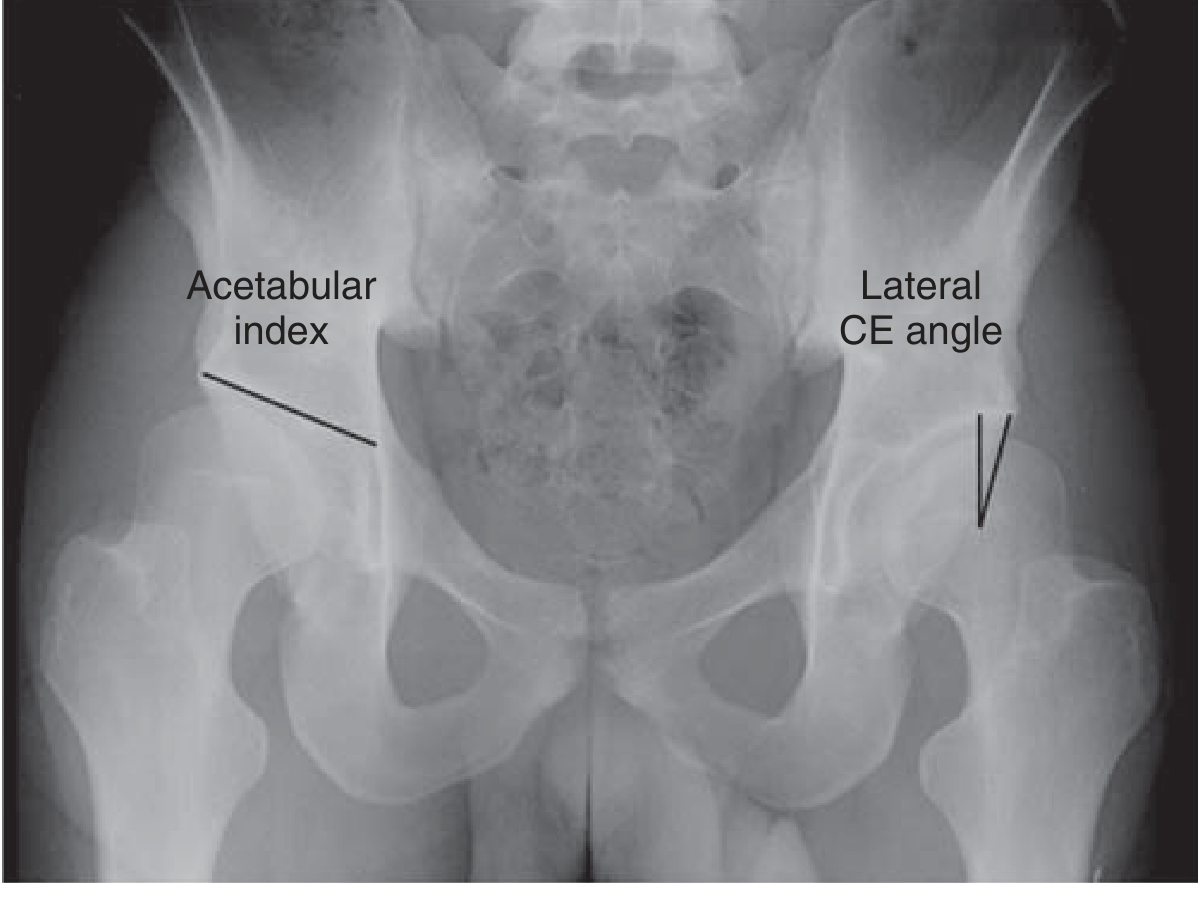
AP pelvis showing acetabular dysplasia measurements (acetabular index and CE angle) - Miller's Review of Orthopaedics
Critical Threshold Values
Three sets of values exist in the literature:
1. Original Matta Criteria (Classic / Traditional)
All three roof arcs > 45 degrees = weight-bearing dome intact = nonoperative management appropriate.
Operative treatment indicated if any roof arc measurement is < 45 degrees in a displaced fracture.
2. Revised Cadaveric Biomechanical Criteria (Keith et al.)
More specific cutoffs from biomechanical cadaver study:
| Roof Arc View | Safe Threshold (nonoperative) |
|---|---|
| Medial (AP) | > 45° |
| Anterior (obturator oblique) | > 25° |
| Posterior (iliac oblique) | > 70° |
3. Sit-to-Stand Loading Study (most recent)
When loading simulates sit-to-stand (rather than single-leg stance), the required intact dome angles are significantly higher:
| Roof Arc | Critical Angle |
|---|---|
| Medial | 90.9° |
| Anterior | 67.3° |
| Posterior | 101.4° |
Clinical implications of these newest findings are still being determined. - Rockwood & Green's Fractures in Adults, 10th ed. 2025
Important Limitations
- Roof arc measurements are NOT applicable to:
- Both-column (ABC) fractures
- Posterior wall fractures
- For posterior wall fractures, stability is assessed differently: if >20-30% of the posterior wall is involved, or if the hip is unstable on stress examination, operative treatment is indicated.
- CT scan correlation: axial CT sections of the superior 10 mm of the acetabular articular surface (Olson & Matta) correspond to the weight-bearing dome region.
Clinical Decision Rule (Summary)
Nonoperative management is appropriate if:
- Fracture is nondisplaced or minimally displaced
- Intact dome is sufficient to maintain stability and congruity
- All roof arc angles are above the threshold (classically >45° on all views)
- No intra-articular fragments, no irreducible dislocation
Operative treatment is indicated if:
- Roof arc angle < 45° on any view (by Matta criteria)
- Displacement > 2 mm in the dome
- Documented hip instability on stress exam
Sources: Campbell's Operative Orthopaedics 15th Ed 2026; Rockwood & Green's Fractures in Adults 10th Ed 2025; Miller's Review of Orthopaedics 9th Edition
This is a shared conversation. Sign in to Orris to start your own chat.