
teach me genetic as teacher
Asking for Preferences
What's your current level in genetics? · Which area of genetics do you want to focus on?
Great! I'll build you a complete, beginner-friendly genetics course from the ground up - covering everything from DNA basics to advanced genomics. Let me pull from authoritative sources to give you the best content.
Reading File
Finding Sources
Finding Sources
Finding Sources
Reading File
Finding Sources
Finding Sources
Reading File
Finding Sources
Finding Sources
Reading File
Reading File
I now have excellent material from authoritative textbooks. Let me compose your complete beginner genetics course.
🧬 Genetics: A Complete Beginner's Course
Taught from scratch — no prior knowledge needed.
📚 COURSE OUTLINE
- What is Genetics?
- The Blueprint of Life: DNA
- From DNA to Protein - The Central Dogma
- Chromosomes and the Human Genome
- How Traits Are Inherited - Mendelian Genetics
- Patterns of Inheritance
- Mutations
- Epigenetics
- Genomics - The Big Picture
🟢 LESSON 1 - What is Genetics?
Genetics is the science of genes, heredity, and how traits are passed from parents to children.
Think of it this way: every living thing - a tree, a bacterium, a human - needs a set of instructions to build itself and function. Those instructions are written in a molecule called DNA. Genetics is the study of those instructions.
🧠 Analogy: Think of DNA as a massive instruction manual. Genetics is the study of how that manual is written, read, copied, and sometimes gets typos.
Key question genetics answers:
- Why do children look like their parents?
- Why do some diseases "run in families"?
- Why is every human being unique?
🔵 LESSON 2 - The Blueprint of Life: DNA
What is DNA?
DNA (Deoxyribonucleic Acid) is a molecule that stores genetic information. It is present in the nucleus of almost every cell in your body.
DNA is a polymer - a long chain made of repeating units called nucleotides. Each nucleotide has three parts:
- A sugar (deoxyribose)
- A phosphate group
- A nitrogenous base (the information-carrying part)
There are 4 bases in DNA:
| Base | Abbreviation |
|---|---|
| Adenine | A |
| Thymine | T |
| Guanine | G |
| Cytosine | C |
The Double Helix
DNA exists as a double helix - two strands wound around each other like a twisted ladder. The two strands are complementary and antiparallel:
- A always pairs with T
- G always pairs with C
This is called base pairing. It's the key to how DNA copies itself.
The strands are linked by 3'-to-5' phosphodiester bonds - covalent bonds joining the sugar of one nucleotide to the phosphate of the next.
🧠 Analogy: The double helix is like a spiral staircase. The rails are the sugar-phosphate backbones. The steps are the base pairs (A-T and G-C).
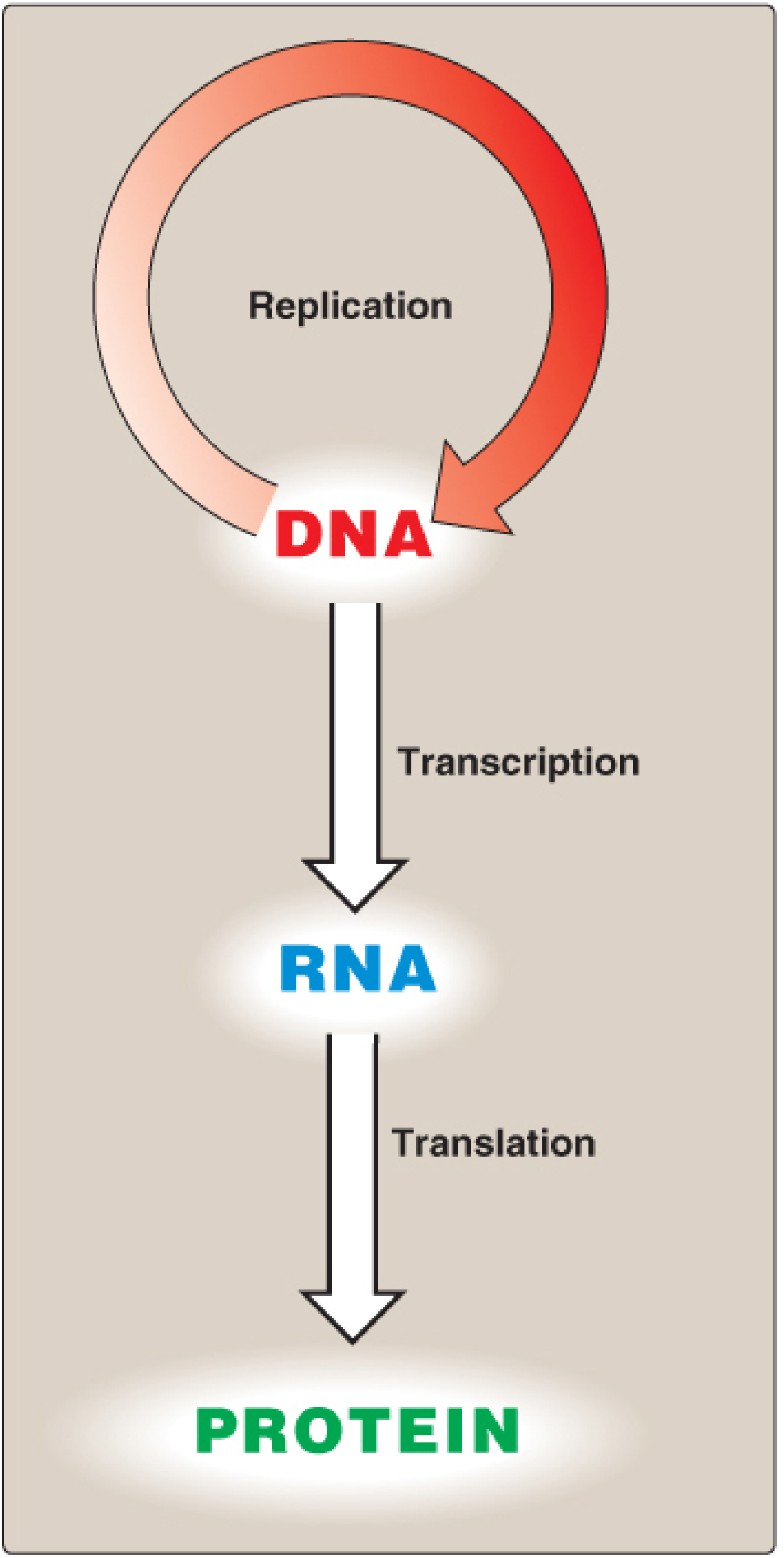
🔵 LESSON 3 - From DNA to Protein: The Central Dogma
This is one of the most important concepts in all of biology.
The Central Dogma states that genetic information flows in one direction:
DNA → RNA → Protein
This involves three processes:
1. Replication (DNA → DNA)
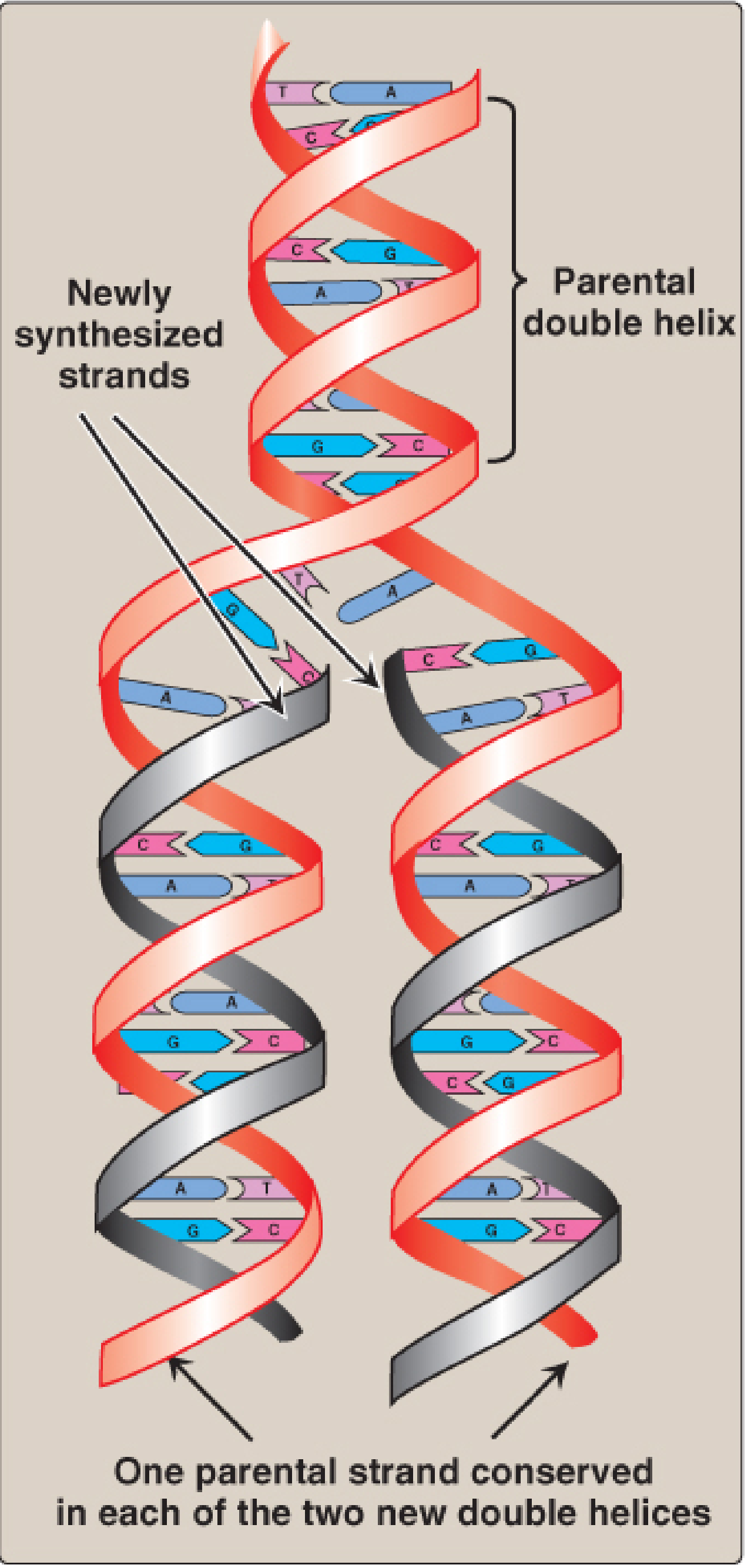
Before a cell divides, it must copy its entire DNA so each daughter cell gets a complete set. This is called semiconservative replication - each new DNA molecule keeps one original strand and builds one new strand.
Key players in DNA replication:
- DNA Helicase - unwinds and separates the two strands at the replication fork
- DNA Primase - lays down a short RNA primer to start synthesis
- DNA Polymerase - reads the template strand and builds the new strand (5'→3' direction only)
In eukaryotes (like humans), replication starts at multiple origins along each chromosome simultaneously - this allows billions of base pairs to be copied quickly.
2. Transcription (DNA → RNA)
The information in a gene is transcribed (copied) into messenger RNA (mRNA) by an enzyme called RNA Polymerase. This happens in the nucleus.
- The strand that serves as the template is the antisense strand
- The mRNA produced has the same sequence as the sense strand, except U (Uracil) replaces T (Thymine)
3. Translation (RNA → Protein)
The mRNA travels to the ribosome in the cytoplasm, where its code is translated into a protein.
- Every 3 nucleotides = 1 codon = 1 amino acid
- There are 64 possible codons (4³) encoding 20 amino acids (the genetic code is redundant)
- Special codons: AUG = Start codon (Methionine), UAA / UAG / UGA = Stop codons
- tRNA molecules carry the correct amino acids to the ribosome
🧠 Analogy: Think of DNA as a master blueprint locked in a vault (the nucleus). mRNA is a photocopy of one page of the blueprint. The ribosome is the factory that reads the photocopy and builds the product (protein).
🔵 LESSON 4 - Chromosomes and the Human Genome
Chromosomes
DNA does not float freely in the nucleus - it is tightly packaged with proteins called histones into structures called chromosomes.
- Humans have 46 chromosomes (23 pairs)
- 22 pairs are autosomes (non-sex chromosomes)
- 1 pair are sex chromosomes: XX = female, XY = male
Genes
A gene is a specific segment of DNA that codes for a functional product (usually a protein). Humans have approximately 20,000-25,000 protein-coding genes.
Key terms:
| Term | Meaning |
|---|---|
| Locus | The physical location of a gene on a chromosome |
| Allele | Different versions of the same gene |
| Genotype | The actual genetic makeup (e.g., Aa, BB) |
| Phenotype | The observable trait (e.g., brown eyes) |
| Homozygous | Both alleles are the same (AA or aa) |
| Heterozygous | Alleles are different (Aa) |
The Human Genome
The human genome contains about 3 billion base pairs of DNA. Remarkably, only ~1-2% of that codes for proteins. The rest includes regulatory sequences, repeated elements, and sequences whose function is still being studied.
🔵 LESSON 5 - How Traits Are Inherited: Mendelian Genetics
Gregor Mendel (1822-1884), an Austrian monk, discovered the basic rules of inheritance by studying pea plants. His work forms the foundation of genetics.
Mendel's Two Laws
Law 1 - Law of Segregation:
Each individual has two copies of each gene. During reproduction, these two copies separate, and each gamete (sperm or egg) gets only one copy.
Law 2 - Law of Independent Assortment:
Genes for different traits are inherited independently of each other (as long as they are on different chromosomes).
The Punnett Square
A Punnett Square predicts the probability of offspring inheriting a trait.
Example: If both parents carry one sickle cell allele (Aa × Aa):
        A        a
   ┌─────────┬─────────┐
 A │   AA    │   Aa    │
   ├─────────┼─────────┤
 a │   Aa    │   aa    │
   └─────────┴─────────┘
Results:
- 25% AA (unaffected, no carrier)
- 50% Aa (carrier)
- 25% aa (affected with sickle cell disease)
🔵 LESSON 6 - Patterns of Inheritance
Not all traits follow simple dominant/recessive rules. Here are the main patterns:
1. Autosomal Dominant (AD)
- One mutant copy is enough to cause disease
- Affects males and females equally
- Vertical transmission - every generation is usually affected
- Each child of an affected parent has a 50% chance of inheriting it
- Examples: Huntington's disease, Marfan syndrome, achondroplasia
2. Autosomal Recessive (AR)
- Two mutant copies (homozygous) are needed to cause disease
- Carriers (one copy) are unaffected
- Often affects siblings in one generation, parents appear normal
- Each child of two carrier parents has a 25% chance of being affected
- Examples: Cystic fibrosis, sickle cell disease, PKU
3. X-Linked Recessive
- Gene is on the X chromosome
- Males (XY) are more severely affected because they only have one X
- Females (XX) are usually carriers - their second normal X compensates
- A carrier mother passes the allele to 50% of sons (who are affected) and 50% of daughters (who are carriers)
- Examples: Haemophilia A & B, Duchenne muscular dystrophy, colour blindness
4. X-Linked Dominant
- One mutant X copy causes disease in both males and females
- Females may be more mildly affected (mosaic due to X-inactivation)
- Example: Rett syndrome, Fragile X syndrome (complex)
5. Mitochondrial Inheritance
- Mitochondria have their own small genome
- Mitochondria are inherited exclusively from the mother (matrilineal)
- ALL children of an affected mother may be affected
- Example: MELAS, Leber's hereditary optic neuropathy
🧠 Memory tip for patterns:
- AD = "one bad copy, always shows"
- AR = "two bad copies, hides in carriers"
- X-linked = "mother carries, sons suffer"
- Mitochondrial = "mother to ALL children"
🔵 LESSON 7 - Mutations
A mutation is any change in the DNA sequence. Mutations are the source of genetic variation - they can be harmless, beneficial, or cause disease.
Types of Mutations
| Type | Description | Example |
|---|---|---|
| Point mutation | Single base change | A→G substitution |
| Missense | Changes one amino acid | Sickle cell disease (Glu→Val) |
| Nonsense | Creates a stop codon early | Shortened, non-functional protein |
| Silent | Same amino acid coded (redundancy) | No effect on protein |
| Insertion/Deletion (Indel) | Base(s) added or removed | Frameshift |
| Frameshift | Insertions/deletions shift the reading frame | Usually catastrophic |
| Chromosomal | Large-scale changes (deletions, inversions, translocations) | Down syndrome (trisomy 21) |
Causes of Mutations
- Spontaneous: errors during DNA replication
- UV radiation: causes thymine dimers (skin cancer)
- Chemical mutagens: alkylating agents
- Viruses: insert their DNA into host genome
DNA Repair
Cells have powerful repair mechanisms (base excision repair, nucleotide excision repair, mismatch repair) to fix most mutations before they cause harm. When repair fails, cancer or genetic disease can result.
🔵 LESSON 8 - Epigenetics
Beyond the DNA Sequence
Epigenetics means "above the genetics." It refers to heritable changes in gene expression that do NOT involve changes to the actual DNA sequence.
Think of it this way: your DNA is the hardware. Epigenetics is the software - programs that turn genes on or off.
Three Main Epigenetic Mechanisms
1. DNA Methylation
- Adding a methyl group (-CH₃) to cytosine bases (usually at CpG sites)
- Generally silences gene expression
- Plays a key role in development, imprinting, and cancer
2. Histone Modification
DNA wraps around histone proteins. Modifications to histones (acetylation, methylation, phosphorylation) either open up (activate) or condense (silence) chromatin:
- Histone acetylation → relaxed chromatin → gene activation
- Histone methylation → can activate OR repress depending on the site
3. Non-coding RNAs
Small RNA molecules (miRNA, siRNA, lncRNA) can block translation or trigger mRNA degradation, effectively silencing genes without changing DNA.
Why Does Epigenetics Matter?
- Explains why identical twins can develop different diseases over time
- Explains how environment (diet, stress, toxins) can affect gene expression
- Cancer is partly an epigenetic disease - tumor suppressor genes get silenced
- Some epigenetic changes can be inherited across generations
🔵 LESSON 9 - Genomics: The Big Picture
What is Genomics?
While genetics studies individual genes, genomics studies the entire genome - all the DNA in an organism simultaneously.
Key Genomics Technologies
DNA Sequencing:
- Sanger sequencing (1970s) - reads ~1000 bp at a time
- Next-Generation Sequencing (NGS) - reads billions of base pairs in parallel, revolutionized medicine
The Human Genome Project (HGP):
- Completed in 2003
- Mapped all ~3 billion base pairs of the human genome
- Discovered ~20,000-25,000 protein-coding genes
- Opened the door to personalized medicine
CRISPR-Cas9:
- A gene-editing tool borrowed from bacteria
- Acts like "molecular scissors" - can cut and edit DNA at precise locations
- Potential to cure genetic diseases (clinical trials ongoing for sickle cell, beta-thalassemia)
Genomics in Medicine
- Pharmacogenomics: tailoring drug choice/dose to a patient's genetic profile
- Cancer genomics: sequencing tumor DNA to find targetable mutations
- Prenatal testing: detecting chromosomal abnormalities before birth
- Carrier screening: identifying people who carry recessive disease alleles
📝 QUICK REVIEW: Key Terms Cheat Sheet
| Term | Simple Definition |
|---|---|
| DNA | The molecule that carries genetic instructions |
| Gene | A DNA segment that codes for a protein |
| Chromosome | Packaged DNA + proteins; humans have 46 |
| Allele | Different versions of the same gene |
| Genotype | Your actual genetic code |
| Phenotype | Your observable traits |
| Dominant | One copy is enough to show the trait |
| Recessive | Two copies needed to show the trait |
| Mutation | A change in the DNA sequence |
| Epigenetics | Gene regulation without changing DNA |
| Genome | The complete set of DNA in an organism |
| Transcription | DNA → RNA |
| Translation | RNA → Protein |
| Replication | DNA → DNA (cell division) |
🗺️ The Flow of Genetics at a Glance
GENOME (all your DNA)
    ↓
CHROMOSOMES (46 in humans)
    ↓
GENES (segments of DNA, ~20,000)
    ↓
TRANSCRIPTION → mRNA
    ↓
TRANSLATION → PROTEINS
    ↓
TRAITS / PHENOTYPE
(shaped by environment + epigenetics)
🎯 What to Study Next
Now that you have the full overview, here are good next steps:
- Practice Punnett squares with real genetic disorder examples
- Draw pedigrees - learn to read family trees and identify inheritance patterns
- Study specific genetic diseases: cystic fibrosis, Huntington's, Down syndrome
- Explore molecular techniques: PCR, gel electrophoresis, CRISPR
- Learn about genomics in cancer - a huge area of modern medicine
Sources: Biochemistry 8th ed (Lippincott Illustrated Reviews) - p.1135-1148; Emery's Elements of Medical Genetics and Genomics - p.93; Dermatology 2-Volume Set 5e - p.1034; Creasy & Resnik's Maternal-Fetal Medicine - p.267
That's your full genetics course from scratch! Every major topic is covered in a logical sequence, building from atoms (nucleotides) up to the whole genome. Let me know which lesson you'd like to go deeper on - I can add practice questions, diagrams, or worked examples for any section.
This is a shared conversation. Sign in to Orris to start your own chat.