
Treatment of fever on opd base
fever management outpatient antipyretic
fever antipyretic treatment
fever outpatient treatment guidelines 2024 antipyretic acetaminophen ibuprofen
Treatment of Fever on an OPD Basis
Definition and Threshold
Step 1 - Assess and Identify the Cause
| Assessment | What to Check |
|---|---|
| History | Duration, pattern (remittent, intermittent, continuous), associated symptoms |
| Exam | Source of infection (throat, ears, lungs, abdomen, skin, lymph nodes, urine) |
| Risk factors | Immunosuppression, recent travel, contacts, medications |
| Danger signs | Altered sensorium, rash + fever (meningococcemia), dyspnea, severe myalgia |
Step 2 - Non-Pharmacological Measures
- Adequate hydration: oral fluids (water, ORS, coconut water) - fever increases insensible losses
- Tepid sponging: lukewarm (not cold) water to help with heat dissipation - adjunct to antipyretics, not replacement
- Light clothing and ventilation: reduce external heat load
- Rest: reduce metabolic demand and oxygen consumption
Fever increases oxygen consumption by 13% for every 1°C rise above 37°C (Harrison's 22E, p. 180)
Step 3 - Pharmacological Treatment (Antipyretics)
First-Line: Paracetamol (Acetaminophen)
| Population | Dose | Frequency | Max Daily |
|---|---|---|---|
| Adults | 500-1000 mg orally | Every 4-6 hours | 4 g/day |
| Children | 10-15 mg/kg/dose orally | Every 4-6 hours | 60-75 mg/kg/day |
| Elderly | 500 mg | Every 6 hours (caution) | 2 g/day |
Alternative/Second-Line: Ibuprofen (NSAID)
| Population | Dose | Frequency |
|---|---|---|
| Adults | 200-400 mg orally | Every 6-8 hours with food |
| Children (>6 months) | 5-10 mg/kg/dose | Every 6-8 hours |
- Often more effective than paracetamol for fever reduction due to its peripheral anti-inflammatory action
- Avoid in: renal impairment, peptic ulcer disease, dehydration, dengue/thrombocytopenia, pregnancy (especially 3rd trimester), age <6 months
- Give with food to reduce GI irritation
Aspirin
- Effective antipyretic but avoided in children under 16 years due to risk of Reye syndrome (Harrison's 22E, p. 180)
- Can be used in adults when indicated (e.g., also treating pain/inflammation)
- Dose: 300-600 mg orally every 4-6 hours
Alternating / Combination Therapy
Rectal Route (If Oral Not Possible)
Step 4 - Who Needs Aggressive Fever Treatment?
| Condition | Reason |
|---|---|
| Cardiac/pulmonary disease | Fever increases O2 demand; can worsen ischemia or respiratory failure |
| CNS disease / head injury | Hyperthermia worsens neurological outcomes |
| Seizure history (febrile) | Aggressive antipyretic use (though exact threshold triggering febrile seizure is unclear) |
| Pregnancy | High fever associated with neural tube defects in early pregnancy |
| Elderly | Poor thermoregulatory reserve, dehydration risk |
| Severe anemia / sickle cell | Increased metabolic stress |
Step 5 - When to Refer / Admit (Red Flags)
- Fever >40°C not responding to antipyretics
- Fever + petechial/purpuric rash (suspect meningococcemia)
- Fever + altered consciousness (meningitis, encephalitis, sepsis)
- Fever + severe dehydration or unable to take oral fluids
- Immunocompromised patient with fever (HIV, chemotherapy, steroids)
- Neonatal fever (<3 months with temperature >38°C - always refer)
- Fever persisting >7-10 days without a source (investigate for FUO)
Summary Table
| Drug | Dose (Adult) | Advantage | Avoid if |
|---|---|---|---|
| Paracetamol | 500-1000 mg Q4-6h | Preferred, GI-safe, platelet-safe | Liver disease, >4g/day |
| Ibuprofen | 200-400 mg Q6-8h | More potent anti-inflammatory | Renal failure, peptic ulcer, dengue, <6 months |
| Aspirin | 300-600 mg Q4-6h | Analgesic + antipyretic | Children <16 (Reye syndrome), peptic ulcer |
| Naproxen | 250-500 mg Q8-12h | Longer-acting | Renal impairment, GI disease |
Special Note on Tepid Sponging
Create a flowchart: when to treat fever vs when to investigate further
A clean, professional medical clinical flowchart titled "Fever Management in OPD: Treat vs Investigate" showing decision pathways. Start node at top: "PATIENT PRESENTS WITH FEVER (Temp >38°C / 100.4°F)" in a blue rounded rectangle. First decision diamond: "Any RED FLAG signs?" with a list inside: "• Temp >40°C not responding | • Petechial/purpuric rash | • Altered consciousness | • Age <3 months | • Immunocompromised | • Severe dehydration | • Cannot take oral fluids" YES arrow (red, right side) leads to box: "IMMEDIATE REFERRAL / ADMIT" (red box) with: "• IV access + fluids | • Urgent labs: CBC, cultures, CRP | • Do NOT discharge" NO arrow (green, downward) leads to second decision diamond: "Duration of fever?" From Duration diamond: - LEFT arrow: "<5 days + clear source identified" → green box "TREAT EMPIRICALLY IN OPD" with: "1st Line: Paracetamol 500-1000mg Q4-6h (Adults) / 10-15mg/kg (Children) | 2nd Line: Ibuprofen 200-400mg Q6-8h (avoid in children <6mo, dengue, renal disease) | + Hydration + Tepid sponging | + Treat underlying cause | Review in 48-72h" - RIGHT arrow: ">7 days OR no clear source" → orange box "INVESTIGATE FURTHER" with: "Basic: CBC, ESR, CRP, urinalysis | Intermediate: Blood culture, chest X-ray, LFTs, RFTs | Targeted by history: Malaria smear, Widal, dengue NS1/IgM, TB workup, ANA/RF | Consider: FUO workup if >3 weeks" Below the TREAT box: a third decision diamond: "Fever persists after 48-72h of treatment?" - YES (orange arrow) → connects back to INVESTIGATE FURTHER box - NO (green arrow) → "CONTINUE TREATMENT + FOLLOW UP" green box Bottom footer notes in small text: "Special populations needing aggressive treatment: cardiac/pulmonary disease, CNS injury, seizure history, pregnancy, sickle cell disease" Use a white background, blue/green/orange/red color coding for boxes, clear sans-serif font, professional medical style with clean arrows and well-spaced layout.
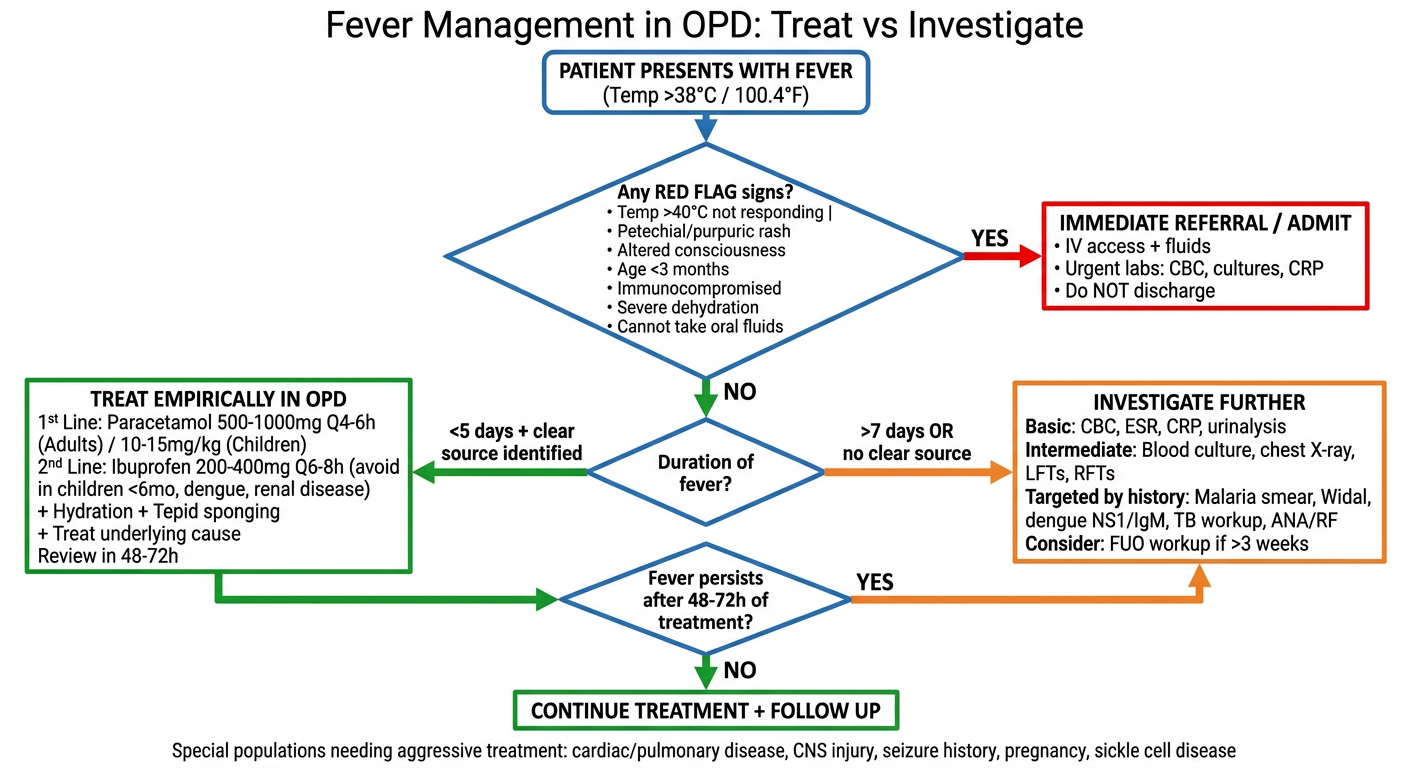
- Red flags present? → Refer/admit immediately (no OPD management)
- No red flags + fever <5 days + clear source? → Treat empirically (paracetamol/ibuprofen + hydration)
- Fever >7 days or no clear source? → Investigate (CBC, cultures, targeted workup)
- Fever persists after 48-72h of treatment? → Escalate to investigation
- 🔴 Red - immediate danger, refer
- 🟠 Orange - investigate, escalate
- 🟢 Green - safe to treat in OPD