
make an ai video of topic sickle cell anemia explaction in detail
sickle cell anemia peripheral blood smear sickled erythrocytes
"sickle cell disease" AND treatment
sickle cell anemia clinical manifestations vaso-occlusive crisis organs affected
Medical diagram comparing a normal biconcave disc-shaped red blood cell to a sickle-shaped (crescent) red blood cell caused by HbS polymerization, side by side, labeled
Medical flow diagram of sickle cell disease pathophysiology: deoxygenation of HbS leads to polymerization, red cell sickling, vaso-occlusion, ischemia, hemolysis and chronic organ damage
Punnett square diagram showing autosomal recessive inheritance pattern of sickle cell anemia from two carrier parents (HbAS x HbAS) producing HbAA, HbAS, and HbSS offspring
Human body diagram illustrating organ complications of sickle cell disease including brain (stroke), lungs (acute chest syndrome), spleen (sequestration/autosplenectomy), bones (avascular necrosis, dactylitis), kidneys, and eyes (retinopathy)
mkdir -p /tmp/workspace/sickle-cell-video/assets /tmp/workspace/sickle-cell-video/output && ls -la /tmp/workspace/
cd /tmp/workspace/sickle-cell-video && python /tmp/skills/shared/scripts/fetch_images.py \ "https://cdn.orris.care/image-gen/b900e5979c0d4a7cb60bf36c36bafbd7.png" \ "https://cdn.orris.care/image-gen/55af28c116564ab5ae1453345cdcae18.png" \ "https://cdn.orris.care/image-gen/e48b7dd6a99c48f087fa843b24958fb2.png" \ "https://cdn.orris.care/image-gen/db8ba651c46249119a7a82463ef2ca57.png" \ "https://cdn.orris.care/cdss_images/pmc_clinical_VQA_1925f8db2053645d14ee8ee8680f1262287c992613065ec27f92d2ae3827fdc5.jpg" \ "https://cdn.orris.care/cdss_images/133a907130fd87089f150eabd0505917d19a8f2c2925aa6fcdb74a67859bf382.png" \ > images.json 2>fetch_err.log; echo EXIT:$?; wc -c images.json; head -c 300 fetch_err.log
~/sickle-cell-video/build_pptx.py
import json, base64
from io import BytesIO
from pptx import Presentation
from pptx.util import Inches, Pt
from pptx.dml.color import RGBColor
from pptx.enum.text import PP_ALIGN, MSO_ANCHOR

with open("images.json") as f:
    imgs = json.load(f)

def img_bytes(idx):
    b64 = imgs[idx]["base64"]
    header, data = b64.split(",", 1) if "," in b64 else (None, b64)
    return BytesIO(base64.b64decode(data))

SICKLE_NORMAL = img_bytes(0)
PATHO_FLOW = img_bytes(1)
PUNNETT = img_bytes(2)
BODY_COMPLICATIONS = img_bytes(3)
CRIZANLIZUMAB = img_bytes(4)
NORMAL_SMEAR = img_bytes(5)

DARK = RGBColor(0x1B, 0x1F, 0x3B)
RED = RGBColor(0xA6, 0x1B, 0x29)
WHITE = RGBColor(0xFF, 0xFF, 0xFF)
GRAY = RGBColor(0x44, 0x44, 0x44)

prs = Presentation()
prs.slide_width = Inches(13.333)
prs.slide_height = Inches(7.5)
blank = prs.slide_layouts[6]

def add_bg(slide, color=WHITE):
    bg = slide.shapes.add_shape(1, 0, 0, prs.slide_width, prs.slide_height)
    bg.fill.solid()
    bg.fill.fore_color.rgb = color
    bg.line.fill.background()
    bg.shadow.inherit = False
    slide.shapes._spTree.remove(bg._element)
    slide.shapes._spTree.insert(2, bg._element)
    return bg

def title_bar(slide, text, subtitle=None, color=DARK):
    bar = slide.shapes.add_shape(1, 0, 0, prs.slide_width, Inches(1.1))
    bar.fill.solid(); bar.fill.fore_color.rgb = color; bar.line.fill.background()
    tb = slide.shapes.add_textbox(Inches(0.5), Inches(0.12), Inches(12.3), Inches(0.9))
    tf = tb.text_frame; tf.word_wrap = True
    p = tf.paragraphs[0]; p.text = text
    r = p.runs[0]; r.font.size = Pt(30); r.font.bold = True; r.font.color.rgb = WHITE; r.font.name="Arial"
    if subtitle:
        p2 = tf.add_paragraph(); p2.text = subtitle
        r2 = p2.runs[0]; r2.font.size = Pt(14); r2.font.color.rgb = RGBColor(0xE0,0xE0,0xE0)

def bullets(slide, items, left=0.6, top=1.4, width=6.0, height=5.6, size=16, color=GRAY):
    tb = slide.shapes.add_textbox(Inches(left), Inches(top), Inches(width), Inches(height))
    tf = tb.text_frame; tf.word_wrap = True
    first = True
    for lvl, text in items:
        p = tf.paragraphs[0] if first else tf.add_paragraph()
        first = False
        p.text = ("• " if lvl==0 else "   – ") + text
        p.level = 0
        r = p.runs[0]; r.font.size = Pt(size if lvl==0 else size-2); r.font.color.rgb = color
        r.font.name = "Arial"
        p.space_after = Pt(8)
    return tb

def add_pic(slide, stream, left, top, width=None, height=None):
    stream.seek(0)
    if width:
        return slide.shapes.add_picture(stream, Inches(left), Inches(top), width=Inches(width))
    else:
        return slide.shapes.add_picture(stream, Inches(left), Inches(top), height=Inches(height))

def notes(slide, text):
    slide.notes_slide.notes_text_frame.text = text

# ---------- Slide 1: Title ----------
s = prs.slides.add_slide(blank)
add_bg(s, DARK)
tb = s.shapes.add_textbox(Inches(1), Inches(2.6), Inches(11.3), Inches(1.6))
tf = tb.text_frame; tf.word_wrap=True
p = tf.paragraphs[0]; p.text = "Sickle Cell Anemia"; p.alignment=PP_ALIGN.CENTER
r = p.runs[0]; r.font.size=Pt(54); r.font.bold=True; r.font.color.rgb=WHITE; r.font.name="Arial"
tb2 = s.shapes.add_textbox(Inches(1), Inches(4.2), Inches(11.3), Inches(0.8))
tf2 = tb2.text_frame
p2 = tf2.paragraphs[0]; p2.text = "A Detailed Medical Explainer: Genetics, Pathophysiology, Clinical Features, Diagnosis & Management"
p2.alignment=PP_ALIGN.CENTER
r2 = p2.runs[0]; r2.font.size=Pt(18); r2.font.color.rgb=RGBColor(0xCF,0xCF,0xCF)
notes(s, "Welcome. In this video we will explain sickle cell anemia in detail: what causes it, how it damages the body, "
         "how it's diagnosed, and how it's treated today. Sickle cell anemia is the most common inherited hemolytic anemia "
         "worldwide, caused by a single mutation in the beta-globin gene.")

# ---------- Slide 2: Overview & Epidemiology ----------
s = prs.slides.add_slide(blank); add_bg(s)
title_bar(s, "What Is Sickle Cell Anemia?", "Overview and Epidemiology")
bullets(s, [
 (0,"Sickle cell anemia is the prototypic hemoglobinopathy — a hereditary disorder of hemoglobin structure."),
 (0,"Caused by a point mutation in the beta-globin gene that produces abnormal hemoglobin S (HbS)."),
 (0,"It is the most common familial hemolytic anemia."),
 (0,"In the US, about 8% of people of African descent carry one HbS allele (sickle cell trait); about 1 in 600 have sickle cell anemia."),
 (0,"The HbS allele persisted through evolution because carriers (heterozygotes) are relatively protected against falciparum malaria."),
 (0,"Endemic regions: equatorial Africa, parts of India, the Mediterranean, and the Middle East."),
], width=12.0)
notes(s, "Sickle cell anemia is caused by an inherited abnormal hemoglobin called hemoglobin S. It's the most common inherited "
         "hemolytic anemia. In the United States roughly 1 in 600 African Americans have the disease, and about 8 percent carry "
         "a single copy, called sickle cell trait. The gene persisted because carrying one copy protects against severe "
         "falciparum malaria, which is why the trait is common in historically malaria-endemic regions of Africa, India, "
         "the Mediterranean, and the Middle East.")

# ---------- Slide 3: Genetics ----------
s = prs.slides.add_slide(blank); add_bg(s)
title_bar(s, "Genetics & Inheritance", "Autosomal Recessive Pattern")
bullets(s, [
 (0,"HbS results from substitution of valine for glutamic acid at position 6 of the beta-globin chain."),
 (0,"Inherited in an autosomal recessive pattern."),
 (0,"HbSS (homozygous) = sickle cell anemia — most severe."),
 (0,"HbAS (heterozygous) = sickle cell trait — usually asymptomatic carriers."),
 (0,"Compound genotypes: HbSC disease and HbS-beta-thalassemia are often milder variants."),
 (0,"Two carrier (HbAS) parents: each pregnancy carries a 25% chance of an HbSS child, 50% chance of HbAS carrier, 25% chance of unaffected HbAA child."),
], left=0.6, top=1.4, width=6.3)
add_pic(s, PUNNETT, left=7.1, top=1.5, width=5.7)
notes(s, "The disease follows autosomal recessive inheritance. The mutation swaps glutamic acid for valine at the sixth amino "
         "acid of beta-globin. If both parents carry one copy of the sickle gene, each child has a 25 percent chance of "
         "inheriting two copies and having sickle cell anemia, a 50 percent chance of being a carrier like the parents, and a "
         "25 percent chance of inheriting no sickle gene at all. Other genotypes, like hemoglobin SC disease or sickle "
         "beta-thalassemia, tend to be milder than classic HbSS disease.")

# ---------- Slide 4: Pathogenesis 1 ----------
s = prs.slides.add_slide(blank); add_bg(s)
title_bar(s, "Pathogenesis: From Mutation to Sickle Shape")
bullets(s, [
 (0,"Normal adult red cells contain mostly HbA (a2b2); in sickle cell anemia HbA is completely replaced by HbS."),
 (0,"On deoxygenation, HbS molecules undergo a conformational change and polymerize into long fibers."),
 (0,"These polymers distort the red cell into an elongated, crescentic (\"sickle\") shape."),
 (0,"Sickling is initially reversible with reoxygenation."),
 (0,"Repeated sickling causes calcium influx, potassium/water loss, and membrane skeleton damage."),
 (0,"Over time this produces irreversibly sickled cells that hemolyze prematurely (lifespan ~ 20 days vs 120 normal)."),
], left=0.6, top=1.4, width=6.3)
add_pic(s, SICKLE_NORMAL, left=7.1, top=1.6, width=5.7)
notes(s, "Here is the core mechanism. Normally red cells are packed with hemoglobin A. In sickle cell anemia, hemoglobin A is "
         "entirely replaced by hemoglobin S. When this hemoglobin gives up its oxygen, it changes shape and polymerizes into "
         "long rigid fibers that push the red cell membrane into a crescent, or sickle, shape. At first this is reversible once "
         "oxygen returns. But repeated cycles of sickling damage the cell membrane permanently, causing calcium to leak in and "
         "potassium and water to leak out. Eventually the cells become irreversibly sickled and are destroyed early, causing "
         "chronic hemolytic anemia.")

# ---------- Slide 5: Pathogenesis 2 - vaso-occlusion ----------
s = prs.slides.add_slide(blank); add_bg(s)
title_bar(s, "Pathogenesis: Vaso-Occlusion & Tissue Injury")
bullets(s, [
 (0,"Sickled cells are abnormally rigid and \"sticky,\" adhering to vascular endothelium."),
 (0,"This causes microvascular occlusion, ischemia, and infarction in downstream tissue."),
 (0,"Factors promoting sickling: low HbF, dehydration, hypoxia, acidosis, and infection."),
 (0,"Fetal hemoglobin (HbF) inhibits polymerization — symptoms usually begin around 5–6 months of age as HbF falls."),
 (0,"Chronic hemolysis + vaso-occlusion together drive both acute crises and long-term organ damage."),
], left=0.6, top=1.4, width=6.3)
add_pic(s, PATHO_FLOW, left=7.1, top=1.5, width=5.7)
notes(s, "Beyond their shape, sickled cells are stiff and sticky. They adhere to the lining of small blood vessels, triggering "
         "inflammation and clumping with white cells and platelets. This blocks blood flow, causing ischemia and infarction in "
         "whatever tissue lies downstream. Dehydration, low oxygen, acidosis, and infection all promote further sickling and "
         "worsen these blockages. Notably, newborns don't show symptoms right away because fetal hemoglobin, which is "
         "protective, is still high; symptoms typically emerge around five to six months of age as fetal hemoglobin declines.")

# ---------- Slide 6: Clinical - acute ----------
s = prs.slides.add_slide(blank); add_bg(s)
title_bar(s, "Acute Clinical Complications")
bullets(s, [
 (0,"Vaso-occlusive (pain) crisis — the hallmark presentation; bone, joint, and abdominal pain."),
 (0,"Acute chest syndrome — pulmonary infarction/infection; a leading cause of death."),
 (0,"Splenic sequestration crisis — sudden trapping of blood in the spleen, can cause rapid anemia and shock (children)."),
 (0,"Aplastic crisis — often triggered by parvovirus B19 infection, causing transient marrow shutdown."),
 (0,"Stroke — especially in children; vaso-occlusion/stenosis of cerebral vessels."),
 (0,"Priapism — vaso-occlusion of penile venous outflow."),
 (0,"Dactylitis — painful swelling of hands/feet in young children, often an early sign."),
], width=12.0, size=17)
notes(s, "Acute complications are dramatic and can be life-threatening. The most common presentation is a painful vaso-occlusive "
         "crisis, often in the bones, joints, chest, or abdomen. Acute chest syndrome, from pulmonary infarction or infection, "
         "is one of the leading causes of death. Young children can develop splenic sequestration, where blood pools "
         "suddenly in the spleen causing severe anemia and shock, or aplastic crisis, often triggered by parvovirus B19. "
         "Stroke can occur even in children due to blocked cerebral vessels. Priapism and dactylitis, painful swelling of the "
         "hands and feet, are also characteristic.")

# ---------- Slide 7: Clinical - chronic ----------
s = prs.slides.add_slide(blank); add_bg(s)
title_bar(s, "Chronic Complications & Organ Damage")
bullets(s, [
 (0,"Autosplenectomy — repeated infarction shrinks and fibroses the spleen, raising infection risk (encapsulated organisms)."),
 (0,"Avascular necrosis of bone (e.g., femoral head), chronic osteomyelitis risk."),
 (0,"Renal papillary necrosis, proteinuria, chronic kidney disease."),
 (0,"Proliferative retinopathy and vision loss."),
 (0,"Pulmonary hypertension, restrictive lung disease."),
 (0,"Growth delay, gallstones (from chronic hemolysis), leg ulcers."),
], left=0.6, top=1.4, width=6.3, size=16)
add_pic(s, BODY_COMPLICATIONS, left=7.1, top=1.5, width=5.7)
notes(s, "Over years, repeated microinfarctions damage almost every organ system. The spleen eventually infarcts itself into a "
         "small fibrotic remnant, called autosplenectomy, leaving patients vulnerable to serious infections from encapsulated "
         "bacteria. Bone can undergo avascular necrosis, especially the femoral head. The kidneys, eyes, lungs, and skin are "
         "all commonly affected, along with gallstones from chronic red cell breakdown.")

# ---------- Slide 8: Diagnosis ----------
s = prs.slides.add_slide(blank); add_bg(s)
title_bar(s, "Diagnosis")
bullets(s, [
 (0,"Universal newborn screening by hemoglobin electrophoresis or HPLC in most countries."),
 (0,"Definitive diagnosis: hemoglobin electrophoresis / high-performance liquid chromatography showing HbS, absent or low HbA."),
 (0,"Rapid bedside screening tests (sickle solubility test / Sickledex) — positive in any sickle hemoglobinopathy, but does not distinguish trait from disease."),
 (0,"Peripheral blood smear: sickled cells, target cells, Howell-Jolly bodies (from hyposplenism), reticulocytosis."),
 (0,"Baseline labs during illness: CBC, reticulocyte count, LFTs, fractionated bilirubin, creatinine/BUN, urinalysis."),
], left=0.6, top=1.4, width=6.3, size=16)
add_pic(s, NORMAL_SMEAR, left=7.1, top=1.7, width=5.5)
notes(s, "Diagnosis usually starts with universal newborn screening using hemoglobin electrophoresis, which can detect the "
         "abnormal hemoglobin before symptoms appear. Confirmation uses electrophoresis or high-performance liquid "
         "chromatography. Quick bedside solubility tests can screen for any sickle hemoglobin but can't tell trait apart from "
         "full disease, and can be falsely negative in newborns with high fetal hemoglobin. A blood smear characteristically "
         "shows sickled cells alongside signs of a poorly functioning spleen.")

# ---------- Slide 9: Management - acute ----------
s = prs.slides.add_slide(blank); add_bg(s)
title_bar(s, "Management: Acute Crises")
bullets(s, [
 (0,"Aggressive hydration (IV fluids) to reduce blood viscosity."),
 (0,"Analgesia — from NSAIDs to opioids for severe vaso-occlusive pain."),
 (0,"Supplemental oxygen if hypoxic; treat underlying triggers (infection, acidosis)."),
 (0,"Simple transfusion for symptomatic anemia, aplastic or sequestration crises."),
 (0,"Red cell exchange transfusion for stroke, severe acute chest syndrome, multiorgan failure, or refractory priapism — goal hematocrit under 30% to avoid hyperviscosity."),
 (0,"Prompt evaluation for fever — risk of sepsis from encapsulated organisms due to functional asplenia."),
], width=12.0, size=17)
notes(s, "Acute management focuses on breaking the vicious cycle of sickling. Patients get IV fluids to reduce blood viscosity, "
         "strong pain control, and supplemental oxygen if needed. For more severe events like stroke, rapidly worsening acute "
         "chest syndrome, or multi-organ failure, doctors use exchange transfusion, replacing sickle cells with donor cells "
         "while carefully avoiding a hematocrit that's too high, which would increase blood viscosity further. Because the "
         "spleen often stops working properly, any fever in a sickle cell patient is treated as a possible emergency due to "
         "the risk of severe bacterial infection.")

# ---------- Slide 10: Management - disease modifying ----------
s = prs.slides.add_slide(blank); add_bg(s)
title_bar(s, "Disease-Modifying & Curative Therapies")
bullets(s, [
 (0,"Hydroxyurea — increases fetal hemoglobin (HbF), reduces frequency of pain crises and acute chest syndrome; first-line for most patients."),
 (0,"L-glutamine — reduces oxidative stress in red cells; fewer vaso-occlusive events."),
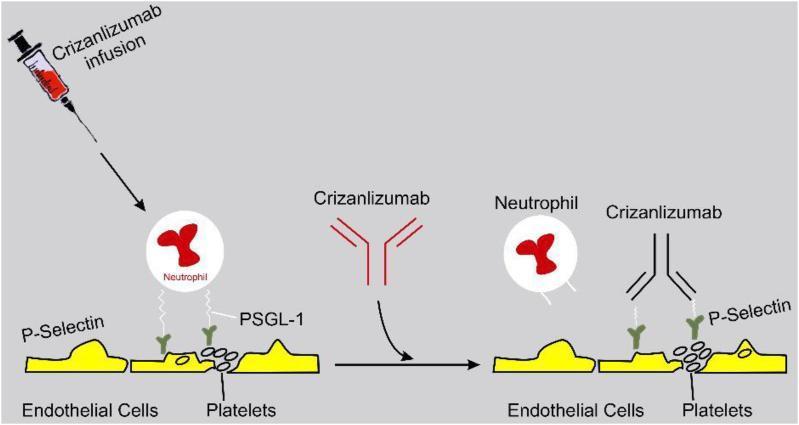
 (0,"Crizanlizumab — monoclonal antibody blocking P-selectin, reducing cell adhesion and vaso-occlusion."),
 (0,"Voxelotor — inhibits HbS polymerization directly, improving hemolysis and anemia."),
 (0,"Chronic transfusion programs — for stroke prevention (e.g., abnormal transcranial Doppler)."),
 (0,"Hematopoietic stem cell transplant and emerging gene therapies (e.g., gene-edited autologous stem cells) — currently the only potentially curative options."),
], left=0.6, top=1.4, width=6.3, size=15)
add_pic(s, CRIZANLIZUMAB, left=7.1, top=1.6, width=5.7)
notes(s, "Beyond crisis management, several drugs now change the course of the disease. Hydroxyurea raises protective fetal "
         "hemoglobin and is first-line therapy for most patients. L-glutamine and voxelotor target red cell biology directly. "
         "Crizanlizumab, shown in this diagram, blocks P-selectin, a molecule that lets sickled cells stick to blood vessel "
         "walls and each other, so it reduces vaso-occlusive crises. Chronic transfusion programs prevent stroke in "
         "high-risk children. Currently, the only potentially curative treatments are bone marrow or stem cell transplant, "
         "and newer gene therapies that correct or bypass the sickle mutation in the patient's own stem cells.")

# ---------- Slide 11: Prevention & Prognosis ----------
s = prs.slides.add_slide(blank); add_bg(s)
title_bar(s, "Prevention, Supportive Care & Prognosis")
bullets(s, [
 (0,"Penicillin prophylaxis in early childhood and full vaccination (pneumococcal, meningococcal, Hib, influenza) to prevent sepsis."),
 (0,"Folic acid supplementation for ongoing hemolysis."),
 (0,"Regular screening: transcranial Doppler (stroke risk), retinal exams, echocardiography, renal function."),
 (0,"Genetic counseling for carrier couples; prenatal diagnosis available."),
 (0,"With modern comprehensive care, median survival now extends well into the 5th-6th decade in high-resource settings — though disparities in access remain a major global issue."),
], width=12.0, size=17)
notes(s, "Prevention centers on protecting against infection, since these patients lose effective spleen function early in "
         "life. Prophylactic penicillin and full vaccination dramatically reduce the risk of overwhelming bacterial sepsis in "
         "young children. Ongoing screening looks for silent organ damage, such as stroke risk on Doppler ultrasound or early "
         "kidney and eye disease. Genetic counseling helps carrier couples understand their risk. With comprehensive modern "
         "care, life expectancy has improved substantially, though access to that care is very unequal worldwide, and in "
         "many low-resource settings sickle cell disease still carries high childhood mortality.")

# ---------- Slide 12: Summary ----------
s = prs.slides.add_slide(blank); add_bg(s, DARK)
title_bar(s, "Key Takeaways", color=RGBColor(0x0D,0x0D,0x20))
bullets(s, [
 (0,"A single beta-globin mutation (Glu6Val) causes HbS, which polymerizes on deoxygenation and deforms red cells."),
 (0,"Sickled, sticky red cells cause chronic hemolysis PLUS vaso-occlusive ischemia — the two pillars of disease."),
 (0,"Presentation ranges from acute painful crises and acute chest syndrome to lifelong progressive organ damage."),
 (0,"Diagnosis relies on hemoglobin electrophoresis, confirmed by newborn screening."),
 (0,"Treatment has evolved from purely supportive care to disease-modifying drugs (hydroxyurea, voxelotor, crizanlizumab) and curative stem cell/gene therapy."),
], color=WHITE, width=12.0, size=18)
notes(s, "To summarize: sickle cell anemia begins with one small genetic change that creates an abnormal hemoglobin. That "
         "hemoglobin distorts red cells and makes them destroy blood vessels' normal flow, producing both chronic anemia and "
         "recurrent vaso-occlusive damage throughout the body. Diagnosis is straightforward with hemoglobin electrophoresis and "
         "newborn screening. And treatment has advanced remarkably, from purely supportive care decades ago to targeted drugs "
         "and potentially curative gene and stem cell therapies today.")

# ---------- Slide 13: References ----------
s = prs.slides.add_slide(blank); add_bg(s)
title_bar(s, "Sources")
bullets(s, [
 (0,"Robbins & Kumar, Basic Pathology, 11th ed. — Sickle Cell Anemia."),
 (0,"The Harriet Lane Handbook, 23rd ed. (Johns Hopkins Hospital) — Sickle Cell Anemia, Ch. 14."),
 (0,"Henry's Clinical Diagnosis and Management by Laboratory Methods — Sickle Cell Anemia / Red Cell Exchange."),
 (0,"Yassin M, et al. Evidence and gaps in clinical outcomes of novel pharmacologic therapies for sickle cell disease. Blood Reviews. 2025. PMID: 40307078."),
 (0,"Alyami K, et al. Palliative care needs of adults severely affected by sickle cell disease. Int J Nurs Stud. 2026. PMID: 41252804."),
], width=12.0, size=15)
notes(s, "These are the textbook and peer-reviewed sources used to compile this explainer.")

prs.save("/tmp/workspace/sickle-cell-video/output/Sickle_Cell_Anemia_Explainer.pptx")
print("DONE")
cd /tmp/workspace/sickle-cell-video && python build_pptx.py
ls -la /tmp/workspace/sickle-cell-video/output/
Sickle Cell Anemia Explainer
Presentation · PPTX
- Title - intro framing
- Overview & Epidemiology - most common inherited hemolytic anemia; ~1 in 600 African Americans in the US; malaria-protection origin of the HbS allele
- Genetics & Inheritance - autosomal recessive, Glu6Val substitution, Punnett square for two HbAS carrier parents
- Pathogenesis I - HbA replaced by HbS, deoxygenation-triggered polymerization, reversible-to-irreversible sickling, hemolysis
- Pathogenesis II - stickiness, vaso-occlusion, ischemia, role of HbF, triggers (dehydration, hypoxia, acidosis, infection)
- Acute complications - vaso-occlusive pain crisis, acute chest syndrome, splenic sequestration, aplastic crisis (parvovirus B19), stroke, priapism, dactylitis
- Chronic complications - autosplenectomy, avascular necrosis, renal papillary necrosis, retinopathy, pulmonary hypertension
- Diagnosis - newborn screening, Hb electrophoresis/HPLC, sickle solubility test limitations, blood smear findings
- Acute management - hydration, analgesia, oxygen, simple vs. exchange transfusion, sepsis vigilance
- Disease-modifying/curative therapy - hydroxyurea, L-glutamine, crizanlizumab, voxelotor, chronic transfusion, HSCT/gene therapy
- Prevention & prognosis - penicillin prophylaxis, vaccination, screening, genetic counseling, survival trends and access disparities
- Key takeaways - condensed summary
- Sources
Find research papers on gene therapy outcomes for sickle cell
"sickle cell disease" AND "gene therapy"
exagamglogene autotemcel OR lovotibeglogene autotemcel
gene therapy sickle cell disease outcomes Casgevy Lyfgenia clinical trial results 2025 2026
lovotibeglogene autotemcel sickle cell disease efficacy safety
PMID: 38661449
PMID: 40857358
"LentiGlobin" AND "sickle cell disease"
PMID: 34898139
Research Papers on Gene Therapy Outcomes for Sickle Cell Disease
Pivotal clinical trials
- 44 patients treated; median follow-up 19.3 months
- 97% (29/30) free of severe vaso-occlusive crises (VOCs) for ≥12 consecutive months
- 100% (30/30) free of hospitalization for VOCs for ≥12 months
- No hematologic cancers observed; safety consistent with busulfan myeloablation + autologous HSPC transplant
- 35 patients in the pivotal Group C cohort; median follow-up 17.3 months
- Total hemoglobin rose from 8.5 g/dL at baseline to ≥11 g/dL by month 6 through 36
- Anti-sickling HbAT87Q made up ≥40% of total hemoglobin, expressed in ~85% of red cells
- All 25 evaluable patients had complete resolution of severe VOCs (vs. median 3.5 events/year pre-treatment)
- No hematologic cancers through ~37.6 months follow-up
Patient-reported outcomes / quality of life
- 30 adults + 12 adolescents, ≥16 months follow-up (CLIMB SCD-121 and CLIMB-131)
- Clinically meaningful, sustained improvements across EQ-5D, FACT-G, ASCQ-Me, and pain scores by month 6, maintained through month 36
Safety signals to flag
- Goyal S, et al. Acute Myeloid Leukemia Case after Gene Therapy for Sickle Cell Disease. N Engl J Med. 2022. PMID: 34898140 — an AML case linked to lentiviral insertional mutagenesis in an earlier lovo-cel-treated patient; part of why Lyfgenia carries a boxed warning for hematologic malignancy.
- Yen A, et al. Specificity of CRISPR-Cas9 Editing in Exagamglogene Autotemcel (and 2025 update). PMID: 38657268 / PMID: 41061237 — off-target editing analyses for exa-cel, generally reassuring.
Recent reviews (2024-2026) synthesizing the field
- Cavazzana M, et al. Treating Sickle Cell Disease: Gene Therapy Approaches. Annu Rev Pharmacol Toxicol. 2025. PMID: 39259977
- Ballantine J, Tisdale JF. Gene therapy for sickle cell disease: recent advances, clinical trials and future directions. Cytotherapy. 2025. PMID: 39729054
- Butt H, Tisdale JF. Gene therapies on the horizon for sickle cell disease: a clinician's perspective. Expert Rev Hematol. 2024. PMID: 39076056
- Leonard A, Tisdale JF. Gene therapy for sickle cell disease. Hematology Am Soc Hematol Educ Program. 2023. PMID: 38066927
Cost and real-world access
- Herring WL, et al. Cost-Effectiveness of Lovotibeglogene Autotemcel for Patients with Sickle Cell Disease. PharmacoEconomics. 2024. PMID: 38684631
- Grilley BJ, et al. Sickle cell disease gene therapy drug expenses and reimbursement. Cytotherapy. 2025. PMID: 39891631