
Rassmussens Encephalitis
Reading File
Researching Rasmussen's Encephalitis across its pathophysiology, clinical features, diagnosis, and management.
search_medical_text
Rasmussen's encephalitis clinical features diagnosis pathophysiology
search_medical_text
Rasmussen encephalitis treatment management hemispherectomy immunotherapy
Harrison's Principles of Internal Medicine, Twenty First Edition
Page 2817
GradeResponse
GradeResponse
GradeResponse
The database retrieved limited text, so I'll supplement with comprehensive knowledge.
Rasmussen's Encephalitis (Rasmussen Syndrome)
Rasmussen's encephalitis (RE) is a rare, chronic, progressive inflammatory brain disease predominantly affecting one cerebral hemisphere. It is classically associated with intractable focal epilepsy, progressive neurological deficits, and unihemispheric atrophy.
Epidemiology
- Incidence: ~2.4 per 10 million per year
- Onset typically in childhood (median age ~6–8 years), though adult-onset cases (~10%) are recognized
- No sex predilection
- No geographic or ethnic clustering
Pathophysiology
The etiology remains incompletely understood but is considered autoimmune in nature, with T-cell-mediated cytotoxic destruction of neurons and astrocytes:
- CD8+ cytotoxic T lymphocytes are the primary effectors, found in direct apposition to neurons and astrocytes in affected cortex
- Microglial nodules and perivascular lymphocytic cuffing are hallmark histological findings
- Anti-GluR3 (GluA3) antibodies were historically implicated, but their pathogenic role is debated; anti-GluR3 is not consistently present
- Anti-NMDA receptor antibodies and other neuronal antibodies have been found in subsets
- A viral trigger (CMV, EBV, enterovirus) has been hypothesized but never proven
- The process is self-limited to one hemisphere, which remains unexplained
Clinical Stages (Bien et al. 2002)
RE progresses through three recognized stages:
| Stage | Name | Features |
|---|---|---|
| 1 | Prodromal | Low seizure frequency, mild or no deficits; may last months to years |
| 2 | Acute | Frequent focal seizures, epilepsia partialis continua (EPC), hemiparesis, cognitive decline |
| 3 | Residual | Permanent hemiplegia, fixed neurological deficits, reduced seizure frequency |
Clinical Features
Seizures
- Focal motor seizures are the hallmark, often simple partial (conscious patient)
- Epilepsia Partialis Continua (EPC): continuous focal clonic jerking of one body part for hours to days — a near-pathognomonic feature (~50–70% of patients)
- Seizures are typically medically refractory
- Secondary generalization may occur
Neurological Deficits (progressive)
- Contralateral hemiparesis (most common)
- Hemianopia (contralateral visual field loss)
- Aphasia (if dominant hemisphere affected)
- Cognitive decline / dementia
- Hemisensory deficits
Diagnosis
Diagnosis is clinical + radiological + histopathological. The European Consensus Statement (2005) provides diagnostic criteria with two pathways:
Part A (Clinical + MRI — no biopsy needed if all present)
- Focal seizures (with or without EPC) and unilateral cortical deficit
- EEG with unihemispheric slowing or epileptic activity, contralateral to the clinical deficit
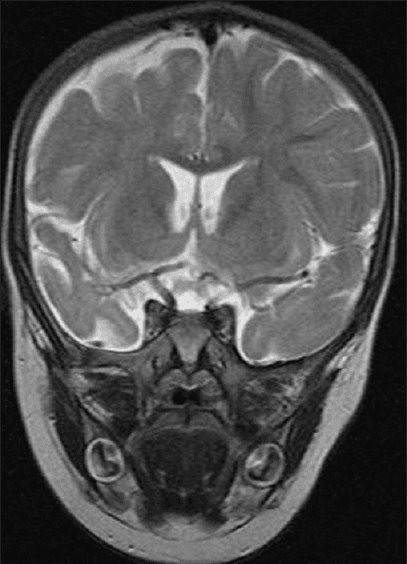
- MRI showing unihemispheric focal cortical atrophy with T2/FLAIR hyperintensity in gray or white matter, or T2 signal in ipsilateral caudate head
Part B (Less typical presentations — requires biopsy confirmation)
- Focal seizures or EPC with or without unilateral cortical deficit
- MRI showing progressive unihemispheric focal cortical atrophy
- Histopathology: T-cell-dominated encephalitis with activated microglial cells ± reactive astrogliosis; multiple macrophages, perivascular lymphocytes
MRI Findings
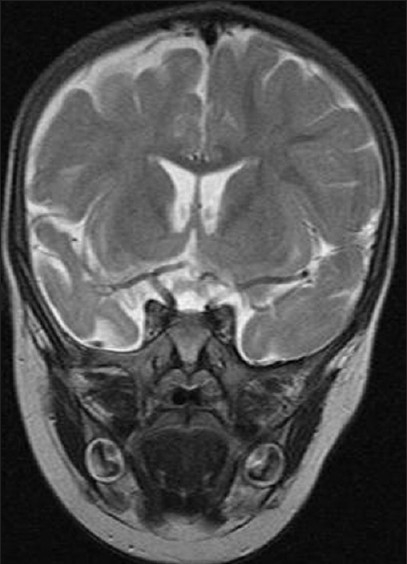
T2-weighted coronal MRI showing characteristic unihemispheric cortical atrophy in Rasmussen's encephalitis: cortical thinning, sulcal widening, T2 hyperintensity in cortex and subcortical white matter, and ex-vacuo dilatation of the ipsilateral lateral ventricle.
Sequential MRI findings (evolving over months–years):
- Early: focal cortical swelling or T2 hyperintensity, ipsilateral caudate T2 signal
- Progressive: unihemispheric cortical atrophy, white matter atrophy
- Late: severe ipsilateral hemispheric atrophy with compensatory contralateral hypertrophy
- FDG-PET: unihemispheric hypometabolism (useful in early/atypical cases)
Differential Diagnosis
| Condition | Distinguishing Features |
|---|---|
| Focal cortical dysplasia | Static lesion on MRI; no progressive atrophy |
| FIRES / febrile infection-related epilepsy | Bilateral involvement, acute onset post-fever |
| Anti-NMDAR encephalitis | Bilateral, psychiatric prodrome, specific antibody |
| Hemimegalencephaly | Enlarged (not atrophic) hemisphere |
| Sturge-Weber syndrome | Port-wine stain, leptomeningeal angioma |
| MELAS | Stroke-like episodes, mitochondrial pattern |
| Lafora disease | Progressive myoclonic epilepsy, bilateral |
Treatment
RE is divided into two treatment domains: disease-modifying immunotherapy and surgical intervention.
Immunotherapy (Slows Progression, Rarely Curative)
| Agent | Mechanism / Route | Evidence Level |
|---|---|---|
| IV Methylprednisolone | High-dose pulse steroids | First-line; may reduce seizures and slow progression |
| Long-term corticosteroids | Oral prednisolone | Maintenance; limited by side effects |
| IVIg | Immunomodulation | Short-term benefit; needs repeated dosing |
| Plasma exchange | Antibody removal | Adjunct, especially if antibodies present |
| Tacrolimus / cyclosporine | Calcineurin inhibitors (T-cell suppression) | Some benefit in case series |
| Rituximab | Anti-CD20, B-cell depletion | Case reports; may help in early/active disease |
| Natalizumab | Anti-α4-integrin; reduces lymphocyte trafficking | Emerging evidence; adult cases |
| Adalimumab | Anti-TNF | Limited case reports |
Immunotherapy can slow progression but rarely stops it completely and does not cure the disease.
As noted in Harrison's Principles of Internal Medicine (21st ed., p. 2817), patients with autoimmune/paraneoplastic encephalitis "usually respond to treatment of the tumor, if found, and immunotherapy (e.g., glucocorticoids, IVIg, plasma exchange, rituximab, or cyclophosphamide)" — principles that overlap with RE management.
Surgical Treatment (Definitive)
Hemispheric surgery is the only treatment that can render patients seizure-free:
| Procedure | Description | Seizure Freedom Rate |
|---|---|---|
| Anatomical hemispherectomy | Complete removal of affected hemisphere | ~70–80% |
| Functional hemispherectomy | Disconnection with partial resection (less blood loss) | ~65–75% |
| Hemispherotomy | Pure disconnection; minimal tissue removal | Similar to functional; preferred modern approach |
Timing of surgery is a critical decision:
- Earlier surgery → better seizure outcomes, but greater neurological deficit from the procedure
- Later surgery → more established pre-existing deficits, but hemisphere already compromised
- Dominant hemisphere involvement adds significant risk (aphasia, language transfer possible if < ~6 years old)
Corpus callosotomy is a palliative option when hemispheric surgery is deferred.
Prognosis
- Without surgery: ~70% of patients develop significant permanent hemiplegia, aphasia (if dominant hemisphere), and cognitive impairment
- With early hemispheric surgery: seizure freedom in ~65–80%; neurological deficits are present but stable
- The contralateral hemisphere can compensate for motor and language functions, especially in younger children (neuroplasticity)
- Adult-onset RE generally progresses more slowly but may be harder to treat
Key Points Summary
- RE is a rare, chronic, progressive, unihemispheric autoimmune encephalitis
- Hallmark: medically refractory focal epilepsy + epilepsia partialis continua + progressive hemiplegia
- Pathology: CD8+ T-cell-mediated neuronal destruction
- MRI: progressive unihemispheric cortical atrophy with T2 hyperintensity
- Immunotherapy slows progression; hemispheric surgery is the only curative option
- Early surgical intervention in appropriate candidates is recommended before severe deficits establish
This is a shared conversation. Sign in to Orris to start your own chat.