
Sphygmomanometer parts
Reading File
search_medical_text
sphygmomanometer parts components structure
search_medical_image
sphygmomanometer parts diagram
GradeResponse
GradeResponse
Sphygmomanometer Parts
A sphygmomanometer (blood pressure meter) consists of the following components:
Core Components
| Part | Description |
|---|---|
| Manometer | The pressure-measuring unit — displays blood pressure readings in mmHg. Two types: mercury column or aneroid gauge. |
| Inflatable Cuff (Bladder) | A fabric-enclosed rubber bladder that wraps around the arm (or other limb). Occludes the artery when inflated. |
| Inflation Bulb (Hand Pump) | A rubber bulb squeezed by hand to pump air into the cuff and raise pressure. |
| Control Valve (Release Valve) | Attached to the inflation bulb; controls the rate of air release during deflation for auscultation. |
| Tubing | Rubber or PVC tubes connecting the bulb, cuff, and manometer, allowing pressure transmission. |
| Velcro/Fastening Strap | Secures the cuff snugly around the limb at a standardized position. |
By Device Type
🔵 Mercury Sphygmomanometer (Traditional)
- Glass manometer tube — contains liquid mercury; pressure is read at the top of the mercury column
- Reservoir (cistern) — mercury reservoir at the base of the column
- Metal/plastic housing — protects the glass tube and reservoir
- Scale — graduated from 0–300 mmHg
🟢 Aneroid Sphygmomanometer
- Aneroid gauge (dial) — mechanical gauge with a needle pointing to the pressure scale; uses metal bellows instead of mercury
- Dial face — circular, graduated in mmHg, typically 0–300 mmHg
- Calibration port — small port for recalibration
🔷 Digital/Automated Sphygmomanometer
- Electronic pressure sensor (transducer) — detects oscillometric pressure changes
- Microprocessor/display unit — calculates and displays systolic, diastolic, and pulse rate
- Automated inflation pump — electrically powered pump
- Memory module — stores previous readings
Cuff Anatomy (Detail)
| Sub-component | Function |
|---|---|
| Outer fabric sleeve | Holds the bladder and wraps around the arm |
| Inner rubber bladder | The air-filled chamber that applies compression |
| Index line / range markers | Guides proper placement over the brachial artery |
| Connector port | Attachment point for the tubing from manometer/pump |
How the Parts Work Together
- The cuff is wrapped around the upper arm at heart level.
- The inflation bulb is squeezed to pump air through the tubing into the bladder, raising pressure above systolic (~180 mmHg).
- The manometer displays this pressure continuously.
- The control valve is slowly released; the clinician listens with a stethoscope over the brachial artery.
- Systolic pressure = first Korotkoff sound heard during deflation.
- Diastolic pressure = point at which sounds disappear (Korotkoff phase V).
Here is a comparative image showing a mercury-free (Galinstan) prototype alongside a standard mercury sphygmomanometer, illustrating the structural components:
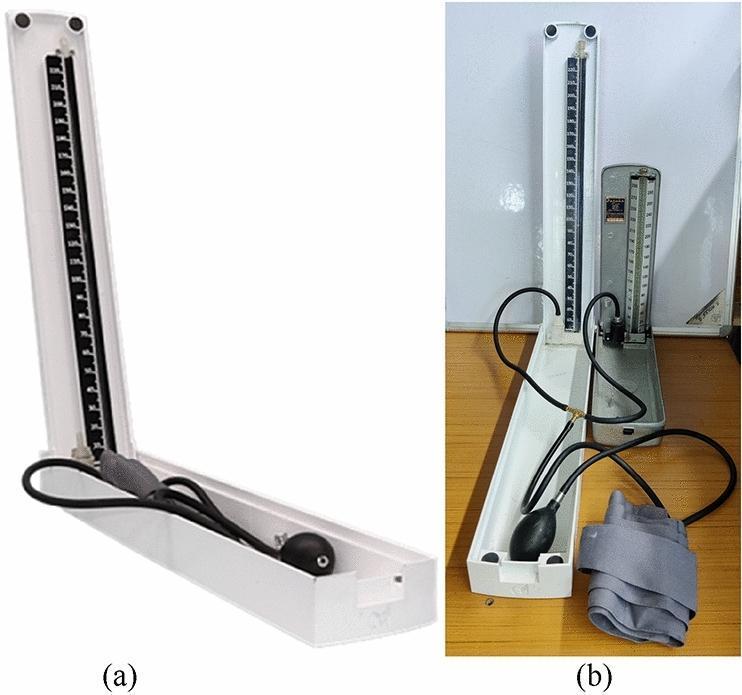
Panel (a): Mercury-free prototype with rubber inflation bulb, tubing, and vertical measuring scale. Panel (b): Comparative setup with a standard mercury sphygmomanometer, both connected via T-connector to the same cuff for validation.
manometer of Sphygmomanometer
search_medical_text
manometer sphygmomanometer types mercury aneroid components
search_medical_image
manometer sphygmomanometer mercury aneroid diagram
GradeResponse
GradeResponse
Manometer of a Sphygmomanometer
The manometer is the pressure-sensing and display unit of the sphygmomanometer. It measures the air pressure inside the cuff and displays it in millimetres of mercury (mmHg). There are three main types:
1. Mercury Manometer
The gold standard for accuracy.
Parts:
| Part | Description |
|---|---|
| Glass tube | Vertical, narrow-bore tube through which mercury rises with pressure |
| Mercury reservoir (cistern) | Holds the bulk of mercury at the base; connects to the glass tube |
| Scale | Graduated markings on the glass tube, 0–300 mmHg |
| Metal/wooden housing | Protective casing for the glass tube and reservoir |
| Inlet port | Connects to the rubber tubing from the cuff and bulb |
| Air vent (filter) | Small vent at the top of the glass tube allowing atmospheric pressure equalization; has a dust filter to prevent mercury contamination |
How it works:
- Air pressure from the inflated cuff is transmitted to the mercury reservoir.
- Mercury rises in the glass tube proportional to the applied pressure.
- The clinician reads the top of the mercury meniscus at eye level.
- Range: 0–300 mmHg; least count: 2 mmHg
Advantages:
- Most accurate; considered the reference standard
- No calibration drift over time
Disadvantages:
- Mercury is toxic — banned/phased out in many countries
- Fragile (glass), not portable
- Risk of spill and environmental hazard
2. Aneroid Manometer
Mechanical, mercury-free gauge.
Parts:
| Part | Description |
|---|---|
| Aneroid capsule (bellows) | A sealed, corrugated metal chamber that expands/contracts with pressure changes |
| Lever/link mechanism | Converts linear movement of the bellows into rotary motion |
| Pinion gear | Small gear that amplifies and transmits the rotary motion to the needle |
| Pointer/needle | Rotates to indicate pressure on the dial face |
| Dial face | Circular scale graduated 0–300 mmHg |
| Zero-adjust screw | Used to recalibrate the needle to zero |
| Calibration port | Port for external calibration against a mercury standard |
| Housing/casing | Protective metal or plastic shell |
| Inlet port | Connects to the rubber tubing |
How it works:
- Pressurized air from the cuff enters the aneroid capsule.
- The capsule expands, moving the lever-gear system.
- The needle rotates on the dial, indicating pressure in mmHg.
Advantages:
- Portable, lightweight, no mercury
- Durable for field/clinical use
Disadvantages:
- Prone to calibration drift — must be recalibrated every 6 months
- Less accurate than mercury if not maintained
3. Electronic (Digital) Manometer
Used in automated oscillometric devices.
Parts:
| Part | Description |
|---|---|
| Pressure transducer (sensor) | Converts air pressure into an electrical signal |
| Microprocessor | Processes oscillometric pressure waveforms to calculate BP |
| Digital display (LCD/LED) | Shows systolic, diastolic pressure, and pulse rate |
| Analog-to-digital converter (ADC) | Converts analog sensor output to digital values |
| Automated pump | Electrically inflates the cuff to a preset pressure |
| Exhaust valve (solenoid) | Controls deflation rate electronically |
How it works:
- Detects oscillations in arterial wall pulsations transmitted through the cuff.
- The microprocessor identifies the point of maximum oscillation (≈ mean arterial pressure) and calculates systolic and diastolic values algorithmically.
Comparison Summary
| Feature | Mercury | Aneroid | Digital |
|---|---|---|---|
| Accuracy | Highest (reference) | Moderate (if calibrated) | Moderate–High (if validated) |
| Calibration needed | No | Every 6 months | Periodic |
| Portability | Low | High | High |
| Toxicity risk | Yes (mercury) | None | None |
| Reading type | Visual column | Dial needle | Digital display |
| Technique required | Auscultatory | Auscultatory | Oscillometric (automated) |
Per the Diagnosis and Management of Hypertension in Primary Care (p. 104), all three manometer types — mercury, aneroid, and electronic manual non-oscillometric — are acceptable for the standard auscultatory technique, provided the device has been validated and recently calibrated.
This is a shared conversation. Sign in to Orris to start your own chat.