
Colon diverticulitis
I'll read the medical library skill first, then research colon diverticulitis comprehensively.
Reading File
Now I'll run parallel searches across the medical library and PubMed simultaneously.
Finding Sources
Searching PubMed
"diverticulitis" AND "colon"
Excellent. Now I'll read the most authoritative and comprehensive sections in parallel - Sleisenger & Fordtran (the gold standard GI textbook), Rosen's Emergency Medicine, and Bailey & Love's Surgery.
Reading File
Reading File
Reading File
Great material. Now let me read more of the Sleisenger & Fordtran section (the most detailed) and Rosen's treatment section, and grab the CT scan image.
Reading File
Reading File
Loading Image
Now let me get the treatment details, Hinchey classification table, and the uncomplicated diverticulitis management from Sleisenger, plus fetch the CT images from Rosen's.
Reading File
Loading Image
Loading Image
I now have comprehensive material across multiple textbooks plus recent PubMed evidence. Let me compile the full answer.
Colon Diverticulitis
Definition
Diverticulitis is inflammation and/or infection of a diverticulum (an outpouching of the colonic wall). It is classified as uncomplicated (localized inflammation without major sequelae) or complicated (associated with abscess, fistula, obstruction, or free perforation). Roughly 80% of first attacks are uncomplicated.
- Sleisenger and Fordtran's Gastrointestinal and Liver Disease
Epidemiology
-
Diverticulitis develops in approximately 4% of patients with known diverticulosis over an 11-year period (older estimates of 10-25% risk are now considered overestimates).
-
Prevalence of diverticulitis hospitalizations in the USA peaked around 2008 and has since stabilized.
-
The proportion of patients requiring surgery decreased from ~25% to ~15% between 2000 and 2010.
-
In Western populations, ~95% of diverticula occur in the sigmoid/left colon. In Asian populations, right-sided diverticula predominate.
-
Sleisenger and Fordtran's
Pathophysiology
The mechanism parallels appendicitis: a fecalith obstructs the neck of a diverticular sac, abrading the mucosa and causing low-grade inflammation. This leads to:
- Increased local bacterial flora
- Diminished venous outflow and localized ischemia
- Altered mucosal defense (defective CD2-induced apoptosis in lamina propria lymphocytes, upregulating local immunity - similar to IBD)
- Possible CMV reactivation (found in >2/3 of affected bowel segments in diverticulitis)
- Transmural bacterial extension -> microperforation
Extent of perforation determines clinical behavior:
-
Microperforation - contained by pericolic fat -> small pericolic abscess
-
Larger perforation - extensive abscess, possible fistula or obstruction
-
Free perforation -> bacterial or fecal peritonitis (incidence ~4/100,000/year)
-
Sleisenger and Fordtran's
Hinchey Classification of Diverticular Perforation
| Stage | Definition |
|---|---|
| I | Confined pericolic abscess |
| II | Distant abscess (retroperitoneal or pelvic) |
| III | Generalized purulent peritonitis from rupture of pericolic/pelvic abscess (diverticular neck obliterated) |
| IV | Fecal peritonitis from free perforation of a diverticulum (communicating with colonic lumen) |
- Sleisenger and Fordtran's
Clinical Features
Uncomplicated diverticulitis:
- LLQ abdominal pain (constant or intermittent) - the hallmark
- Change in bowel habits (diarrhea or constipation)
- Low-grade fever
- Anorexia, nausea, vomiting
- "Sympathetic cystitis" - dysuria/urinary frequency from bladder irritation by inflamed sigmoid
- LLQ tenderness on exam; possible palpable mass; guarding/rebound
- Note: BRBPR is NOT seen in acute diverticulitis
Right-sided diverticulitis (more common in Asian patients): mimics appendicitis closely - RLQ pain and tenderness.
Complicated diverticulitis - additional features:
- Diffuse tenderness with rebound/guarding -> perforation or abscess rupture
- Dysuria + fecaluria -> colovesical fistula
- Feculent vaginal discharge -> colovaginal fistula
- Palpable mass -> localized abscess
- Vomiting + distension -> obstruction
- High fever / sepsis
Elderly and immunocompromised patients may present subtly despite severe disease; perforation is more frequent and carries high mortality.
- Sleisenger and Fordtran's; Rosen's Emergency Medicine
Diagnosis
Imaging
CT scan with IV contrast (and ideally oral/rectal contrast) is the standard of care - sensitivity 98%, specificity 99%.
CT findings:
- Colonic wall thickening
- Pericolic fat stranding
- Localized microperforation
- Abscess formation
- Free air or fluid (perforation)
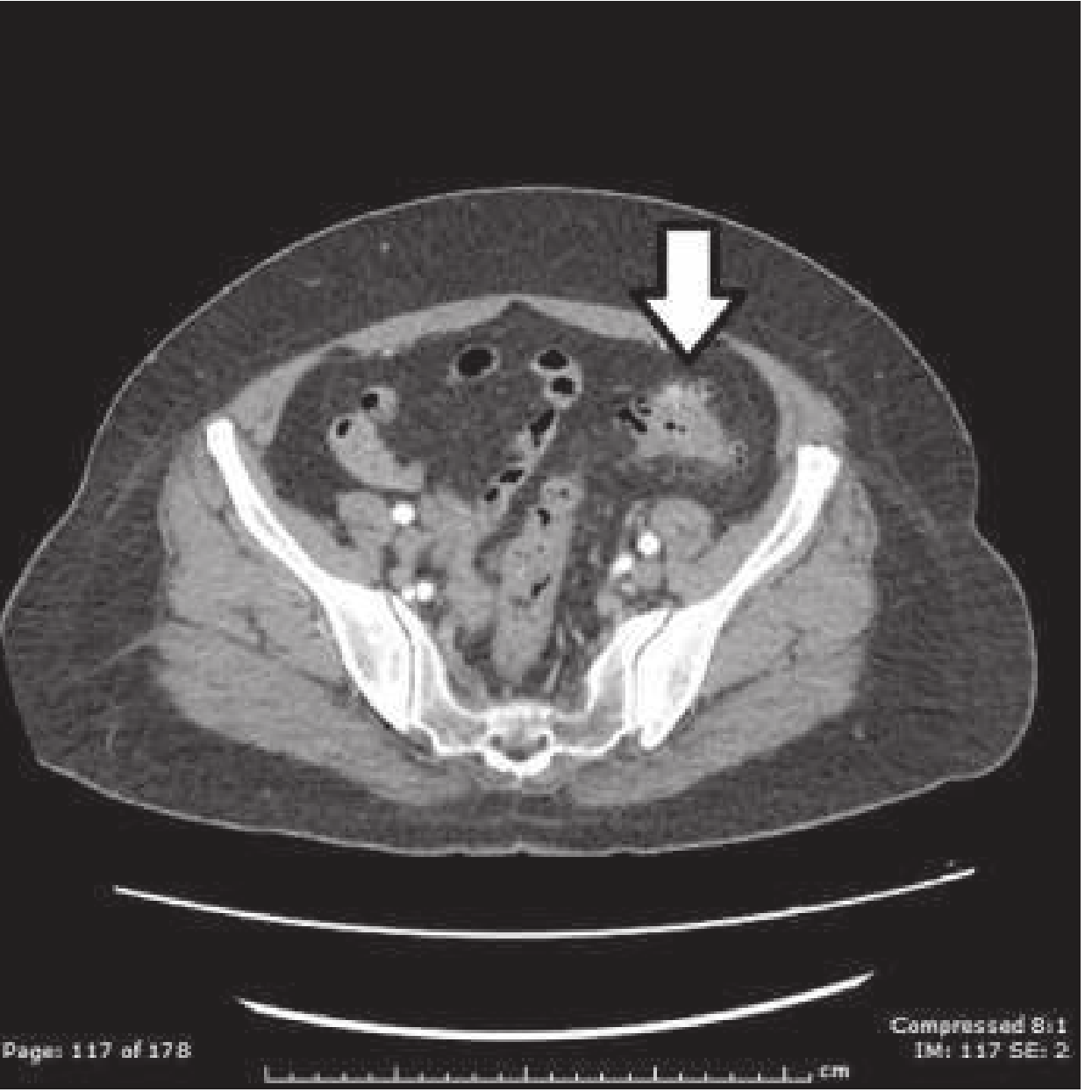
CT of uncomplicated diverticulitis - axial view showing air-filled diverticula along the left colon and hazy outer bowel wall (fat stranding):
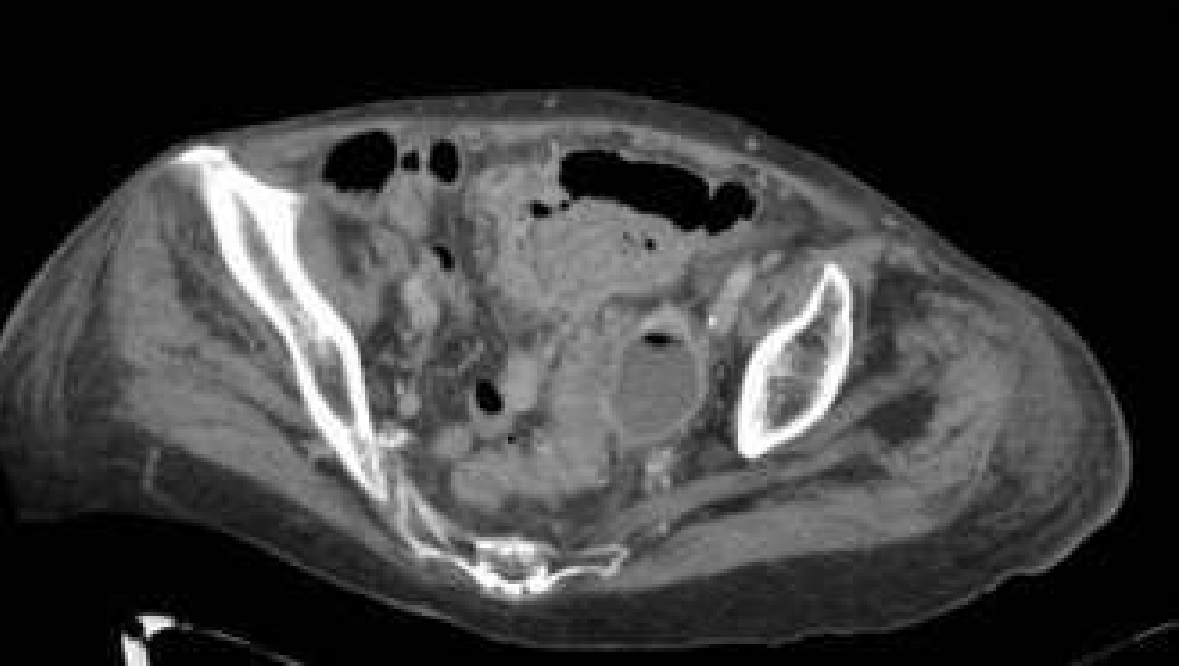
CT of diverticulitis with abscess - axial view demonstrating a sigmoid abscess:
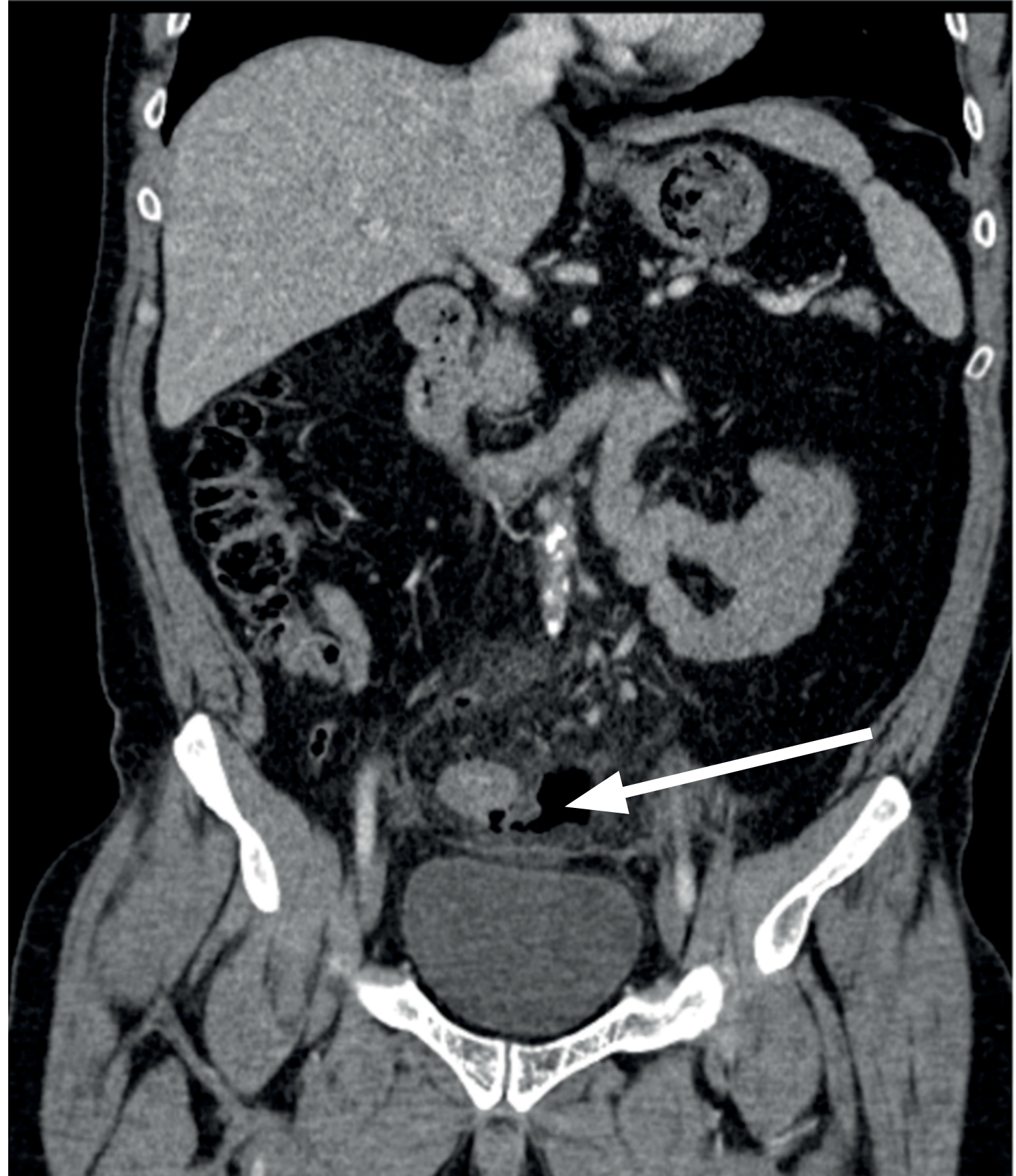
Coronal CT showing diverticular perforation with extraluminal gas track (arrow) and surrounding sigmoid stranding - note this is localized rather than generalized pneumoperitoneum:
Modalities no longer recommended: barium enemas, water-soluble contrast enemas, plain radiography, routine colonoscopy after each episode (now follow age-appropriate cancer screening guidelines).
Lab Work
-
WBC elevated in most but normal WBC in up to 46% - does not exclude diagnosis
-
Urinalysis when colovesical fistula suspected
-
Sleisenger and Fordtran's; Rosen's Emergency Medicine; Bailey and Love's Surgery
Differential Diagnosis
| Condition | Key distinguishing feature |
|---|---|
| Appendicitis | RLQ pain; most common misdiagnosis for right-sided diverticulitis |
| Colorectal cancer | Insidious onset; weight loss; evaluate after acute episode resolves |
| IBD (Crohn's/UC) | Younger patients; rectal involvement; histology |
| Ischemic colitis | Acute-onset rectal bleeding; vascular risk factors |
| Infectious colitis | Diarrhea, stool cultures |
| Pelvic pathology | Women: PID, ovarian cyst rupture, ectopic pregnancy |
| Ureteral stones | Colicky flank pain, hematuria |
Management
Uncomplicated Diverticulitis
Key paradigm shift: Current evidence (AGA guidelines 2015 onward) supports diverticulitis as primarily an inflammatory, not infectious process. Routine antibiotics are not required in uncomplicated cases - they are used selectively.
Outpatient (majority of uncomplicated cases):
- Liquid/low-residue diet, advance as tolerated
- Oral analgesics
- Selective antibiotics (if used): cover Gram-negative aerobes AND anaerobes (e.g., metronidazole + ciprofloxacin; or amoxicillin-clavulanate)
- No benefit of IV over oral antibiotics for uncomplicated disease
Inpatient (IV antibiotics + bowel rest) indicated for:
- Elderly or immunocompromised patients
- Multiple comorbidities
- Unable to tolerate oral intake
- Failure of outpatient therapy
- First episode with diagnostic uncertainty
Recurrence risk: 15-30% after first attack; half of second attacks occur within 1 year.
Complicated Diverticulitis
Abscess (Hinchey I/II):
- Stage I (<3-4 cm): may resolve with antibiotics alone + bowel rest
- Stage II (>3-4 cm or pelvic): CT-guided percutaneous drainage - success rate 74-80% for patient stabilization, allowing later single-stage resection in 3-4 weeks
- 20-25% require urgent surgery (multiloculated, inaccessible, or non-resolving abscess)
Free Perforation (Hinchey III/IV):
- Emergency surgery required
- Options: Hartmann's procedure (sigmoid resection + end colostomy) vs. primary anastomosis (with or without protective stoma)
- A recent 2025 meta-analysis on primary anastomosis in emergency left colon surgery supports safety of primary anastomosis without protective stoma in selected patients
Fistula:
- Develops in <5% of all diverticulitis cases but ~20% of surgical cases
- Colovesical fistula is the most common (men > women due to uterus acting as barrier)
- Treatment: elective surgical resection after bowel prep and preoperative cystoscopy/urologic evaluation
Obstruction:
- Colonic obstruction from stricture or inflammatory mass
- Acute: IV fluids, bowel decompression, consider stenting vs. surgery
- Chronic stricture: elective resection
Elective Surgery - Indications
- Recovery from complicated diverticulitis (abscess/fistula/obstruction)
- Recurrent symptomatic disease significantly impairing quality of life
- Inability to exclude carcinoma
Approach: Elective laparoscopic sigmoid colectomy is the preferred approach (shorter hospital stay, lower costs than open colectomy; considered standard of care). A 2025 meta-analysis found no significant difference in quality of life between elective surgery and non-operative management for uncomplicated recurrent diverticulitis, reinforcing selective surgical referral.
- Sleisenger and Fordtran's; Rosen's Emergency Medicine; Bailey and Love's Surgery
Post-Acute Surveillance
- Colonoscopy is not routinely required after each episode
- Follow standard colorectal cancer screening intervals
- High-fiber diet post-recovery (reduces recurrence and symptom burden)
- Physical activity reduces risk of developing diverticulitis (mechanism unclear)
- Previously advised avoidance of nuts/seeds/popcorn has been discredited - no evidence base
Recent Evidence (PubMed 2024-2026)
- A 2025 systematic review and meta-analysis (Kahana et al., Surgery) found no significant QoL advantage of elective surgery over non-operative management for colonic diverticulitis - supports conservative management as first-line for most recurrent cases.
- A 2026 systematic review (Sassun et al., Colorectal Dis) found low rates of recurrent diverticulitis after sigmoid resection, supporting surgery in high-recurrence-risk patients.
- Genetic determinants of diverticulosis are increasingly recognized, with connective tissue genes implicated - relevant to younger patients with early-onset disease.
This is a shared conversation. Sign in to Orris to start your own chat.