
Function of respiratory system ?
Reading File
Searching for information on the functions of the respiratory system.
search_medical_text
functions of the respiratory system
Harrison's Principles of Internal Medicine, Twenty First Edition
Page 7853
GradeResponse
GradeResponse
Functions of the Respiratory System
The respiratory system serves several vital physiological roles, with gas exchange being its primary function.
1. Gas Exchange (Primary Function)
The core function is to oxygenate blood and eliminate carbon dioxide (Harrison's, p. 7853). This occurs in the lung alveoli, where:
- Blood in alveolar wall capillaries is separated from alveolar gas by an extremely thin membrane of flattened endothelial and epithelial cells.
- O₂ diffuses from alveolar air into the blood; CO₂ diffuses from blood into the alveolar air.
- The alveoli provide an enormous surface area (~70 m²) for this diffusion within the compact thoracic cavity.
2. Ventilation
- The airway brings fresh air in and stale alveolar gas out through tidal breathing (inhalation + exhalation), driven by the respiratory muscles (diaphragm, intercostals).
- Respiratory rate (RR) regulates how often alveolar air is refreshed.
3. Acid-Base Regulation
- By controlling CO₂ elimination, the respiratory system regulates blood pH.
- Faster breathing (hyperventilation) lowers CO₂ → raises pH (alkalosis).
- Slower breathing (hypoventilation) retains CO₂ → lowers pH (acidosis).
4. Filtration and Defense
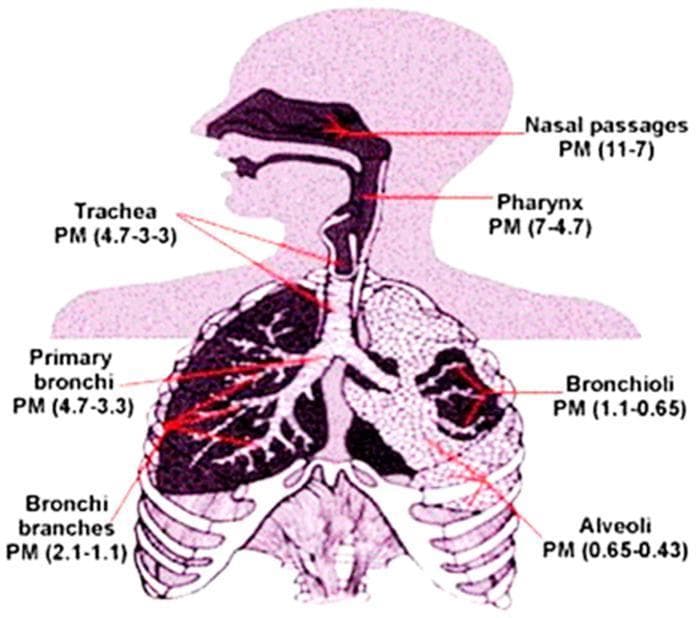
- The nasal passages, pharynx, trachea, and bronchi filter inhaled particles.
- Larger particles (>7 µm) are trapped in the upper airways; smaller particles penetrate deeper into bronchioles and alveoli.
- Mucociliary clearance, macrophages, and immune cells protect against pathogens and particulates.
5. Phonation (Speech)
- Air expelled through the larynx vibrates the vocal cords, producing sound.
6. Olfaction Support
- Airflow through the nasal passages carries odorant molecules to olfactory receptors.
7. Thermoregulation and Humidification
- The respiratory tract warms and humidifies inhaled air to protect delicate alveolar surfaces.
- Some heat and water are lost during exhalation.
Anatomical Overview
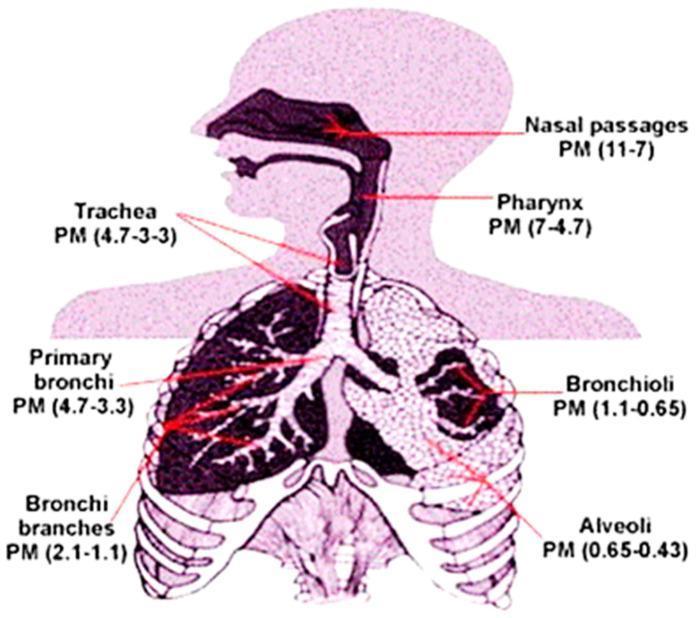
Diagram showing the respiratory tract from nasal passages to alveoli, with particle deposition patterns by size.
Summary Table
| Function | Key Structure(s) |
|---|---|
| Gas exchange (O₂/CO₂) | Alveoli, pulmonary capillaries |
| Ventilation | Diaphragm, airways |
| Acid-base balance | Lungs (CO₂ regulation) |
| Filtration & immune defense | Nose, cilia, mucus, macrophages |
| Phonation | Larynx, vocal cords |
| Olfaction | Nasal passages |
| Humidification/thermoregulation | Upper airways |
Function of human heart ?
Searching for information on the functions of the human heart.
search_medical_text
functions of the human heart cardiac physiology
Evaluation, Risk Stratification, and Management of Arrhythmogenic Cardiomyopathy
Page 34
search_medical_image
human heart anatomy diagram chambers valves
Harrison's Principles of Internal Medicine, Twenty First Edition
Page 7407
GradeResponse
GradeResponse
Functions of the Human Heart
The human heart is a muscular organ that acts as the body's pump, driving blood through two circulatory circuits to sustain life.
Anatomy at a Glance
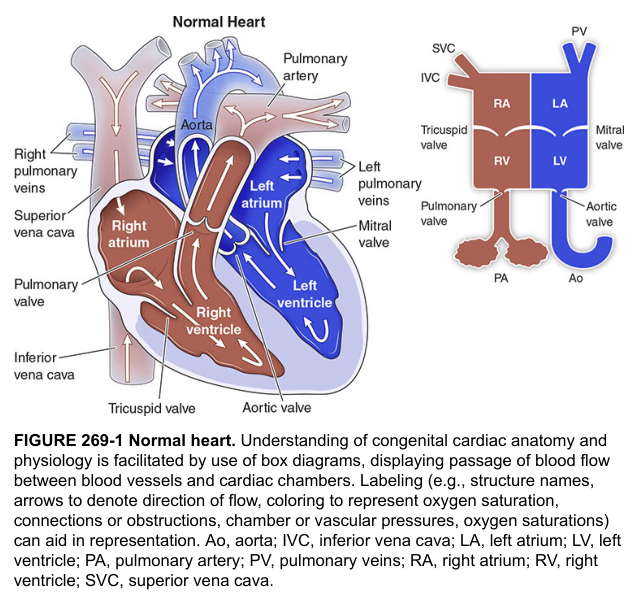
Cross-section of the human heart showing four chambers, major vessels, and valves. Blue = deoxygenated blood; Red = oxygenated blood. (Harrison's, p. 7407)
1. Pumping Blood (Primary Function)
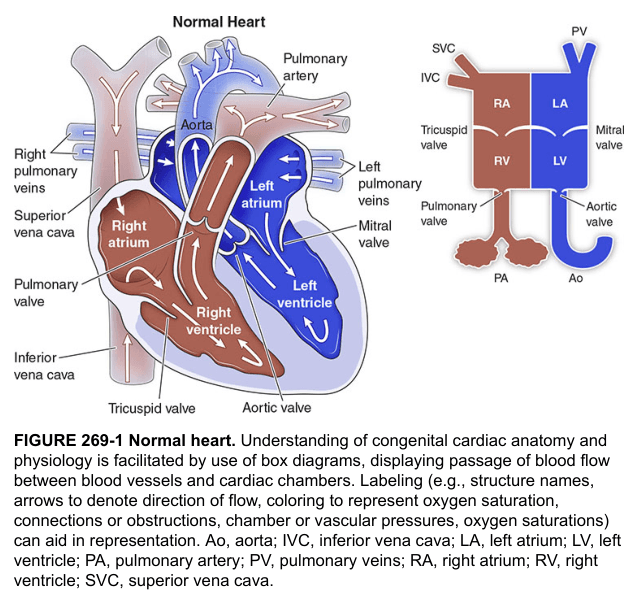
The heart has four chambers working in coordinated sequence:
| Chamber | Role |
|---|---|
| Right Atrium | Receives deoxygenated blood from the body (via superior & inferior vena cava) |
| Right Ventricle | Pumps deoxygenated blood to the lungs via the pulmonary artery |
| Left Atrium | Receives oxygenated blood from the lungs via pulmonary veins |
| Left Ventricle | Pumps oxygenated blood to the entire body via the aorta |
2. Maintaining Two Circulatory Circuits
- Pulmonary circulation: Right side of heart → lungs → left side. Sends blood to the lungs for oxygenation and CO₂ removal.
- Systemic circulation: Left side of heart → entire body → right side. Delivers oxygen and nutrients to all tissues and organs.
3. Regulating Blood Pressure
- The force and rate of cardiac contractions maintain adequate blood pressure to perfuse vital organs (brain, kidneys, etc.).
- The left ventricle generates the highest pressure to drive blood through the systemic circulation.
4. Directing Unidirectional Blood Flow (Valves)
Four valves prevent backflow and ensure blood moves in one direction:
| Valve | Location | Function |
|---|---|---|
| Tricuspid | Right atrium → Right ventricle | Prevents backflow into right atrium |
| Pulmonary | Right ventricle → Pulmonary artery | Prevents backflow into right ventricle |
| Mitral (Bicuspid) | Left atrium → Left ventricle | Prevents backflow into left atrium |
| Aortic | Left ventricle → Aorta | Prevents backflow into left ventricle |
5. Electrical Conduction and Rhythm
- The heart generates its own electrical impulses via the sinoatrial (SA) node (natural pacemaker), ensuring regular, coordinated contractions.
- The electrical signal propagates through the AV node → Bundle of His → Purkinje fibers, synchronizing atrial and ventricular contractions.
- At the cellular level, gap junctions in the intercalated discs between cardiomyocytes ensure rapid propagation of electrical signals and mechanical force throughout the myocardium (Arrhythmogenic Cardiomyopathy Guidelines, p. 34).
6. Oxygen and Nutrient Delivery
- By continuously circulating blood, the heart ensures delivery of oxygen, glucose, hormones, and other nutrients to every cell in the body.
- It simultaneously facilitates removal of metabolic waste products (CO₂, urea, lactic acid).
7. Endocrine Function
- The heart acts as an endocrine organ — atrial cardiomyocytes secrete Atrial Natriuretic Peptide (ANP) and ventricular cells secrete Brain Natriuretic Peptide (BNP) in response to increased wall stretch/pressure.
- These hormones regulate blood volume, blood pressure, and sodium balance.
Summary
| Function | Mechanism |
|---|---|
| Pumping blood | Rhythmic contraction of four chambers |
| Pulmonary circulation | Right heart → lungs |
| Systemic circulation | Left heart → body |
| Blood pressure maintenance | Cardiac output regulation |
| Unidirectional flow | Four cardiac valves |
| Electrical rhythm | SA node, conduction system |
| Nutrient/waste transport | Continuous blood circulation |
| Hormonal regulation | ANP, BNP secretion |
This is a shared conversation. Sign in to Orris to start your own chat.