
Ccp anatomy physiology pathophysiology risk factor clinical manifestations diagnostic evaluation management
Reading File
"CCP" could refer to a few things - let me clarify before diving deep.
Asking for Preferences
What does 'CCP' refer to in your question?
Searching sources...
Finding Sources
Finding Sources
Searching PubMed
"chronic calcific pancreatitis" AND management
Good results found. Now reading the most comprehensive sections in parallel.
Reading File
Reading File
Reading File
Now reading deeper sections on management, radiology, and dedicated CCP sections:
Reading File
Reading File
Finding Sources
Reading File
Reading File
Reading File
Reading File
Finding Sources
Reading File
Reading File
I now have comprehensive information. Let me also fetch a key image and finalize the answer.
Loading Image
Chronic Calcific Pancreatitis (CCP)
1. ANATOMY OF THE PANCREAS (Normal)
The pancreas is a retroperitoneal gland lying transversely in the upper abdomen, with the head nestled in the C-loop of the duodenum, the body crossing the spine at L1-L2, and the tail reaching the splenic hilum.
Structural components:
- Exocrine pancreas (90% of mass): Acinar cells secrete digestive enzymes (as zymogens) into an elaborate ductal system. The main pancreatic duct (Wirsung duct) runs the length of the gland, normally ≤3 mm in the body and ≤2.5 mm overall, joining the common bile duct at the ampulla of Vater to drain into the duodenum.
- Endocrine pancreas (islets of Langerhans, ~2%): Scattered clusters of beta (insulin), alpha (glucagon), delta (somatostatin), and PP cells, concentrated more in the tail.
- Ductal cells: Secrete bicarbonate-rich fluid (1-2 L/day) to neutralize duodenal acid and carry zymogens downstream.
Key anatomic relationships relevant to CCP:
- The intrapancreatic portion of the common bile duct traverses the pancreatic head - vulnerable to compression in fibrotic CP
- The main pancreatic duct system can become chain-of-lakes in CCP due to alternating strictures and dilations
2. PHYSIOLOGY (Normal Pancreatic Function)
| Function | Detail |
|---|---|
| Exocrine | Secretes ~1.5–2 L/day of pancreatic juice rich in lipase, amylase, proteases (trypsinogen, chymotrypsinogen), bicarbonate |
| Protective mechanism | Zymogens are activated ONLY in the duodenum by enterokinase; trypsin is the master activator; SPINK1 (trypsin inhibitor) prevents premature activation |
| Bicarbonate secretion | Ductal cells secrete HCO₃⁻ to alkalinize the duct lumen, preventing protein precipitation |
| Endocrine | Islets regulate glucose homeostasis via insulin, glucagon, somatostatin |
3. PATHOPHYSIOLOGY
CCP (also called Tropical Pancreatitis when occurring in endemic tropical regions) is a form of chronic pancreatitis defined by large intraductal calculi, marked main pancreatic duct dilation, gland atrophy, and fibrosis.
Core Pathophysiologic Mechanisms
Step 1 - Toxic/genetic insult to acinar cells:
Alcohol, cassava cyanogenic glycosides, oxidative stress, or genetic mutations (SPINK1, CFTR, PRSS1) alter zymogen activation - either via: (a) premature intracellular trypsin activation, (b) inadequate bicarbonate flow with protein plug formation, or (c) direct toxic/oxidative acinar injury.
Step 2 - Recurrent acinar injury and inflammation:
Repeated bouts of acute pancreatitis trigger a wound-healing response. Activated pancreatic stellate cells deposit collagen and other extracellular matrix proteins - this is the cellular basis of fibrosis.
Step 3 - Ductal obstruction and stone formation:
Decreased bicarbonate secretion causes precipitation of protein plugs in the pancreatic ducts. Over time, calcium salts (calcium carbonate) deposit around these plugs forming the hallmark intraductal calculi (stones). These obstruct the duct, raising intraductal pressure.
Step 4 - Progressive destruction:
- Fibrosis + ductal obstruction → acinar cell loss → exocrine insufficiency
- Initially islets are spared (relative sparing), but eventually the sclerotic tissue envelops and destroys them → endocrine insufficiency (diabetes)
Morphology on gross examination: Hard, shrunken gland; extremely dilated ducts; visible calcific concretions (especially in CCP/tropical pancreatitis where stones are very large, >5 mm).
Histology: Parenchymal fibrosis, reduced/absent acini, variable ductal dilation, chronic inflammatory infiltrate, ductal concretions, squamous metaplasia of ductal epithelium. - Robbins & Kumar Basic Pathology, p. 3056-3059
4. RISK FACTORS (TIGAR-O Classification)
| Category | Risk Factors |
|---|---|
| T - Toxic-metabolic | Alcohol (most common cause overall), tobacco smoking, hypercalcemia (hyperparathyroidism), hypertriglyceridemia, chronic renal failure, certain drugs |
| I - Idiopathic | Early-onset idiopathic, late-onset idiopathic, tropical pancreatitis |
| G - Genetic | PRSS1 mutation (hereditary pancreatitis), SPINK1 mutation (especially tropical/CCP - ~40-50% of tropical pancreatitis), CFTR mutations, CTRC, CPA1, CLDN2 mutations |
| A - Autoimmune | Type 1 AIP (IgG4-related), Type 2 AIP |
| R - Recurrent/Severe Acute | Post-necrotic, recurrent acute pancreatitis, vascular disease, post-irradiation |
| O - Obstructive | Pancreas divisum, sphincter of Oddi dysfunction, duct stricture, ductal tumors |
Special context - Tropical/CCP:
- Endemic within 30 degrees of the equator - Indian subcontinent (particularly southern India, prevalence ~1 in 500-800), sub-Saharan Africa, Brazil
- Traditionally linked to protein-calorie malnutrition + cassava (tapioca) consumption - cassava contains cyanogenic glycosides that generate free radical toxins
- SPINK1 mutation found in ~40-50% of tropical pancreatitis patients
- Disease of youth: mean age of onset ~24 years; >90% present before age 40
- Male predominance - Sleisenger & Fordtran's, p. 4136-4141
5. CLINICAL MANIFESTATIONS
A. Pain (Primary Symptom)
- Recurrent, episodic epigastric pain radiating to the back; initially triggered by oral intake
- Pain intensity and frequency increase as disease progresses
- Significantly impairs quality of life; may require narcotic analgesics
- Pain paradoxically may "burn out" in end-stage disease as the gland is fully destroyed
B. Exocrine Insufficiency
- Requires >90% gland destruction before clinical manifestations appear
- Steatorrhea (oily, foul-smelling, floating stools) - most characteristic
- Chronic diarrhea, bloating, weight loss, malnutrition
- Fat-soluble vitamin deficiency (A, D, E, K) → bleeding tendency, osteopenia/osteoporosis
- Occurs in 80-90% of patients with long-standing CCP
C. Endocrine Insufficiency - Fibrocalculous Pancreatic Diabetes (FCPD)
- Diabetes mellitus occurs in >50% of tropical CCP patients (up to 40-80% in long-standing CP)
- Develops years after pain onset
- Type 3c (pancreatogenic) diabetes - insulin deficiency due to islet destruction
- FCPD is recognized as a distinct type of diabetes in India
D. Jaundice / Biliary Obstruction
- Occurs in 5-10% of patients
- Caused by fibrosis of the intrapancreatic portion of the common bile duct
- May present with cholangitis
E. Other Manifestations
- Duodenal obstruction (extensive head fibrosis): severe nausea, vomiting
- Upper GI bleeding from portal/splenic vein thrombosis (rare)
- Pseudocyst formation
- Pancreatic ascites or pleural effusion (duct disruption)
- Pancreatic cancer risk: 16-fold increased risk in long-standing CP - Sabiston Textbook of Surgery, p. 2008; Sleisenger & Fordtran's, p. 4136-4138
6. DIAGNOSTIC EVALUATION
Imaging
Plain Abdominal X-ray (KUB):
- Pancreatic calcifications - readily visible, highly suggestive of CCP
- Inexpensive first screen
Ultrasound (US):
- Dilated main pancreatic duct (>2.5 mm), intraductal stones, heterogeneous echogenicity
- Limited by body habitus and overlying bowel gas
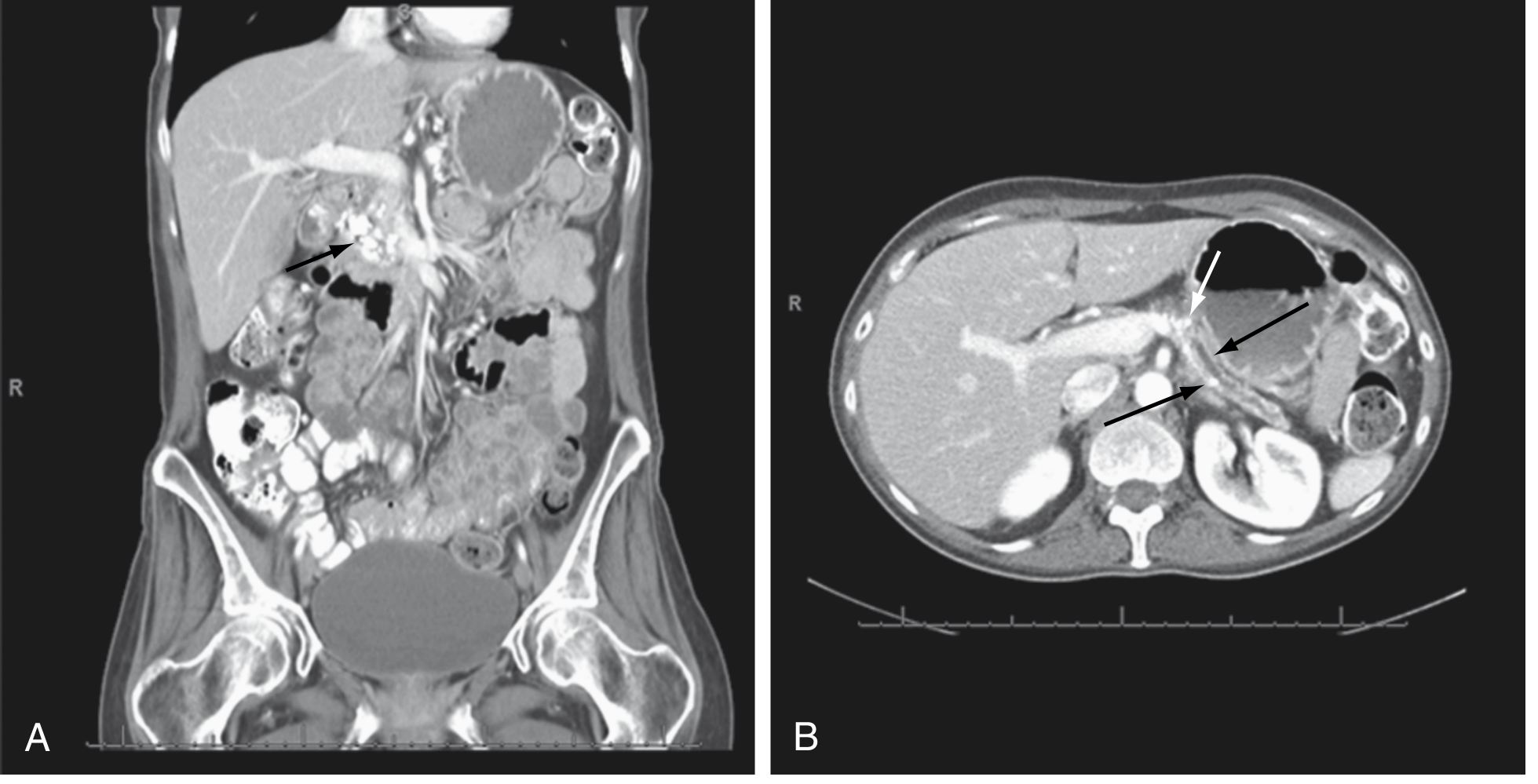
CT Scan (Gold standard for assessment):
- Most common findings: dilated MPD (68%), parenchymal atrophy (54%), pancreatic calcifications (50%)
- Sensitivity 56-95%, specificity 85-100%
- Excellent for assessing complications (pseudocysts, vascular changes, biliary dilation)
- Diagnosis with high specificity when ≥3 of: parenchymal calcifications, intraductal calcification, parenchymal atrophy, cystic lesions
MRI / MRCP:
- Lower sensitivity for calcifications than CT, but excellent for parenchymal changes
- Secretin-stimulated MRCP: evaluates ductal strictures and disruption
- Avoids radiation; preferred when CT is contraindicated
ERCP:
- Historically the "gold standard" for ductal imaging
- Classic finding: chain of lakes appearance (alternating dilations and strictures)
- Also shows intraductal filling defects (protein plugs/stones), CBD narrowing
- Now reserved primarily as a therapeutic tool; MRCP preferred for diagnosis
- Contraindicated if malignancy not ruled out
Endoscopic Ultrasound (EUS):
- Most sensitive for early/minimal-change CP
- Uses Rosemont Criteria (2009) for diagnosis:
- Major A: Hyperechoic foci with posterior shadowing, main pancreatic duct calculi
- Major B: Honeycombing lobularity
- Minor: Hyperechoic nonshadowing foci, lobularity, irregular MPD contour, dilated side branches, MPD dilation, hyperechoic MPD margin
- Consistent with CP: 1 Major A + ≥3 minor, OR 2 Major A criteria
Functional Tests
| Test | Details |
|---|---|
| Fecal elastase-1 | Preferred noninvasive test; >200 μg/g = normal; 100-200 = mild-moderate insufficiency; <100 = severe |
| Fecal fat (72-hr) | >7 g/day on 100 g/day fat diet = steatorrhea confirmed |
| HbA1c / Fasting glucose | Screen for FCPD |
| Secretin stimulation test | Direct test of bicarbonate output - most sensitive but invasive |
| Serum lipase/amylase | Often NORMAL in CCP (minimal residual acinar tissue); low sensitivity |
Laboratory Tests
- CA 19-9 (to screen for pancreatic cancer if concern exists)
- IgG4 (if autoimmune pancreatitis suspected)
- Genetic testing: SPINK1, CFTR, PRSS1 mutations (especially in young patients, tropical pancreatitis, family history)
- Nutritional markers: albumin, pre-albumin, fat-soluble vitamins (A, D, E, K), B12
7. MANAGEMENT
Management is guided by the dominant symptom and the degree of ductal dilation. It is multidisciplinary and aims at palliation of symptoms + prevention of progression (the disease is irreversible).
A. General Measures
- Alcohol and smoking cessation - mandatory (both are independent disease accelerators)
- Low-fat diet (30-40 g/day in exocrine insufficiency)
- Correction of nutritional deficiencies: fat-soluble vitamins, B12, zinc
- Treat underlying cause (e.g., hypertriglyceridemia, hypercalcemia)
B. Pain Management (Stepwise)
- NSAIDs - first-line analgesic
- Tramadol - for moderate-severe pain not responding to NSAIDs
- Strong opioids (long-acting) - reserved for severe, refractory pain; monitor for dependence
- Adjuvant agents: Tricyclic antidepressants (TCAs), SSRIs, SNRIs, gabapentin, pregabalin for neuropathic component
- Pancreatic enzyme supplementation: May reduce pain by negative feedback suppression of CCK (controversial)
- Antioxidants: May benefit in tropical pancreatitis (vitamin C, E, selenium, methionine)
- Celiac plexus block: Temporary relief; not sustained in chronic pancreatitis
Early surgical drainage (ESCAPE trial evidence): A recent RCT showed early surgical pancreatic drainage produced lower pain scores (37 vs. 49, p=0.02) versus conventional medical/endoscopic therapy - supporting surgical consideration early in symptomatic large-duct disease.
C. Treatment of Exocrine Insufficiency (Pancreatic Enzyme Replacement Therapy - PERT)
- Dose: ≥40,000-50,000 IU lipase per main meal; 25,000 IU per snack
- Take with food (ideally mid-meal)
- Use enteric-coated microsphere preparations
- Add proton pump inhibitor if inadequate response (to prevent acid inactivation)
- Monitor nutritional status and fat-soluble vitamin levels
D. Treatment of FCPD (Fibrocalculous Pancreatic Diabetes)
- Insulin is usually required (most patients are insulin-deficient)
- Oral hypoglycemics have limited role
- High risk of hypoglycemia (glucagon also deficient)
E. Endoscopic Management
| Indication | Procedure |
|---|---|
| Ductal stricture | ERCP + balloon dilation + plastic stent placement |
| Intraductal stones | Endoscopic stone extraction ± ESWL (extracorporeal shock wave lithotripsy) |
| Large/impacted stones | ESWL first → then therapeutic ERCP (success rate 44-77%) |
| Biliary obstruction | Temporary biliary stenting (plastic stent) for cholangitis/malnutrition; long-term: surgical bypass |
| Pseudocyst | EUS-guided or transgastric drainage |
ESWL is the first-line treatment for large intraductal calculi causing duct obstruction - fragmentation followed by ERCP extraction.
Recent meta-analysis (Na et al., 2024 - PMID 39448404): Compared endoscopic interventions vs. surgery for pain in CCP - surgery showed superior long-term pain relief.
F. Surgical Management
Indicated for: intractable pain, biliary/pancreatic duct obstruction, duodenal obstruction, pseudocyst/pseudoaneurysm, inability to exclude malignancy.
Large duct disease (MPD ≥7 mm): Decompression procedures
- Modified Puestow procedure (lateral pancreaticojejunostomy / Roux-en-Y): Side-to-side anastomosis of unroofed pancreatic duct to jejunum; pain relief in 80%; 30% recurrence at 3-5 years
- Frey procedure (local pancreatic head resection + LPJ): For enlarged head (≥5 cm); combines decompression + resection; lower recurrence
Small duct disease (MPD <7 mm): Resectional procedures
- Whipple procedure (pancreaticoduodenectomy): When disease is predominantly in the head or malignancy cannot be excluded
- Distal pancreatectomy: For disease predominantly in body/tail
- Total pancreatectomy + islet autotransplantation (TPIAT): Last resort; preserves some islet function
Biliary obstruction: Surgical biliary-enteric bypass preferred over long-term plastic stenting
- Sabiston Textbook of Surgery, p. 2008-2010; Sleisenger & Fordtran's, p. 4139-4141
Summary Table
| Feature | Details |
|---|---|
| Definition | Irreversible chronic pancreatitis with large intraductal calculi + MPD dilation + fibrosis + gland atrophy |
| Endemic regions | South/Southeast Asia, southern Africa (within 30° of equator) |
| Age at onset | Young; mean 24 years; >90% before age 40 |
| Hallmark genetic mutation | SPINK1 (40-50%); also CFTR, CTRC, PRSS1 |
| Classic triad | Pain + malnutrition + diabetes (FCPD) |
| Pathognomonic radiology | Large intraductal calcifications + dilated MPD |
| Dx gold standard | CT abdomen; EUS with Rosemont criteria for early disease |
| Exocrine test | Fecal elastase-1 (<100 = severe) |
| Pain management | NSAIDs → Tramadol → Opioids → ESWL/Endoscopy → Surgery |
| Surgery for large duct | Modified Puestow (lateral pancreaticojejunostomy) |
| Cancer risk | 16-fold increased risk of pancreatic adenocarcinoma |
Sources: Robbins & Kumar Basic Pathology; Sabiston Textbook of Surgery (19e); Sleisenger & Fordtran's GI and Liver Disease; Clinical GI Endoscopy (3e); Grainger & Allison's Diagnostic Radiology. Recent meta-analysis: Na et al., 2024 - endoscopy vs. surgery in CCP (PMID 39448404, Systematic Review, Surg Endosc).
This is a shared conversation. Sign in to Orris to start your own chat.