
Respiratory waves according to guyton n hall physiology book
Respiratory Waves in the Arterial Pressure
What They Are
Mechanisms (3 Causes)
-
Spillover from the respiratory center to the vasomotor center
- Breathing signals arising in the medullary respiratory center spill over into the vasomotor center with each respiratory cycle, periodically altering vasomotor tone.
-
Intrathoracic pressure changes during inspiration
- During inspiration, intrathoracic pressure becomes more negative, causing thoracic blood vessels to expand.
- This reduces blood return to the left heart, which momentarily decreases cardiac output and arterial pressure.
-
Excitation of vascular and atrial stretch receptors
- Pressure changes in thoracic vessels during respiration can excite vascular and atrial stretch receptors, which reflexly influence vasomotor activity.
Net Result
- During early expiration: arterial pressure typically rises
- During the remainder of the respiratory cycle: pressure falls
Vasomotor Waves (Mayer Waves) - Related Concept
- Cycle duration: 26 seconds in anesthetized dogs; 7-10 seconds in unanesthetized humans
- These represent oscillations of reflex pressure control systems, not simple respiratory mechanics
Two causes of vasomotor waves:
- High pressure excites baroreceptors -> sympathetic inhibition -> pressure falls a few seconds later
- Reduced pressure removes baroreceptor stimulation -> vasomotor center reactivates -> pressure rises again
- This delayed feedback loop creates cyclical oscillations
- The chemoreceptor reflex oscillates simultaneously; it dominates when pressure is in the 40-80 mm Hg range (where baroreceptor control is weaker)
- When cerebrospinal fluid pressure is elevated (e.g., to 160 mm Hg), cerebral vessel compression triggers the CNS ischemic response, driving arterial pressure up to ~200 mm Hg
- Relief of ischemia at high pressure makes sympathetic activity fall -> pressure drops rapidly
- Brain ischemia recurs -> pressure rises again, and the cycle repeats
Key Principle
- The feedback intensity is strong enough, AND
- There is a delay between excitation of the pressure receptor and the subsequent pressure response
Give whole necroptosis pathway n what it is according to cell signalling
Necroptosis - Complete Pathway & Cell Signalling
What is Necroptosis?
| Feature | Apoptosis | Classical Necrosis | Necroptosis |
|---|---|---|---|
| Controlled/programmed | Yes | No (passive/accidental) | Yes |
| Caspase-dependent | Yes | No | No (caspase-independent) |
| Plasma membrane rupture | No (membrane blebs) | Yes | Yes |
| Inflammation triggered | Minimal | Yes | Yes |
| ATP loss | No | Yes | Yes |
| ROS generation | Minimal | Yes | Yes |
| Lysosomal enzyme release | No | Yes | Yes |
The Complete Necroptosis Pathway
Step 1: Trigger Signals
- TNFR1 ligation (most studied model) - by TNF (Tumour Necrosis Factor)
- Fas/CD95 ligation
- Toll-like receptors (TLR3, TLR4) - pattern recognition in innate immunity
- T-cell receptor (TCR) signalling
- Viral DNA/RNA sensors - cytoplasmic sensors detect viral nucleic acids
- DNA damage
Critical condition: Necroptosis preferentially occurs when caspase-8 is inactive or inhibited. Normally, active caspase-8 cleaves RIPK1 and RIPK3, suppressing necroptosis in favour of apoptosis. When caspases are blocked (e.g., by viral caspase inhibitors or pharmacological agents), the necroptotic cascade is unleashed.
Step 2: RIPK1-RIPK3 Complex (Necrosome) Formation
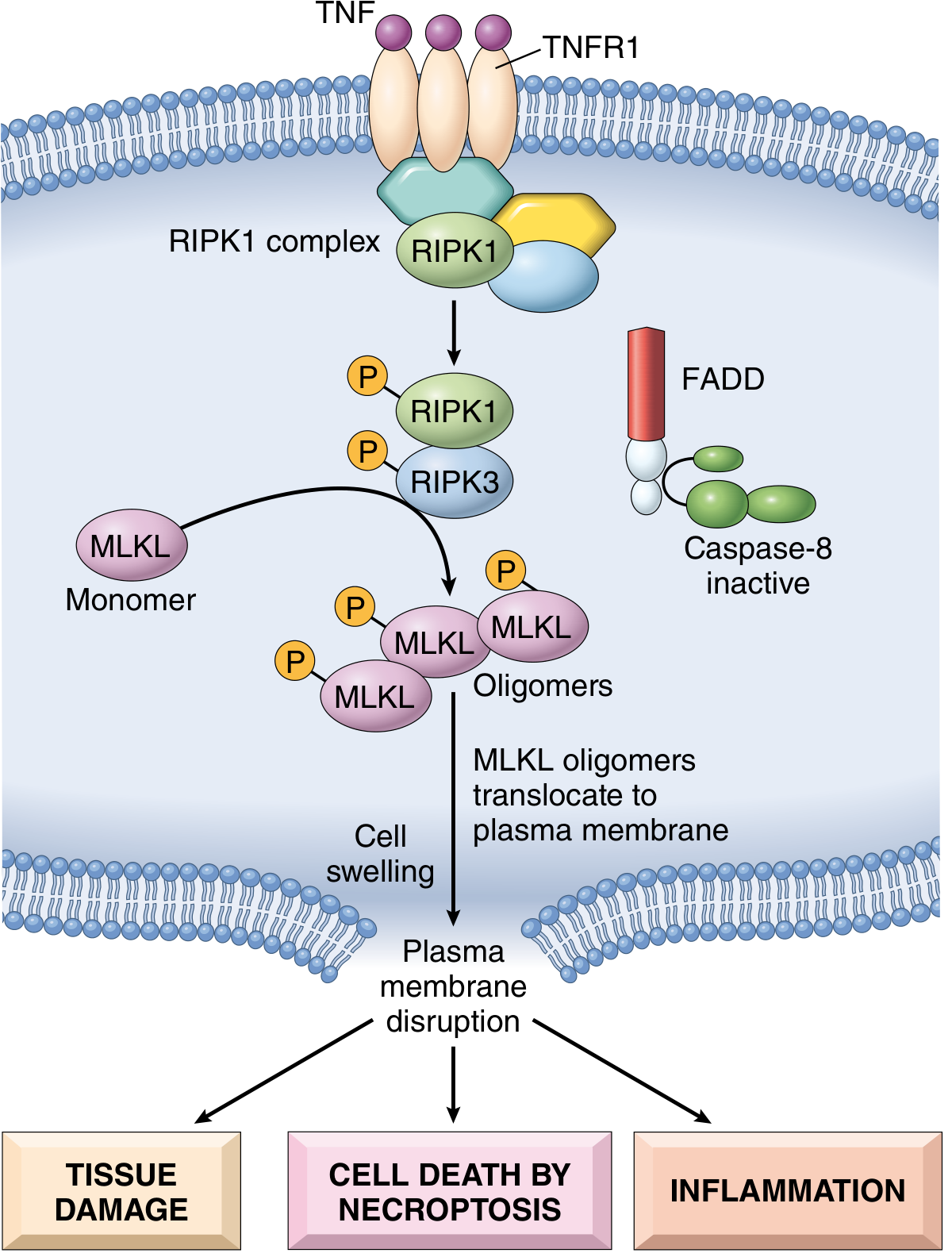
- TNFR1 is ligated by TNF (trimerized TNF binds to trimerized receptor)
- Ligation recruits RIPK1 (Receptor-Interacting Protein Kinase 1) into a multiprotein complex at the intracellular death domain of TNFR1
- RIPK1 is phosphorylated (auto- and trans-phosphorylation)
- Phosphorylated RIPK1 recruits and activates RIPK3 (Receptor-Interacting Protein Kinase 3)
- RIPK1 and RIPK3 form the necrosome - a multiprotein signalling complex
Note: RIPK1 is not always required - in some TLR3/4 and viral RNA-triggered necroptosis, RIPK3 can be activated independently of RIPK1.
Step 3: MLKL Phosphorylation (The Executioner Step)
- Within the necrosome, RIPK3 phosphorylates MLKL (Mixed Lineage Kinase domain-Like protein) at key serine/threonine residues
- Phosphorylated MLKL undergoes a conformational change
- MLKL monomers assemble into oligomers (homo-oligomerization)
- MLKL oligomers translocate from the cytosol to the plasma membrane
- MLKL functions as an endogenous porin - it inserts into and disrupts the plasma membrane
Step 4: Plasma Membrane Disruption and Cell Death
- Plasma membrane rupture leads to cell swelling (oncosis) - microscopically visible as a "balloon-like structure"
- Cytoplasmic contents are released into the extracellular space
- This release includes DAMPs (Damage-Associated Molecular Patterns) - endogenous danger signals
- Result: Cell death + sterile inflammation
Why Does Necroptosis Occur? (Caspase-8 as the Switch)
- Caspase-8 ACTIVE → cleaves RIPK1 and RIPK3 → necrosome cannot form → apoptosis proceeds
- Caspase-8 INACTIVE (e.g., viral inhibitors, pharmacological blockade) → RIPK1/RIPK3 remain intact → necroptosis proceeds
Downstream Consequences
- Tissue damage - local destruction
- Inflammation - DAMP-mediated recruitment of innate immune cells; likely contributes to systemic inflammatory response
- Release of internalized pathogens into the extracellular space where complement and neutrophils can destroy them
ROS and Metabolic Collapse
- Over-generation of reactive oxygen species (ROS)
- Metabolic collapse (ATP depletion)
Inhibitors
- Necrostatin-1: a specific RIPK1 inhibitor - the key research tool to confirm necroptosis is occurring
- RIPK3 knockout / MLKL knockout mice are used experimentally to study necroptosis
Physiological and Pathological Roles
| Context | Role |
|---|---|
| Bone growth plate formation | Physiological necroptosis drives terminal differentiation |
| Viral infection (e.g., CMV) | Backup killing when viruses inhibit caspases |
| Ischemia-reperfusion injury (brain, kidney, liver) | Pathological RIPK3/MLKL activation |
| Steatohepatitis | Contributes to hepatocyte death |
| Acute pancreatitis | Cell death mechanism |
| Neurodegenerative diseases (Parkinson's) | Chronic neuronal death |
| Cancer | Potential target when apoptosis resistance develops |
Key Summary (Robbins & Cotran)
"Necroptosis resembles necrosis morphologically, but like apoptosis is a genetically controlled form of cell death. Necroptosis is triggered by ligation of TNFR1 and by proteins found in RNA and DNA viruses. Necroptosis is caspase independent and depends on the RIPK1-RIPK3 complex. RIPK1-RIPK3 signaling leads to the phosphorylation of MLKL, which then forms pores in the plasma membrane. Release of cellular contents evokes an inflammatory reaction as in necrosis."
- Robbins, Cotran & Kumar - Pathologic Basis of Disease, p. 61
- Medical Physiology (Boron & Boulpaep)
- Scott-Brown's Otorhinolaryngology, Head & Neck Surgery Vol. 1
Can you tell me about the program of complex one and complex two formed in, uh, in the microcosmos? And also, what is the difference between a hikotozoon and necro- necrozoan?
When you say 'Complex I and Complex II formed in the necrosome' - do you mean the protein complexes formed during necroptosis signalling (e.g. TNFR1-associated Complex I and Complex II that decide between survival, apoptosis, and necroptosis)? · For 'hikotozoon vs necrozoan' - these terms are not standard medical/biology terms I recognise. Could you clarify what you mean?
Give whole necroptosis pathway n what it is according to cell signallingCan you tell me about the program of complex one and complex two formed in, uh, in the microcosmos? And also, what is the difference between a ripotosome n and necro- necrosome
- Complex I and Complex II formed at the TNFR1 receptor (the signalling complexes in necroptosis/apoptosis decision)
- Difference between Ripoptosome and Necrosome
TNFR1 Complex I Complex II necrosome ripoptosome necroptosis pathway cell signalling
https://www.abcam.com/en-us/technical-resources/guides/cell-…
Necroptosis Pathway: Complex I, Complex II, Ripoptosome vs Necrosome
The Big Picture - Three Sequential Complexes
TNF + TNFR1
      ↓
  COMPLEX I  (membrane-bound, pro-survival)
      ↓  (RIPK1 deubiquitination → RIPK1 released)
  COMPLEX IIa / RIPOPTOSOME  (cytosolic, pro-apoptotic)
      ↓  (if caspase-8 is blocked)
  COMPLEX IIb / NECROSOME  (cytosolic, pro-necroptotic)
      ↓
   CELL DEATH by NECROPTOSIS
COMPLEX I - The Pro-Survival Complex (Membrane-Bound)
| Protein | Role |
|---|---|
| TRADD | Adaptor protein; first recruited to TNFR1 death domain |
| RIPK1 | Kinase; key scaffold protein |
| TRAF2 / TRAF5 | Ubiquitin E3 ligases |
| cIAP1 / cIAP2 | Cellular inhibitor of apoptosis proteins; E3 ligases |
| LUBAC (HOIL + HOIP) | Linear ubiquitin chain assembly complex |
| TAK1 complex | MAP kinase kinase kinase |
| IKK complex (IKK1, IKK2, NEMO) | IκB kinase complex |
- TNF trimerizes and binds TNFR1
- TNFR1 trimerizes; cytoplasmic death domain exposed
- TRADD is recruited to the death domain
- TRADD recruits RIPK1
- TRAF2/cIAP1/cIAP2 and LUBAC polyubiquitinate RIPK1 (K63-linked and linear ubiquitin chains)
- Polyubiquitinated RIPK1 serves as a scaffold to recruit TAK1 complex and IKK complex
- IKK complex phosphorylates IκB → IκB degraded → NF-κB released and activated
- NF-κB drives expression of pro-survival and pro-inflammatory genes
Key regulatory check: A20 and CYLD are deubiquitinases that remove ubiquitin chains from RIPK1, thereby attenuating Complex I signalling. CYLD-mediated deubiquitination of RIPK1 is the critical switch that allows RIPK1 to dissociate from the membrane and form Complex II.
The Switch: RIPK1 Deubiquitination
- RIPK1 becomes deubiquitinated (by CYLD or A20)
- Deubiquitinated RIPK1 dissociates from the membrane complex
- RIPK1 moves into the cytosol and recruits FADD + Caspase-8
- This forms Complex II - the death complex
COMPLEX IIa / RIPOPTOSOME - The Pro-Apoptotic Complex
| Protein | Role |
|---|---|
| RIPK1 | Scaffold/kinase |
| FADD | Adaptor with death effector domain (DED) |
| Caspase-8 (pro-caspase-8) | Initiator caspase |
| cFLIP | Regulatory protein (can promote or inhibit) |
- Caspase-8 is ACTIVE → caspase-8 cleaves and inactivates RIPK1 and RIPK3 → classical apoptosis proceeds via caspase cascade
- Caspase-8 is INACTIVE (viral inhibitor, pharmacological blockade, genetic deletion) → RIPK1 and RIPK3 remain intact → complex matures into the Necrosome
The ripoptosome is essentially Complex IIa+b together - it is the cytosolic platform from which either apoptosis OR necroptosis can be executed.
COMPLEX IIb / NECROSOME - The Pro-Necroptotic Complex
| Protein | Role |
|---|---|
| RIPK1 | Kinase; recruits RIPK3 via RHIM domain |
| RIPK3 | Executioner kinase; phosphorylates MLKL |
| MLKL | Final effector; pore-forming protein |
- RIPK1 recruits RIPK3 via RHIM-RHIM interaction
- RIPK1 and RIPK3 undergo mutual (reciprocal) phosphorylation
- RIPK3 oligomerizes (necessary for full activation)
- Activated RIPK3 phosphorylates MLKL at:
- Threonine 357
- Serine 358
- Phospho-MLKL undergoes conformational change
- MLKL monomers homo-oligomerize
- MLKL oligomers translocate to the plasma membrane
- MLKL binds phosphatidylinositol lipids and cardiolipin → directly permeabilizes the membrane
- Plasma membrane rupture → cell swelling (oncosis) → lytic cell death
Ripoptosome vs Necrosome - Clear Comparison
| Feature | Ripoptosome | Necrosome |
|---|---|---|
| Also called | Complex II / Complex IIa | Complex IIb |
| Location | Cytosolic | Cytosolic |
| Key components | RIPK1 + FADD + Caspase-8 (± cFLIP) | RIPK1 + RIPK3 + MLKL |
| How it forms | RIPK1 deubiquitinated → leaves Complex I → recruits FADD + Casp-8 | Ripoptosome matures when Caspase-8 is blocked |
| Caspase-8 status | Caspase-8 present (active) | Caspase-8 absent or inactive |
| RIPK1 fate | Cleaved and inactivated by Casp-8 | Intact; phosphorylates RIPK3 via RHIM |
| Outcome | APOPTOSIS | NECROPTOSIS |
| Inhibitor | z-VAD (caspase inhibitor blocks apoptosis) | Necrostatin-1 (RIPK1 inhibitor) |
| Inflammation | Minimal (clean death) | Massive (DAMPs released) |
| Key interaction | Death domain / DED interaction | RHIM-RHIM interaction between RIPK1 and RIPK3 |
Death-Receptor-Independent Necroptosis (RIPK1-independent routes)
- TLR3 (dsRNA) → TRIF adaptor → TRIF has RHIM domain → directly activates RIPK3
- TLR4 (LPS) → TRIF → RIPK3
- ZBP1 (viral Z-RNA sensor) → RHIM domain → activates RIPK3 directly
- Interferons (IFN type I and II) → upregulate MLKL and RIPK3 expression
Summary Flowchart
TNF
 │
 ▼
TNFR1 (membrane)
 │
 ▼
COMPLEX I: TRADD–RIPK1–TRAF2–cIAP1/2–LUBAC
 │   (RIPK1 polyubiquitinated → NF-κB → SURVIVAL)
 │
 │ [CYLD/A20 deubiquitinate RIPK1 → RIPK1 leaves membrane]
 ▼
RIPOPTOSOME (cytosol): RIPK1–FADD–Caspase-8
 │
 ├──[Caspase-8 ACTIVE]──► Caspase-8 cleaves RIPK1 & RIPK3
 │                              ↓
 │                          APOPTOSIS
 │
 └──[Caspase-8 INACTIVE]──► RIPK1 intact → recruits RIPK3 via RHIM
                                  ↓
                           NECROSOME: RIPK1–RIPK3 (mutual phosphorylation)
                                  ↓
                           RIPK3 phosphorylates MLKL (T357/S358)
                                  ↓
                           MLKL oligomerizes → translocates to membrane
                                  ↓
                           Plasma membrane DISRUPTION
                                  ↓
                    TISSUE DAMAGE + CELL DEATH + INFLAMMATION
Can you tell me about the everything about what is the autophagy and its sites and then the new station in the station along with it and all the, uh, factory according to sensitive knowledge about auto factory?
Your message had some unclear voice-to-text terms. Which of these best matches what you meant? · Which source should I focus on?
Tell me about autophagy according to cell signalling what it is , types n pre initiation,initiation elongation all the signalling steps
Autophagy - Complete Cell Signalling Guide
What is Autophagy?
- A survival mechanism during nutrient deprivation (cells cannibalize themselves to survive)
- A quality control system - removing damaged organelles, misfolded proteins, protein aggregates
- A defense mechanism - degrading intracellular pathogens (xenophagy)
- A developmental signal (essential for embryogenesis)
- At extremes, a form of programmed (Type II) cell death
~33 autophagy-related genes (Atg genes) have been identified in mammalian cells that coordinate this process.
The Three Types of Autophagy
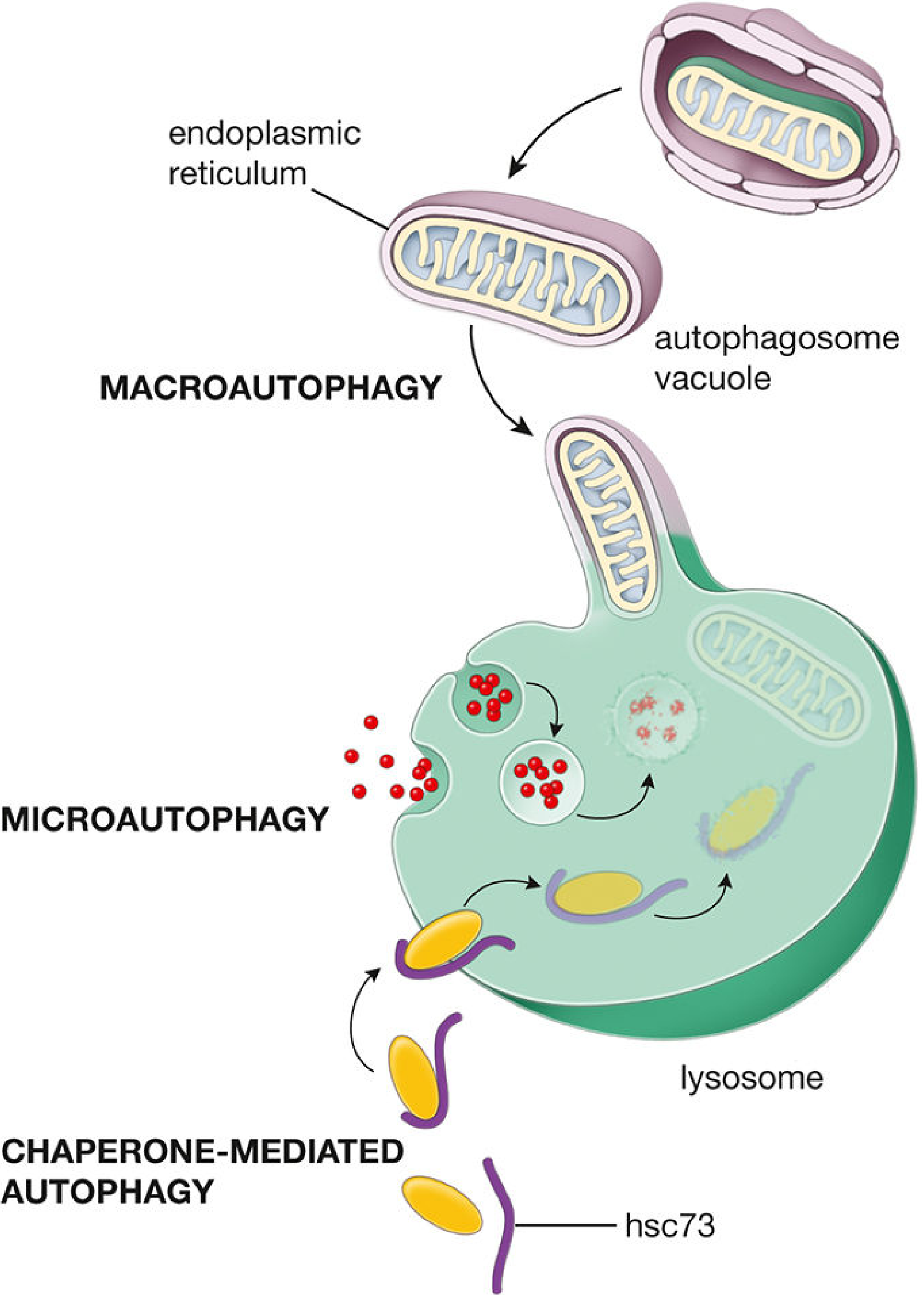
1. Macroautophagy (= "Autophagy" when used alone)
- The major, most studied pathway
- Non-selective (in general; though selective subtypes exist)
- A double-membraned isolation membrane (phagophore) forms from the ER (and contributions from plasma membrane, mitochondria, Golgi)
- The phagophore wraps around and sequesters a portion of cytoplasm or entire organelle
- Seals to form an autophagosome (double-membrane vesicle)
- Autophagosome fuses with lysosome → autolysosome
- Contents are degraded by lysosomal hydrolases
- Products (amino acids, fatty acids, nucleotides) are recycled
2. Microautophagy
- Non-selective, slow, continuous process
- Occurs under normal physiologic conditions
- Cytoplasmic proteins are internalized directly into lysosomes by invagination of the lysosomal membrane
- No autophagosome formed
3. Chaperone-Mediated Autophagy (CMA)
- The only selective form of autophagy
- Activated during nutrient deprivation
- Requires a targeting signal (KFERQ-like pentapeptide motif) on the substrate protein
- hsc70 (heat shock cognate chaperone protein) recognizes and binds the targeting signal
- hsc70 escorts the protein to the lysosomal membrane receptor LAMP-2A
- Protein is unfolded and transported directly through the lysosomal membrane into the lumen
- Responsible for degradation of ~30% of cytoplasmic proteins in liver and kidney
Upstream Signalling: What Turns Autophagy ON and OFF?
The Master Regulator: mTOR (Mammalian Target of Rapamycin)
| Condition | mTOR Activity | Autophagy |
|---|---|---|
| Nutrients plentiful, growth factors present | HIGH | OFF (inhibited) |
| Nutrient starvation, hypoxia, high temp | LOW | ON (activated) |
| Rapamycin treatment | Inhibited | Activated |
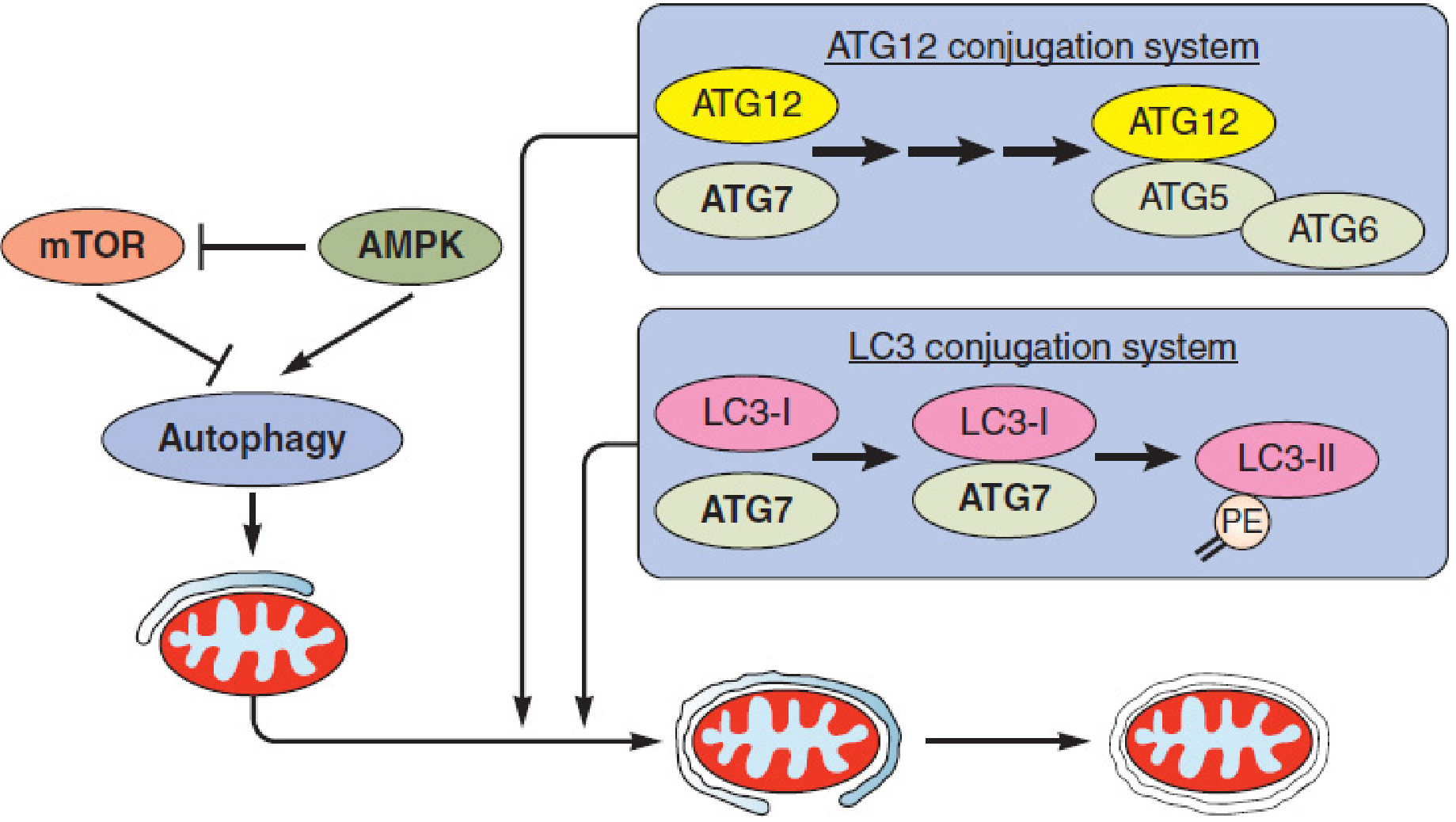
- When nutrients and growth factors are sufficient → PI3K/Akt → mTORC1 activation → mTOR phosphorylates and inhibits ULK1 → autophagy suppressed
- mTOR also inhibits autophagy by phosphorylating Atg13 (prevents it from associating with ULK1)
AMPK - The Energy Sensor
- Senses elevated AMP:ATP ratio (low energy state)
- AMPK inhibits mTOR (by activating TSC1/TSC2 complex and by directly phosphorylating Raptor)
- AMPK also directly activates ULK1 (phosphorylates Ser317 and Ser777)
- So: Low energy → AMPK active → mTOR inhibited → Autophagy ON
Other Inducers
- Hypoxia (HIF-1 independent pathways)
- Oxidative stress (ROS)
- ER stress (unfolded protein response)
- DNA damage (p53-dependent)
- PAMPs (LPS via TLR4-TRIF-RIP1-p38 MAPK pathway)
- DAMPs (HMGB1)
- Starvation / growth factor withdrawal
The Step-by-Step Autophagy Signalling Pathway (Macroautophagy)
STEP 1: PRE-INITIATION SIGNALLING (Upstream)
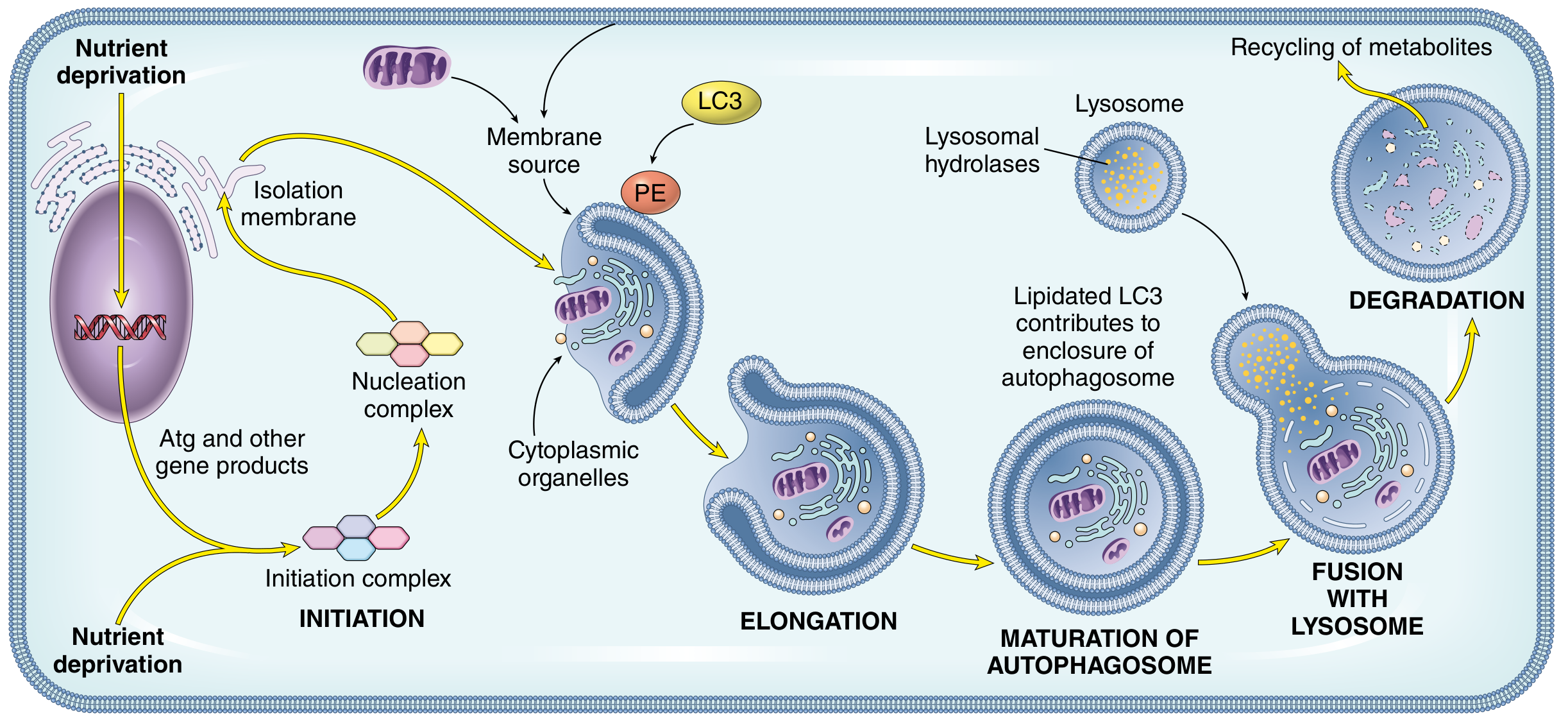
Nutrient deprivation / Stress
        ↓
  mTOR INHIBITED
  AMPK ACTIVATED
        ↓
  ULK1/2 kinase activated
- ULK1 / ULK2 (Unc-51-like kinase) = mammalian homologue of yeast Atg1
- Normally suppressed by mTOR-mediated phosphorylation
- When mTOR is inhibited → ULK1/2 becomes active → triggers downstream Atg cascade
STEP 2: INITIATION - ULK1 Complex Assembly
- ULK1/ULK2 (kinase)
- ATG13 (adaptor; when dephosphorylated, tightly binds ULK1 → enhances kinase activity)
- FIP200 (focal adhesion kinase family-interacting protein 200 kDa)
- ATG101
STEP 3: NUCLEATION - PI3K Complex & Phagophore Formation
- VPS34 (Class III phosphatidylinositol 3-kinase) - generates PI3P (phosphatidylinositol 3-phosphate)
- Beclin-1 (ATG6) - key regulatory scaffold; mammalian homologue of yeast Atg6
- ATG14L (targets complex to ER)
- VPS15 (regulatory subunit of VPS34)
- PI3P on the phagophore membrane recruits WIPI proteins and ATG2
- These recruit more Atg proteins to expand the isolation membrane
- A cup-shaped isolation membrane (phagophore) forms, initially from the ER
Beclin-1 regulation: Beclin-1 is normally held in check by Bcl-2 (antiapoptotic protein). When Bcl-2 binds Beclin-1, autophagy is suppressed. Under stress, Bcl-2 releases Beclin-1, freeing it to form the PI3K complex → autophagy is activated. This is a key cross-talk point between autophagy and apoptosis.
STEP 4: ELONGATION - Two Ubiquitin-Like Conjugation Systems
Conjugation System 1: ATG12 System
ATG12 + ATG7 (E1-like) → ATG12~ATG7
ATG12~ATG7 + ATG10 (E2-like) → ATG12~ATG10
ATG12 covalently conjugated to ATG5
ATG12–ATG5 complex + ATG16L1 → ATG12–ATG5–ATG16L1 trimeric complex
Conjugation System 2: LC3 (ATG8) System
LC3-I (cytosolic, full-length)
        ↓ ATG4 (cysteine protease cleaves C-terminus)
LC3-I (processed, cytosolic)
        ↓ ATG7 (E1-like activation)
LC3-I~ATG7
        ↓ ATG3 (E2-like)
LC3-I + PE (phosphatidylethanolamine)  [catalyzed by ATG12-ATG5-ATG16L1 as E3]
        ↓
LC3-II (PE-lipidated LC3; membrane-bound)
- LC3-I = cytosolic, soluble form
- LC3-II = lipidated (PE-conjugated) form that inserts into both the inner and outer membrane of the growing phagophore
- LC3-II on the inner membrane is responsible for cargo capture (selective autophagy via cargo receptors like p62/SQSTM1)
- LC3-II on the outer membrane drives membrane curvature and closure
- LC3-II levels are the most widely used marker of autophagy - increased LC3-II = autophagy occurring
The two systems work in concert: ATG12-ATG5 facilitates LC3 lipidation; both complexes together drive membrane elongation and curvature.
STEP 5: MATURATION & CLOSURE
- The elongating phagophore membrane bends and seals around the cargo
- ATG12-ATG5-ATG16L1 complex dissociates from the outer membrane
- LC3-II remains on both membranes of the completed autophagosome
- Result: a double-membraned autophagosome enclosing cytoplasmic material
STEP 6: FUSION WITH LYSOSOME
- Autophagosome traffics along microtubules (dynein-dependent) toward the perinuclear region
- Fuses with a late endosome or lysosome
- Fusion requires LAMP-1, LAMP-2 (lysosomal membrane proteins), Rab7, and SNAREs
- Forms the autolysosome (autophagolysosome)
- The inner membrane and enclosed cargo are degraded by lysosomal acid hydrolases
- LC3-II on the inner membrane is degraded
- LC3-II on the outer membrane is recycled back to LC3-I by ATG4
STEP 7: DEGRADATION & RECYCLING
- Macromolecules broken down to:
- Amino acids → protein synthesis
- Fatty acids → energy via β-oxidation
- Nucleotides → nucleic acid synthesis
- Products exported from the lysosome via permeases and transporters
- Recycled metabolites support cell survival during stress
Complete Signalling Summary Table
| Step | Molecules | Function |
|---|---|---|
| Pre-initiation | mTOR (inhibitor), AMPK (activator) | Sense nutrient/energy status |
| Initiation | ULK1/2 + ATG13 + FIP200 + ATG101 | Activate Atg cascade; translocate to ER |
| Nucleation | VPS34 + Beclin-1 + ATG14L + VPS15 | Generate PI3P; nucleate phagophore |
| Elongation (System 1) | ATG12–ATG5–ATG16L1 | Scaffold; E3 ligase activity; outer membrane |
| Elongation (System 2) | LC3-I → LC3-II (via ATG7, ATG3, PE) | Membrane curvature, closure, cargo selection |
| Cargo capture | p62/SQSTM1, NBR1 (cargo receptors) | Link ubiquitinated cargo to LC3-II |
| Maturation | Rab7, LAMP-1/2, SNAREs | Autophagosome → lysosome fusion |
| Degradation | Lysosomal hydrolases | Break down cargo |
| Recycling | Nutrient exporters | Export metabolites for reuse |
Selective Autophagy Subtypes
| Subtype | Cargo | Receptor |
|---|---|---|
| Mitophagy | Damaged mitochondria | PINK1/Parkin pathway; NIX |
| Xenophagy | Intracellular bacteria/viruses | NDP52, p62, optineurin |
| Lipophagy | Lipid droplets | - |
| Aggrephagy | Protein aggregates | p62/SQSTM1 |
| Ribophagy | Ribosomes | - |
| Pexophagy | Peroxisomes | - |
Disease Associations
| Disease | Autophagy Defect |
|---|---|
| Alzheimer disease | Impaired autophagosome maturation; accelerated neurodegeneration with Atg knockouts |
| Huntington disease | Mutant huntingtin impairs autophagy |
| Crohn's disease / IBD | SNPs in ATG16L1 gene |
| Cancer | Dual role: tumor suppression early (removes damaged organelles); tumor promotion late (supplies nutrients to hypoxic tumors) |
| Tuberculosis | Macrophage Atg5 knockout → increased TB susceptibility |
| Ischemia-reperfusion | Autophagy is protective; impaired flux worsens injury |