
generate most important mcqs only...for batterjee medical college and generate image to explain each MCQ in end generate most useful tips for each lecture and top 10 must knows
cd /home/daytona/workspace/attachments/1ff94ee1-1c18-4fab-ae67-3a39969ba9db && python3 -c " import pdfplumber, os files = [ 'Anatomy Of LARYNX (PART I) 2025-2026.pdf', 'Anatomy Of LARYNX (PART II) 2025-2026.pdf', 'Anatomy Of LUNG 2025-2026.pdf', 'Anatomy Of Mediastinum -Part I- 2025-2026.pdf', 'Anatomy Of Mediastinum -Part II- 2025-2026.pdf', ] for fname in files: print(f'\n\n===== {fname} =====') with pdfplumber.open(fname) as pdf: for i, page in enumerate(pdf.pages[:8]): text = page.extract_text() if text: print(f'-- Page {i+1} --') print(text[:2000]) "
cd /home/daytona/workspace/attachments/1ff94ee1-1c18-4fab-ae67-3a39969ba9db && python3 -c " import pdfplumber files = [ 'Anatomy Of LARYNX (PART I) 2025-2026.pdf', 'Anatomy Of LARYNX (PART II) 2025-2026.pdf', 'Anatomy Of LUNG 2025-2026.pdf', 'Anatomy Of Mediastinum -Part I- 2025-2026.pdf', 'Anatomy Of Mediastinum -Part II- 2025-2026.pdf', ] for fname in files: print(f'\n\n===== {fname} =====') with pdfplumber.open(fname) as pdf: total = len(pdf.pages) print(f'Total pages: {total}') for i, page in enumerate(pdf.pages[8:]): text = page.extract_text() if text: print(f'-- Page {i+9} --') print(text[:1500]) "
Detailed anatomical diagram of larynx cartilages labeled: thyroid cartilage with Adam's apple, cricoid cartilage signet-ring shape at C6, epiglottis leaf-shaped, arytenoid cartilages with vocal process and muscular process, corniculate and cuneiform cartilages. Show anterior and posterior views. Medical textbook style.
Anatomical diagram of laryngeal muscles showing: posterior cricoarytenoid (only abductor of vocal cords), lateral cricoarytenoid, transverse arytenoid, oblique arytenoid, cricothyroid muscle (fan-shaped on outer surface), thyroarytenoid and vocalis muscles. Label nerve supply: recurrent laryngeal nerve to all except cricothyroid which is supplied by external laryngeal nerve. Medical education style.
Anatomical diagram comparing right and left lungs: right lung with 3 lobes (upper, middle, lower) and 2 fissures (horizontal and oblique); left lung with 2 lobes (upper, lower) and 1 oblique fissure, cardiac notch and lingula labeled. Show hilum structures: bronchus most posterior, superior pulmonary vein most anterior, inferior pulmonary vein most inferior, pulmonary artery most superior on left. Medical textbook style.
Medical diagram of mediastinum divisions: superior mediastinum above sternal angle to T4 plane, inferior divided into anterior (in front of pericardium), middle (heart and pericardium), and posterior (behind pericardium). Label contents: superior has trachea, esophagus, arch of aorta, SVC, thymus; posterior has descending aorta, esophagus, thoracic duct, azygos system. Cross-sectional and lateral views. Educational anatomy style.
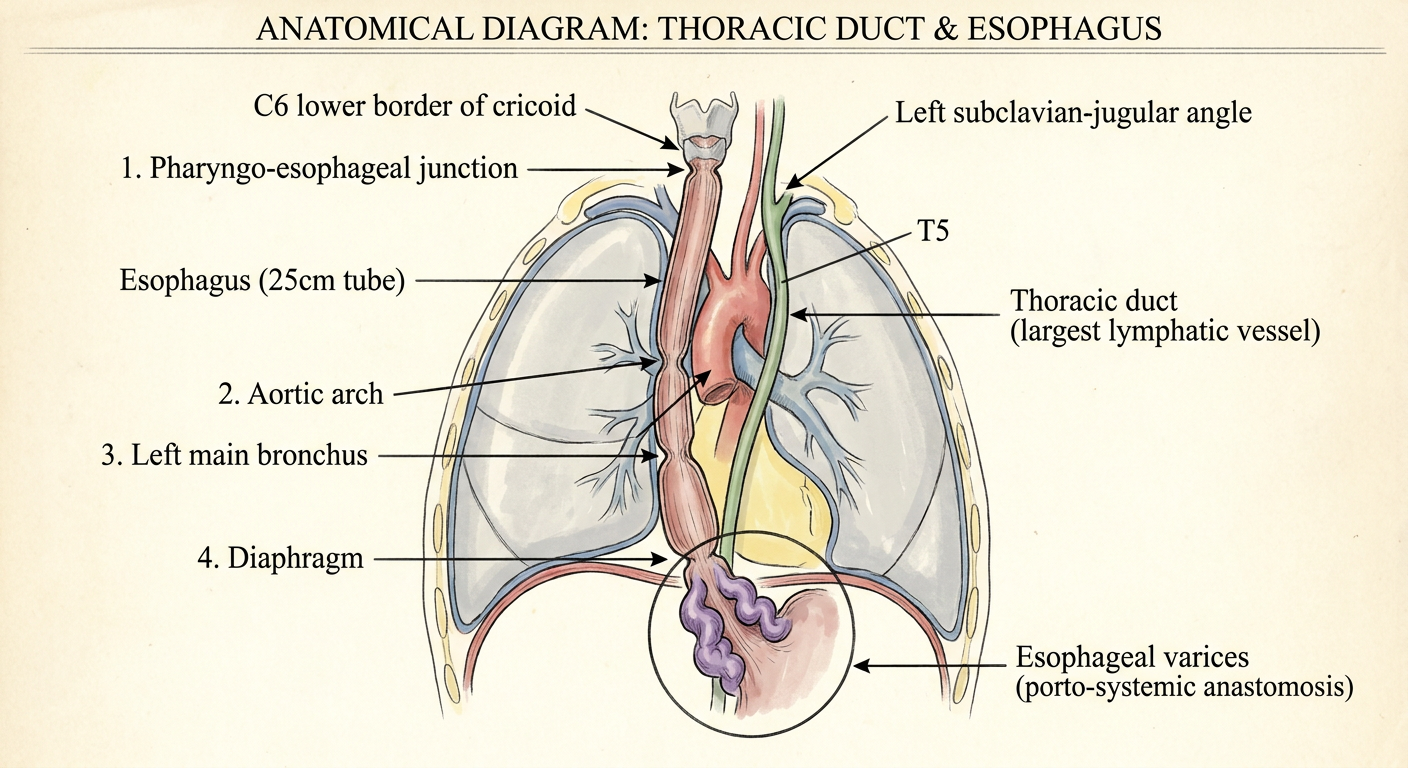
Anatomical diagram of thoracic duct and esophagus: esophagus 25cm tube starting at C6 lower border of cricoid, 4 constrictions labeled (pharyngo-esophageal junction, aortic arch, left main bronchus, diaphragm). Thoracic duct as largest lymphatic vessel crossing from right to left at T5, ending at left subclavian-jugular angle. Esophageal varices at lower end porto-systemic anastomosis highlighted. Medical textbook style.
🏥 BMC Anatomy — MCQ Study Package 2025–2026
Larynx I & II | Lung | Mediastinum I & II
📚 LECTURE 1: Anatomy of Larynx — Part I
🖼️ Visual Reference
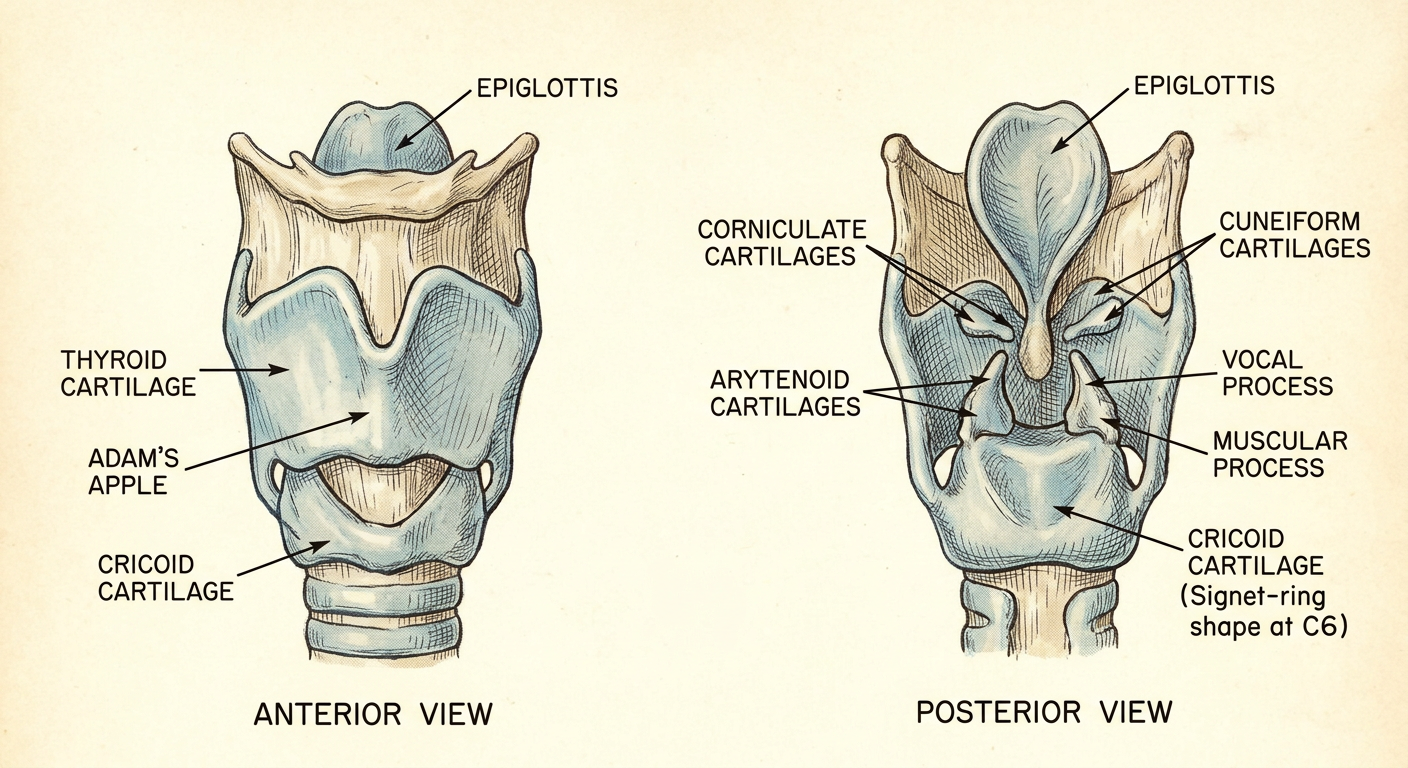
✅ Top MCQs
- A) C2–C4
- B) C4–C6 ✓
- C) C6–T1
- D) T1–T3
Explanation: The larynx is in the midline of the neck at C4–C6, suspended from the hyoid above and attached to the trachea below.
- A) 120°
- B) 150°
- C) 90° ✓
- D) 60°
Explanation: In males the angle is 90° (more acute), making Adam's apple more prominent. In females it is 120°.
- A) Thyroid cartilage
- B) Epiglottis
- C) Cricoid cartilage ✓
- D) Arytenoid cartilage
Explanation: The cricoid is the only complete cartilaginous ring in the airway. It has a quadrate lamina posteriorly and a narrow arch anteriorly.
- A) Hyoepiglottic ligament
- B) Cricothyroid membrane
- C) Thyroepiglottic ligament ✓
- D) Quadrangular membrane
Explanation: The thyroepiglottic ligament connects the tapering lower end (stalk) of the epiglottis to the inner surface of the thyroid cartilage. The hyoepiglottic ligament connects the anterior surface of the epiglottis to the hyoid bone.
- A) External laryngeal nerve and inferior laryngeal artery
- B) Internal laryngeal nerve and superior laryngeal vessels ✓
- C) Recurrent laryngeal nerve and superior laryngeal artery
- D) Vagus nerve and inferior thyroid artery
Explanation: The internal laryngeal nerve (sensory above vocal cords) and superior laryngeal artery and vein pierce the thyrohyoid membrane to enter the larynx.
- A) Lower free margin of the quadrangular membrane
- B) Upper free border of the cricothyroid membrane (conus elasticus) ✓
- C) Aryepiglottic fold
- D) Vestibular fold
Explanation: The true vocal cord = upper free border of the lateral part of the cricothyroid membrane, running from the thyroid angle to the vocal process of the arytenoid. The false (vestibular) cord = lower free margin of the quadrangular membrane.
- A) The space between the vestibular folds
- B) The space between the vestibular fold and vocal fold
- C) The narrowest part of the laryngeal cavity ✓
- D) The saccule of the larynx
Explanation: Rima glottidis is divided into an inter-membranous part (between the two vocal cords) and an inter-cartilaginous part (between the two arytenoids).
- A) Lengthening and shortening
- B) Abduction and adduction ✓
- C) Tensing and relaxing
- D) Closure of laryngeal inlet
Explanation: The cricothyroid joint (plane synovial) allows forward/backward tilting of the thyroid → tensing/relaxing cords. The cricoarytenoid joint (plane synovial) allows gliding/rotation of arytenoids → abduction/adduction of cords.
- A) Vocalis and thyroarytenoid muscles
- B) Lateral cricoarytenoid and posterior cricoarytenoid
- C) Aryepiglottic muscle, corniculate and cuneiform cartilages ✓
- D) Quadrangular membrane only
- A) Elastic recoil of the epiglottis
- B) Contraction of aryepiglottic, transverse and oblique arytenoid muscles ✓
- C) Action of posterior cricoarytenoid only
- D) Contraction of cricothyroid muscle
💡 Top 10 Must-Knows — Larynx Part I
- Level: Larynx at C4–C6; cricoid at C6
- Thyroid angle: 90° in men (prominent Adam's apple), 120° in women
- Cricoid = only complete ring in the entire airway
- True vocal cord = upper free border of cricothyroid membrane (conus elasticus)
- False (vestibular) cord = lower free border of quadrangular membrane
- Rima glottidis = narrowest part of laryngeal cavity
- Thyrohyoid membrane pierced by internal laryngeal nerve + superior laryngeal vessels
- Cricoarytenoid joint → abduction/adduction; Cricothyroid joint → tension of cords
- Aryepiglottic fold contains: aryepiglottic muscle + corniculate + cuneiform cartilages
- Laryngeal inlet opens by elastic recoil of epiglottis ONLY (no muscles needed to open it)
🔑 Most Useful Exam Tips — Larynx Part I
- Mnemonic for cartilages: Three Singles (Thyroid, Cricoid, Epiglottis) + Three Pairs (Arytenoid, Corniculate, Cuneiform)
- Distinguish thyroepiglottic (stalk → thyroid) vs hyoepiglottic (anterior epiglottis → hyoid)
- The sinus/ventricle of larynx = space BETWEEN vestibular fold and vocal fold
- Saccule = upward recess deep to vestibular folds (clinically important — laryngocele)
- Always link the vocal cord anatomy question to the membrane: conus elasticus = true cord
📚 LECTURE 2: Anatomy of Larynx — Part II
🖼️ Visual Reference
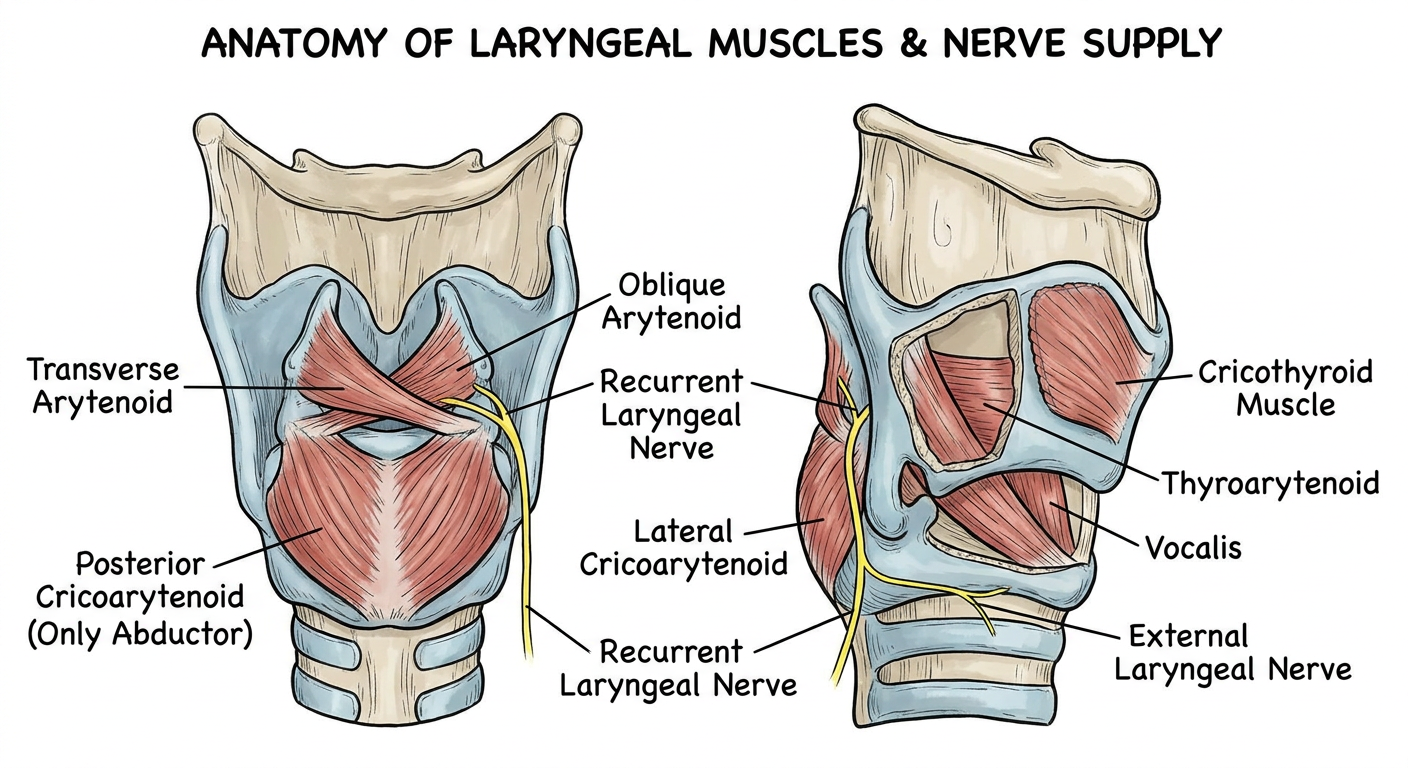
✅ Top MCQs
- A) Lateral cricoarytenoid
- B) Transverse arytenoid
- C) Posterior cricoarytenoid ✓
- D) Cricothyroid
Explanation: Posterior cricoarytenoid is the ONLY abductor (opens the glottis). It inserts into the muscular process of the arytenoid and produces posterolateral displacement. Loss of both = suffocation if partial bilateral injury.
- A) Posterior cricoarytenoid
- B) Transverse arytenoid
- C) Thyroarytenoid
- D) Cricothyroid ✓
Explanation: ALL intrinsic laryngeal muscles are supplied by the recurrent laryngeal nerve EXCEPT cricothyroid, which is supplied by the external laryngeal nerve (branch of superior laryngeal nerve from vagus).
- A) Aphonia
- B) Suffocation
- C) Low-pitched voice (loss of high-pitched voice) ✓
- D) Cadaveric position of vocal cords
Explanation: External laryngeal nerve → cricothyroid → tenses/lengthens vocal cords → responsible for high-pitched (sharp, loud) voice. Injury = loss of ability to produce high-pitched voice.
- A) Aphonia with no suffocation
- B) Low-pitched voice
- C) Adduction of vocal cords → suffocation ✓
- D) Cadaveric position of cords
Explanation: Abductor fibers lie in the OUTER part of the nerve (affected first in partial injury) → loss of abduction → cords adduct → airway obstruction → suffocation. Complete bilateral injury → cadaveric position (midway) → aphonia but NO suffocation.
- A) External laryngeal nerve
- B) Recurrent laryngeal nerve
- C) Internal laryngeal nerve ✓
- D) Vagus nerve directly
Explanation: Internal laryngeal nerve = sensory above vocal cords. Recurrent laryngeal nerve = sensory below vocal cords AND motor to all intrinsic muscles except cricothyroid.
- A) Inferior laryngeal artery (from inferior thyroid artery)
- B) Superior laryngeal artery (from superior thyroid artery) ✓
- C) Cricothyroid branch
- D) Lingual artery
- A) Thyroarytenoid
- B) Posterior cricoarytenoid
- C) Vocalis
- D) Cricothyroid ✓
Explanation: Cricothyroid is fan-shaped, on the OUTER surface of the larynx. It bridges the cricoid arch and thyroid lamina → tilts thyroid forward at cricothyroid joint → lengthens and tenses vocal cords → sharp, loud, high-pitched voice.
- A) Lower deep cervical lymph nodes
- B) Pre-tracheal lymph nodes
- C) Upper deep cervical lymph nodes ✓
- D) Paratracheal lymph nodes
Explanation: Upper half (above cords) → upper deep cervical LNs. Lower half (below cords) → lower deep cervical LNs. This has clinical significance in laryngeal cancer spread.
- A) Transverse arytenoid
- B) Oblique arytenoid
- C) Subglottic laryngeal mucosa
- D) Cricothyroid muscle ✓
- E) Cricoarytenoid muscles
Explanation: The nerve along the inferior thyroid artery = recurrent laryngeal nerve. Cricothyroid is supplied by the EXTERNAL laryngeal nerve (runs with the SUPERIOR thyroid artery), so it is spared.
- A) Spastic paralysis of all intrinsic muscles
- B) Adduction of vocal cords with suffocation
- C) Normal voice with mild hoarseness
- D) Cadaveric position of vocal cords → aphonia but NO suffocation ✓
💡 Top 10 Must-Knows — Larynx Part II
- Posterior cricoarytenoid = ONLY abductor of vocal cords (the "safety muscle")
- ALL intrinsic muscles = recurrent laryngeal nerve, EXCEPT cricothyroid = external laryngeal nerve
- External laryngeal nerve injury → low-pitched voice (paralysis of cricothyroid)
- Partial bilateral RLN injury → abductors fail first → adduction → suffocation
- Complete bilateral RLN injury → cadaveric position → aphonia, NO suffocation
- Sensory: above cords = internal laryngeal nerve; below cords = recurrent laryngeal nerve
- Arterial: above cords = superior laryngeal artery; below cords = inferior laryngeal artery
- Lymphatics: above cords = upper deep cervical; below cords = lower deep cervical
- Cricothyroid runs along SUPERIOR thyroid artery; RLN runs along INFERIOR thyroid artery
- Voice production = adducted cords + forced air causing vibration at rima glottidis
🔑 Most Useful Exam Tips — Larynx Part II
- "Only abductor" = Posterior cricoarytenoid — exam loves this fact
- Partial injury affects outer fibers (abductors) first → adduction → remember "P-artial = adduction P-roblem"
- Cricothyroid is on the OUTER surface = unique; all others are inside/deep
- The external laryngeal nerve travels with superior thyroid artery — used in thyroid surgery identification
- Voice is modified by vocalis (fine relaxation) and cricothyroid (tensing/pitch control)
📚 LECTURE 3: Anatomy of Lungs
🖼️ Visual Reference
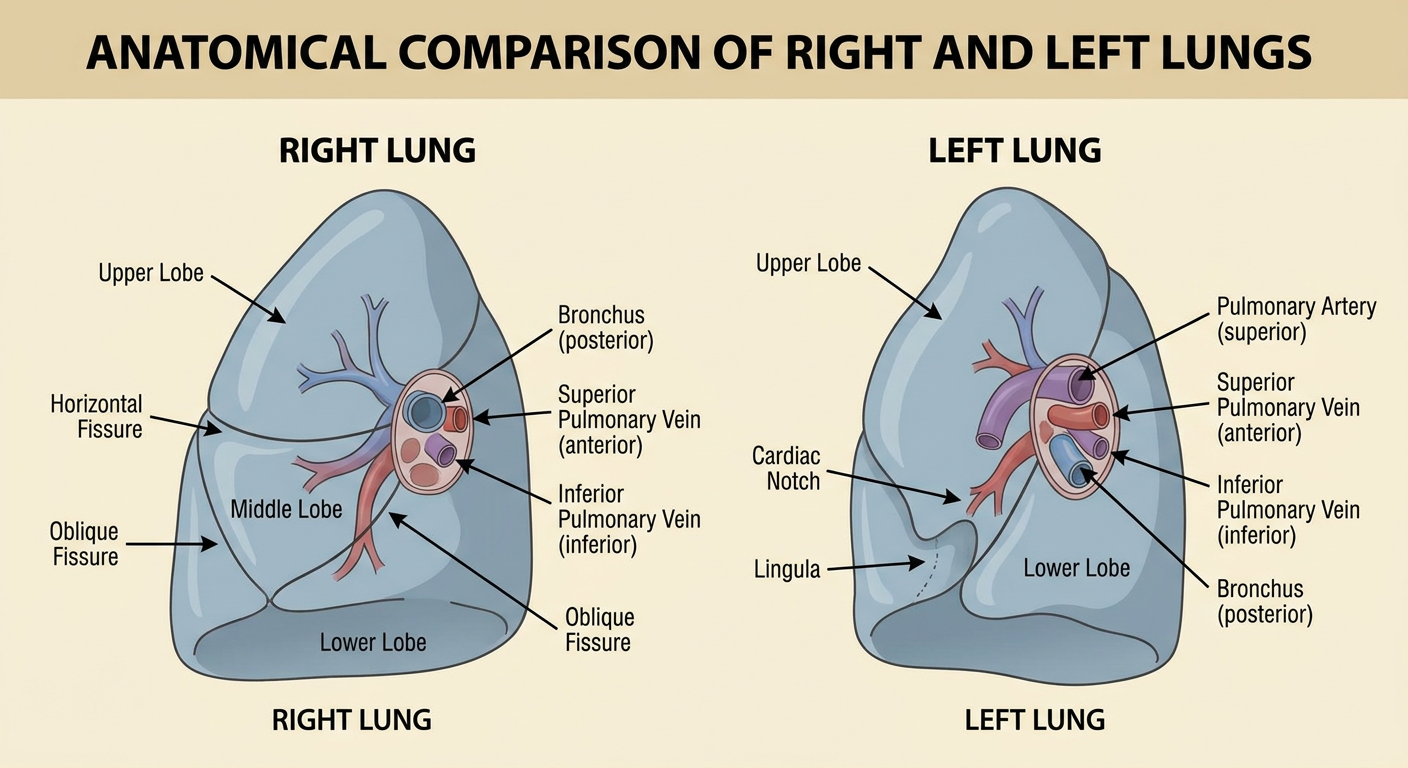
✅ Top MCQs
- A) One fissure and two lobes
- B) A cardiac notch
- C) Two fissures (horizontal + oblique) and three lobes ✓
- D) A lingula
Explanation: Right = 3 lobes (upper, middle, lower) + 2 fissures (horizontal and oblique). Left = 2 lobes (upper, lower) + 1 oblique fissure + cardiac notch + lingula.
- A) A lobe of the right lung below the cardiac notch
- B) A forward protrusion of the upper lobe of the LEFT lung below the cardiac notch ✓
- C) The middle lobe of the right lung
- D) A feature of the base of both lungs
- A) Pulmonary artery
- B) Superior pulmonary vein
- C) Inferior pulmonary vein
- D) Main bronchus ✓
Explanation: Mnemonic for hilum from anterior → posterior: Superior pulmonary vein → Pulmonary artery → Bronchus (most posterior in both lungs).
- A) Main bronchus
- B) Superior pulmonary vein
- C) Pulmonary artery
- D) Inferior pulmonary vein ✓
Explanation: The inferior pulmonary vein is the most inferior hilar structure, closest to the pulmonary ligament (double layer of pleura below the root of lung).
- A) Left ventricle
- B) Right atrium ✓
- C) Right ventricle
- D) Aorta
Explanation: Right lung mediastinal surface: pericardial impression = right atrium. Left lung: pericardial impression = left ventricle.
- A) Descending thoracic aorta directly
- B) Right subclavian artery
- C) Right 3rd posterior intercostal artery ✓
- D) Internal thoracic artery
Explanation: Right lung = ONE bronchial artery from right 3rd posterior intercostal artery. Left lung = TWO bronchial arteries (superior and inferior) from descending thoracic aorta directly.
- A) Thoracic aorta → right subclavian → right internal thoracic → right bronchial artery
- B) Thoracic aorta → pulmonary trunk → right pulmonary → bronchial artery
- C) Thoracic aorta → right posterior intercostal artery → right bronchial artery ✓
- D) Thoracic aorta → right pulmonary artery → bronchial artery
- A) Left brachiocephalic vein
- B) Azygos vein ✓
- C) SVC
- D) Pulmonary veins
Explanation: Right bronchial vein → azygos vein. Left bronchial veins → accessory (superior) hemiazygos vein.
- A) Right lung
- B) Left lung ✓
- C) Both lungs
- D) Neither
Explanation: Left lung mediastinal surface has: arch of aorta groove, descending thoracic aorta, left subclavian artery, left common carotid artery. Right lung has: SVC groove, IVC groove, azygos arch groove.
- A) They contain amniotic fluid
- B) They are made of cartilage
- C) They contain no air (not yet breathed) ✓
- D) They have a higher fat content
Explanation: Fetal lungs never expanded with air → solid → sink. Normal adult lung = spongy (full of air) → floats. This is used in medico-legal autopsies (hydrostatic test).
💡 Top 10 Must-Knows — Lung
- Right lung: 3 lobes, 2 fissures (horizontal + oblique); Left lung: 2 lobes, 1 oblique fissure
- Left lung unique features: cardiac notch + lingula (from upper lobe)
- Hilum order A→P: Superior pulmonary vein → Pulmonary artery → Bronchus (most posterior)
- Most inferior hilum structure = inferior pulmonary vein (nearest to pulmonary ligament)
- Most superior hilum of LEFT lung = pulmonary artery
- Right lung bronchial artery = from right 3rd posterior intercostal artery
- Left lung bronchial arteries (×2) = from descending thoracic aorta directly
- Right bronchial vein → azygos; Left → accessory hemiazygos
- Right pericardial impression = right atrium; Left = left ventricle
- Fetal lung sinks; adult lung floats (medico-legal importance)
🔑 Most Useful Exam Tips — Lung
- "Right has more" — 3 lobes, 2 fissures, 2 bronchi (eparterial above + hyparterial below pulmonary artery)
- Left lung bronchial arteries come directly from aorta — right comes from intercostal artery (common MCQ trap)
- The pulmonary ligament anchors the lung — inferior pulmonary vein is just above it
- Lymphatic drainage pathway: intrapulmonary → bronchopulmonary → tracheobronchial → paratracheal → mediastinal trunk → brachiocephalic vein
- Subclavian artery grooves the apex anteriorly in both lungs
📚 LECTURE 4: Anatomy of Mediastinum — Part I
🖼️ Visual Reference
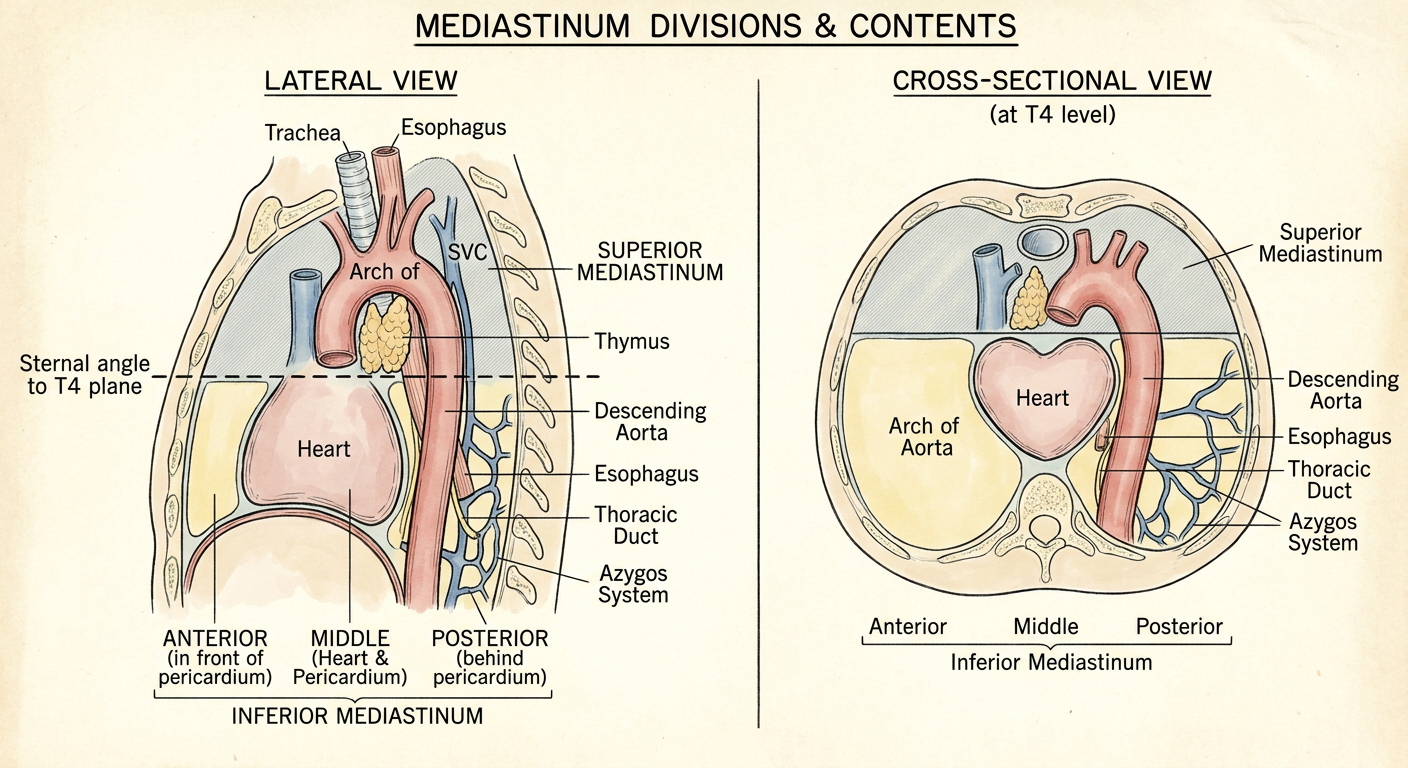
✅ Top MCQs
- A) Xiphisternal joint to T6
- B) Clavicle to T1
- C) Sternal angle to lower border of T4 vertebra ✓
- D) Manubriosternal junction to T3
- A) Manubrium of sternum
- B) Pericardium
- C) Upper 4 thoracic vertebrae (T1–T4) ✓
- D) All 12 thoracic vertebrae
- A) Trachea
- B) Arch of aorta
- C) Right and left brachiocephalic veins
- D) Heart within pericardium ✓
Explanation: The heart within its pericardium is the main content of the MIDDLE mediastinum. Superior mediastinum contains the arch of aorta and its 3 branches, SVC (upper half), brachiocephalic veins, trachea, esophagus, thoracic duct (entering from posterior), thymus, vagus nerves, left recurrent laryngeal nerve, phrenic nerves.
- A) Left common carotid, right common carotid, left subclavian
- B) Brachiocephalic artery, left common carotid, left subclavian ✓
- C) Right subclavian, right common carotid, left common carotid
- D) Brachiocephalic, right subclavian, left subclavian
- A) Heart and pericardium
- B) Descending thoracic aorta
- C) Trachea and esophagus
- D) Sternopericardial ligaments, remains of thymus, few lymph nodes ✓
Explanation: Anterior mediastinum is the smallest compartment. It lies between the body of sternum (anterior) and pericardium (posterior). Contains mainly connective tissue, remnants of thymus, a few lymph nodes.
- A) Superior mediastinum only
- B) Anterior mediastinum
- C) Posterior mediastinum
- D) Both superior and middle mediastinum (on the sides of the pericardium) ✓
- A) Superior mediastinum
- B) Anterior mediastinum
- C) Posterior mediastinum
- D) Middle mediastinum ✓
- A) Engorgement of upper body veins (SVC compression)
- B) Dysphagia (esophageal compression)
- C) Dysphonia (left recurrent laryngeal nerve compression)
- D) Hemoptysis ✓
Explanation: Mediastinal syndrome = SVC compression, esophageal compression (dysphagia), tracheal compression (dyspnea), left RLN compression (dysphonia), phrenic nerve compression (hemidiaphragm paralysis). Hemoptysis is NOT a feature.
- A) IVC
- B) Thoracic duct
- C) Aorta
- D) Vagus nerves ✓
Explanation: T8 = IVC through diaphragm. T10 = esophagus + vagus nerves. T12 = aorta + thoracic duct + azygos vein. Classic exam triad!
- A) Sternum
- B) Pericardium ✓
- C) Vertebral column
- D) Diaphragm
💡 Top 10 Must-Knows — Mediastinum Part I
- Dividing plane: Sternal angle → T4 lower border (separates superior from inferior mediastinum)
- Superior mediastinum contents: Trachea, esophagus, arch of aorta + 3 branches, brachiocephalic veins, upper ½ SVC, thymus, vagus, left RLN, phrenic nerves, thoracic duct
- Middle mediastinum = heart + pericardium (THE key compartment)
- Anterior mediastinum = smallest; sternopericardial ligaments + thymus remnants
- Posterior mediastinum = descending aorta, esophagus, thoracic duct, azygos system, sympathetic chains, vagi
- T8 = IVC; T10 = esophagus + vagus; T12 = aorta + thoracic duct
- 3 branches of aortic arch (right to left): brachiocephalic → left common carotid → left subclavian
- Left RLN loops under arch of aorta (in superior mediastinum) — most commonly compressed by aortic pathology
- Mediastinal syndrome: SVC compression + dysphagia + dyspnea + dysphonia + diaphragm paralysis
- Posterior mediastinum boundaries: T5–T12 vertebrae posterior, pericardium anterior
🔑 Most Useful Exam Tips — Mediastinum Part I
- "T8, T10, T12" diaphragm openings = most commonly tested in clinical MCQs
- Remember: Left RLN only is in the mediastinum (loops around aortic arch). Right RLN loops around right subclavian in the neck.
- Azygos vein arch empties into SVC in the middle mediastinum
- The SVC is split: upper ½ in superior mediastinum, lower ½ in middle mediastinum
- Thymus is in BOTH superior and anterior mediastinum — extends across the dividing plane
📚 LECTURE 5: Anatomy of Mediastinum — Part II (Thymus, Esophagus, Thoracic Duct)
🖼️ Visual Reference
✅ Top MCQs
- A) C4
- B) C5
- C) C6 ✓
- D) T1
Explanation: Esophagus begins at C6 (lower border of cricoid = level of C6), ends at T11 (cardiac end of stomach). Pierces diaphragm at T10.
- A) Pylorus of stomach
- B) Ileocecal junction
- C) Pharyngo-esophageal junction ✓
- D) Cardiac end of stomach
- A) 6, 8, 10, 14 inches
- B) 6, 9, 11, 16 inches ✓
- C) 5, 8, 12, 18 inches
- D) 4, 7, 11, 15 inches
Explanation:
- Pharyngo-esophageal junction → 6 inches from incisors
- Aortic arch → 9 inches
- Left main bronchus → 11 inches
- Diaphragm → 16 inches
- A) Trachea
- B) Left recurrent laryngeal nerve
- C) Left main bronchus
- D) Thoracic duct ✓
Explanation: Thoracic duct is a POSTERIOR relation of the thoracic esophagus (at level T5). Anterior relations: trachea, left RLN, left main bronchus, pericardium + left atrium.
- A) Anterior indentation of trachea
- B) Displacement of SVC to the right
- C) Shallow depression on the FRONT of the esophagus on barium swallow ✓
- D) Widened carina angle
Explanation: Left atrium is an ANTERIOR relation of the thoracic esophagus. Enlargement compresses the anterior esophageal wall, visible as a posterior indentation on barium swallow.
- A) Primary esophageal inflammation
- B) Porto-systemic anastomosis at the lower end of the esophagus ✓
- C) Malignant transformation of esophageal mucosa
- D) Compression by enlarged lymph nodes
Explanation: The lower esophageal veins drain into BOTH the left gastric vein (portal) and azygos/hemiazygos veins (systemic). In portal hypertension, these anastomoses dilate → esophageal varices → risk of fatal hematemesis.
- A) T8
- B) T10
- C) T12
- D) T5 ✓
Explanation: Thoracic duct enters thorax at T12 (through aortic opening), ascends on the RIGHT side of the vertebral column through the posterior mediastinum, then crosses to the LEFT at T5. It then ascends in the superior mediastinum to the LEFT of the esophagus.
- A) Right subclavian vein
- B) Right internal jugular vein
- C) Left brachiocephalic vein
- D) Junction of left subclavian and left internal jugular veins ✓
Explanation: At the level of C7, the thoracic duct arches laterally and opens into the angle between the left subclavian vein and left internal jugular vein. The right lymphatic duct drains into the corresponding RIGHT junction.
- A) Superior thyroid artery and internal thoracic artery
- B) Inferior thyroid artery and internal thoracic artery ✓
- C) Superior and inferior thyroid arteries
- D) Subclavian artery and brachiocephalic artery
- A) Atrioventricular block
- B) Mitral valve regurgitation
- C) Penile squamous cell carcinoma
- D) Thoracic aortic aneurysm ✓
Explanation: Tertiary syphilis causes obliterative endarteritis of the vasa vasorum of the aorta → weakening of the aortic wall → thoracic aortic aneurysm (classically of the ascending aorta or arch). This is a well-known complication of neurosyphilis/cardiovascular syphilis.
💡 Top 10 Must-Knows — Mediastinum Part II
- Esophagus: C6 → T10 (diaphragm) → T11 (stomach); 25 cm total; 3 parts (cervical 2", thoracic 8", abdominal ½–1")
- 4 constrictions at 6, 9, 11, 16 inches from incisors — critical for endoscopy
- Pharyngo-esophageal junction = narrowest part of alimentary canal (except appendix)
- Anterior esophageal relations: trachea, left RLN, left main bronchus, left atrium
- Esophageal varices = porto-systemic anastomosis; rupture → fatal hematemesis
- Thoracic duct: starts T12, crosses right→left at T5, ends at left subclavian-internal jugular angle
- Thoracic duct drains: both lower limbs, abdomen, left thorax, left upper limb, left head/neck (everything EXCEPT right upper quadrant)
- Thymus blood supply: inferior thyroid + internal thoracic arteries
- Achalasia = failure of lower esophageal sphincter to relax → barium swallow shows "bird's beak" appearance
- Left atrial enlargement → posterior indentation of esophagus on barium swallow
🔑 Most Useful Exam Tips — Mediastinum Part II
- "6-9-11-16" = four esophageal constrictions — memorize as a number sequence
- Thoracic duct crosses at T5 — "T5 = cross-over point" — then stays LEFT
- The esophagus pierces the diaphragm at T10 with the vagus nerves — and the case scenario (esophageal carcinoma at T10) tests this
- Left atrium is the most posterior cardiac chamber → its enlargement always impacts the esophagus
- Portal hypertension always → varices at 3 porto-systemic sites: lower esophagus, paraumbilical, anorectal
🎯 QUICK REVISION — HIGH-YIELD COMPARISON TABLE
| Topic | Right Side | Left Side |
|---|---|---|
| Lung lobes | 3 (upper, middle, lower) | 2 (upper, lower) |
| Lung fissures | 2 (horizontal + oblique) | 1 (oblique only) |
| Bronchial artery | From right 3rd intercostal | 2× from descending aorta |
| Bronchial vein | → Azygos vein | → Accessory hemiazygos |
| Pericardial impression | Right atrium | Left ventricle |
| Recurrent laryngeal nerve | Loops around right subclavian (neck) | Loops around aortic arch (mediastinum) |
| Thoracic duct position at T12 | Right side | Crosses to LEFT at T5 |
🔴 DIAPHRAGM OPENINGS — MUST MEMORIZE
| Level | Structure |
|---|---|
| T8 | IVC + right phrenic nerve |
| T10 | Esophagus + both vagus nerves |
| T12 (aortic opening) | Aorta + thoracic duct + azygos vein |
⚡ NERVE SUPPLY MASTER SUMMARY
| Nerve | Supplies | Injury Effect |
|---|---|---|
| External laryngeal N. | Cricothyroid only | Low-pitched voice |
| Recurrent laryngeal N. (partial bilateral) | All other intrinsic muscles (motor + sensory below cords) | Adduction → suffocation |
| Recurrent laryngeal N. (complete bilateral) | Same | Cadaveric position → aphonia, no suffocation |
| Internal laryngeal N. | Sensory above vocal cords | Loss of sensation → aspiration risk |