
Hemodialysis prescription in pregnancy give in poster form
hemodialysis pregnancy prescription dialysis dose
hemodialysis pregnancy outcomes
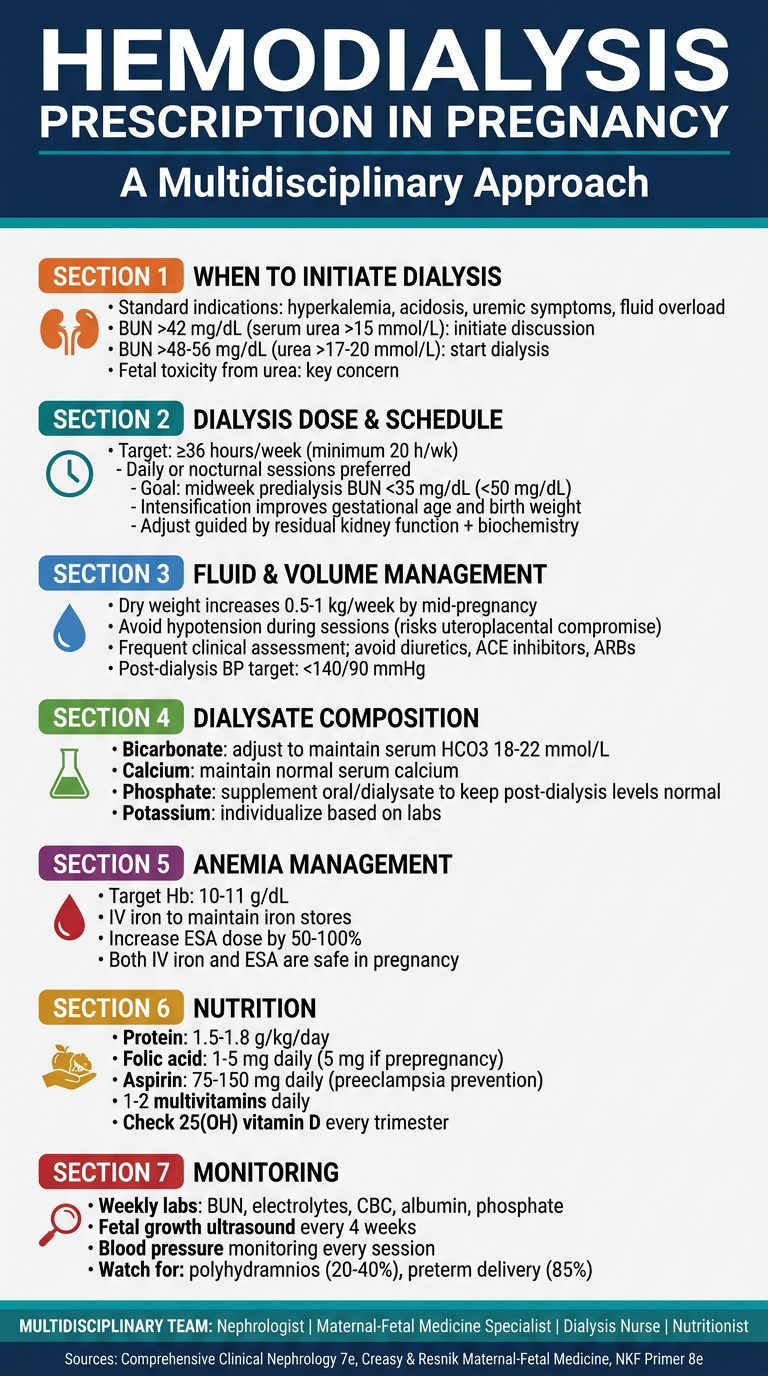
Medical educational poster titled "Hemodialysis Prescription in Pregnancy" with a clean clinical design on a deep navy blue background with white and light blue text. Organized into clearly labeled sections with icons: HEADER: Large bold title "HEMODIALYSIS PRESCRIPTION IN PREGNANCY" with a subtitle "A Multidisciplinary Approach" on navy background with a teal accent bar. SECTION 1 - "WHEN TO INITIATE DIALYSIS" (orange accent): - Standard indications: hyperkalemia, acidosis, uremic symptoms, fluid overload - BUN >42 mg/dL (serum urea >15 mmol/L): initiate discussion - BUN >48-56 mg/dL (urea >17-20 mmol/L): start dialysis - Fetal toxicity from urea: key concern SECTION 2 - "DIALYSIS DOSE & SCHEDULE" (teal accent): - Target: ≥36 hours/week (minimum 20 h/wk) - Daily or nocturnal sessions preferred - Goal: midweek predialysis BUN <35 mg/dL (<50 mg/dL) - Intensification improves gestational age and birth weight - Adjust guided by residual kidney function + biochemistry SECTION 3 - "FLUID & VOLUME MANAGEMENT" (blue accent): - Dry weight increases 0.5-1 kg/week by mid-pregnancy - Avoid hypotension during sessions (risks uteroplacental compromise) - Frequent clinical assessment; avoid diuretics, ACE inhibitors, ARBs - Post-dialysis BP target: <140/90 mmHg SECTION 4 - "DIALYSATE COMPOSITION" (green accent): - Bicarbonate: adjust to maintain serum HCO3 18-22 mmol/L - Calcium: maintain normal serum calcium - Phosphate: supplement oral/dialysate to keep post-dialysis levels normal - Potassium: individualize based on labs SECTION 5 - "ANEMIA MANAGEMENT" (purple accent): - Target Hb: 10-11 g/dL - IV iron to maintain iron stores - Increase ESA dose by 50-100% - Both IV iron and ESA are safe in pregnancy SECTION 6 - "NUTRITION" (amber accent): - Protein: 1.5-1.8 g/kg/day - Folic acid: 1-5 mg daily (5 mg if prepregnancy) - Aspirin: 75-150 mg daily (preeclampsia prevention) - 1-2 multivitamins daily - Check 25(OH) vitamin D every trimester SECTION 7 - "MONITORING" (red accent): - Weekly labs: BUN, electrolytes, CBC, albumin, phosphate - Fetal growth ultrasound every 4 weeks - Blood pressure monitoring every session - Watch for: polyhydramnios (20-40%), preterm delivery (85%) FOOTER: "MULTIDISCIPLINARY TEAM: Nephrologist | Maternal-Fetal Medicine Specialist | Dialysis Nurse | Nutritionist" on a teal bar. Small text: Sources: Comprehensive Clinical Nephrology 7e, Creasy & Resnik Maternal-Fetal Medicine, NKF Primer 8e
Key Points Covered in the Poster
- Discuss dialysis when BUN >42 mg/dL (urea >15 mmol/L)
- Start dialysis when BUN is consistently >48-56 mg/dL (urea >17-20 mmol/L)
- Urea fetotoxicity is the primary pregnancy-specific indication
- Minimum 20 h/week, ideally ≥36 h/week
- Daily or nocturnal sessions are preferred
- Target midweek predialysis BUN <35 mg/dL (strict) or <50 mg/dL (minimum)
- Intensification improves gestational age and birth weight (meta-analysis confirmed)
- Bicarbonate adjusted to keep serum HCO3 at 18-22 mmol/L (pregnancy normal)
- Phosphate supplementation often needed (hypophosphatemia risk with intensive HD)
- Calcium maintained normal via vitamin D and dialysate calcium adjustment
- Target Hb 10-11 g/dL
- Increase ESA dose by 50-100%; IV iron to maintain stores
- Both are safe in pregnancy
- Protein 1.5-1.8 g/kg/day
- Folic acid 1-5 mg/day, Aspirin 75-150 mg/day
- Vitamin D levels checked each trimester
- Dry weight adjusted for expected weight gain (~0.5-1 kg/wk by midpregnancy)
- Avoid ACE inhibitors, ARBs, and aggressive ultrafiltration
- Avoid hypotension (risks uteroplacental insufficiency)