
Closing capacity/ closing volume and FRC . Md anaesthesia exam . Short and crisp withheadings , with possible viva questions
Reading File
Searching sources...
Finding Sources
Finding Sources
Finding Sources
Finding Sources
Reading File
Reading File
Reading File
Reading File
Reading File
Loading Image
I now have excellent material. Let me fetch the age-vs-CC/FRC graph too, then compile the full answer.
Loading Image
Loading Image
All the material I need is now in hand. Here is the complete, exam-ready write-up.
Closing Volume (CV), Closing Capacity (CC) and FRC
MD Anaesthesia Viva / Short Answer
1. Definitions
| Term | Definition | Formula |
|---|---|---|
| Closing Volume (CV) | Lung volume above RV at which small, cartilage-free airways in dependent lung zones begin to close during expiration | CV = CC - RV |
| Closing Capacity (CC) | Total lung volume at which these dependent airways first close | CC = CV + RV |
| FRC | Volume of gas remaining in the lungs at end of a normal passive expiration | FRC = ERV + RV (~2300 mL in adults) |
Normal values (young adult):
- CV ~400 mL (CV/VC ~8%)
- CC ~1900 mL (CC/FLC ~30%)
- FRC ~2300 mL
2. Mechanism of Airway Closure
- Small airways (<1 mm) lack cartilaginous support; they depend on radial traction from surrounding lung parenchyma to stay open.
- During expiration, as lung volume falls, this radial traction decreases.
- In dependent (basal) lung zones, pleural pressure is less negative, so these airways close first.
- Once closed, the alveoli they supply continue to be perfused but not ventilated - this creates intrapulmonary shunt (venous admixture) and hypoxemia.
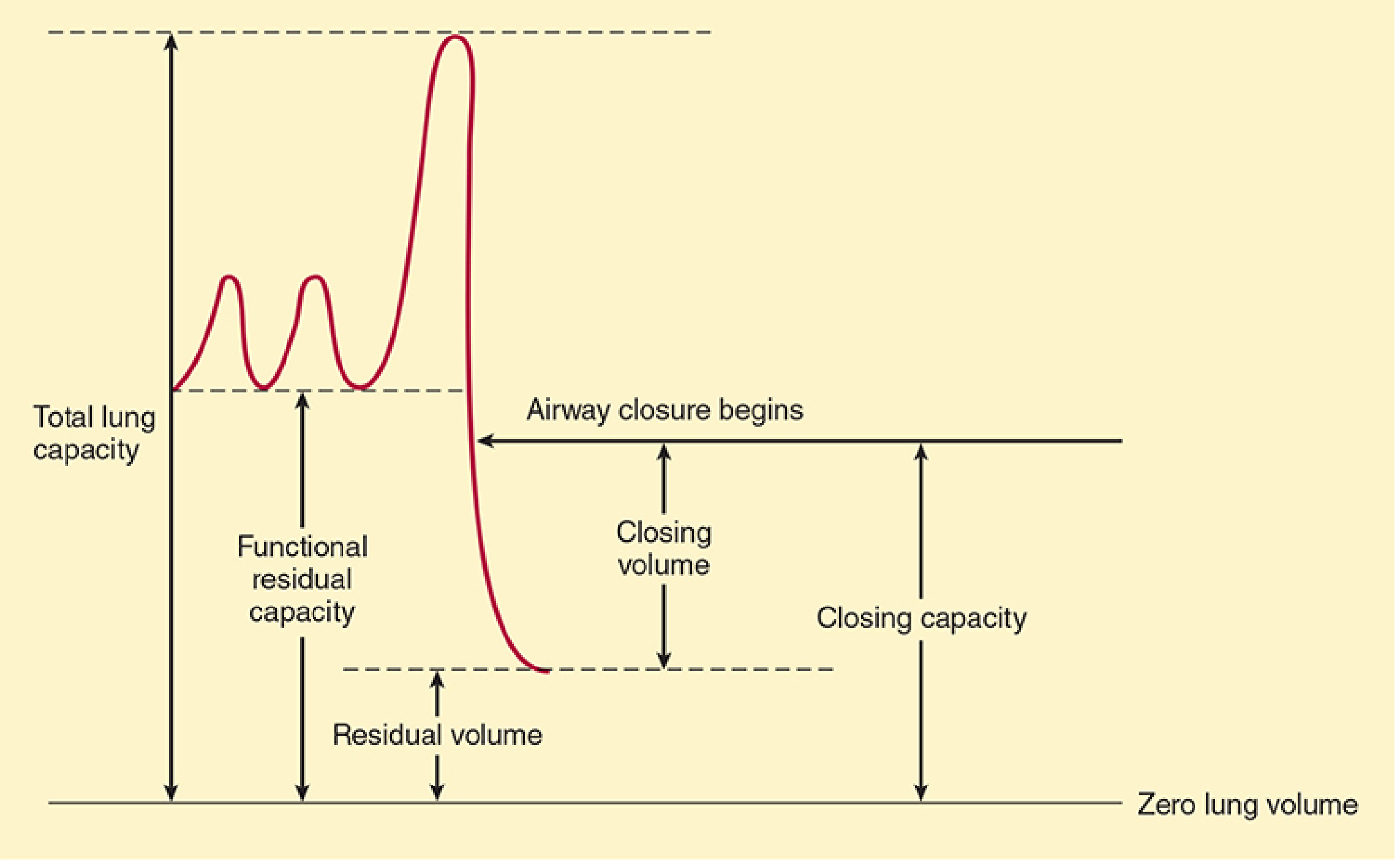
3. Measurement - Single-Breath Nitrogen (N₂) Washout Test
- Patient exhales to RV, then inhales a single breath of 100% O₂ to TLC.
- Slowly exhales back to RV while expired N₂ concentration is measured.
Four phases of the N₂ washout curve:
| Phase | Source | N₂ |
|---|---|---|
| I | Anatomical dead space | 0% |
| II | Mix of dead space + alveoli | Rising |
| III | "Alveolar plateau" - uniform alveolar gas | Flat (slight rise) |
| IV | Closing volume begins here - dependent airways close, only apical (N₂-rich) gas exits | Sudden steep rise |
- The take-off point of Phase IV = Closing Capacity
- The volume from this point to RV = Closing Volume
4. The Critical Relationship: CC vs FRC
This is the most important concept for anaesthesia exams.
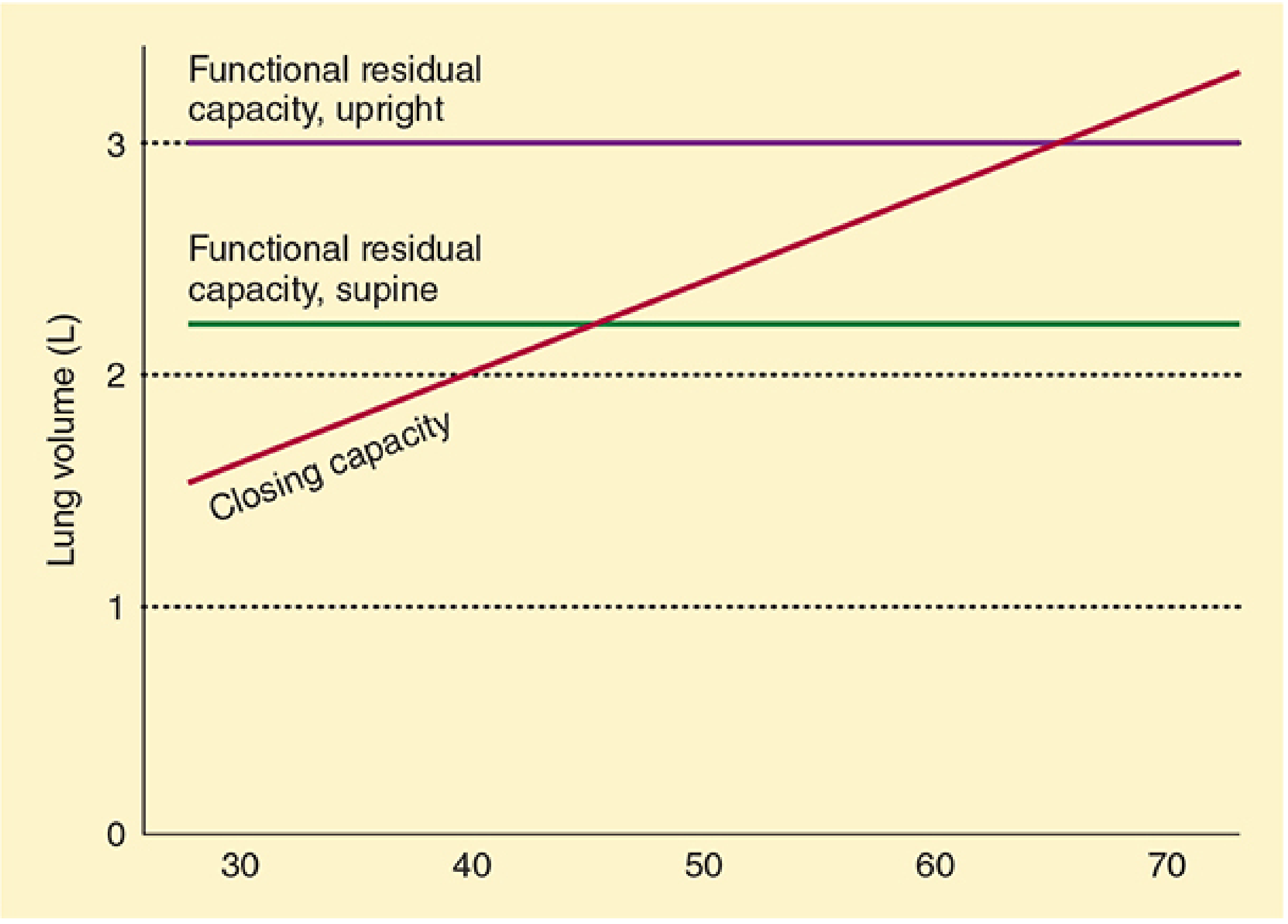
Normal (young adult, upright): CC < FRC
- Airways remain open throughout tidal breathing
- No shunt, normal oxygenation
When CC exceeds FRC: Dependent airways close during normal tidal breathing → V/Q mismatch → hypoxemia
| Age / Position | When CC = FRC |
|---|---|
| Supine position | ~44 years |
| Upright position | ~66 years |
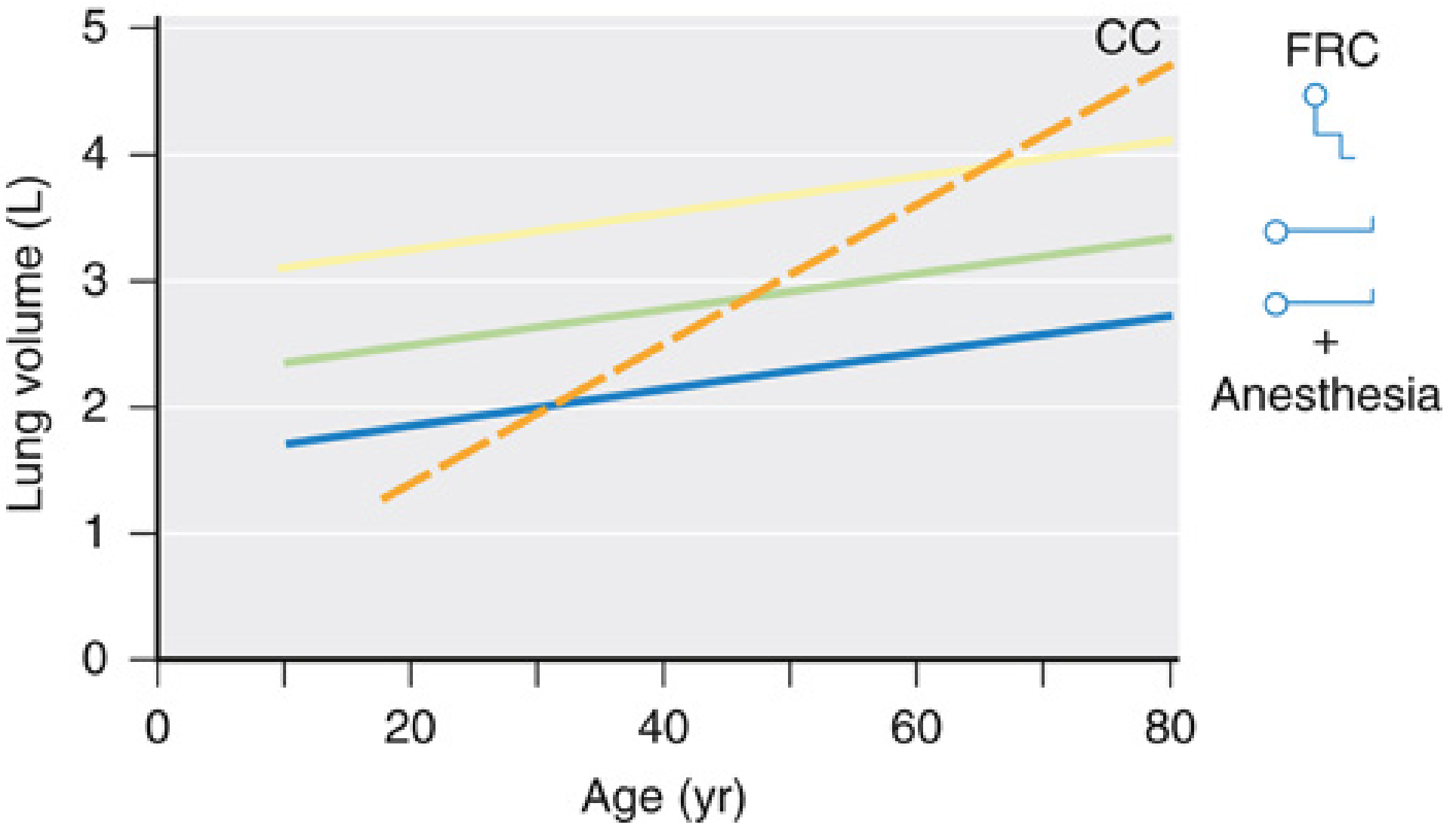
Key: FRC remains relatively constant with age, but CC rises steeply with age (loss of lung elastic recoil). This is why elderly patients desaturate rapidly.
5. Factors Affecting FRC
Decreases FRC:
- Supine / prone position (vs upright) - by 0.8-1.0 L
- General anaesthesia - additional 0.4-0.5 L reduction (loss of inspiratory muscle tone, cephalad diaphragm shift, chest wall rigidity change)
- Obesity (reduced chest wall compliance, raised abdominal pressure)
- Pregnancy / ascites / laparoscopy (pneumoperitoneum)
- Female sex (10% less than males)
- Restrictive lung disease
- Trendelenburg position (>30°)
Increases FRC:
- Upright posture
- PEEP / CPAP
- Emphysema (loss of elastic recoil, air trapping)
- Bronchospasm
FRC is NOT significantly changed by muscle paralysis in an already-anaesthetised patient.
6. Factors Increasing Closing Capacity
- Age (most important - linear rise with age)
- Smoking / COPD / small airway disease
- Pulmonary oedema
- Supine position (less so)
- Very young children (physiologically elevated CC - explains why neonates are prone to atelectasis)
7. Anaesthetic Relevance
| Situation | Effect | Clinical Consequence |
|---|---|---|
| Supine + GA | FRC ↓ by ~1.2-1.5 L total | CC may exceed FRC → shunt → SpO₂ ↓ |
| Obesity | FRC markedly ↓ | CC > FRC even in young patients |
| Elderly | CC ↑ steeply | Airway closure during tidal breathing even awake |
| Neonates | CC large relative to FRC | Prone to atelectasis + hypoxemia |
| PEEP | FRC ↑ | Reopens closed airways, reduces shunt |
| Preoxygenation | Replaces N₂ in closed alveoli with O₂ | Absorption atelectasis if 100% O₂ used |
Both FRC and CC are generally reduced to the same extent under anaesthesia, so the relative risk of increased shunting is similar to the awake state - but it is greatest in obese, elderly, and those with lung disease.
8. Summary: Key Numbers to Remember
| Parameter | Value |
|---|---|
| FRC (normal adult) | ~2300 mL (RV 1200 + ERV 1100) |
| CC = FRC (supine) | Age ~44 years |
| CC = FRC (upright) | Age ~66 years |
| FRC ↓ on going supine | 0.8-1.0 L |
| FRC ↓ on induction of GA (supine) | Additional 0.4-0.5 L |
| CV/VC normal | ~8% |
| CC/FLC normal | ~30% |
9. Possible Viva Questions
Q1. What is closing capacity? How is it measured?
CC = CV + RV. Measured by single-breath N₂ washout test; Phase IV take-off indicates CC.
Q2. What is the significance of CC > FRC?
Dependent airways close during tidal breathing → unventilated alveoli remain perfused → intrapulmonary shunt → hypoxemia.
Q3. At what age does CC exceed FRC in the supine position?
~44 years. In the upright position, ~66 years.
Q4. How does general anaesthesia affect FRC?
Supine position reduces FRC by 0.8-1.0 L; induction of GA adds a further 0.4-0.5 L reduction (loss of muscle tone, cephalad diaphragm shift, altered chest wall shape).
Q5. What is the clinical relevance of CC in obese patients?
Obesity markedly reduces FRC. Even in younger obese patients, CC exceeds FRC, causing airway closure during tidal breathing, shunt, and perioperative hypoxemia.
Q6. Why do neonates desaturate rapidly under anaesthesia?
Neonates have a relatively large CC and a small FRC (chest wall highly compliant, low elastic recoil). CC > FRC even normally, leading to atelectasis and rapid desaturation.
Q7. How does PEEP help?
PEEP increases FRC, "stenting" dependent airways open so CC is less likely to exceed FRC. Reduces intrapulmonary shunt.
Q8. What is Phase IV of the N₂ washout, and why does N₂ rise steeply?
Phase IV begins at the closing capacity. Basal (dependent) airways close and only apical alveoli (which received more N₂-rich gas at the start of inhalation because they were already partially inflated at RV) contribute to expired gas - hence N₂ concentration rises.
Q9. What is the difference between closing volume and closing capacity?
CV = volume above RV where closure starts; CC = CV + RV (measured from zero/RV baseline, hence the total lung volume at closure).
Q10. Does muscle paralysis change FRC under anaesthesia?
No - muscle paralysis does not significantly alter FRC in an already-anaesthetised patient (Morgan & Mikhail).
Sources: Morgan & Mikhail's Clinical Anesthesiology 7e (pp. 924-937); Miller's Anesthesia 10e (Fig. 12.10); Fishman's Pulmonary Diseases (Block 31); Nunn's Applied Respiratory Physiology 8e.
This is a shared conversation. Sign in to Orris to start your own chat.