
Hb electrophoresis
Reading File
Now let me search the medical library for Hb electrophoresis content in parallel.
Finding Sources
Finding Sources
Good - I found the key sections. Let me read them in parallel, including the image.
Reading File
Reading File
Excellent content gathered. Now let me fetch the electrophoresis gel images and search for more detailed content on patterns and HPLC comparisons.
Loading Image
Loading Image
Finding Sources
Let me get the Tietz Textbook content on globin chain electrophoresis and Lippincott Biochemistry content on sickle cell electrophoresis migration.
Reading File
Reading File
I now have comprehensive content. Let me also fetch the electrophoresis diagram from Lippincott showing HbA/HbS/HbC migration.
Loading Image
I now have all the information needed for a thorough, well-illustrated answer. Here is the complete breakdown:
Hemoglobin Electrophoresis
Principle
Hemoglobin electrophoresis separates Hb variants based on molecular charge and size in an electric field. At alkaline pH, hemoglobins are negatively charged and migrate toward the anode (+). The speed of migration depends on the net charge of each variant - amino acid substitutions that alter charge (e.g., Glu → Val in HbS) shift the band position.
Methods
1. Alkaline Electrophoresis (pH 8.6) - Cellulose Acetate
The standard first-line test. Migration from cathode (-) toward anode (+):
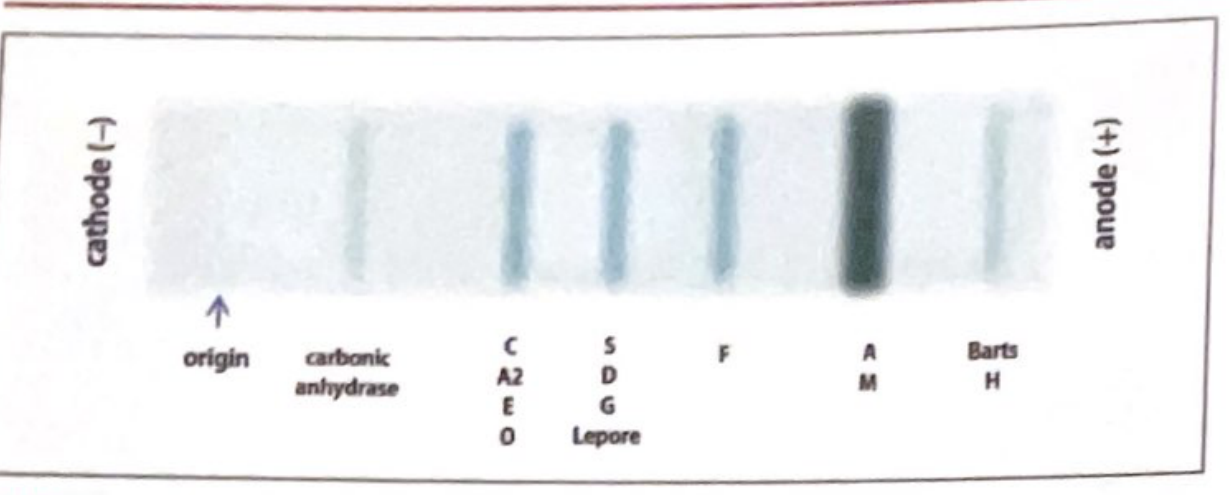
Band positions (slowest to fastest toward anode):
| Band Position | Hemoglobins |
|---|---|
| C band (slowest) | HbC, HbA2, HbE, HbO |
| S band | HbS, HbD, HbG, Hb Lepore |
| F band | HbF |
| A band (fastest common) | HbA, HbM |
| Fast (beyond A) | Hb Barts, HbH |
Key limitation: Cannot distinguish HbS from HbD, HbG, or Hb Lepore. HbC, HbA2, HbE, and HbO all co-migrate at the C band.
2. Acid Electrophoresis (pH 6.2) - Citrate Agar
Used as a confirmatory/complementary test when alkaline results are ambiguous:
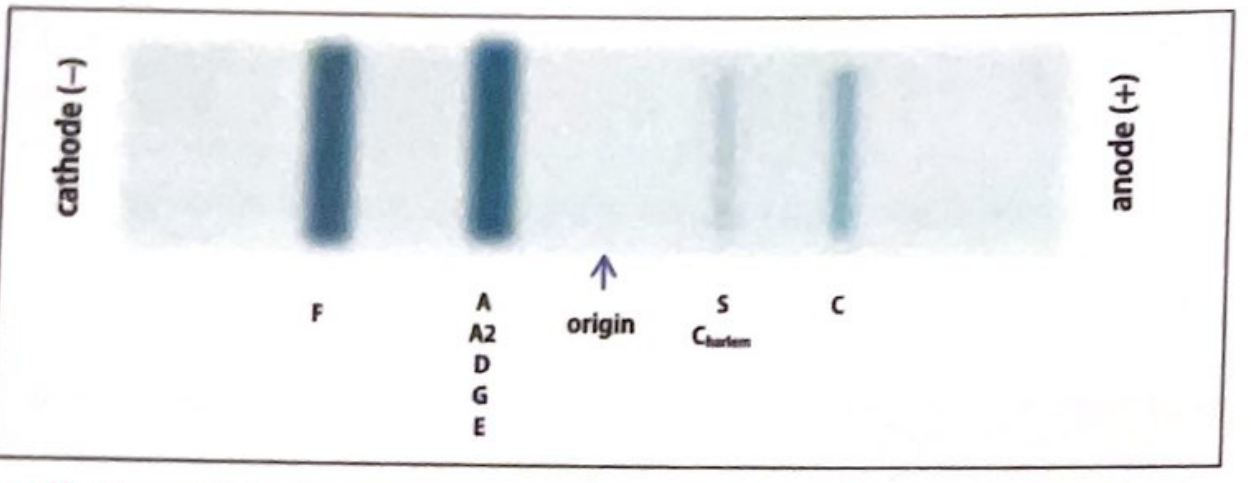
Key differentiations at acid pH:
- HbS and HbC are now clearly separated from each other
- HbA, HbA2, HbD, HbG, and HbE all co-migrate in the A/A2 position
- HbF moves toward the cathode (separate from HbA)
- A band at S on alkaline: if it migrates to A position on acid, it is HbD/G/Lepore (not HbS); if it stays at S, it confirms HbS
3. Migration Mechanism (Lippincott Biochemistry)
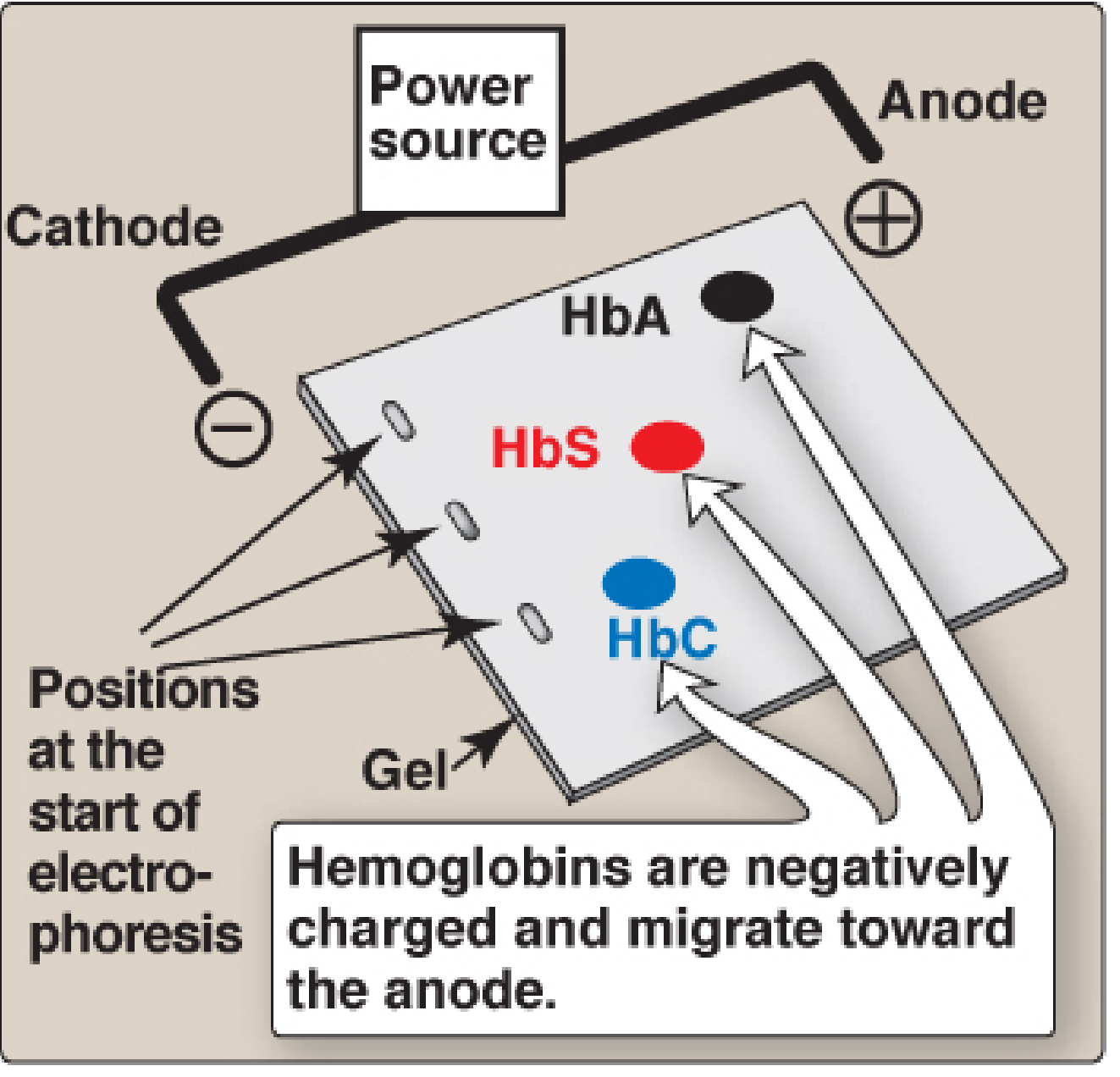
- HbS: Glu → Val substitution at β-chain position 6 removes two negative charges, making HbS less negative than HbA → migrates slower toward anode
- HbC: Glu → Lys substitution at β-chain position 6 adds a positive charge → migrates even slower than HbS
- Migration order at alkaline pH: HbA (fastest) > HbF > HbS > HbC (slowest)
Normal Adult Pattern
- >97% HbA (α2β2)
- <3% HbA2 (α2δ2) - seen in the C band
- No other bands
- Normal: HbF is <1% in adults
Interpretation of Common Patterns
| Pattern | Interpretation |
|---|---|
| Predominantly HbA, small HbA2 (<3%) | Normal |
| HbA + HbA2 elevated (>3.5%) | β-thalassemia trait |
| HbA + HbA2 (normal) + thalassemic indices | α-thalassemia (HbA2 normal in α-thal) |
| HbA + HbS (~40% S) | Sickle cell trait (AS) |
| HbS only (~90%) + no HbA | Sickle cell disease (SS) or Sβ⁰-thal |
| HbS + HbC (roughly equal) | HbSC disease |
| HbS + HbA + HbA2 (HbA present) | Sβ⁺-thalassemia |
| HbF only | β-thalassemia major or HPFH |
| HbA + HbC (~40%) | HbC trait |
Neonatal Hb Electrophoresis Patterns (Harriet Lane)
Variants are reported in order of decreasing abundance (e.g., FA = more F than A):
| Pattern | Meaning |
|---|---|
| FA | Normal newborn (HbF predominant, some HbA) |
| FAS | Sickle cell trait (benign) |
| FS | Sickle cell disease (SS) or Sβ⁰-thal - clinically significant |
| FSC | HbSC disease - clinically significant |
| FSA | Sβ⁺-thalassemia - clinically significant |
| FC | Homozygous HbC (mild disorder) |
| FAC | HbC trait (benign) |
| F only | β-thalassemia major or HPFH |
| AF | Likely prior transfusion - repeat at 4 months |
Newborn screening for sickle cell is mandatory in many states; positive sickle prep tests must be confirmed with electrophoresis or isoelectric focusing.
Advanced / Modern Methods
Isoelectric Focusing (IEF)
- Greater resolving power than conventional electrophoresis
- Separates HbD and HbG from each other and from HbS (which alkaline electrophoresis cannot)
- Hemolysate migrates to its isoelectric point in a pH gradient (pH 6.0-8.0)
- Limitation: temperature-sensitive, cannot accurately quantify HbA2 and HbF at low concentrations
Capillary Electrophoresis (CE)
- Automated, can accurately quantify low HbA2 levels and HbE levels separately
- HbC still co-migrates with HbA2 in this method
- High throughput, widely used in newborn screening programs
HPLC (High Performance Liquid Chromatography)
- Gold standard for quantification (especially HbA1c, HbA2, HbF)
- Separates by ion exchange chromatography
- Limitation: cannot separate HbS from HbD on alkaline electrophoresis, but HPLC handles this well
- Peaks noted in S and C positions in HbSC disease
Globin Chain Electrophoresis
- Individual globin chains are dissociated using dithiothreitol and urea, then run at both acidic and alkaline pH
- Used to determine whether a variant involves the α chain or β chain
- Useful for characterizing novel/rare variants
Clinical Significance Summary
| Disease | Electrophoresis Finding |
|---|---|
| Sickle cell anemia | HbS ~90%, no HbA |
| Sickle cell trait | HbA ~60%, HbS ~40% |
| HbSC disease | HbS ~50%, HbC ~50% |
| β-thalassemia major | HbF predominant, HbA2 elevated, no/little HbA |
| β-thalassemia trait | HbA2 >3.5%, mild elevation HbF |
| α-thalassemia | Normal HbA2, normal electrophoresis (diagnosis by molecular/MCH) |
| HPFH | HbF elevated (up to 100% in homozygous), HbA2 normal |
| HbC disease | HbC ~90%, no HbA |
Sources: Quick Compendium of Clinical Pathology 5th ed., p. 13495-13513 | Lippincott Biochemistry 8th ed., p. 122 | Harriet Lane Handbook 23rd ed., p. 477 | Tietz Textbook of Laboratory Medicine 7th ed.
This is a shared conversation. Sign in to Orris to start your own chat.