
Epidimiology of malaria and national program park based 10 marks also include treatment and management of northeastern countries park based
malaria AND India
India National Center for Vector Borne Diseases Control malaria treatment guidelines northeastern states epidemiology
https://www.who.int/india/health-topics/malaria
Malaria: Epidemiology, National Programme and Management in North-Eastern India
10-mark answer, Park-based
Definition
Park’s Textbook of Preventive and Social Medicine, p. 299.
1. Epidemiology
Agent factors
- Causative organisms: P. vivax, P. falciparum, P. malariae, P. ovale and P. knowlesi.
- In India, P. vivax and P. falciparum account for almost all indigenous malaria.
- P. vivax produces dormant liver forms, hypnozoites, causing relapses.
- P. falciparum can cause cerebral malaria, severe anaemia, acute kidney injury, shock and death.
Reservoir
- Mainly infected human beings, including asymptomatic carriers.
- Female Anopheles mosquito acts as the biological vector.
Mode of transmission
- Bite of infected female Anopheles mosquito, the usual route.
- Blood transfusion, contaminated needles and congenital transmission, rarely.
Vector factors
- Anopheles culicifacies: rural plains.
- Anopheles stephensi: urban malaria.
- Anopheles fluviatilis: foothills and forest areas.
- In North-East India: Anopheles minimus and Anopheles baimaii are highly efficient vectors.
Host factors
- All ages are susceptible, but severe disease is common in young children, pregnant women, non-immune migrants and malnourished persons.
- Partial immunity develops after repeated exposure in endemic areas.
- Sickle-cell trait provides some protection against severe P. falciparum malaria.
Environmental and social factors
- Transmission increases with rainfall, humidity, warm temperature, stagnant water, poor housing and inadequate vector control.
- Forested, hilly, tribal, border and difficult-to-access regions are high-risk areas.
- Migration, population movement, conflict, poor access to diagnosis and incomplete treatment sustain transmission.
Epidemiological indices
- Annual Parasite Incidence (API): Confirmed malaria cases during one year per 1,000 population.
- Annual Blood Examination Rate (ABER): Blood smears examined in one year per 100 population. Desired level is at least 10%.
- Slide Positivity Rate (SPR): Positive slides per 100 slides examined.
- Slide Falciparum Rate (SFR): P. falciparum-positive slides per 100 slides examined.
- Pf percentage: P. falciparum cases as percentage of total malaria cases.
2. National Malaria Control Programme
Evolution
| Year | Major event |
|---|---|
| 1953 | National Malaria Control Programme (NMCP) launched |
| 1958 | Converted into National Malaria Eradication Programme (NMEP) |
| 1977 | Modified Plan of Operations due to resurgence |
| 1997 | Enhanced Malaria Control Project started |
| 1999 | Renamed National Anti-Malaria Programme (NAMP) |
| 2002 | Integrated into National Vector Borne Disease Control Programme (NVBDCP) |
| 2005 | RDTs introduced; programme integrated with NRHM |
| 2006 onwards | ACT introduced for chloroquine-resistant falciparum malaria |
| 2009 | Long-lasting insecticidal nets (LLINs) introduced |
| 2016 | National Framework for Malaria Elimination in India, 2016-2030 |
| 2023-27 | National Strategic Plan for Malaria Elimination |
Goal
Major components / activities
-
Early case detection and complete treatment
- Test every suspected fever case using microscopy or RDT.
- Prompt species-specific treatment.
- Referral and treatment of severe malaria.
-
Integrated vector management
- Indoor residual spraying (IRS) in high-risk areas.
- LLINs or insecticide-treated nets.
- Larval source reduction and environmental management.
- Personal protective measures such as repellents, protective clothing and screened houses.
-
Surveillance
- Passive and active surveillance.
- Case-based reporting, investigation and response.
- Monitoring API, ABER, SPR, SFR and Pf%.
-
Targeted interventions
- Focus on tribal, forest, foothill, migrant, border and conflict-affected populations.
- Special focus on high-burden districts and difficult-to-reach areas.
-
Capacity building and logistics
- Training of health workers.
- Supply of RDTs, antimalarials, insecticides and LLINs.
- Monitoring, evaluation, operational research and drug-resistance surveillance.
-
Intersectoral and cross-border coordination
- Essential in inter-state and international border areas, particularly in the North-East.
Park’s Textbook of Preventive and Social Medicine, p. 469.
- Essential in inter-state and international border areas, particularly in the North-East.
3. Special epidemiology of North-Eastern India
Reasons for high risk
- Dense forests, hills, heavy rainfall and favourable climate for mosquito breeding.
- Large tribal and remote populations with reduced access to health facilities.
- International borders and migration, causing importation and spread of malaria.
- Efficient vectors: Anopheles minimus and Anopheles baimaii.
- Transmission is commonly perennial, with a seasonal rise from April to September.
- P. vivax is especially important in Arunachal Pradesh, Nagaland and Manipur; P. falciparum predominates in several southern and forested belts.
4. Diagnosis and treatment
Diagnosis
- Suspect malaria in every acute fever case from an endemic area.
- Confirm by:
- Peripheral blood smear microscopy, thick and thin films, or
- Rapid diagnostic test (RDT).
- Start treatment immediately after confirmation, especially for P. falciparum.
Park’s Textbook of Preventive and Social Medicine, p. 308.
A. Uncomplicated P. vivax malaria
- Chloroquine: total 25 mg base/kg over 3 days:
- Day 1: 10 mg/kg
- Day 2: 10 mg/kg
- Day 3: 5 mg/kg
- Primaquine: 0.25 mg base/kg once daily for 14 days for radical cure and prevention of relapse.
Park’s Textbook of Preventive and Social Medicine, p. 309.
B. Uncomplicated P. falciparum malaria in North-Eastern states
| Body weight | Artemether-lumefantrine dose | Duration |
|---|---|---|
| 5-14 kg | 20 mg/120 mg twice daily | 3 days |
| 15-24 kg | 40 mg/240 mg twice daily | 3 days |
| 25-34 kg | 60 mg/360 mg twice daily | 3 days |
| More than 34 kg | 80 mg/480 mg twice daily | 3 days |
- Add single-dose primaquine 0.75 mg base/kg on day 2 to reduce transmission.
- ACT-AL is not recommended in the first trimester of pregnancy or in children weighing less than 5 kg.
- Primaquine is contraindicated in pregnancy, infancy and G6PD deficiency.
Park’s Textbook of Preventive and Social Medicine, pp. 309-310.
C. Severe malaria: emergency management
- Admit and urgently refer to a hospital.
- Give parenteral artesunate as per national protocol.
- Once the patient can take oral drugs, complete a full course of ACT.
- Supportive treatment:
- Airway, oxygen and careful fluid balance.
- Check and correct hypoglycaemia.
- Treat seizures.
- Antipyretics for fever.
- Blood transfusion for severe anaemia if indicated.
- Dialysis for renal failure where required.
- Monitor urine output, haemoglobin, glucose, renal function and parasitaemia.
Conclusion
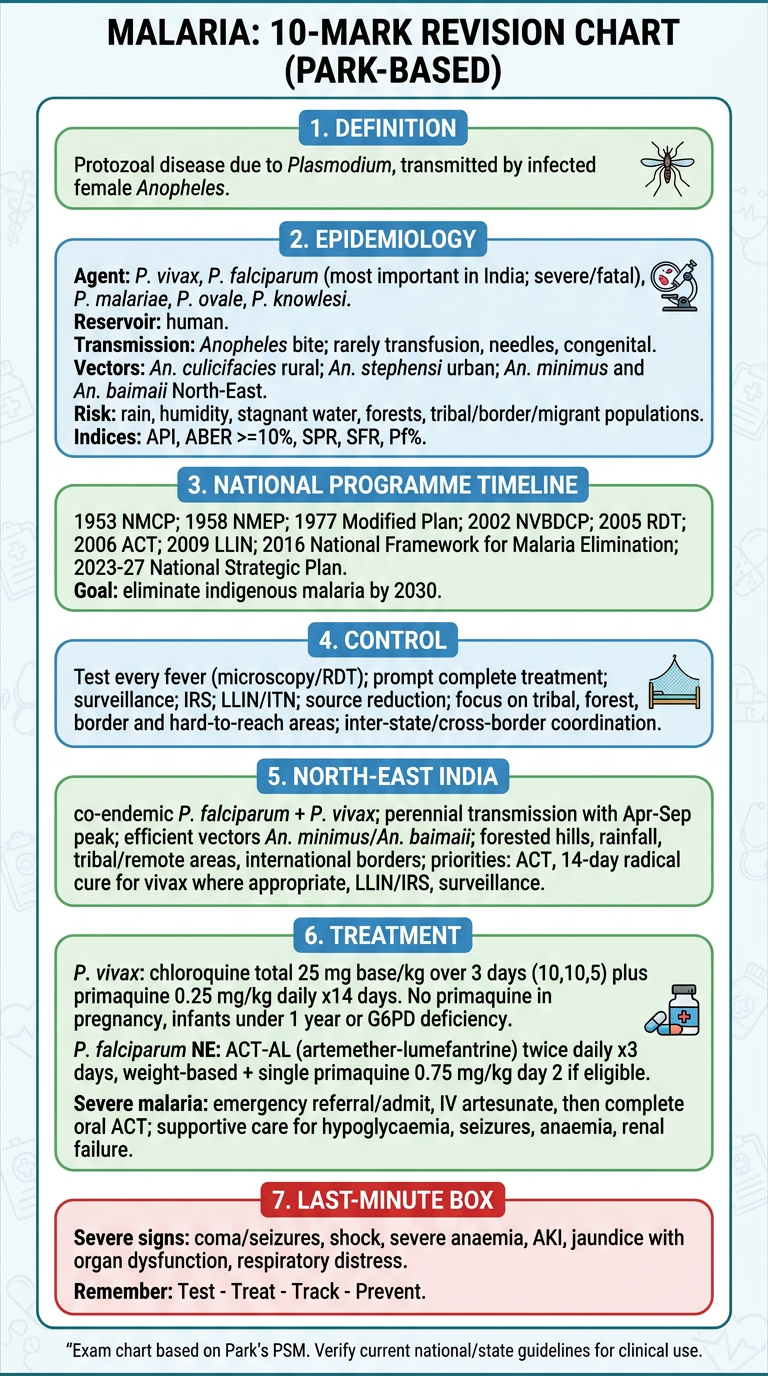
Create a one-page malaria exam revision chart
Create a single-page portrait exam revision chart titled “MALARIA: 10-MARK REVISION CHART (PARK-BASED)”. The chart must be clear, accurate, highly readable and compact for medical students. Include sections with these exact concise points: 1) DEFINITION: Protozoal disease due to Plasmodium, transmitted by infected female Anopheles. 2) EPIDEMIOLOGY: Agent: P. vivax, P. falciparum (most important in India; severe/fatal), P. malariae, P. ovale, P. knowlesi. Reservoir: human. Transmission: Anopheles bite; rarely transfusion, needles, congenital. Vectors: An. culicifacies rural; An. stephensi urban; An. minimus and An. baimaii North-East. Risk: rain, humidity, stagnant water, forests, tribal/border/migrant populations. Indices: API, ABER >=10%, SPR, SFR, Pf%. 3) NATIONAL PROGRAMME TIMELINE: 1953 NMCP; 1958 NMEP; 1977 Modified Plan; 2002 NVBDCP; 2005 RDT; 2006 ACT; 2009 LLIN; 2016 National Framework for Malaria Elimination; 2023-27 National Strategic Plan. Goal: eliminate indigenous malaria by 2030. 4) CONTROL: Test every fever (microscopy/RDT); prompt complete treatment; surveillance; IRS; LLIN/ITN; source reduction; focus on tribal, forest, border and hard-to-reach areas; inter-state/cross-border coordination. 5) NORTH-EAST INDIA: co-endemic P. falciparum + P. vivax; perennial transmission with Apr-Sep peak; efficient vectors An. minimus/An. baimaii; forested hills, rainfall, tribal/remote areas, international borders; priorities: ACT, 14-day radical cure for vivax where appropriate, LLIN/IRS, surveillance. 6) TREATMENT: P. vivax: chloroquine total 25 mg base/kg over 3 days (10,10,5) plus primaquine 0.25 mg/kg daily x14 days. No primaquine in pregnancy, infants under 1 year or G6PD deficiency. P. falciparum NE: ACT-AL (artemether-lumefantrine) twice daily x3 days, weight-based + single primaquine 0.75 mg/kg day 2 if eligible. Severe malaria: emergency referral/admit, IV artesunate, then complete oral ACT; supportive care for hypoglycaemia, seizures, anaemia, renal failure. 7) LAST-MINUTE BOX: Severe signs: coma/seizures, shock, severe anaemia, AKI, jaundice with organ dysfunction, respiratory distress. Remember: Test - Treat - Track - Prevent. Put a bottom footnote: “Exam chart based on Park’s PSM. Verify current national/state guidelines for clinical use.” Add a small female mosquito icon, blood smear/microscope icon, LLIN bed-net icon, and medicine icon. Ensure all text is spelled exactly and legible.
malaria AND India
WHO India malaria National Strategic Plan 2023 2027 treatment guidelines
Xdr in tb
extensively drug-resistant tuberculosis
WHO definition extensively drug-resistant tuberculosis XDR-TB 2021
XDR-TB: Extensively Drug-Resistant Tuberculosis
- Rifampicin-resistant with or without isoniazid resistance, that is MDR/RR-TB, and
- Resistant to any fluoroquinolone: levofloxacin or moxifloxacin, and
- Resistant to at least one other Group A drug: bedaquiline or linezolid.
XDR-TB = MDR/RR-TB + fluoroquinolone resistance + resistance to bedaquiline and/or linezolid.
Related definitions
| Term | Definition |
|---|---|
| RR-TB | TB resistant to rifampicin, with or without resistance to other drugs |
| MDR-TB | TB resistant to at least both isoniazid and rifampicin |
| Pre-XDR-TB | MDR/RR-TB with resistance to any fluoroquinolone |
| XDR-TB | MDR/RR-TB + fluoroquinolone resistance + resistance to bedaquiline or linezolid |
Old definition, important for exams
MDR-TB plus resistance to any fluoroquinolone and at least one second-line injectable drug: amikacin, kanamycin, or capreomycin.
Diagnosis
- Confirm TB bacteriologically with sputum smear, molecular test and culture where possible.
- Perform rapid molecular testing for rifampicin resistance and fluoroquinolone resistance.
- Drug-susceptibility testing for bedaquiline and linezolid is required to classify XDR-TB accurately.
- Assess HIV status, diabetes, nutritional status, chest radiograph, and extrapulmonary involvement.
Management principles
- Refer to a DR-TB centre or specialist programme immediately.
- Use an individualized, all-oral, DST-guided regimen under national TB programme guidance.
- Ensure adherence support, contact investigation, nutrition support, adverse-effect monitoring and infection-control measures.
- Monitor for bedaquiline-associated QT prolongation and linezolid-associated neuropathy, myelosuppression and optic toxicity.
“XDR = RR/MDR + FQ + B/L”
FQ = fluoroquinolone; B/L = bedaquiline and/or linezolid.
Regimen? Park
extensively drug-resistant tuberculosis treatment
Park textbook XDR TB regimen India PMDT regimen
https://tbcindia.mohfw.gov.in/wp-content/uploads/2024/10/TB-…
XDR-TB Regimen: Park-based
Duration
- 20 months for XDR-TB.
Park’s Textbook of Preventive and Social Medicine, p. 225.
All-oral longer regimen shown in Park for MDR/RR-TB
18-20 months: Bdq (6 months) + Lfx + Lzd + Cfz + Cs
| Abbreviation | Drug |
|---|---|
| Bdq | Bedaquiline, for first 6 months or 24 weeks |
| Lfx | Levofloxacin |
| Lzd | Linezolid |
| Cfz | Clofazimine |
| Cs | Cycloserine |
Important XDR-TB point
- Delamanid
- Pyrazinamide
- Ethambutol
- Ethionamide/prothionamide
- PAS
- Imipenem-cilastatin or meropenem
- Amikacin only if proven susceptible and necessary
Write in exam
XDR-TB is treated under NTEP at a Nodal DR-TB Centre with an individualized DST-guided all-oral longer regimen for 20 months. Park’s longer all-oral regimen is Bdq for 6 months plus Lfx, Lzd, Cfz and Cs; however, in XDR-TB, fluoroquinolone-resistant drugs are excluded and appropriate effective Group B/C drugs are substituted according to DST.
“XDR: 20 months, all oral, DST-guided.”