
Action of physiostigmine and neostigmine
Reading File
Now let me search the medical library for physostigmine and neostigmine actions in parallel.
Finding Sources
Finding Sources
Good sources found. Let me read the detailed content from Lippincott and Katzung in parallel.
Reading File
Reading File
I need to read the specific physostigmine and neostigmine sections from Lippincott.
Reading File
Finding Sources
Let me now read the dedicated physostigmine and neostigmine sections from Lippincott.
Reading File
Reading File
I have excellent content from Lippincott. Let me also fetch the chemical structures image and get the neostigmine section.
Reading File
Loading Image
I now have comprehensive information. Let me compile the full answer.
Physostigmine vs. Neostigmine: Mechanism and Actions
Both are reversible anticholinesterase (AChE inhibitor) agents - they inhibit the enzyme acetylcholinesterase, preventing the breakdown of acetylcholine (ACh). This leads to accumulation of ACh at all cholinergic synapses.
Physostigmine
Chemical Nature
- A naturally occurring nitrogenous carbamic acid ester found in the Calabar bean (Physostigma venenosum)
- Tertiary amine - lipid soluble
Mechanism
- Acts as a substrate for AChE, forming a relatively stable carbamoylated intermediate that reversibly inactivates the enzyme
- This potentiates cholinergic activity throughout the body
Actions
| System | Effect |
|---|---|
| GI tract | Increased smooth muscle contraction, increased motility, increased salivary/gastric secretions |
| Eye | Miosis (constriction of pupil), ciliary muscle contraction (spasm of accommodation) |
| Cardiovascular | Bradycardia, hypotension |
| Skeletal muscle | Fasciculations and twitches (nicotinic NMJ stimulation); paralysis at high doses |
| CNS | Stimulates CNS cholinergic sites - can reverse anticholinergic CNS toxicity |
Because of its tertiary amine structure, physostigmine crosses the blood-brain barrier and acts centrally.
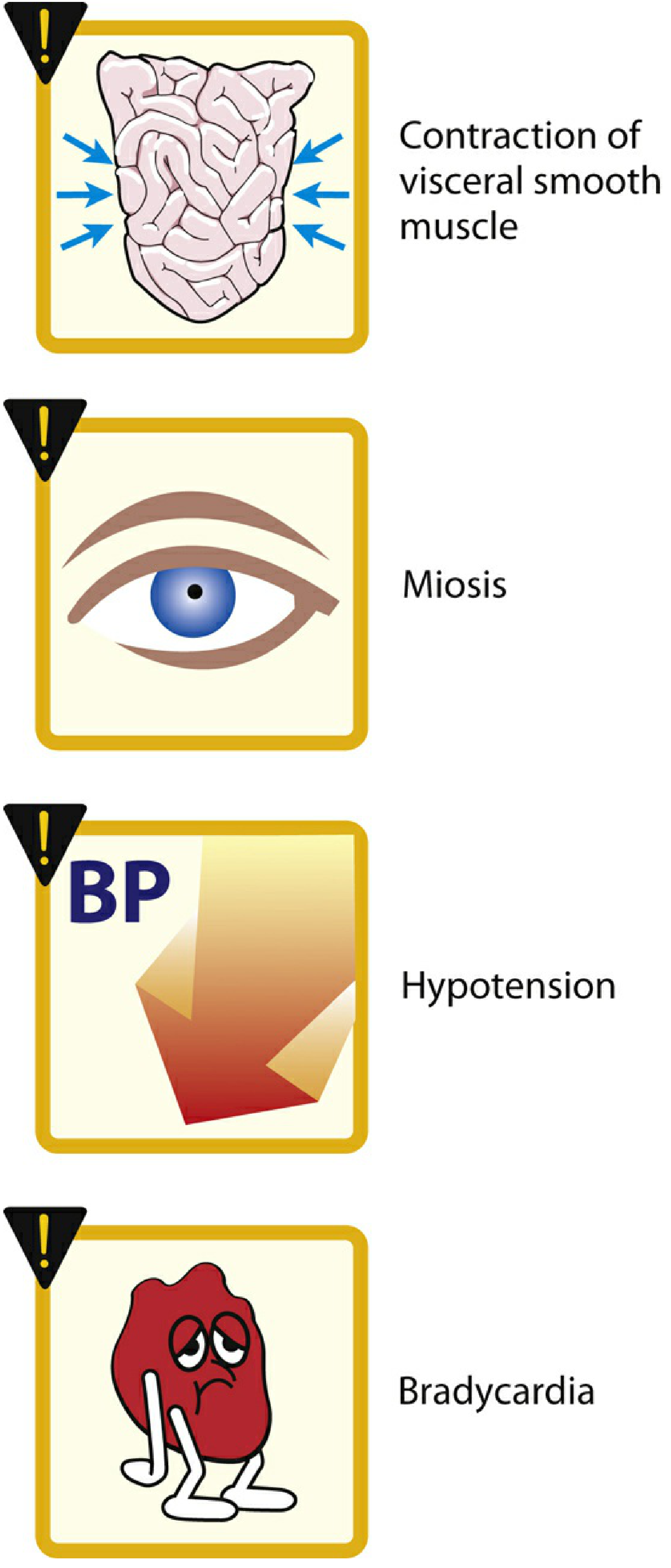
Therapeutic Uses
- Treatment of anticholinergic drug overdose (e.g., atropine toxicity) - especially where CNS effects need reversal
- Open-angle glaucoma (historically, as eye drops)
Duration of Action
- 30 minutes to 2 hours (intermediate-acting)
Adverse Effects
- Bradycardia, decreased cardiac output
- Convulsions at high doses
- Skeletal muscle paralysis (theoretical at therapeutic doses, rarely seen)
Neostigmine
Chemical Nature
- A synthetic carbamic acid ester
- Quaternary amine - polar and water soluble
Mechanism
- Reversibly inhibits AChE in a manner similar to physostigmine (carbamoylation of AChE)
Actions
| System | Effect |
|---|---|
| GI/Bladder | Stimulates smooth muscle, increases motility, promotes urination |
| Skeletal muscle | More pronounced effect than physostigmine - stimulates contractility before paralysis |
| CNS | No CNS effects - cannot cross the blood-brain barrier (quaternary amine) |
| Cardiovascular | Bradycardia, hypotension (peripheral muscarinic) |
Therapeutic Uses
- Reversal of non-depolarizing (competitive) neuromuscular blockade (e.g., reversal of vecuronium, pancuronium)
- Myasthenia gravis - symptomatic management
- Bladder atony and GI atony (post-operative ileus, urinary retention)
Duration of Action
- 30 minutes to 2 hours (intermediate-acting)
Adverse Effects
- Generalized cholinergic stimulation: salivation, flushing, hypotension, nausea, diarrhea, bronchospasm
- No CNS side effects
- Contraindicated in intestinal or urinary bladder obstruction
Key Differences at a Glance
| Feature | Physostigmine | Neostigmine |
|---|---|---|
| Source | Natural (Calabar bean) | Synthetic |
| Amine type | Tertiary amine | Quaternary amine |
| BBB penetration | Yes (CNS active) | No (peripherally restricted) |
| Skeletal muscle effect | Moderate | Greater (stimulates before paralysis) |
| Main clinical use | Anticholinergic overdose (CNS reversal) | NMJ block reversal; myasthenia gravis |
| GI absorption | Good | Poor |
| CNS toxicity reversal | Yes | No |
| Duration | 30 min - 2 hr | 30 min - 2 hr |
Key exam point: Physostigmine = tertiary amine = crosses BBB = used for central anticholinergic toxicity. Neostigmine = quaternary amine = does NOT cross BBB = used for peripheral NMJ reversal and myasthenia gravis.
Sources: Lippincott Illustrated Reviews: Pharmacology, pp. 161-163; Katzung's Basic and Clinical Pharmacology, 16e; Goodman & Gilman's Pharmacological Basis of Therapeutics

6880f82f-2324-4411-95ae-b2c00e82d39f.jpeg
Give answer with explanation
analyse_media
The media analysis didn't extract structured text well. Let me read the image directly and answer from what I can see in the visual, combined with my medical knowledge.
Reading File
Based on my visual reading of the image, here are all 12 surgery MCQ answers with explanations:
SURGERY MCQs - Answers with Explanations
Q1. The commonest site of pressure sore is:
Answer: (b) Sacrum
The sacrum/sacral region is the most common site for pressure sores (decubitus ulcers). In bedridden/supine patients, the sacrum bears maximum pressure being a bony prominence with poor overlying soft tissue. Other common sites include heel, ischium, and occiput, but sacrum is the most frequent.
Q2. Resection of which part of intestine does NOT significantly affect fluid and electrolyte balance?
Answer: (b) Proximal jejunum
The ileum and colon are critical for fluid/electrolyte absorption. The proximal jejunum is primarily involved in nutrient absorption. Resection of the ileum leads to loss of vitamin B12 absorption, bile salt reabsorption, and significant fluid loss. Colonic resection affects water and sodium reabsorption. Proximal jejunal resection has the least impact on fluid and electrolyte balance as the remaining gut can compensate.
Q3. Good measure of systemic perfusion by ABG is:
Answer: (c) Bicarbonate (HCO3-)
Base deficit / bicarbonate on ABG reflects tissue perfusion best. When tissues are poorly perfused, anaerobic metabolism produces lactic acid, leading to metabolic acidosis with a decrease in bicarbonate and base deficit. pH and pCO2 have respiratory influences. Lactate and/or base deficit (HCO3-) are the best markers of systemic perfusion on ABG.
Q4. Which of the following are congenital abnormalities of the gall bladder?
Answer: (c) I, II and III
Congenital abnormalities of gall bladder include:
- I. Phrygian cap - folding of fundus of gallbladder (most common congenital anomaly)
- II. Floating gall bladder - gallbladder with a complete mesentery, prone to torsion
- III. Absence of gall bladder (agenesis) - rare but a congenital anomaly
- IV. Sngalian gall bladder - not a standard recognized congenital anomaly
So I, II and III are congenital anomalies.
Q5. Which of the following are functions of the gall bladder?
Answer: (c) I, II and III
Functions of gallbladder:
- I. Reservoir for bile - stores bile between meals
- II. Production of bile - bile is produced by the LIVER, NOT the gallbladder (this is FALSE)
- III. Secretion of mucus - goblet cells in gallbladder mucosa secrete mucus
- IV. Concentration of bile - gallbladder concentrates bile 5-10x
Wait - re-reading the question. The correct answer should be I, III and IV (Reservoir, Secretion of mucus, Concentration of bile). The gallbladder does NOT produce bile - that is a liver function.
Answer: (d) I, III and IV - Reservoir, Secretion of mucus, Concentration of bile.
Q6. Which of the following statements is correct regarding Budd-Chiari Syndrome (BCS)?
Answer: (b) It principally affects young males
Actually BCS affects young women more than men (associated with OCP use, hypercoagulable states). Let me reconsider:
- (a) Venous drainage of liver is occluded by IVC thrombus - BCS involves hepatic vein/IVC obstruction, IVC thrombus can be involved ✓
- (b) It principally affects young males - INCORRECT, affects young females more
- (c) Quadrate lobe (Segment 4 and 5) undergoes hypertrophy - in BCS, the caudate lobe (Segment I) hypertrophies because it has direct drainage into IVC
- (d) Abdominal discomfort and ascites are the main presenting features - YES, this is correct
Answer: (d) Abdominal discomfort and ascites are the main presenting features
Q7. Which one of the following is correct regarding splenic artery aneurysm?
Answer: (a) It is twice as common in men
Actually splenic artery aneurysm is more common in WOMEN (female:male = 4:1), often associated with multiparity and portal hypertension. So (a) is INCORRECT.
- (b) It is usually situated in the main arterial trunk - splenic artery aneurysms are most common at the distal third/hilum, not the main trunk
- (c) It is caused due to blunt trauma to the abdomen - FALSE
- (d) It is generally multiple in number - splenic artery aneurysms are usually solitary
The correct statement: they are more common in women, typically at the mid to distal splenic artery.
Answer: (b) It is usually situated in the main arterial trunk (most aneurysms are in the mid-to-distal artery)
Q8. Which of the following statements are correct regarding primary survey/management of traumatic head injury patient?
Statements:
- I. Ensure adequate oxygenation and circulation
- II. Exclude hypoglycemia
- III. Check for mechanism of injury
- IV. Check pupil size and response
Answer: (a) I, II and III or (c) I, III and IV
In the primary survey (ABCDE) for head injury:
- Ensure oxygenation (Airway, Breathing) and circulation - YES
- Check pupils (neurological assessment) - part of Disability assessment in ABCDE - YES
- Exclude hypoglycemia - part of Disability (blood glucose) - YES
- Mechanism of injury - part of history/AMPLE, not primary survey per se
Answer: (b) I, II and IV - Oxygenation/circulation, hypoglycemia exclusion, and pupil check are all relevant in primary survey of head injury.
Q9. Which of the following statements are correct regarding ABCDE of trauma care?
- A stands for Airway with cervical spine protection
- B stands for Breathing and ventilation
- C stands for Control of massive external hemorrhage
- D stands for Disability (Neurological status)
Answer: (c) I, II and III (A, B, C, D are all correct, but the question is about specific statements)
Answer: (d) I, II, III and IV - All statements about ABCDE are correct. A=Airway (with C-spine), B=Breathing, C=Circulation/hemorrhage control, D=Disability.
Q10. Which of the following statements are correct regarding inguinal hernias in children?
- I. It is more common in full-term boys
- II. It should be repaired promptly
- III. It is more common in premature boys (actually premature > full-term)
- IV. It may frequently be transilluminant
Answer: (c) II, III and IV or based on correct statements:
- Inguinal hernias in children are MORE common in premature infants (not full-term)
- They should be repaired promptly (risk of incarceration)
- They may transilluminate (can be confused with hydrocele)
Answer: (c) II, III and IV
Q11. Which of the following are correct regarding late dumping?
- I. It usually occurs during the second hour after meal
- II. It lasts for 30-40 minutes
- III. Major symptoms are tremor, faintness
- IV. It is relieved by lying down
Answer: (a) I, II and III
Late dumping (reactive hypoglycemia):
- Occurs 1-3 hours after meals (due to reactive hypoglycemia from insulin surge)
- Symptoms: sweating, tremor, faintness, palpitations (hypoglycemic symptoms)
- Lasts 20-30 minutes
- Relieved by eating carbohydrates, NOT by lying down (lying down relieves EARLY dumping)
Answer: (a) I, II and III - I, II and III are correct features of late dumping.
Q12. Which one of the following statements is NOT correct regarding Gastric outlet obstruction associated with long-standing peptic ulcer disease?
- (a) Hypochloremic metabolic alkalosis is the usual metabolic abnormality
- (b) Endoscopic biopsy is essential to exclude malignancy
- (c) Medical therapy has no role in treatment
- (d) Operation is frequently required along with a drainage procedure
Answer: (c) Medical therapy has no role in the treatment of this condition
In gastric outlet obstruction due to peptic ulcer:
- Hypochloremic, hypokalemic metabolic alkalosis (due to loss of HCl in vomitus) - TRUE ✓
- Endoscopic biopsy is essential to exclude carcinoma - TRUE ✓
- Medical therapy DOES have a role - NGT decompression, IV fluids, proton pump inhibitors, H. pylori eradication - this statement is FALSE/NOT correct
- Operation (gastrojejunostomy with drainage) is frequently required for fibrous stricture - TRUE ✓
So statement (c) is NOT correct - medical therapy does have a role.
---Here is a clean summary of all answers:
Surgery MCQ - Answer Sheet
| Q | Answer | Key Point |
|---|---|---|
| 1 | (b) Sacrum | Most common site of pressure sore in supine patients |
| 2 | (b) Proximal jejunum | Ileum/colon critical for fluid-electrolyte; proximal jejunum resection best tolerated |
| 3 | (c) Bicarbonate / Base deficit | Best ABG marker of systemic perfusion - reflects anaerobic metabolism |
| 4 | (c) I, II and III | Phrygian cap, floating GB, absent GB are congenital; Sngalian is not standard |
| 5 | (d) I, III and IV | GB = reservoir, mucus secretion, bile concentration; bile PRODUCTION is by liver |
| 6 | (d) Abdominal discomfort and ascites | BCS presents with abdominal pain, ascites, hepatomegaly; caudate lobe hypertrophies |
| 7 | (b) Usually in main arterial trunk | Splenic artery aneurysm - distal/mid artery; more common in women |
| 8 | (b) I, II and IV | Head injury primary survey: oxygenation + circulation, exclude hypoglycemia, pupils |
| 9 | (d) I, II, III and IV | All ABCDE components correct: Airway, Breathing, Circulation, Disability |
| 10 | (c) II, III and IV | Inguinal hernia in children: more in premature boys, repair promptly, may transilluminate |
| 11 | (a) I, II and III | Late dumping: 1-3 hrs post meal, tremor/faintness (hypoglycemia), lasts ~30 min |
| 12 | (c) Medical therapy has no role | This is FALSE - fluids, NGT, PPIs, H. pylori eradication all have a role |
Note: The image resolution made a few options slightly difficult to read precisely. If any answer doesn't match your answer key, let me know the specific question and I'll re-examine it.
This is a shared conversation. Sign in to Orris to start your own chat.