
Cotrimoxazole
Reading File
Cotrimoxazole is a combination antibiotic of sulfamethoxazole (SMX) + trimethoprim (TMP) in a 5:1 ratio, acting synergistically to block folate synthesis. It covers a broad range of organisms and is used for UTIs, PCP prophylaxis, Pneumocystis pneumonia treatment, and more.
Searching sources...
Finding Sources
Searching PubMed
cotrimoxazole trimethoprim sulfamethoxazole
Good. Now let me pull detailed content from the best pharmacology sources - Goodman & Gilman and Katzung - in parallel.
Reading File
Reading File
Reading File
Good content from Katzung and Urology. Let me now read the Goodman & Gilman block 16 content and the Katzung clinical uses section in full detail.
Reading File
Reading File
Now let me get the Goodman & Gilman adverse effects and therapeutic uses sections, plus the mechanism diagram image:
Reading File
Loading Image
I now have comprehensive information. Let me compile the full answer.
Cotrimoxazole (Trimethoprim-Sulfamethoxazole, TMP-SMX)
Cotrimoxazole is the fixed-dose combination of trimethoprim (TMP) + sulfamethoxazole (SMX) in a 1:5 ratio by weight (TMP 80 mg : SMX 400 mg in a single-strength tablet; 160 mg : 800 mg in a double-strength tablet). The combination is widely known as cotrimoxazole in much of the world.
Chemical Structure
The trimethoprim component is a trimethoxybenzylpyrimidine:
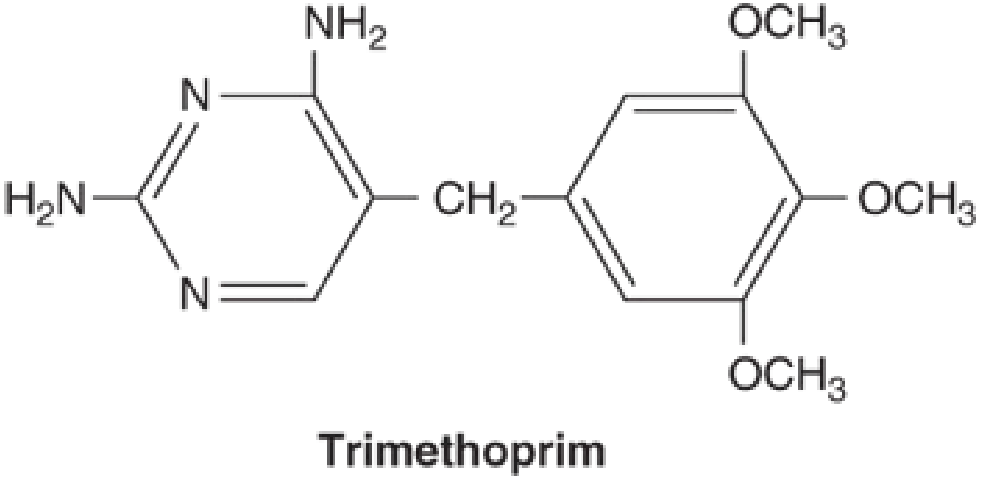
Sulfamethoxazole is a sulfonamide - a derivative of para-aminobenzenesulfonamide and a congener of para-aminobenzoic acid (PABA).
Mechanism of Action
The combination blocks two sequential, essential steps in bacterial tetrahydrofolate (THF) synthesis:
| Step | Drug | Target |
|---|---|---|
| 1 | Sulfamethoxazole | Dihydropteroate synthase - competes with PABA, blocks dihydropteroic acid synthesis |
| 2 | Trimethoprim | Dihydrofolate reductase (DHFR) - blocks conversion of dihydrofolic acid → tetrahydrofolic acid |
THF is required for one-carbon transfer reactions (e.g., thymidylate synthesis from deoxyuridylate) - ultimately essential for DNA synthesis in bacteria. TMP is ~100,000 times more selective for bacterial DHFR than for mammalian DHFR.
Key point: Each drug alone is largely bacteriostatic; together they are often bactericidal due to synergistic sequential blockade. The optimal in vitro ratio of SMX:TMP is 20:1 - which is what the formulation achieves in plasma.
Pharmacokinetics
| Parameter | TMP | SMX |
|---|---|---|
| Absorption | Well absorbed orally | Well absorbed orally |
| Peak plasma (oral DS tablet) | ~2 μg/mL at ~2 h | ~40 μg/mL at ~4 h |
| Peak plasma (IV) | ~3.4 μg/mL | ~46 μg/mL |
| Protein binding | ~40% | ~65% |
| Volume of distribution | Large (9× that of SMX) | Smaller |
| Half-life | ~11 h | ~10 h |
| CNS/CSF penetration | Good | Good |
| Excretion (24 h urine) | ~60% | 25-50% |
- TMP is more lipid-soluble and concentrates in prostatic fluid and vaginal fluid (both more acidic than plasma), which is why it is particularly effective for prostatitis.
- High concentrations in bile.
- Dose adjustment required when CrCl is 15-30 mL/min (halve the dose). Excretion rates are significantly reduced in uremia.
Antimicrobial Spectrum
Susceptible organisms:
- E. coli, Proteus mirabilis, Klebsiella spp., Enterobacter spp., Serratia spp., Salmonella, Shigella
- Staphylococcus aureus (>90%, including many MRSA strains - though geographic variation)
- H. influenzae, Moraxella catarrhalis, S. pneumoniae (though increasing resistance)
- Nocardia asteroides, Stenotrophomonas maltophilia, Brucella abortus
- Pneumocystis jirovecii
- Yersinia spp., Pasteurella haemolytica
Intrinsically resistant (clinically resistant):
- Pseudomonas aeruginosa
- Bacteroides fragilis
- Enterococcus spp.
- Mycoplasma pneumoniae
Note: E. coli resistance rates have increased significantly (up to 30% or more in some regions). Guidelines recommend avoiding empiric TMP-SMX for UTIs when local E. coli resistance exceeds 20% or if the patient has received TMP-SMX recently.
Formulations & Dosing
| Formulation | TMP | SMX |
|---|---|---|
| Single-strength (SS) tablet | 80 mg | 400 mg |
| Double-strength (DS) tablet | 160 mg | 800 mg |
| IV solution | 80 mg/5 mL | 400 mg/5 mL |
Standard Doses
| Indication | Dose | Duration |
|---|---|---|
| Uncomplicated UTI/cystitis | 1 DS tablet (160/800 mg) PO q12h | 3 days |
| Complicated UTI/pyelonephritis | 1 DS tablet q12h | 10-14 days |
| Prostatitis | 1 DS tablet q12h | 4-6 weeks (chronic) |
| Skin & soft tissue infections (MRSA) | 1-2 DS tablets q12h | 5-7 days |
| Shigellosis/Salmonella | 1 DS tablet q12h | 3-5 days |
| UTI prophylaxis (recurrent) | 1 SS tablet 3× weekly | Long-term |
| Bone & joint infections (S. aureus) | 8-10 mg/kg/day TMP component | - |
| Children (UTI/otitis media/shigellosis) | TMP 8 mg/kg/day + SMX 40 mg/kg/day divided q12h | - |
PCP (Pneumocystis jirovecii Pneumonia)
| Purpose | Dose |
|---|---|
| Treatment (moderate-severe) | TMP 15-20 mg/kg/day + SMX 75-100 mg/kg/day in 3-4 divided doses IV or oral |
| Prophylaxis | 1 DS tablet daily or 3× weekly |
- IV route: 80 mg TMP + 400 mg SMX per 5 mL, diluted in 125 mL D5W, infused over 60-90 minutes.
- Adjunctive corticosteroids should be given with treatment of moderate-severe PCP (PaO₂ <70 mmHg or A-a gradient >35 mmHg).
Therapeutic Uses (Summary)
- Urinary tract infections - uncomplicated cystitis, complicated UTI, pyelonephritis
- Prostatitis (acute and chronic) - TMP concentrates well in prostatic secretions
- PCP treatment and prophylaxis (drug of choice)
- Skin and soft tissue infections (MRSA, community-acquired)
- Respiratory tract infections - acute exacerbations of chronic bronchitis, otitis media, sinusitis (H. influenzae, S. pneumoniae - where susceptible)
- GI infections - shigellosis (alternative to fluoroquinolones), typhoid (alternative)
- Nocardiosis
- Stenotrophomonas maltophilia infections
- Listeria infections (in penicillin-allergic patients)
- Toxoplasmosis prophylaxis in immunosuppressed patients
- Traveler's diarrhea - no longer recommended due to widespread resistance
Not effective for:
- Streptococcal pharyngitis (does not eradicate organism from the pharynx)
- Pseudomonas infections
- Enterococcal infections
Resistance
Two mechanisms operate:
To sulfonamides:
- Mutations in dihydropteroate synthase (reduced drug binding)
- Overproduction of PABA
- Decreased uptake of drug
To trimethoprim:
- Point mutations in DHFR gene (reduced binding)
- Plasmid-encoded alternative DHFR (most common - via transposons on conjugative plasmids with broad host range, accounting for rapid spread among many species)
- Reduced cell permeability
- Overproduction of DHFR
Resistance to the combination is generally lower than resistance to either agent alone.
Adverse Effects
| Category | Effects |
|---|---|
| Hematologic | Megaloblastic anemia, leukopenia, thrombocytopenia (folate deficiency, especially in folate-deficient patients); hemolytic anemia in G6PD deficiency |
| Hypersensitivity | Rashes (including urticaria, Stevens-Johnson syndrome, toxic epidermal necrolysis - especially sulfonamide component) |
| Renal | Crystalluria (sulfonamide precipitation), interstitial nephritis, hyperkalemia (TMP blocks ENaC - potassium-sparing effect like amiloride), elevated serum creatinine (TMP inhibits tubular creatinine secretion - spurious rise) |
| GI | Nausea, vomiting, diarrhea, hepatitis (rare), cholestasis |
| CNS | Headache, aseptic meningitis (rare) |
| HIV patients | Particularly high rate of adverse reactions (rash, fever, cytopenias) - up to 50-60% |
| Photosensitivity | Sulfonamide component |
Key metabolic effects of TMP:
- Hyperkalemia - blocks aldosterone-sensitive sodium channels (ENaC) in collecting duct, similar to amiloride
- Spurious creatinine rise - blocks tubular creatinine secretion; GFR is not actually affected
Contraindicated in:
- Pregnancy (especially 1st trimester - folate antagonism; 3rd trimester - neonatal hyperbilirubinemia/kernicterus)
- Neonates and infants <2 months (risk of kernicterus and hemolytic anemia)
- Severe renal or hepatic impairment (unless adjusted)
- Known sulfonamide hypersensitivity
Drug Interactions
| Drug | Interaction |
|---|---|
| Warfarin | TMP-SMX potentiates anticoagulant effect (inhibits CYP2C9 metabolism of warfarin S-enantiomer) |
| Methotrexate | Increased toxicity (additive folate antagonism) |
| Phenytoin | Increased phenytoin levels |
| Cyclosporine | Increased nephrotoxicity; reduced cyclosporine levels |
| ACE inhibitors/ARBs, potassium-sparing diuretics | Additive hyperkalemia risk (with TMP's ENaC-blocking effect) |
| Azathioprine/6-mercaptopurine | Myelosuppression |
| Digoxin | Increased digoxin levels (in elderly) |
Recent Evidence
Recent systematic reviews (2024-2026) have examined:
- PCP treatment - A 2025 network meta-analysis (PMID 39732393) confirmed that high-dose TMP-SMX remains the standard of care for P. jirovecii pneumonia in HIV patients, with superior outcomes compared to alternatives.
- Complicated UTIs - A 2026 systematic review (PMID 41693075) comparing oral beta-lactams vs TMP-SMX and fluoroquinolones for complicated UTIs found TMP-SMX remains a first-line option where susceptibility is confirmed.
- Recurrent UTI prophylaxis in children - A 2024 systematic meta-analysis (PMID 39492618) evaluated prophylaxis options including TMP-SMX in children with recurrent UTIs.
Sources: Goodman & Gilman's Pharmacological Basis of Therapeutics (14th Ed.), p. 1159-1160; Katzung's Basic and Clinical Pharmacology (16th Ed.), pp. 1301-1302; Smith and Tanagho's General Urology (19th Ed.)
This is a shared conversation. Sign in to Orris to start your own chat.